Economy
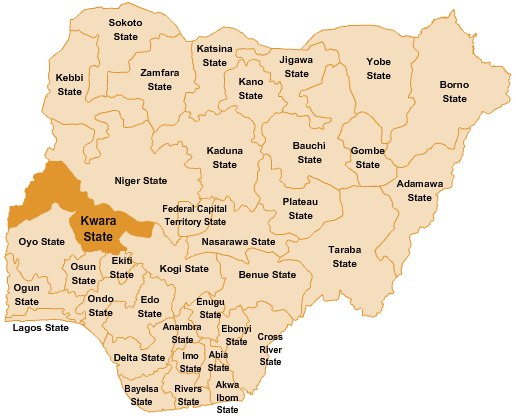
Saudi Firm Plans Agric City in Kwara

By Modupe Gbadeyanka
A Saudi Investment company called Zain Al-abdin group is to set up an Agric City in Kwara State. The proposed Agric City, which is to be located along the River Niger in Kwara North will comprise a cluster of farms specializing in cultivation, processing and export of rice, maize and vegetables.
Chairman of the investment group, Zain Al-Abdin Nafawi disclosed this when he and other members of the group visited the Kwara State Governor, Mr Abdulfatah Ahmed last Friday at the Government House, Ilorin.
According to the Chairman, the Agric city will also contain facilities such as schools, hospitals, shops and other associated services.
He noted that the project is a multimillion dollar investment, which will commence as soon as all paper work is completed.
Nafawi said that the project has the backing of the Saudi Arabian government which is currently supporting Saudi investors to invest in agriculture across the world, especially Africa.
He explained that the choice of Kwara for the project was because of its advances in large scale agricultural investment as demonstrated by Shonga farm initiative and its beneficial weather and arable land particularly along the belt of the River Niger.
Responding, Governor Ahmed directed the officials of the State Ministry of Agriculture to meet with the investors to iron out modalities for the commencement of the project.
The Governor welcomed the project and expressed delight at the intention of the Saudi businessmen to invest in Kwara State, which he said has a large population of young people who are hardworking and are available to work on the farms and also market the farm produce.
He further noted that the proposed investment is in line with the government’s plan to broaden the state economy, feed the people and provide feed stock for industries.
Mr Ahmed emphasized that the fact that oil-rich Saudi Arabia is encouraging its citizens to invest in agribusiness abroad demonstrates the timeliness of ongoing efforts to diversify the national economy through agriculture.
Governor Ahmed said the State has all the appropriate facilities including an airport as well as an incoming cargo terminal that has wet storage facilities. He assured that the government will continue to initiate policies and create enabling environment to attract investors and support businesses in the state.
Economy
Extensive Distribution Network, Promotional Activities Buoy Indomie 60% Noodles Market Share
By Aduragbemi Omiyale
Dufil Prima Foods Limited, makers of the popular Indomie Noodles, has been able to control over 60 per cent of the noodles market share in Nigeria because of its strong customer base, extensive distribution network and promotional activities, GCR Ratings has said.
These strategies deployed by the organisation have improved its financial profile, prompting the rating agency to upgrade the national scale long-term and short-term issuer ratings of Dufil to A(NG)/A1(NG) from A-(NG)/A2 (NG), previously, with a stable outlook.
It was disclosed that the company has witnessed strong cash generation and modest debt levels, which have enhanced its credit profile.
GCR said Dufil’s supply chain stability and ongoing product development have helped it to sustain the brand’s appeal to the young demographics in Nigeria and deepen market penetration.
These strengths are partly offset by high revenue concentration, with noodles accounting for more than 74 per cent, while other business lines, including flour, pasta, snacks, packaging, and palm oil, contribute a combined 26 per cent in 2025, it stated.
“We expect noodles to remain a dominant contributor to topline, supported by plans to expand noodle production capacity in 2026. Nevertheless, the completion of the flour plant expansion in Q3 2026 is expected to modestly increase the contribution of the flour business and support margins in the snacks segment,” a part of the statement obtained by Business Post read.
In the 2025 fiscal year, Dufil grew its earnings by 30 per cent to N1.1 trillion as a result of inflation-induced price review and gradual volume recovery. Its absolute EBITDA contracted to N84.5 billion from N92.7 billion in 2024, while its EBITDA margin eased to 8 per cent from 11.4 per cent in 2024.
Also, gross debt reduced to N96.2 billion from N163.6 billion in 2024, and to N79.6 billion in the first quarter of 2026, driven by management efforts to deleverage its balance sheet from expensive borrowings.
In addition, the liquidity position has slightly improved on robust cash holding of N44.6 billion, including restricted cash of N20.8 billion as of March 2026, adequate to cover the anticipated short-term debt obligations of N47.9 billion over the next nine-month period to December 31, 2026.
Although refinancing risk remains high with short-term debt accounting for above 40 per cent of the total debt, liquidity is further supported by sizable, unutilised committed facilities of N106.5 billion, indicating the company’s wide access to funding sources.
GCR said it expects the anticipated higher capital spending of N32.5 billion over the next 21 months to December 2027, as well as projected higher dividend payments in view of robust prior year profits to be sufficiently covered by the projected robust operating cash flow.
Economy
FG Encourages Businesses to Tap $1bn AfCFTA Financing Scheme
By Adedapo Adesanya
The federal government says Nigerian businesses now have access to a $1 billion financing facility under the African Continental Free Trade Area (AfCFTA), designed to strengthen production and improve export competitiveness across African markets.
Speaking at the 2nd Quarter 2026 meeting of the AfCFTA Central Coordination Committee in Abuja, the Minister of Industry, Trade and Investment, Mrs Jumoke Oduwole, described the financing window as a major opportunity for businesses looking to scale operations and deepen regional trade.
“This financing facility presents a significant opportunity for Nigerian companies seeking to expand operations, modernise production, and increase exports across African markets,” she said.
Mrs Oduwole noted that despite progress in AfCFTA implementation, Nigerian exporters still face challenges such as documentation bottlenecks, certification requirements, and standards compliance issues.
She said the government is addressing these gaps through trade facilitation reforms and stronger collaboration with agencies, including the Nigeria Customs Service (NCS) and the Nigerian Export Promotion Council (NEPC).
The trade minister also stressed the importance of strengthening Nigeria’s legal and regulatory framework, particularly through the domestication of the AfCFTA Digital Trade Protocol.
At the meeting, the National Coordinator and CEO of the Nigeria AfCFTA Coordination Office, Mrs Patience Okala, said the $1 billion AfCFTA Adjustment Fund Credit Facility is targeted at large-scale businesses with a minimum financing threshold of US$10 million.
“The facility will support business expansion, modernisation, working capital requirements, project development, industrialisation efforts, and regional value chain integration,” she explained.
Mrs Okala added that the coordination office is working with fund managers to ensure qualified Nigerian firms can access the facility, while also assembling a pilot group of businesses to maximise participation.
She further highlighted growing private sector engagement, noting that recent sensitisation events in Kano attracted more than 470 businesses, including women-led enterprises.
On his part, a representative of the Federal Ministry of Industry, Trade and Investment, Mr Simon Om-Ezomo, commended stakeholders for their collaboration and urged sustained commitment to policy implementation.
Economy
Senate Pushes for Ban on Textile Imports
By Aduragbemi Omiyale
To revive the local industry and create jobs to boost the economy, the Senate has advised the federal government to ban textile imports.
The upper chamber of the federal parliament made this suggestion on Tuesday at the plenary presided over by the Deputy Senate President, Mr Jibrin Barau.
They noted that to resuscitate textile industries in the country, the Federal Ministry of Industry, Trade and Investment, and the Federal Ministry of Agriculture should immediately implement investment-friendly policies.
The red chamber of the National Assembly recalled when Nigeria used to have a vibrant textile industry, but lamented that the influx of foreign fabrics destroyed the sector.
The Senate emphasised that to stimulate economic growth and tackle insecurity in the country, there must be a total ban on the importation of textile materials into Nigeria.
“With the lifting of the ban on textile importation in 2010, Nigeria now has almost 80 per cent of its textiles imported from China, Indonesia, Taiwan and other countries.
“This trend is definitely not helping the Nigerian economy in terms of employment generation and the conservation of foreign exchange,” Mr Katung Marshall, who co-sponsored a motion on the Urgent Need to Revive the Textile Industries in Nigeria, said on the floor of the Senate yesterday.
The Senator informed his colleagues that the government protection policies in the 1960s and 1970s, particularly the restrictions on textile imports, attracted investors and helped the sector to flourish.
According to him, during the period, Nigeria’s textile industry accommodated about 167 mills and directly employed over 500,000 people, making it the nation’s second-largest employer after the federal government.
But he said this went south in the late 1990s due to obsolete machinery, inadequate capital and persistent power supply challenges, adding that by 2007, major companies, including Kaduna Textile Limited, Arewa Textiles and United Nigerian Textiles Limited, had shut down operations, leading to the loss of over 7,000 jobs.
-
Feature/OPED6 years agoDavos was Different this year
-
Travel/Tourism10 years ago
Lagos Seals Western Lodge Hotel In Ikorodu
-
Showbiz3 years agoEstranged Lover Releases Videos of Empress Njamah Bathing
-
Banking8 years agoSort Codes of GTBank Branches in Nigeria
-
Economy3 years agoSubsidy Removal: CNG at N130 Per Litre Cheaper Than Petrol—IPMAN
-
Banking3 years agoSort Codes of UBA Branches in Nigeria
-
Banking3 years agoFirst Bank Announces Planned Downtime
-
Sports3 years agoHighest Paid Nigerian Footballer – How Much Do Nigerian Footballers Earn