Economy
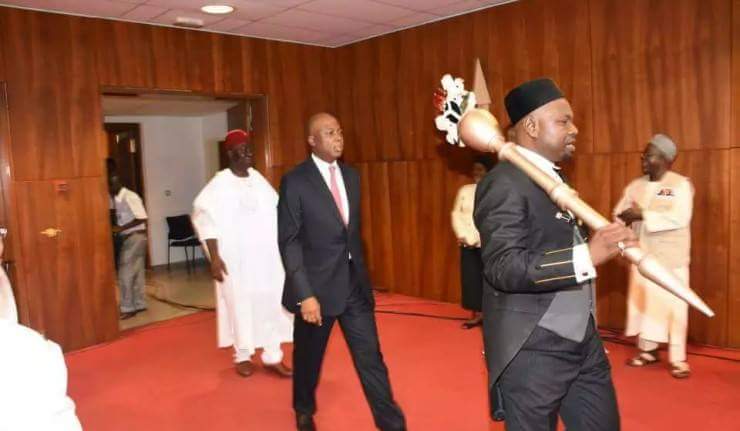
Senate Passes Forensic Accounting Bill
By Dipo Olowookere
The Chartered Institute of Forensic and Investigative Auditors in Nigeria Bill and Chartered Institute of Forensic Accountants of Nigeria Bill were yesterday passed by the Senate.
This followed consideration of the clause by clause of a report submitted by Chairman of the Committee on Establishment and Public Service, Senator Emmanuel Paulker.
The report comprises Bills on Chartered Institute of Forensic and Investigative Auditors in Nigeria; Chartered Institute of Finance and Control in Nigeria; Chartered Institute of Forensic Accountants of Nigeria.
Recall that prior to the passage of the Bill about four months ago Professional Accountants and Auditors from different bodies, at a public hearing on the Bills disagreed with the Senate on the proposed Bill for Chartered Institute of Forensic and Investigative Auditors in Nigeria; and Bill for Chartered Institute of Forensic Accountants of Nigeria, respectively.
Consequently while speaking to participants at the forum, Minister of Finance, Mrs Kemi Adeosun said the relevance of forensic accounting globally could not be over stressed, noting that many countries across the world, including Nigeria have suffered from fraudulent practices.
In their presentations, representatives of the Institute of Forensic Accountants of Nigeria, Professor Usman Ali Awheela and the Chartered Institute of Forensic and Investigative Auditors in Nigeria, CIFIAN, Mrs. Victoria Ayishetu Enape while applauding the senate for the proposed bills, noted that their members have not been allowed to practice forensic accounting since there was no legislation to that effect.
According to Mrs. Enape, if the Bill for Chartered Institute of Forensic Accountants of Nigeria is passed “will help Nigeria to have skilled professionals to deepen the fraud prevention, detection and preserve money in government treasury for infrastructural development that is fast disappearing in our country today”.
She disabused the minds of stakeholders at the session about the alleged conflict between the functions of the CIFIA and other institutes established by existing legislations.
“CIFIA should not be seen as a rival to ICAN, just as CIFIA is not seen as a rival to ANAN. Nothing stops an accountant from becoming a member of ICAN and CIFIA or any other professional body for that matter”, she stressed.
Mrs. Enape further informed that accounting profession has many branches with different responsibilities with professional bodies regulating their activities.
She added that the “auditing which has no professional body regulating it, gave the opportunity for financial accountants to claim autonomy, and as a matter of fact leads to their inability to control and prevent fraud, corruption and other financial crimes”.
In his submission, the Chief Executive of Institute of Forensic Accountants of Nigeria, Prof. Awheela, said “forensic accounting is the unique blend of education and experience in applying accounting, auditing skills and investigative techniques to uncover truth, form legal opinions in order to assist in litigation support”.
According to him, “forensic accounting professionals provide assistance on cases which are primarily related to calculation and estimation of economic damages and related issues that includes white-collar crimes”.
However, the Institute of Chartered Accountants of Nigeria, ICAN kicked against the proposed bills, saying their functions and responsibilities are already contained in the 1965 Act that established the Institute and would therefore amount to needless duplication of functions.
ICAN President, Mr. Ismaila Zakari informed that the Institute had in 2009 established seven Faculties to provide training for members in their areas of specialization, adding that they also provide specialist certification courses and issue certificates to qualified members as evidence of expertise and authority to practise their specialized skills.
“The Forensic accounting curriculum is carefully drawn to ensure that, to be a forensic accountant, one must necessarily be a qualified chartered accountant, be certain of technical competence and preserved professional integrity.
“From the foregoing, Forensic accounting is adequately covered within the scope of the training that ICAN provides and therefore, the quest for a separate Institute for just Forensic accounting is totally uncalled for”, Zakari stressed.
Economy
UAE to Leave OPEC May 1
By Adedapo Adesanya
The United Arab Emirates has announced its decision to quit the Organisation of the Petroleum Exporting Countries (OPEC) to focus on national interests.
This dealt a heavy blow to the oil-exporting group at a time when the US-Israel war on Iran had caused a historic energy shock and rattled the global economy.
The move, which will take effect on May 1, 2026, reflects “the UAE’s long-term strategic and economic vision and evolving energy profile”, a statement carried by state media said on Tuesday.
“During our time in the organisation, we made significant contributions and even greater sacrifices for the benefit of all,” it added. “However, the time has come to focus our efforts on what our national interest dictates.”
The loss of the UAE, a longstanding OPEC member, could create disarray and weaken the oil cartel, which has usually sought to show a united front despite internal disagreements over a range of issues from geopolitics to production quotas.
UAE Energy Minister Suhail Mohamed al-Mazrouei said the decision was taken after a careful look at the regional power’s energy strategies.
“This is a policy decision. It has been done after a careful look at current and future policies related to the level of production,” the minister said.
OPEC’s Gulf producers have already been struggling to ship exports through the Strait of Hormuz, a narrow chokepoint between Iran and Oman through which a fifth of the world’s crude oil and liquefied natural gas supplies normally pass, because of threats and attacks against vessels during the war.
The UAE had been a member of OPEC first through its emirate of Abu Dhabi in 1967 and later when it became its own country in 1971.
The oil cartel, based in Vienna, has seen some of its market power wane as the US has increased its production of crude oil in recent years.
Additionally, the UAE and Saudi Arabia have increasingly competed over economic issues and regional politics, particularly in the Red Sea area.
The two countries had joined a coalition to fight against Yemen’s Iran-backed Houthis in 2015. However, that coalition broke down into recriminations in late December when Saudi Arabia bombed what it described as a weapons shipment bound for Yemeni separatists backed by the UAE.
Economy
NASD OTC Exchange Inches Up 0.03% as CSCS Outshines Four Price Decliners
By Adedapo Adesanya
Central Securities Clearing System (CSCS) Plc bested four price decliners on the NASD Over-the-Counter (OTC) Securities Exchange on Monday, April 27. The alternative stock market opened the week bullish during the session with a 0.03 per cent uptick.
According to data, the security depository company added N2.61 to its share price to close at N76.26 per unit compared with the preceding session’s N78.87 per unit.
As a result, the market capitalisation of the platform increased by N820 million to N2.425 trillion from N2.424 trillion, and the NASD Unlisted Security Index (NSI) gained 1.38 points to finish at 4,053.97 points compared with the 4,052.58 points it ended last Friday.
The four price losers were led by NASD Plc, which slumped by N3.80 to sell at N34.70 per share versus N38.50 per share. FrieslandCampina Wamco Nigeria Plc fell by N1.45 to N98.10 per unit from N99.55 per unit, Food Concepts Plc slid by 27 Kobo to N2.43 per share from N2.70 per share, and Geo-Fluids Plc dipped by 9 Kobo to N2.91 per unit from N3.00 per unit.
The value of securities transacted by market participants went down by 82.0 per cent to N7.4 million from N41.3 million units, the volume of securities declined by 28.5 per cent to 319,831 units from 447,403 units, and the number of deals dropped by 34.1 per cent to 29 deals from 44 deals.
Great Nigeria Insurance (GNI) Plc was the most active stock by value on a year-to-date basis with 3.4 billion units worth N8.4 billion, followed by CSCS Plc with 59.6 million units sold for N4.0 billion, and Okitipupa Plc with 27.8 million units exchanged for N1.9 billion.
Also, GNI Plc was the most traded stock by volume on a year-to-date basis with 3.4 billion units valued at N8.4 billion, followed by Resourcery Plc with 1.1 billion units traded for N415.7 million, and Infrastructure Guarantee Credit Plc with a turnover of 400 million units worth N1.2 billion.
Economy
Naira Opens Week Weaker at N1,364/$ at NAFEX After N5.80 Loss
By Adedapo Adesanya
The first trading day of the week in the currency market was bearish for the Naira in the Nigerian Autonomous Foreign Exchange Market (NAFEX) on Monday, April 27.
Yesterday, it lost N5.80 or 0.43 per cent against the United States Dollar to trade at N1,364.24/$1, in contrast to the N1,358.44/$1 it was traded last Friday.
In the same vein, the Nigerian currency depreciated against the Pound Sterling in the official market by N13.70 to close at N1,847.72/£1 versus the preceding session’s N1,834.02/£1, and slumped against the Euro by N11.56 to sell at N1,602.29/€1 versus N1,590.73/€1.
Also, the Nigerian Naira tumbled against the greenback during the trading day by N5 to quote at N1,385/$1 compared with the previous rate of N1,380/$1, and at the GTBank FX desk, it traded flat at N1,370/$1.
The poor performance of the domestic currency could be attributed to liquidity shortage at the official currency market on Monday, which came amid surging demand for international payments. At $76.50 million, interbank liquidity printed higher across 79 deals, up from the $43.572 million reported on Friday.
Nigeria’s gross external reserves declined to $48.45 billion amid a month-long decline in inflows, amid uncertainties in the global commodity market. The depletion of foreign reserves could be partly attributed to the Central Bank of Nigeria’s intervention in the FX market.
The market remains perturbed by persistent concerns over liquidity constraints, policy transparency, and weakening confidence in Nigeria’s FX market, while boosters, including oil prices, continue to look rocky due to stalled discussions and unclear ceasefire negotiations between the US and Iran.
A look at the cryptocurrency market, Bitcoin (BTC) has been rejected near $79,000 three times in eight sessions, leaving the level as the de facto ceiling of its current trading range even as major cryptocurrencies trade lower over the past day. It lost 0.9 per cent to sell at $77,003.61.
Analysts say that upcoming US Federal Reserve policy decisions and top tech firms’ earnings this week could provide the catalyst to push bitcoin decisively above $80,000.
The market also continued to weigh Iran’s interim deal proposal to reopen the Strait of Hormuz, which failed to advance over the weekend. The White House said US officials were discussing the latest Iranian proposal but maintained “red lines” on any deal to end the eight-week war.
Solana (SOL) dropped 1.8 per cent to $84.25, Ripple (XRP) went down by 1.6 per cent to $1.39, Ethereum (ETH) depreciated by 1.3 per cent to $2,290.00, Binance Coin (BNB) declined by 0.5 per cent to $625.18, and Cardano (ADA) fell by 0.2 per cent to $0.2480.
However, Dogecoin (DOGE) rose by 2.0 per cent to $0.1002, and TRON (TRX) appreciated by 0.2 per cent to $0.3242, while the US Dollar Tether (USDT) and the US Dollar Coin (USDC) remained unchanged at $1.00 apiece.
-
Feature/OPED6 years agoDavos was Different this year
-
Travel/Tourism10 years ago
Lagos Seals Western Lodge Hotel In Ikorodu
-
Showbiz3 years agoEstranged Lover Releases Videos of Empress Njamah Bathing
-
Banking8 years agoSort Codes of GTBank Branches in Nigeria
-
Economy3 years agoSubsidy Removal: CNG at N130 Per Litre Cheaper Than Petrol—IPMAN
-
Banking3 years agoSort Codes of UBA Branches in Nigeria
-
Banking3 years agoFirst Bank Announces Planned Downtime
-
Sports3 years agoHighest Paid Nigerian Footballer – How Much Do Nigerian Footballers Earn