Connect with us

Economy

Senate Stops Probe of $122.2m Excess Crude Account Fraud

Published

on

senate-scrapped-ncc-nominee

By Dipo Olowookere

The Nigerian Senate has moved to stop an attempt by some of its members to influence the setting up of an ad-hoc committee to investigate the $122.2 million that had accrued from the Excess Crude Account (ECA) between May 2015 and August 2017, but not paid into the account.

This is just as the upper legislative chamber approved immediate abolition of ECA, an account being used to save oil revenues above a base amount derived from a defined benchmark price.

According to the upper legislative chamber of the National Assembly, the account is alien to the 1999 constitution as amended or any known law in the country.

The Senate resolution followed the adoption of a motion, ‘The Excess Crude Account: an Illegality and a Drain Pipe’, by Senator Rose Oko and co-sponsored by 43 other senators cutting across party and ethnic differences.

One of the prayers on the motion was that the senate should “mandate an ad-hoc committee to investigate the revenue that accrued from the amount above the oil benchmark from 2004 to date and its utilization, identifying any infractions committed and report back within two months.”

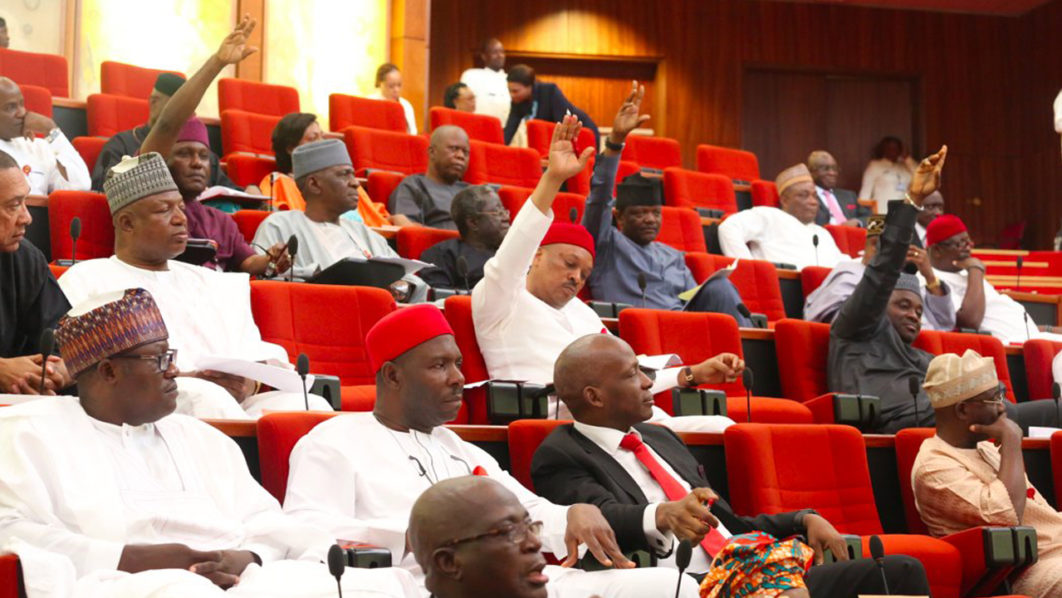
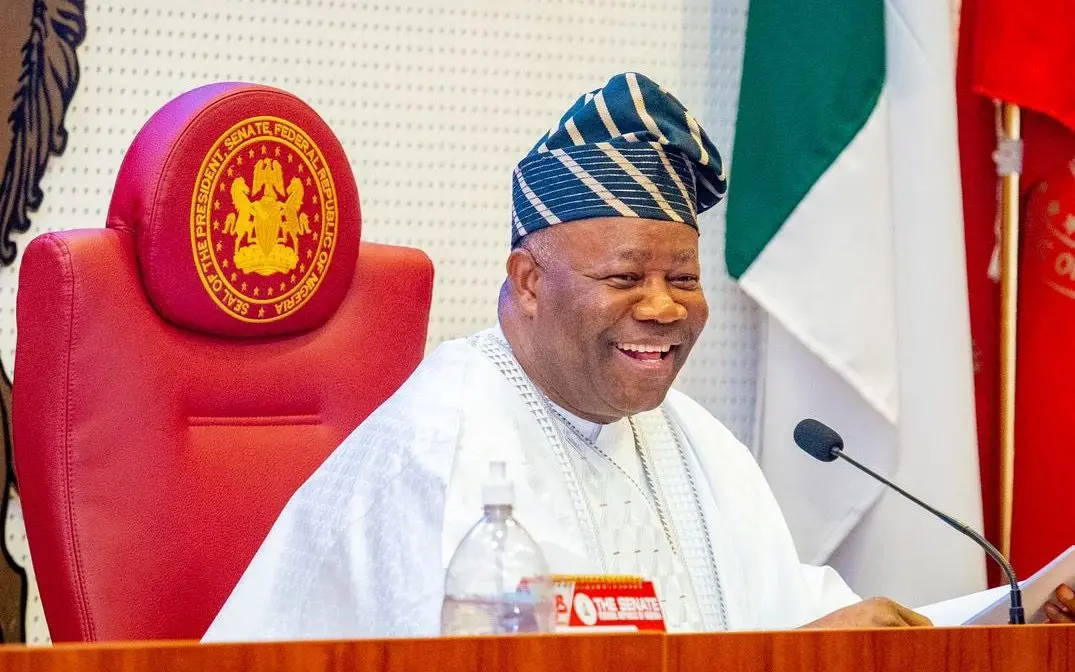
Surprisingly, majority of the senators, including former Governors who were parts of management of the account in their various states when it was introduced shouted ‘nayes’ while the Senate President, Mr Bukola Saraki, also a former Governor quickly ruled in favour of opposition to the probe.

The upper legislative chamber, however, urged the government to pay the amount above the oil benchmark into the Federation Account and appropriate some into the Nigerian Sovereign Investment Authority (NSIA) and other sectors in compliance with the constitution.

Senator Oko, while leading debate on the motion, said the Senate had observed that between May, 2015 and August, 2017, about $122.2 million had accrued and ought to have been paid to the ECA.

She enjoined the upper house to place the $122.2 million in the Sovereign Wealth Fund (SWF) upon the amendment of section 162 of the Constitution and other sectors as deemed appropriate.

The lawmaker particularly advised the government to act in conformity with sections 80 (1-4) and 162 (1-3) of the 1999 Constitution as amended in its revenue receipt and expenditure, saying that the present administration had in May 2017, announced a resumption of arbitrary payment into the ECA of $87 million ostensibly since May, 2015.

According to her, the Senate was “deeply saddened by the continued impunity of the ECA and its discretionary operation in contravention of the 1999 Constitution, creating room for imprudence, recklessness and arbitrariness.”

She added that the upper legislative chamber was “very concerned that this is one veritable source of huge revenue leakage in the country.”

The lawmaker informed that ECA was set up in 2004, ostensibly to provide savings for the country and stabilization for the economy during periods of shortfalls in oil revenue, adding that the accruals to the account were expected to be the amount above the benchmark of crude oil sales.

Senator Oko said the Upper House was “further alarmed that a report by the National Resource Governance Institute rates Nigeria’s Excess Crude Account as one of the most poorly managed around the world, where its operation is discretionary and at the whims of the Executive.”

She noted for instance that the ECA increased from $5.16 billion in 2005 to over $20 billion in 2008, and decreased to less than $4 billion by 2010 with no known tracking of its operations.

The lawmaker alleged that “at various times and from several quarters in 2013, it was purported that $5 billion was missing from the ECA, and that $2 billion was withdrawn without authorization.”

According to her, Nigeria cannot continue to operate an appreciable quantum of revenue arbitrarily, outside the law with no checks and balances while expecting amendment of section 162 of the constitution to cure the problem of savings for the nation.

In his contributions, Senator Adamu Aliero supported the abolition of the ECA which he recalled was introduced during former President Olusegun Obasanjo administration to protect planned budgets against shortfalls due to volatile crude oil prices.

He said if the account, out of which the independent power project, IPP among others were sponsored, is stopped, it would ensure transparency and accountability in revenue generation and payment into the Federation Account.

Senator Mao Ohuabunwa also argued that the ECA should be abolished despite the fact that the country needs to save for the rainy day due to the alleged impunity and arbitrariness in the account’s operation.

He called for the setting up an ad-hoc committee to investigate the revenue that accrued from the country’s oil benchmark from 2004.

Speaking in the same vein, Senator Atai Ali Aidoko described the present operations of ECA as the “biggest flush fund” in the country, saying one-third of the spending were done with illegality.

But Senator Suleiman Hunkuyi advised that National Assembly should look into how to regulate the ECA for surplus funding rather than its complete abrogation.

According to him, the exigency of the time called for the introduction of the account, but agreed that the way it was poorly managed should be urgently addressed.


Dipo Olowookere is a journalist based in Nigeria that has passion for reporting business news stories. At his leisure time, he watches football and supports 3SC of Ibadan. Mr Olowookere can be reached via [email protected]

Economy

FG Insists on January 2026 Implementation of Tax Laws

Published

on

taiwo oyedele tax implementation

By Modupe Gbadeyanka

The planned implementation of the new tax laws from Thursday, January 1, 2026, will not be reversed, the federal government has emphasised.

This emphasis was made amid controversies over discrepancies in the harmonised and gazetted copies of the laws.

A lawmaker in the House of Representatives, Mr Abdussamad Dasuki, raised this alarm last week during plenary.

He said parts of the laws passed by the National Assembly were different from the gazetted, calling on the leadership to look into this.

In June 2025, President Bola Tinubu signed the four tax-related bills in law as part of his government’s reform programme

The new tax laws are the Nigeria Revenue Service (Establishment) Act, the Joint Revenue Board of Nigeria (Establishment) Act, the Nigeria Tax Act, and the Nigeria Tax Administration Act.

Addressing newsmen after a meeting with Mr Tinubu in Lagos on Friday, the Chairman of the Presidential Committee on Fiscal Policy and Tax Reforms, Mr Taiwo Oyedele, stressed there were no plans to suspend the implementation of the laws from next Thursday, despite calls for this.

However, he welcomed the decision of the House of Representatives to investigate the matter, stressing that the federal government is ready to work with the National Assembly if any action becomes necessary, but maintained that the reform timeline remains unchanged.

Mr Oyedele explained that the reforms are aimed at providing relief to Nigerians and stimulating economic growth rather than generating immediate revenue, noting about 98 per cent of workers would either pay no personal income tax or pay less, while 97 per cent of small businesses would be exempted from corporate income tax and VAT withholding tax.

He added that large businesses would also benefit from lower effective tax rates, noting that the reforms are designed to promote inclusivity, shared prosperity and improved tax compliance.

The tax expert said preparations for the reforms began in October 2024 when the bills were first submitted to the National Assembly and have continued through capacity building, system upgrades and stakeholder sensitisation since the laws were signed in June 2025.

Continue Reading

Economy

Looming Supply Glut, Ukraine Peace Deal Hope Weaken Oil Market

Published

on

three oil marketers

By Adedapo Adesanya

The oil market depreciated by more than 2 per cent on Friday as investors weighed a looming global supply glut, while also keeping an eye on a potential Ukraine peace deal.

Brent crude futures lost $1.60 or 2.57 per cent to trade at $60.64 per barrel and the US West Texas Intermediate (WTI) crude futures crumbled by $1.61 or 2.76 per cent to $56.74 a barrel.

The global oil supply next year will exceed demand by 3.84 million barrels per day, according to figures from the International Energy Administration (IEA) in its December oil market report.

Supply rose sharply this year boosted by output hikes from the Organization of the Petroleum Exporting Countries and allies (OPEC+) as well as growth in the United States and other producers. The group also paused output increases for the first quarter of 2026.

Meanwhile, OPEC kept its global demand growth forecast for year next unchanged in its monthly report, with its data indicating that world oil supply will match demand closely in 2026, in contrast to the IEA’s view.

While supply disruptions have helped oil prices rebound in recent sessions from their near five-year low, they are on track for their steepest annual decline since 2020. Brent and WTI are down 19 per cent and 21 per cent respectively on the year, as rising crude output caused concerns of an oil glut heading into next year.

Investors are watching for developments in the Russia-Ukraine peace process ahead of talks this weekend between Ukrainian President Volodymyr Zelenskiy and US President Donald Trump.

They will be focusing on the possible impact on future oil prices as a peace agreement could lead to the removal of international sanctions against Russia’s oil sector.

The Ukrainian president has said he would be willing to call a referendum on an agreed peace framework if Russia agrees to a ceasefire.

In Venezuela, the White House ordered the US military forces to focus on a “quarantine” of Venezuelan oil for at least the next two months, indicating the Trump administration is currently more interested in using economic rather than military means to pressure the South American OPEC member.

During the week, the American Petroleum Institute (API) estimated that crude oil inventories in the United States saw a build of 2.4 million barrels in the week ending December 19. Crude oil inventories data from the Energy Information Administration (EIA) will be released next week due to the Christmas holidays.

Continue Reading

Economy

Sources of Business Finance in Nigeria: Types and Options

Published

on

sources of business finance

Finance may be the single most essential element when it comes to the progress and sustainability of businesses in Nigeria. The level of funding available to businesses, small and big, determines their ability to function, grow, and compete. The Nigerian business environment, due to the interplay between the local economy, financial institutions, government, and private investors, offers multiple financing opportunities. The dynamics of these financing opportunities helps business owners and managers make the right decisions that best respond to their objectives and the level of risk they are willing to take.

Start your Livescorebet registration and discover more as this article analyzes the different sources of business finance in Nigeria in a systematic and detailed manner. It defines and explains internal and external financing options and the criteria relevant businesses may use in their search for the best financing instrument.

Understanding Sources of Business Finance

Before one can delve into the different options of business financing available, it is important to define business finances and categorize it. The objective of this is to establish a foundation for understanding the extent to which some options may be more appropriate for different businesses than others.

What Are Sources of Finance?

Sources of finance are how a business acquires funds to begin activities, settle daily operations, or pay for additional business activities like acquisitions, expansions, and long-term projects. Businesses may need to finance the purchase of new equipment, hire and pay additional staff, manage business cash flow, develop new products, or finance the expenses required to enter or compete in new markets.

In Nigeria, the Sources of finance are determined by interest rates, availability of bank services, regulations, and the growth stage of capital markets, among other things. A business may use its own cash resources, borrow from a financial institution, receive funds from an investor, or receive a government grant or other government-funded assistance program. Each of these also offers different-related costs, obligations, and levels of control.

Types of Finance: Major Categories

Business finance is typically subdivided into two larger subsets: internal finance, and external finance. Internal finance is from the business and its resources; external finance is from third parties.

The classification of finance by time is also an option. Short-term finance is used for the working capital needs like inventory and operational expenses. Medium-term finance is used for the purchase of an asset like a machine. Long-term finance is used for significant investments like expansion or infrastructure. These classifications often overlap with internal and external sources and help a business structure their financing efficiently.

Key Principles and Examples

Cost is the most influential principle when it comes to the choice and method of utilizing finance. Aspects like interest and dividends affect profitability. Additionally, other opportunity costs must also be focused on. Another principle is risk. Increased borrowing equates to an increase in financial obligations. Control and flexibility are also essential, especially in terms of the original decision makers.

For instance, a small retail shop could potentially rely on the profits previously obtained to purchase stock and restock their shelf. On the other hand, a manufacturing business may need to obtain a bank loan in addition to leasing an arrangement in order to get the needed equipment. These principles must be understood so that finance can be used to support the objectives of the company.

Internal Sources of Business Finance

Internal sources of finance are the finance obtained within a business without the need of external lenders or investors. These sources are often preferred as with them, the business relies a minimal amount on external parties to minimize financial risk.

retained earnings

Retained Earnings

Profits that a company reinvests rather than giving out to owners or stockholders is called retained earnings. Within Nigeria, retained earnings is a common type of financing for SMEs that do not have access to external funding.

This type of financing is cost effective as it does not incur interest or have repayment schedules. Retained earnings financing ensures owners have complete operational control. However, retained earnings depend on profitability, meaning they can be limited or unavailable for new businesses or those that are struggling. Overreliance on retained earnings can also slow expansion if significant capital is needed for growth.

Ordinary (Equity) Shares

For incorporated businesses, it is understood that issuing ordinary shares is considered an internal source if funding is collected from existing owners/shareholders. When an owner nets additional funding, they are strengthening the business’ finances without taking on additional debt.

Equity shares do not have to be paid back, relieving some pressure from cash outflows. This does mean that ownership and profit rights, in the form of dividends, will be repealed. Equity financing in Nigeria is more prevalent in larger businesses and startups with growth potential, especially those that are preparing for future investment rounds or new public listings.

Other Internal Sources

The other internal sources include the streamlining of cash flows, the sale of unused assets, and the reduction of working capital. For instance, a business might dispose of old vehicles or equipment to obtain cash for more productive investments. Likewise, enhanced control of inventories and the speedy collection of receivables can liberate cash for other operational uses.

The techniques described here are often undervalued, especially since they provide short-term relief without incurring external liabilities. Nevertheless, the main limitation of these techniques is scale. They are unlikely to provide the necessary funds to sustain larger projects.

External Sources of Business Finance

External sources imply sourcing funds from outside the business. These sources are particularly necessary for new ventures and rapidly expanding businesses as well as for capital intensive industries.

Bank Lending

Bank lending is, and continues to be, a major source of business finance in Nigeria. Commercial banks, microfinance banks, and development finance institutions all grant businesses loans, overdrafts, and other credit facilities.

Bank loans are easier to obtain and can provide in a short time big amounts of money, making them more attractive for funding major business expansions and for acquisition of new assets. However, such loans are usually associated with a range of challenges such as high-interest rates and demands for strict repayment periods and collateral. Many Nigerian SMEs do not easily gain access to such bank credit due to their limited credit history and insufficient collateral.

loan stock

Loan Stock

Loan stock is a long-term debt financial instrument provided by companies to obtain funding from customers and pays a fixed interest and is repaid after a determined time. In Nigeria debt stock is more prevalent with large established companies.

A loan stock has the benefit of providing long-term financing without losing partial company control. But the financial risk of the company rising during poor economic times increases, as loan interest rates must always be paid.

Venture Capital

Venture capital, funds provided by the investors of a business with the potential of high growth, is in exchange for equity. Venture capital in Nigeria is more common in technology, fintech, and agri-business.

Venture capitalists do not just provide funding; they also provide their experience in the field, their connections, as well as their planning and do-adding-knowledge, making it highly beneficial for new companies. However, these investors more often than not expect the high amounts of profit; therefore, a greater stake of their ownership of the valuable business is lost.

Leasing and Hire Purchase

Hire purchase and leasing, in asset financing, provide the means for firms to use equipment without the need to make the full payment for the equipment up front. Leasing allows the renting of a fixed-term asset, while hire purchase enables the attainment of the full ownership of the asset after making a series of payment installments.

These techniques are common in Nigeria for acquiring college textbooks, vehicles, office technology, etc. These techniques allow one to maintain positive cash flow, while avoiding large capital expenses. The main disadvantage is the total expenditure is higher than buying the item outright.

Government Assistance and Grants

The government of Nigeria, through its various agencies, has a wide range of funding programs aimed at supporting businesses, particularly for Small and Medium Enterprises (SMEs) and start-ups, which come in the form of grants, subsidised loans, and intervention funds.

When it comes to government assistance, there are lower interest rates for longer periods of time, more flexibility for the beneficiary. However, the availability of such assistance is often restricted, which is often accompanied by complex application procedures and lengthy delays. At the end of the day, although there is a lack of availability, government funding is still a major contributor to the country’s entrepreneurship base development and the economy’s overall growth.

Franchising

From a financing standpoint, franchising is a business model where an entrepreneur receives the right to operate a business under a specified brand for a fee or royalty. While it is not a direct cash resource, the model helps startup a business with lower risk and reduces the financing needed as it comes with brand recognition and an established business system.

In Nigeria, franchising is an approach that is widely adopted, particularly in the food services and hospitality industries. It is especially helpful to startups, as they do not need to build a business model from scratch, and if they need it, the franchising becomes a solid base for acquiring additional funds.

How to Choose the Right Source of Finance

How to choose the right Source of Finance will need balancing what the business needs, how much money is available, and the other goals they want to accomplish over time, since finance refers to how a business entity plans to raise funds from various sources of finance to support business operations and long-term business development.

business finance

Step-by-Step Approach to Choosing a Source of Finance

The first thing to do is say what the finance will go towards. Will it be designed to go towards working capital, purchasing raw materials, buying new assets like a new factory, or is it going to be used for expanding into new markets and securing capital for growth? After that, the company decides how much money it will need and how long it will need it for. This helps clarify whether the required sources of funds fall under short-term sources, often needed within one year, or long-term sources used to finance strategic investments.

The 3rd thing to do is to look at the advantages and disadvantages of each funding option, including risks and costs. Some of these will be interest payments, specific repayment terms, and whether financing involves debt or equity financing, which may dilute ownership or preserve the owner’s control. The business must assess if it will rely on borrowed funds, a secured loan, or equity capital, and whether it can manage repayment with interest, including principal and interest, without risking default or bankruptcy. In the end, the business should look at what it will be able to do and whether it should mix together a few main sources from various sources of finance to meet different business needs.

Factors Affecting the Need for Finance

There is a range of different reasons, that can affect the decisions that are made. Things like how big the business and what point in its lifecycle it’s at, which sector it’s in, and how stable its cash flow is. A new business is likely to need finance in the form of equity and government programs while an older company will likely go for a bank loan or use the money that is already in the company.

The economic climate will also have an influence on the cost and availability of finance in a certain country. Things like inflation and interest rates can make it more difficult to get finance in a certain country. Also the absence of certain regulations and the rules that have to be followed will affect what kind of external finance can be used or what type of external finance will be available.

Comparing Major Sources at a Glance

Internal sources lack scale but are less risky and cheaper. External sources are costly and more risky but can provide larger amounts. Equity financing is less risky in terms of repayments but ownership is diluted, while in debt financing, control is maintained but the risk is higher. Businesses need to understand these trade-offs to incorporate financing into their business strategy.

Conclusion

There are several sources of business finance in Nigeria, and these continue diversifying with the progress of the economy and the financial sector. Each of these sources, from internal such as retained earnings, to external like bank lending, government programs, and venture capital, are tailored to address specific business requirements.

This understanding enables entrepreneurs, managers to make accurate and timely decisions, mitigate risks, and facilitate growth. The optimal level of financing is more than a simple matter of availability as is often the case with entrepreneurs, but ensuring the financial architecture of the business is coherent with its objectives in the long term.

FAQs

What is the difference between internal and external sources of finance?

Internal sources are from the business itself like retained earnings and selling of assets, while external sources are from outside the business like banks, investors and government programs. Internal finance poses less risk, but external finance allows access to much larger funds.

How can startups access venture capital in Nigeria?

Accessing venture capital entails constructing sound business models, designing robust business plans, and then forming relationships with investors through incubators, accelerators, and other platforms. A clear organizational structure and the ability to catalyze substantial interest are invaluable.

What are the advantages of retained earnings as a source of finance?

The cost of retained earnings as a source of finance is low, as money does not need to be repaid. Furthermore, the business owner does not need to share control over the company. Retained earnings are also complementary to the financial position of the business. On the downside, retained earnings can only be used if a business is profitable, and may restrict growth if insufficient profits are generated.

How does leasing differ from hire purchase?

When leasing, a company can use an asset for a specified period of time, but ownership stays with the original owner. In hire purchase agreements, a business can use an asset for a specified time but takes ownership after making the required payment. A leasing agreement is flexible but hire purchase agreements are better for a purchase where an ownership is intended.

What government programs are available for business funding in Nigeria?

The Nigerian government, through its development finance institutions and government agencies, provides a wide range of activities, including lending to small and medium enterprises, offering intervention funds, as well as providing grants. These activities aim to support entrepreneurial activities, stimulate job creation, and develop specific sectors.

Continue Reading

Trending