Connect with us

Economy

JUST IN: Senate Approves Tinubu’s $2.2bn External Loan Request

Published

on

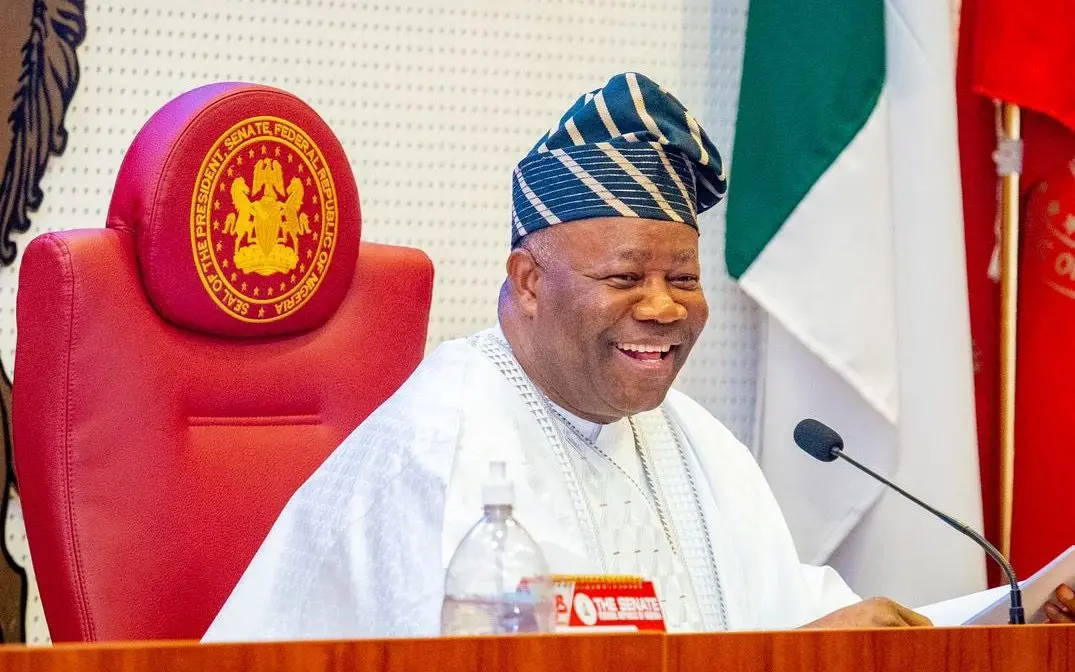
Godswill akpabio Senate President

By Adedapo Adesanya

The Senate has granted the request of President Bola Tinubu to borrow $2.2 billion (about N1.77 trillion) from external sources, two days after it was sent to the legislative arm of government for approval.

The upper chamber of the National Assembly authorised Mr Tinubu to get the $2.2 billion loan after a voice vote in favour of the request at plenary on Thursday.

The Senate session, presided over by Deputy Senate President, Mr Barau Jibrin, approved the loan after the Senate Committee on Local and Foreign Debts, chaired by Mr Wammako Magatarkada, presented the report of the committee today.

The loan request, which was submitted by the President on Tuesday, is part of a fresh external borrowing plan to partially finance the N9.7 trillion budget deficit for the 2024 fiscal year.

President Tinubu had on Tuesday written to the National Assembly, seeking approval of a fresh N1.767 trillion, the equivalent of $2.209 billion as a new external borrowing plan in the 2024 Appropriation Act.

The fresh loan is expected to stretch the amount spent on debt servicing by the federal government.

The Central Bank of Nigeria (CBN) recently said that it cost the federal government $3.58 billion to service foreign debt in the first nine months of 2024.

The CBN report on international payment statistics showed that the amount represents a 39.8 per cent increase from the $2.56 billion spent during the same period in 2023.

According to the report, while the highest monthly debt servicing payment in 2024 occurred in May, amounting to $854.37m, the highest monthly expenditure in 2023 was $641.70m, recorded in July.

The trend in foreign debt servicing by the CBN highlights the rising cost of debt obligations by Nigeria.

Further breakdown of international debt figures showed that in January 2024, debt servicing costs surged by 398.9 per cent, rising to $560.52 million from $112.35 million in January 2023. February, however, saw a slight decline of 1.8 per cent, with payments reducing from $288.54 million in 2023 to $283.22 million in 2024.

March recorded a 31.0 per cent drop in payments, falling to $276.17 million from $400.47 million in the same period last year. April saw a significant rise of 131.8 per cent, with $215.20 million paid in 2024 compared to $92.85 million in 2023.

The highest debt servicing payment occurred in May 2024, when $854.37 million was spent, reflecting a 286.5 per cent increase compared to $221.05 million in May 2023. June, on the other hand, saw a 6.51 per cent decline, with $50.82 million paid in 2024, down from $54.36 million in 2023.

July 2024 recorded a 15.48 per cent reduction, with payments dropping to $542.50 million from $641.70 million in July 2023. In August, there was another decline of 97 per cent, as $279.95 million was paid compared to $309.96 million in 2023.

However, September 2024 saw a 17.5 per cent increase, with payments rising to $515.81 million from $439.06 million in the same month last year.


Adedapo Adesanya is a journalist, polymath, and connoisseur of everything art. When he is not writing, he has his nose buried in one of the many books or articles he has bookmarked or simply listening to good music with a bottle of beer or wine. He supports the greatest club in the world, Manchester United F.C.

Economy

Nigeria Imports 61.7 million Barrels of US Crude in Two Years

Published

on

Cawthorne crude oil

By Adedapo Adesanya

Nigeria imported about 61.7 million barrels of crude oil from the United States between January 2024 and January 2026, according to data from the US Energy Information Administration (EIA).

This came even as the country continued to export significantly larger volumes within the same period, exposing a growing imbalance in the country’s oil supply chain.

Data from the US agency showed a sharp shift in trade flows, with American crude now flowing steadily into Nigeria after nearly a decade of negligible transactions. Before 2024, the only notable supply came in 2016, when exports averaged just 19,000 barrels per day.

The trend changed in 2024 with the start of operations at the Dangote refinery, which industry players say has increasingly turned to foreign crude to bridge gaps in domestic supply.

Within the first six months of that year alone, Nigeria imported 15.7 million barrels from the US, with June recording the highest inflow at 3.96 million barrels.

Imports accelerated further in 2025, accounting for the bulk of the two-year volume. Between February and December, inflows reached 41.06 million barrels, peaking in June at 305,000 barrels per day, equivalent to 9.15 million barrels in one month.

However, volumes dropped sharply towards the end of the year, reflecting fluctuating supply dynamics.

In January 2026, imports rose again to 159,000 barrels per day, translating to 4.93 million barrels, bringing the total volume over the two-year period to 61.7 million barrels.

The figures stand in contrast to Nigeria’s export profile.

According to data from the Central Bank of Nigeria (CBN), the country exported about 306.7 million barrels of crude between January and October 2025, representing roughly 69 per cent of total production during the period. In the first two months of 2026 alone, exports reached 55.39 million barrels.

Despite producing over 443 million barrels within the first 10 months of 2025, only about 137 million barrels were retained for domestic use, leaving local refineries struggling to secure adequate feedstock.

Operators say the Dangote Refinery requires over 19 million barrels monthly to run at optimal capacity, a demand that local supply has failed to meet consistently. This shortfall has forced the facility to source crude not only from the US but also from Ghana and other African producers.

Imports became necessary to stabilise the 650,000 barrels per day refinery operations amid inconsistent domestic allocations, despite the introduction of the Naira-for-crude arrangement. According to the management of the company, only about four to five cargoes were distributed, but this has since changed.

Alongside Dangote Refinery, other smaller operators were also affected, since the country’s crude allocation is tied to joint ventures with International Oil Companies (IOCs).

The development underscores a persistent structural challenge in Nigeria’s oil sector, exporting large volumes of crude while struggling to supply domestic refineries, raising fresh concerns about policy coordination, upstream allocation, and the long-term viability of local refining.

Continue Reading

Economy

Edun Thanks Tinubu, Expresses Optimism About Nigeria’s Trajectory

Published

on

Wale Edun Nigeria wont borrow

By Aduragbemi Omiyale

The outgoing Minister of Finance and Coordinating Minister of the Economy, Mr Wale Edun, has thanked President Bola Tinubu for giving him the opportunity to serve in his administration.

In a statement personally signed by him on Tuesday, Mr Edun said it was an honour to be called by the President to help put the Nigerian economy on the path of recovery after facing difficult economic circumstances.

“It has been an honour to contribute to the implementation of the administration’s economic agenda at a pivotal moment in Nigeria’s journey,” a part of the statement made available to Business Post read.

The Minister noted that he was “proud of what we achieved alongside colleagues in the Federal Executive Council (FEC), State Governors, our partners in the public and private sectors, and the many dedicated professionals whose work continues to support the nation’s economic transformation. While much remains to be done, the direction is clear, and the foundations are firmly in place.”

While reaffirming his commitment to the service of the nation and to supporting Mr President, he declared that, “The work of economic reform is, by its nature, a continuous process,” expressing optimism about Nigeria’s trajectory.

“I wish my successor and the entire government the very best as they continue the work of improving the lives of Nigerians,” he stated.

In 2023, Mr Edun first served as the head of the Presidential Transition Committee, and later became the Special Adviser to the President on Monetary Policy, before his appointment as Finance Minister.

During his time as Minister, he worked to advance critical reforms that stabilised the macroeconomic environment, strengthened fiscal sustainability, and laid the foundation for inclusive and long-term growth.

Key results of these efforts included growth improving from a rate of 2 per cent to over 4 per cent, and inflation falling from 35 per cent to 15 per cent.

These outcomes were driven by a shared commitment to restoring public trust and enabling faster and inclusive growth through greater investor confidence and improved economic coordination.

Continue Reading

Economy

CSCS Improves NASD Securities Exchange by 0.56%

Published

on

CSCS NGX more synergies

By Adedapo Adesanya

A price appreciation recorded by Central Securities Clearing System (CSCS) Plc lifted the NASD Over-the-Counter (OTC) Securities Exchange by 0.56 per cent on Tuesday, April 21.

Data showed that the Nigerian depository company gained N4.13 during the trading day to close at N63.15 per share compared with the preceding session’s N59.02 per share.

As a result, the NASD Unlisted Security Index (NSI) added 21.81 points to close at 3,935.27 points compared with Monday’s closing value of 3,913.46 points, and the market capitalisation expanded by N12.99 billion to finish at N2.354 trillion, in contrast to the previous day’s N2.341 trillion.

Yesterday, the price of 11 Plc went down by N21.08 to settle at N191.00 per unit versus N212.08 per unit.

There was a 48.9 per cent decline in the value of transactions on Tuesday to N5.7 million from N11.1 million, as the volume of transactions dipped by 48.9 per cent to 185,420 units from 245,830 units, while the number of deals shrank by 4.2 per cent to 23 deals from 24 deals.

Great Nigeria Insurance (GNI) Plc remained the most active stock by value on a year-to-date basis, with 3.4 billion units worth N8.4 billion, followed by CSCS Plc with 58.9 million units exchanged for N4.0 billion, and Okitipupa Plc with 27.8 million units traded at N1.9 billion.

GNI Plc was also the most traded stock by volume on a year-to-date basis with 3.4 billion units valued at N8.4 billion, followed by Resourcery Plc with 1.1 billion units sold for N415.7 million, and Infrastructure Guarantee Credit Plc with 400 million units transacted for N1.2 billion.

Continue Reading

Trending