Economy
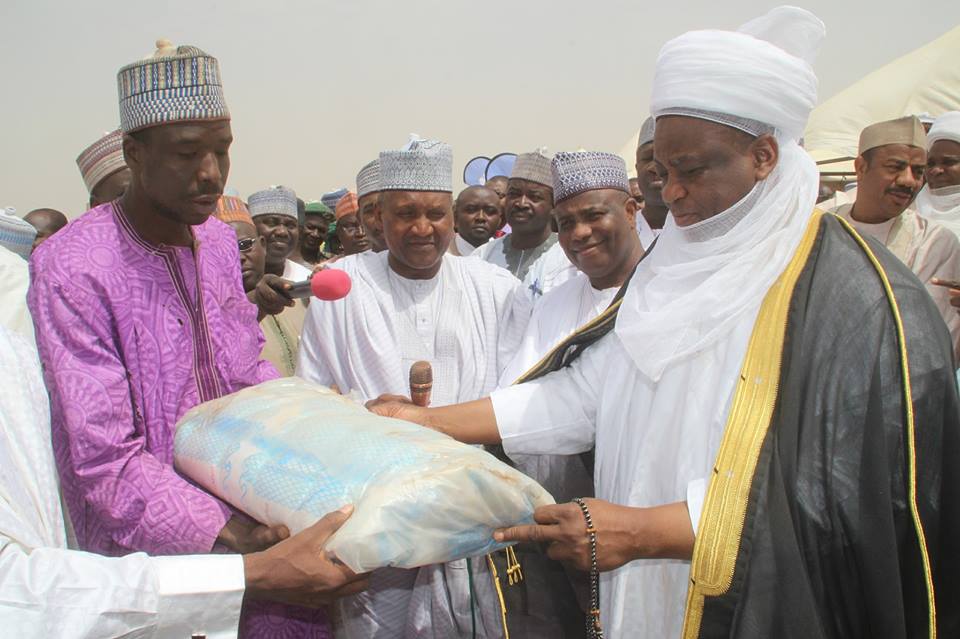
Tambuwal, Dangote, Sultan Flag off Rice Mill at Goronyo

By Modupe Gbadeyanka
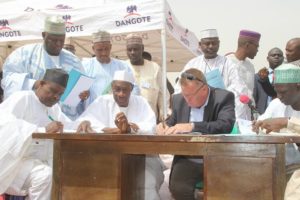
Governor Aminu Tambuwal along with the President of Dangote Group, Mr Aliko Dangote flagged off a rice outgrowers’ scheme on Wednesday, which will cover 25,000 hectares of farmland across some selected local government areas of Sokoto state.
Speaking at the site of the event which held in Goronyo Dam, Mr Dangote said the project will within the next three years produce at least one million tonne of high quality parboiled rice for Nigerian market.
He said to achieve this, his company plans to cultivate 160,000 hectares of irrigable rice farmland in selected states, including Sokoto, which will be cultivated to grow paddy during two cropping-season per year.
“With this, we hope to achieve a minimum yield of five to six tonnes per hectare. Our plans are to off-take not less that 80 percent of the paddy produced by the outgrowers. We will also develop our own farm operations to include seed multiplication capabilities,” he added.
According to him, Dangote Rice Limited aims to boost the local economy, create jobs along the value and make a significant contribution to the transformation of subsistence farms into market-oriented agribusinesses.
In his remarks, Mr Tambuwal commended Dangote for siting the project in Sokoto State, saying the renewed efforts of his administration in the sector has started yielding the desired result.
The Governor said education and agriculture have remained the two top sectors in the priority list in the state in the last two years, revealing that this year, Sokoto has allocated more to agriculture than all states of the federation.
“We have had series of visits to different countries and signed various MoUs with many organisations and entities, Dangote inclusive, with a view to uplifting agriculture in the state.
“So the Dangote Rice Project in Sokoto State will not only provide food security and employment to our teeming unemployed youths, it would ensure the overall development of agricultural activities in the state,” he added.
Mr Tambuwal assured that all necessary incentives have been put in place to ensure smooth operation of the scheme.
In his remarks, Sultan of Sokoto, Mr Muhammad Sa’ad Abubakar, urged the people to embrace this opportunity to improve their farming technique and standards of living.
He said the people of Sokoto are grateful for the opportunity and will mobilise needed resources to ensure its success.

Economy
SEC Advances Fintech Innovation With Seven New ARIP Approvals
By Adedapo Adesanya
The Securities and Exchange Commission (SEC) has cleared seven new fintech and digital asset firms for admission into its Accelerated Regulatory Incubation Programme (ARIP), granting them Approval-in-Principle (AIP) to operate within the programme’s regulatory sandbox as part of efforts to promote innovation while protecting investors.
The commission said the move reinforces its commitment to fostering responsible innovation that deepens Nigeria’s capital market without compromising market integrity.
The seven firms set for admission into the programme are Bitbarter Technologies Limited, Luno Fintech Nigeria Limited, GetEquity Limited, Koinkoin Global Network Limited, Wrapped CBDC Ltd, Trovotech Ltd and Blockvault Custodian Ltd.
According to the SEC, the Approval-in-Principle permits the firms to operate within the defined scope of the programme, subject to conditions stipulated by the Commission.
It clarified that the approval is not a final operating licence but confirms that each entity has satisfied the admission requirements for ARIP.
“An Approval-in-Principle confirms that an entity has satisfied the Commission’s admission requirements for the Programme. It is not a final licence and remains conditional on the entity’s continued compliance with all applicable regulatory, operational, and supervisory obligations,” the Commission stated.
The ARIP is a controlled regulatory environment established by the SEC to accelerate the onboarding of digital asset and other investment service providers, including Virtual Asset Service Providers (VASPs) and tokenised product platforms.
The programme enables the Commission to evaluate emerging business models and financial technologies under regulatory supervision before they are offered to the investing public.
According to the commission, the initiative is designed to ensure that adequate safeguards are in place to protect investors while preserving the integrity of Nigeria’s capital market.
The SEC reiterated its commitment to supporting innovation that enhances efficiency, transparency, financial inclusion and sustainable growth in the capital market through initiatives such as ARIP.
It also urged members of the public to verify the regulatory status of individuals or organisations promoting investment products or services through its official channels before committing funds.
Economy
FG Denies IMF Allegation of 2% GDP Off-Budget Expenditure
By Adedapo Adesanya
The Nigerian government has dismissed claims by the International Monetary Fund (IMF) that it spent about two per cent of Nigeria’s Gross Domestic Product (GDP) outside the approved budget.
The widely reported claim was made by the IMF’s Resident Representative in Nigeria, Mr Christian Ebeke, last week. He alleged that the country failed to record public spending equivalent to about two per cent of its GDP in recent official budgets, amounting to about N8 trillion.
But in a statement issued on Sunday, the Minister of Finance and Coordinating Minister of the Economy, Mr Taiwo Oyedele, said the federal government does not operate a “shadow budget” or spend public funds outside the constitutional and statutory framework governing public finance, and described the reports as a misrepresentation of Mr Ebeke’s comments.
He explained that sections 80–83 and 162 of the 1999 Constitution (as amended) provide that public funds can only be withdrawn and spent in accordance with the Constitution and laws enacted by the National Assembly.
According to him, all FG spending is backed by duly enacted Appropriation Acts, Supplementary Appropriation Acts or other statutory authorisations approved by the National Assembly.
Mr Oyedele added that multi-year capital projects, which span several budget cycles, are implemented in line with existing laws and approved capital rollover provisions where applicable.
“These are recognised features of public financial management and should not be misconstrued as expenditures outside the budget,” he said.
He described as inaccurate suggestions that trillions of naira were secretly spent without legislative approval, arguing that such allegations should identify the specific projects allegedly executed without appropriation or legal authority and provide credible evidence to support the claims.
“To be meaningful, assertions of this magnitude must be supported by verifiable facts rather than conjecture.
“For the purpose of public education, it is important to distinguish between appropriation, expenditure authorisation, financing and fiscal reporting,” he added.
Mr Oyedele said Nigeria’s public finance framework includes several statutory transfers, first-line charges and intervention mechanisms established by Acts of the National Assembly.
These, he said, include statutory allocations to development commissions and other agencies created by law, cost of collection and administration retained by designated revenue-collecting agencies, capital expenditure approved under separate budgets for some agencies and the Federal Capital Territory, special interventions for national priorities such as security, infrastructure and disaster response, as well as debt service obligations and other statutory transfers.
The minister maintained that the expenditures are neither secret nor illegal, stressing that they are established by law, disclosed in official fiscal reports and subject to oversight, audit and accountability mechanisms.
“Their treatment for reporting purposes may differ from their presentation in the annual Appropriation Act, particularly under international statistical and reporting standards adopted by the Federal Government. Such classification differences should not be misrepresented as evidence of unlawful expenditure,” he said.
Mr Oyedele also rejected claims that the reported amount represented an increase in Nigeria’s budget deficit.
“A fiscal deficit is determined by the relationship between total government revenues and total government expenditures. Whether a capital project is financed through annual appropriations, supplementary appropriations, statutory transfers, approved intervention mechanisms, or other lawful financing arrangements does not, by itself, increase the fiscal deficit,” he said.
He further explained that the IMF’s observation related primarily to the comprehensiveness, timing and presentation of Nigeria’s fiscal reporting rather than the legality of government expenditure.
According to him, Nigeria, like many other countries, is working to improve the alignment between its budget presentation and international fiscal reporting standards as part of ongoing public financial management reforms.
Mr Oyedele recalled that President Bola Tinubu had, during the presentation of the 2026 Appropriation Bill to a joint session of the National Assembly on December 19, 2025, urged lawmakers to end the practice of operating multiple and overlapping budgets and instead adopt a single, harmonised budget framework.
He said the federal government remains committed to prudent fiscal management, transparency and accountability, adding that recent reforms have strengthened budget credibility, revenue administration, treasury management and the digitalisation of government financial processes.
According to him, these reforms have been acknowledged by the IMF, other multilateral institutions, international credit rating agencies, investors and major global media organisations.
While describing public debate as essential in a democracy, Mr Oyedele urged commentators to base their arguments on facts and a proper understanding of Nigeria’s constitutional and fiscal framework.
“Mischaracterising technical observations as evidence of unlawful expenditure neither advances informed public discourse nor strengthens democratic accountability,” he said.
He added that the federal government would continue to uphold the rule of law, ensure transparency in the management of public resources and work with the National Assembly, oversight institutions, development partners and Nigerians to further strengthen fiscal governance in line with international best practices
Economy
Ahimie to Position CIS as Key Contributor to Capital Market, National Economy
By Dipo Olowookere
The 14th president and chairman of the council of the Chartered Institute of Stockbrokers (CIS), Ms Fiona Ahimie, has promised to position the organisation as a leading professional body contributing meaningfully to the growth and development of the Nigerian capital market and the national economy.
She made this commitment during her swearing-in ceremony on Thursday, June 25, 2026, as the first female leader of the 34-year-old institute.
Ms Ahimie also pledged to strengthen professional excellence, deepen stakeholder engagement, expand financial literacy, promote youth and women’s development, and drive innovation and digital transformation.
The event, which was attended by several capital market stakeholders, was also used as a send-off ceremony for Ms Ahimie’s predecessor, Mr Oluropo Samuel Dada, in recognition of his exemplary leadership and dedicated service to the organisation over the past two years.
Present were Nigeria’s Vice President, Mr Kashim Shettima, represented by the Special Adviser to the President on Economic Affairs, Mr Tope Fasua; the Minister of Women Affairs & Social Development, Ms Imaan Sulaiman-Ibrahim; the Governor of Ekiti State, Mr Biodun Abayomi Oyebanji; the Governor of Lagos State, Mr Babajide Sanwo-Olu, represented by the Commissioner for Finance, Mr Abayomi Oluyomi; the Governor of the Central Bank of Nigeria (CBN), Mr Olayemi Cardoso, represented by the Director of Financial Policy & Regulations at the CBN, Ms Rita Ijeoma Sike; the Director-General of the Securities and Exchange Commission, Mr Emomotimi Agama; the Chairman of First Holdco, Mr Femi Otedola, represented by the chief executive First Holdco, Mr Adebowale Oyedeji; the former DG of the Nigerian Exchange (NGX), formerly known as the Nigerian Stock Exchange (NSE), Ms Ndi Okereke-Onyiuke; and the chairman of NGX Group, Mr Umaru Kwairanga, amongst others.
-
Feature/OPED6 years agoDavos was Different this year
-
Travel/Tourism10 years ago
Lagos Seals Western Lodge Hotel In Ikorodu
-
Showbiz4 years agoEstranged Lover Releases Videos of Empress Njamah Bathing
-
Banking8 years agoSort Codes of GTBank Branches in Nigeria
-
Economy3 years agoSubsidy Removal: CNG at N130 Per Litre Cheaper Than Petrol—IPMAN
-
Banking3 years agoSort Codes of UBA Branches in Nigeria
-
Banking3 years agoFirst Bank Announces Planned Downtime
-
Sports3 years agoHighest Paid Nigerian Footballer – How Much Do Nigerian Footballers Earn