Economy
UBA Seeks Entries for 2019 National Essay Competition
By Modupe Gbadeyanka
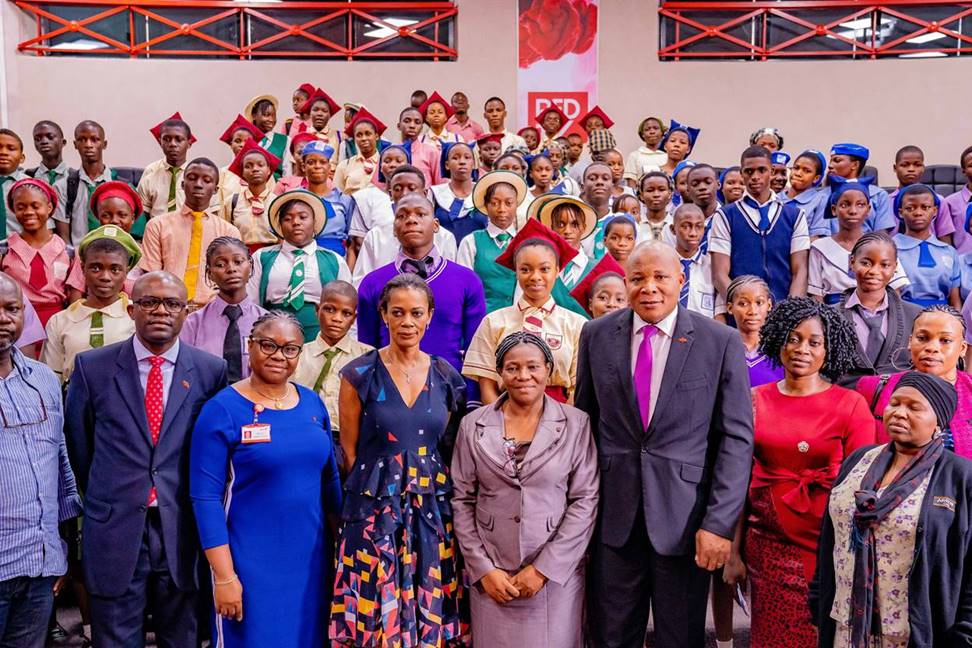
Entries for the 2019 edition of the annual National Essay Competition organised by the corporate social responsibility arm of the United Bank for Africa (UBA) Plc, UBA Foundation, have commenced.
At a media launch to herald the competition in its ninth series last week, the CEO of UBA Foundation, Mrs Bola Atta, explained that the educational contest will provide an opportunity for students in secondary schools across the country to put in their entries and to win prizes in the form of educational grants to study in any university of their choice on the African continent.
At the event held at the UBA headquarters in Lagos, the organisers said the essay competition was targeted at senior secondary school students in Nigeria and was part of UBA Foundation’s education initiative which is aimed at promoting the reading culture and encouraging healthy and intellectual competition amongst secondary school students in Nigeria and across Africa.
Beginning from last year, the prize money increased significantly as the UBA Foundation emphasises that education remains one of the foundation’s key initiatives.
The first prize for the UBA National Essay Competition is a N2 million educational grant, while the second and third prizes are N1.5 million and N1m educational grants respectively.
“To us at the Foundation, this is our drive to improve the quality of education across the continent. It is also our way of giving back to the society.
“The competition is a key aspect of our investment drive in human capital, as we seek to improve knowledge base, allow students to express themselves and write creatively.
“We will continue to sustain the initiative because education is very important to UBA and we are more than committed to providing the necessary support for students in Nigeria and across the African continent,” Mrs Attah noted.
She said further that, “We are driven by the mantra to do well and do good and we will not relent in our efforts to touch lives through our various projects, and initiatives.”
Explaining the modalities for the competition, she stated that entries received from students for the competition will be reviewed by a distinguished panel of judges made up of professors from reputable Nigerian Universities, who will then shortlist 12 best essays for further assessment.
Following this, a second round of the competition will involve the 12 finalists who will write a second supervised essay from which three best essays will be selected as the overall winners from the 12 finalists emerged from the first round of the competition.
Mrs Atta explained that the choice of essay for this year’s competition is one that helps promote creative and analytical thinking in students and helps them to be problem solvers. This year, the topic is What do you think the government should do to control fraud in Nigeria?
It is important to note that apart from Nigeria, the national essay competition has been taken to other African countries including Ghana and Senegal. More countries including Mozambique and Kenya will kick off the initiative this year. A unique component of this year’s edition is that, schools that turn in the highest number of entries will be recognised and rewarded a special prize by the Foundation.
Also speaking at the call to entries today, the Group Head, Direct Sales Agency, Ms Ogechi Altraide, who spoke on the benefits of reading and writing essays, motivated the students to research into the topics and give it their best shot, adding that there is the need for them to focus on adapting themselves to happenings in their generation, and to have a growth mindset. This she explained, will ensure that they can apply themselves and conquer whatever challenges they are faced with.
According to her, reading and writing go hand in hand, and so it is important for students to keep abreast of how the economy can develop through reading and writing.
An English teacher from Holy Child College, Ikoyi, Mrs Ezechukwu Ngozi, gave the students tips on how to write good essays, and advised them to keep to the proper tenets of essay writing to come out tops in the competition.
As the CSR platform for the UBA Group, UBA Foundation embodies the Group’s CSR objectives and seeks to impact positively on societies through a number of laudable projects and initiatives.
Each year, the bank donates thousands of books to students in Nigeria and across Africa, under the ‘Read Africa’ initiative to encourage and promote the reading culture in secondary schools.
Economy
Meristem Projects Nigeria’s March 2026 Inflation at 13.59%
By Aduragbemi Omiyale
Analysts at Meristem Research have projected that the inflation rate in Nigeria for March 2026 should further moderate to 13.59 per cent on a year-on-year basis from the 15.06 per cent recorded in February 2026.
The company, in a note sighted by Business Post, explained that easing in the average prices of goods and services for last month would be impacted by a high base from the same period of 2025, but noted that on a month-on-month basis, the rate will spike.
Last month, energy prices soared after the price of crude oil on the global market soared as a result of the war in Iran, with prices of items growing in Nigeria.
“However, month-on-month pressures are likely to pick up, driven by the renewed increases in energy prices, which should nudge headline inflation higher.
“Core inflation is also likely to edge higher, reflecting second-round effects from higher transportation and production costs, although the relative stability of the Naira should help moderate the pace of increase.
“Food inflation is also expected to rise on a month-on-month basis, driven by higher logistics and distribution costs, as well as recent increases in staple food prices,” a part of the report noted.
The National Bureau of Statistics (NBS) is expected to release the inflation numbers later today.
Nigeria’s headline inflation rate moderated marginally by 0.04 per cent to 15.06 per cent in February 2026 from 15.10 per cent in January 2026, though on a month-on-month basis, inflationary pressures accelerated.
Economy
Nigeria’s Public Debt Nears N160trn
By Adedapo Adesanya
Nigeria’s total public debt rose from N153.29 trillion at the end of September 2025 to N159.28 trillion in December 2025, according to the latest data released by the Debt Management Office (DMO) on Tuesday.
The increase indicates a quarter-on-quarter increase of N5.98 trillion or 3.9 per cent.
The debt office noted that the December 2025 figures are provisional and were converted using the Central Bank of Nigeria’s official exchange rate of N1,435.25/$, while the September 2025 figures were converted using N1,474.85/$.
On a year-on-year basis, the debt profile marked an increase of N14.61 trillion or 10.1 per cent, from N144.67 trillion in December 2024 to N159.28 trillion in December 2025, representing a rise from $94.23 billion to $110.97 billion, an increase of $16.75 billion, in Dollar terms.
Domestic debt remained the largest, rising from N81.82 trillion in September 2025 to N84.85 trillion in December 2025.
This represents a quarter-on-quarter increase of N3.03 trillion or 3.7 per cent compared to December 2024, when domestic debt stood at N74.38 trillion – the figure increased by N10.47 trillion or 14.1 per cent year-on-year.
In Dollar terms, domestic debt rose from $55.47 billion in September 2025 to $59.12 billion in December 2025, and from $48.44 billion in December 2024. This highlights a sustained reliance on the domestic market for financing.
The federal government accounted for the bulk of domestic debt at N80.49 trillion, representing 50.53 per cent of total public debt, while states and the Federal Capital Territory (FCT) accounted for N4.36 trillion.
Nigeria’s external debt stood at N74.43 trillion as of December 2025, representing 46.73 per cent of total public debt.
This reflects a quarter-on-quarter increase of N2.95 trillion from N71.48 trillion in September 2025, and a year-on-year increase of N4.14 trillion from N70.29 trillion recorded in December 2024.
In Dollar terms, external debt rose from $48.46 billion in September 2025 to $51.86 billion in December 2025, and from $45.78 billion in December 2024.
The federal government continued to dominate external borrowing, accounting for N66.27 trillion of the total external debt, while states and the FCT accounted for N8.16 trillion.
However, the structure of Nigeria’s debt portfolio remained broadly stable despite the increase in overall debt.
While domestic debt accounted for 53.27 per cent of total debt in December 2025, compared to 53.37 per cent in September 2025 and 51.41 per cent in December 2024, external debt stood at 46.73 per cent in December 2025, compared to 46.63 per cent in September 2025 and 48.59 per cent a year earlier.
Economy
Daily Petrol Consumption in Nigeria Slips to 47.3 million Litres Amid Price Hike
By Dipo Olowookere
The volume of premium motor spirit (PMS), commonly known as petrol, consumed daily in Nigeria stood at 47.3 million litres in March 2026 compared with the 56.9 million litres recorded in February 2026.
This information was revealed by the Nigerian Midstream and Downstream Petroleum Regulatory Authority (NMDPRA) in its latest factsheet.
The decline in daily petrol consumption in Nigeria coincided with a hike in the price of the product, triggered by a rise in global crude oil prices as a result of the Middle East crisis.
The United States and Israel launched airstrikes in Iran in late February, with crude oil rising above $100 per barrel and even above $110 per barrel at one point.
The price is currently below $100 per barrel on the global market after the President of the United States, Mr Donald Trump, signalled his intention to negotiate with Iran amid the blockage of the Strait of Hormuz.
Data by NMDPRA also showed that diesel consumption eased to 14.5 million litres per day from the previous month’s 20.3 million litres per day, while aviation fuel stood at 2.1 million litres per day versus 2.9 million litres per day in February 2026.
It was also disclosed that PMS daily supply for the month under review increased to 40.1 million litres per day from the preceding month’s 39.5 million litres per day.
From this, domestic supply came down by 6.30 per cent to 34.2 million litres per day from 36.5 million litres per day, while imported petrol stood at 5.9 million litres per day versus 3.0 million litres per day a month earlier.
Business Post observed that Dangote Refinery supplied about 34.2 million litres per day of PMS into the Nigerian market from the 48.2 million litres per day it produced. The private refiner produced 16.5 million litres of diesel per day in March 2026, supplying 2.2 million litres per day into the domestic market.
In the period, the Warri and Kaduna refineries were totally shut down, while the Port Harcourt refinery, according to the report, though it was shut down, witnessed the evacuation of about 0.048 million litres of diesel per day while it was operational.
-
Feature/OPED6 years agoDavos was Different this year
-
Travel/Tourism10 years ago
Lagos Seals Western Lodge Hotel In Ikorodu
-
Showbiz3 years agoEstranged Lover Releases Videos of Empress Njamah Bathing
-
Banking8 years agoSort Codes of GTBank Branches in Nigeria
-
Economy3 years agoSubsidy Removal: CNG at N130 Per Litre Cheaper Than Petrol—IPMAN
-
Banking3 years agoSort Codes of UBA Branches in Nigeria
-
Banking3 years agoFirst Bank Announces Planned Downtime
-
Sports3 years agoHighest Paid Nigerian Footballer – How Much Do Nigerian Footballers Earn