Economy
US, Nigeria Tie Under BNC Will Foster Trade, Investment—FG
By Dipo Olowookere
Minister of Industry, Trade and Investment Mr Okechukwu Enelamah, has disclosed that the collaboration between the US and Nigeria under the Bi-National Commission (BNC) will further foster trade and investment relations between the two countries.
He further observed that the outcomes of Nigeria’s recession experience include learning to improve and have a more sustainable approach to resolving and translating this experience into opportunities.
Mr Enelamah made these comments on Monday at the US-Nigeria Business Dinner at the Transcorp Hilton Hotel in Abuja.
The dinner was organised by the Nigerian Investment Promotion Commission (NIPC) and the Federal Ministry of Industry Trade and Investment (MITI), in partnership with the US Department of Commerce and the American Business Council.
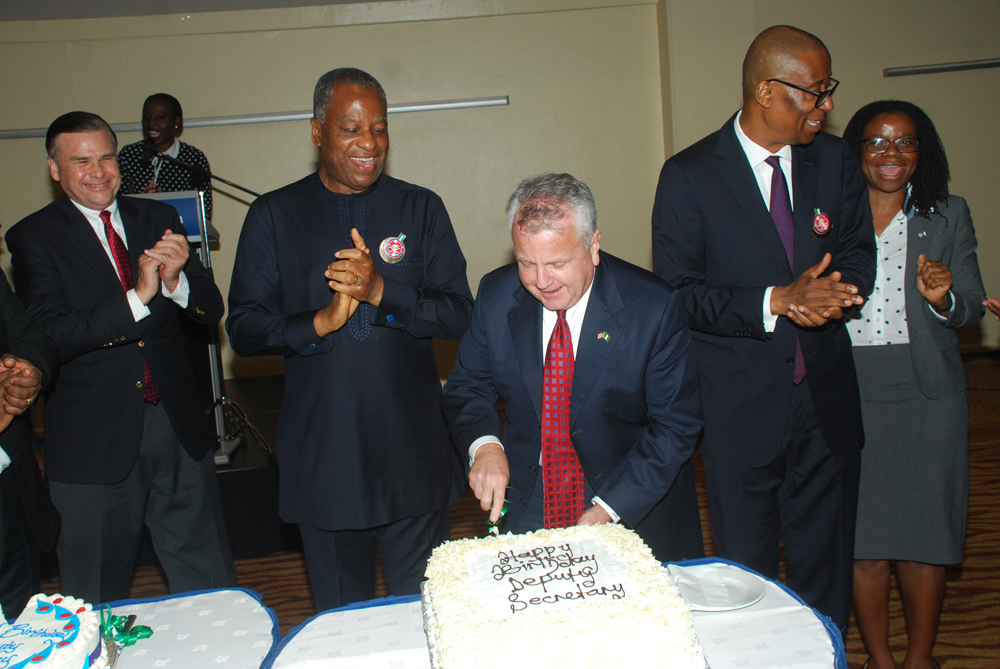
The dinner was part of the events organized in the wake of the Nigeria-US BNC meeting with the mission is “to build partnerships for tangible and measurable progress on issues critical to United States’ and Nigeria’s shared future” and the US Nigeria commercial and investment dialogue – a government to private sector initiative that was launched this week.
The US Deputy Secretary of State John Sullivan, Assistant Secretary of the department of Commerce, Skip Jones, the US Ambassador to Nigeria Stuart Symington, the Consular- General John Bray, key representatives of the US Mission, the Nigerian Ministers of Foreign Affairs, Mr Geoffrey Onyeama, Minister of Industry trade and Investments, top government functionaries, CEOs and representatives of Nigerian Companies and American Business Council attended the event.
President of the America Business Council and Managing Director of GE, Mr Lazarus Angbazo, in his goodwill message, stressed the business opportunities that Nigeria presents and is convinced that “in Nigeria, there’s a genuine openness and optimism to collaborate with the United States and this I have witnessed across different administrations.”
He added that US is a national partner for Nigeria and one with long standing commitment to the country. As such, the strengthening of this bi-national relationship portends a positive development for business operating in Nigeria.
The American Business Council is the voice of American Business in Nigeria and the American Chamber of Commerce. Over the years, it has become a key advocacy platform with the Nigerian public and private sectors.
Among other recent engagements, the Council organized strategic discussions with the Central Bank Governor, the Minister of Industry Trade and Investment and the Minister of Budget and Planning, and shared insights and inputs on major policy decisions, including the Economic Growth and Recovery Plan, the Improving the Ease of Doing Business Initiative and CBN’s currency interventions. The Council is working continually with stakeholder groups to engage regulatory agencies and resolve critical challenges around regulatory reforms.
Margaret Olele, CEO of the Council noted that American Business Council is committed to working with partners -government and stakeholders to drive sustainable socio – economic reforms and improve the ease of doing business in Nigeria.
“This partnership with the Nigerian Investment Promotion Council is a demonstration of this.
“In the coming weeks, American Business Council will release the results of the first comprehensive business survey of US firms operating in Nigeria which will demonstrate the significant impact that US trade and investment has on this economy,” she added.
Economy
Guinness Nigeria Shareholders to Pocket N4.38bn Interim Dividend for Q1’26
By Aduragbemi Omiyale
Shareholders of Guinness Nigeria Plc will share about N4.38 billion as an interim dividend for the first quarter of 2026, the board has disclosed.
This cash reward amounts to N2.00 per share, as the company has shares outstanding of 2,190,382,819 on the floor of the Nigerian Exchange (NGX) Limited.
The brewer stated that the interim dividend would be paid to investors whose names appear on the register of members as of the close of business on April 20, 2026.
The dividend payout is being proposed following the sustained profitability reflected in the unaudited financial results of the company in the first three months of this year and its “strong performance in FY 2025.”
It would be “paid from distributable profits in accordance with Sections 426–428 of the Companies and Allied Matters Act (CAMA) 2020.”
Analysis of the performance of the brewery giant between January and March 2026 showed that revenue grew by 4 per cent on a year-on-year basis to N122.77 billion from N118.34 billion in the same period of last year, while the gross profit contracted to N43.48 billion from N44.52 billion due to prevailing cost pressures within the operating environment.
The company’s operating profit also shrank to N17.18 billion from N18.00 billion in the first quarter of 2025 due to elevated marketing & distribution costs and administrative expenses.
However, the reduction in net finance costs to N1.43 billion from N7.72 billion in Q1 of 2025 helped the organisation to grow its post-tax profit to N10.39 billion in the period under review versus the N7.03 billion recorded in the corresponding period of last year.
Economy
Right Institutional Structures Critical to Unlocking Sustainable Growth—Kwairanga
By Aduragbemi Omiyale
The chairman of the Nigerian Exchange (NGX) Group Plc, Mr Umaru Kwairanga, says enabling entrepreneurship requires more than access to funding.
He said this at a workshop held in Kano under the theme Unlocking Growth – Harnessing the Capital Market for SME Growth.
The event was organisation by the NGX in partnership with the Bank of Industry (BoI) as part of their financing advocacy.
Mr Kwairanga noted that the right institutional structures and market platforms are critical to unlocking sustainable growth.
“Kano provides a fitting backdrop for this engagement, not only as a historic commercial hub but as a gateway to significant untapped potential. The priority is to connect that potential to capital and the frameworks required for long-term growth,” he stated.
The programme was put together to integrate small and medium-sized enterprises (SMEs) into Nigeria’s formal capital market.
The Kano workshop follows the inaugural edition held in Lagos last year, signalling a more structured push by both institutions to bridge the gap between Nigeria’s SME ecosystem and long-term capital.
Participants were equipped with insights on financing pathways, governance structures, and long-term growth strategies within the capital market.
On his part, the chief executive of NGX Limited, Mr Jude Chiemeka, emphasised the central role of SMEs in strengthening market depth and resilience, noting that recent market performance continues to reflect investor confidence despite macroeconomic pressures.
“Through initiatives like this, we are demystifying the capital market and demonstrating that with the right structure and governance, SMEs can access capital to scale sustainably,” he said.
An Executive Director for MSME at BOI, Mr Oluwatoyin Ahmed Edu, said the bank remains focused on bridging financing gaps for businesses that may not yet meet listing requirements.
“Where viable enterprises require capacity building before accessing the market, BOI is positioned to provide the necessary support to prepare them for that transition,” he noted.
Delivering remarks on behalf of the Emir of Kano, Mr Shehu Muhammed Dankade highlighted the region’s strong entrepreneurial base, particularly the growing participation of women-led businesses, describing it as a signal of resilience and economic potential.
The workshop featured detailed presentations from NGX on listing requirements, corporate governance, and the use of the NGX Growth Board as a platform for raising long-term capital.
It also created space for direct engagement with SME operators across Northern Nigeria, offering insights into their challenges, growth ambitions, and readiness to access structured financing.
The initiative aligns with NGX Group’s broader strategy to position SMEs as a critical engine of economic growth, while strengthening the institutional pathways that enable businesses to transition from informal operations to investment-ready enterprises.
Economy
Spike in Energy Prices Raises Nigeria’s Inflation to 15.38% in March
By Adedapo Adesanya
Nigeria’s inflation rate increased in March 2026 to 15.38 per cent from 15.1o per cent in February, data from the National Bureau of Statistics showed on Wednesday.
The Consumer Price Index (CPI) increased to 135.4 in March 2026, higher than the 130.0 in the preceding month by 5.4 points. The spike was likely stoked by the US-Israeli war on Iran, that’s pushed up the cost of fuel and has had a ripple effect in other areas.
At 15.38 per cent, the inflation numbers beat expectations of analysts at Meristem Research, which projected that the inflation rate in Nigeria for the month should come in at 13.59 per cent, after the price of crude oil on the global market soared as a result of the war in Iran, with prices of items growing in Nigeria.
The March 2026 headline inflation rate showed an increase of 0.32 per cent compared to the February 2026 headline inflation rate. However, on a month-on-month basis, the headline inflation rate in March 2026 was 4.18 per cent, which was 2.17 per cent higher than the rate recorded in February 2026 at 2.01 per cent.
This means that last month, the rate of increase in the average price level was higher than the rate of increase in the average price level a month earlier.
Food inflation rate in the review month stood at 14.31 per cent on a year-on-year basis versus 25.22 per cent in the same month of last year. However, on a month-on-month basis, the food inflation rate in March 2026 was 4.17 per cent, which is 0.52 per cent lower than the 4.69 per cent achieved in February 2026.
According to the stats office, “This can be attributed to the rate of change in the average prices of the following products: Yam, Ginger (Fresh), Cassava Tuber, Groundnuts (Shelled), Irish Potatoes, Avenger (Ogbono/Apon) – Dried Ungrinded, Tomatoes (fresh), Cassava Flour sold loose, etc.”
The average annual rate of food inflation for the twelve months ending March 2026 over the previous twelve-month average was 18.21 per cent, which was 17.81 per cent lower than the average annual rate of change recorded in March 2025 at 36.02 per cent.
On a year-on-year basis, in March 2026, the urban inflation rate was 14.64 per cent, and 3.16 per cent on a month-on-month basis, which is 0.61 per cent higher than the 2.55 per cent in February 2026.
As for the rural inflation rate, it was 17.22 per cent in the month under consideration and on a month-on-month basis, it stood at 6.73 per cent versus 0.71 per cent a month earlier.
-
Feature/OPED6 years agoDavos was Different this year
-
Travel/Tourism10 years ago
Lagos Seals Western Lodge Hotel In Ikorodu
-
Showbiz3 years agoEstranged Lover Releases Videos of Empress Njamah Bathing
-
Banking8 years agoSort Codes of GTBank Branches in Nigeria
-
Economy3 years agoSubsidy Removal: CNG at N130 Per Litre Cheaper Than Petrol—IPMAN
-
Banking3 years agoSort Codes of UBA Branches in Nigeria
-
Banking3 years agoFirst Bank Announces Planned Downtime
-
Sports3 years agoHighest Paid Nigerian Footballer – How Much Do Nigerian Footballers Earn