Connect with us

Economy

Vetiva Predicts 20% Growth for Nigerian Stock Market in 2018

Published

on

amosun at stock market

By Dipo Olowookere

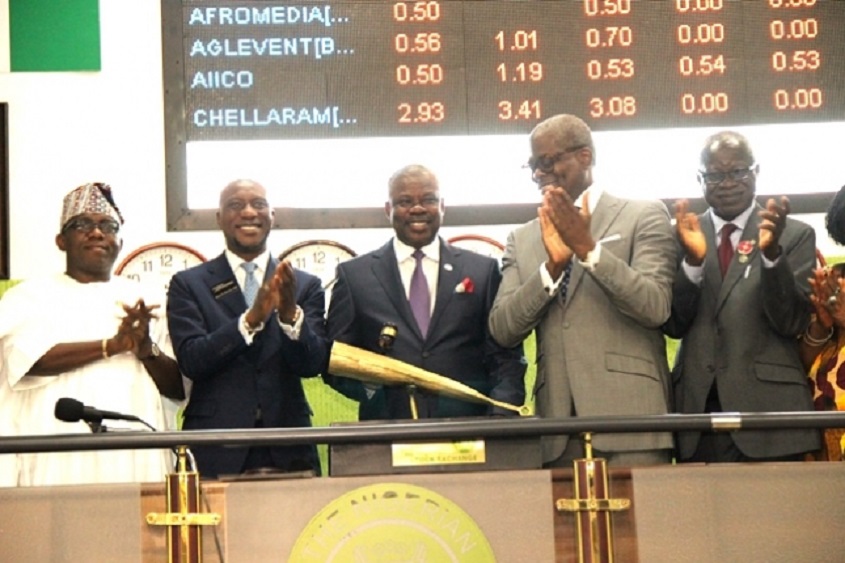
Investors in the Nigerian capital market should expect more gains in 2018 as the nation’s stock market will further grow next year, analysts at Vetiva Research have predicted.

In its recently released report titled ‘Nigeria 2018 Outlook: Acta Non Verba,’ Vetiva research said the growth would be boosted by stability in the country’s foreign exchange (forex) market in 2017.

“Despite the 2017 equity market rally driven by a partial liberalization of the country’s exchange rate regime, the Nigerian Stock Exchange remains relatively undervalued.

“Now, favourable external conditions support further growth; bolstered by stability in FX and energy supply, receding cost pressure and strengthening consumer demand.

“Amidst this, we project a strong equity market performance in 2018, with an estimated full year return of 15 percent-20 percent (Bear: -10 percent, Bull: 30 percent).

“Meanwhile, late-2017 likely marked the end of Nigeria’s golden yield environment as the monetary authorities chart a path towards lower interest rates in the country.

“Material monetary easing is expected in 2018, the intensity of which would be driven by the relative demands of economic growth and the pace of moderation in inflation,” the 169-page report stated.

The report said in 2017, the Nigerian bourse enjoyed a very good performance, advancing 43 percent by the close of business on December 15 and chief among the drivers of this surge was the introduction of the ‘Investors & Exporters’ foreign exchange window (I&E window) which revived investor confidence and boosted liquidity in the foreign exchange market (FX).

“Going forward, we anticipate continued progress on this front amidst a positive outlook for FX earnings on the back of stable oil prices and production levels. Supplementing this, recent regulation points towards a more significant role for domestic institutions in the Nigerian market which would inevitably support demand.

“Amidst these, an improving economic environment (2017E GDP growth: 0.6%, 2018F GDP growth: 2.0%) would buoy company earnings and risk appetite in the market, especially given our expectation of lower interest rates in 2018,” it said.

Continuing, the report said, “We expect this performance to be driven by strong growth across undervalued Tier 2 banking names and continued recovery in the consumer goods sector.

“In the long run, steps to improve corporate governance and investor sophistication are necessary to achieve the desired level of market deepening and diversity.

“We consider initiatives such as a thriving derivatives market and demutualization of the Nigerian Stock Exchange (NSE) as precursors to this and hope to see progress on these fronts in 2018.”

On the economy, the Vetiva report said in the year 2018, Nigeria’s Gross Domestic Product (GDP) is expected to increase by 2 percent.

“Amidst brighter prospects for global economic growth and the OPEC decision to extend the output cut agreement through 2018, we expect Nigeria to pursue its growth agenda within a relatively favourable global economic landscape.

“A promising revenue outlook and another record budget present a case for a year of strong fiscal stimulus – contingent on a deviation from the recent trend of delayed budget passage. The FX market, a significant win in 2017, would remain essential in the coming year.

“Overall, driven by expansive fiscal and monetary policies, as well as strengthening consumer wallets, we anticipate 2.0 percent y/y GDP for Nigeria 2018 in our base scenario (Bear: -0.3 percent y/y, Bull: 2.9 percent y/y). As the Nigerian economy looks set to reach another gear, the timing of the potential political disruption from 2019 elections is unwelcome.

“Despite this, we anticipate an outsized influence of the imminent elections on economic and political stakeholders as 2018 winds down, hopefully only at a minor cost to economic activities,” the report said.


Dipo Olowookere is a journalist based in Nigeria that has passion for reporting business news stories. At his leisure time, he watches football and supports 3SC of Ibadan. Mr Olowookere can be reached via [email protected]

Economy

46 Stocks Gain Weight, 53 Equities Lose on NGX in One Week

Published

on

NGX investors

By Dipo Olowookere

The Nigerian Exchange (NGX) Limited was bullish last week despite investors’ mood swing, triggered by happenings in the country and across the globe, especially the Middle East crisis.

The All-Share Index (ASI) and the market capitalisation appreciated week-on-week by 3.94 per cent to 225,722.49 points and N145.335 trillion, respectively.

Similarly, all other indices finished higher with the exception of the growth and commodity indices, which depreciated by 0.02 per cent and 0.41 per cent, respectively, while the sovereign bond index closed flat.

A look at the price changes of shares in the five-day trading week showed that

46 stocks gained weight versus 61 stocks of the previous week, 53 equities shed weight compared with 36 equities a week earlier, and 47 shares closed flat, in contrast to 49 shares of the preceding week.

UAC Nigeria led the gainers’ chart after it chalked up 42.00 per cent to trade at N142.00, Union Dicon appreciated by 32.73 per cent to N21.90, NASCON expanded by 32.63 per cent to N206.90, Trans-Nationwide Express rose by 30.58 per cent to N7.90, and Zichis improved by 25.71 per cent to N15.60.

On the flip side, Infinity Trust Mortgage Bank led the losers’ group after it gave up 50.79 per cent to close at N9.35, Abbey Mortgage Bank declined by 33.33 per cent to N5.40, Guinea Insurance slipped by 15.20 per cent to N1.06, Stanbic IBTC lost 13.82 per cent to settle at N162.50, and Living Trust Mortgage Bank slumped by 10.98 per cent to N3.65.

As for the activity log, Customs Street recorded a turnover of 3.805 billion shares worth N213.955 billion in 297,202 deals in the week compared with 3.588 billion shares valued at N195.313 billion transacted in 254,553 deals in the previous week.

Financial stocks led the activity chart with 2.739 billion units sold for N106.269 billion in 135,101 deals, contributing 71.99 per cent and 49.67 per cent to the total trading volume and value, respectively.

Services equities traded 212.324 million units worth N4.024 billion in 17,042 deals, and consumer goods shares exchanged 180.076 million units valued at N13.269 billion in 32,457 deals.

Access Holdings, UBA, and First Holdco were the busiest with 814.060 million units traded for N39.032 billion in 37,195 deals, contributing 21.40 per cent and 18.24 per cent to the total equity turnover volume and value, respectively.

Continue Reading

Economy

NGX Group’s 65th Annual General Meeting Holds April 29

Published

on

NGX Group Shares

By Aduragbemi Omiyale

The 65th Annual General Meeting (AGM) of the Nigerian Exchange (NGX) Group Plc has been fixed for Wednesday, April 29, 2026, at 11:00 am at its corporate head office on 2–4 Customs Street, Lagos.

Business Post gathered that the meeting would be streamed live on the company’s website and social media platforms to enable broader participation by shareholders and stakeholders unable to attend physically.

As part of a special business, shareholders will consider a proposed bonus issue of one new ordinary share for every three existing shares held as at the close of business on April 10, 2026, subject to regulatory approvals.

The proposal also includes an increase in the organisation’s share capital from N1,102,309,954 to N1,469,746,605, to accommodate the bonus shares and amendments to the Memorandum of Association to reflect the new capital structure.

Also at the gathering, shareholders will consider and, if deemed fit, approve the company’s audited financial statements for the year ended December 31, 2025, alongside the reports of the directors, auditors, board evaluation consultants, and audit committee.

The meeting will also deliberate on the declaration of a final dividend and the re-election of three non-executive directors retiring by rotation, who are Mr Umaru Kwairanga, Mrs Ojinika Olaghere, and Dr Okechukwu Itanyi.

Other ordinary business items on the agenda include authorising the board to fix the remuneration of the external auditors, determining the remuneration of managers, and electing members of the statutory audit committee.

Continue Reading

Economy

BNB Price Reflects Changing Dynamics in the Digital Asset Market

Published

on

BNB price

Digital asset markets have slowed, though not in a dramatic way. Things are still moving, just not with much urgency. The BNB price reflects that shift, sitting within a tighter range as broader conditions begin to shape behavior more than short bursts of demand.

It can feel uneventful at first. No strong push higher, no sharp drop either. But the movement is still there. It just does not travel far. A rise begins, then fades. A dip forms, then steadies again. It repeats more than you might expect.

That pattern tends to linger. Sometimes longer than people anticipate, especially when there is no clear reason for it to change quickly.

BNB Price Movement Reflects Exchange-Driven Demand

BNB does not behave like assets that rely purely on outside demand. Its connection to the Binance ecosystem changes that.

Usage matters here. Trading activity, transaction volume and general platform engagement all feed into how BNB is used. That connection is not always obvious in the short term, but it sits underneath everything.

Sometimes it shows up clearly. Other times it does not. The relationship is there either way.

When activity holds steady, price often follows that tone. It does not surge, but it does not weaken much either. It stays somewhere in the middle, supported without needing strong momentum. It reflects usage more than speculation in many cases.

Market Conditions Continue to Shape Price Behaviour

There is also the wider market to consider. Binance has pointed out that liquidity remains tight, with capital concentrating in a smaller number of assets.

Bitcoin still holds close to 59% of the market. Ethereum sits much lower, around 11.8%. After that, the drop-off becomes more noticeable. Smaller assets make up far less than they once did. That shift matters. It changes how everything moves.

When capital gathers like this, movement tends to compress. Prices still change, but not as freely. It becomes harder for assets to break away from the general pattern.

BNB is part of that. It does not sit outside these conditions. It moves with them more often than against them.

BNB Utility Remains Central to Its Value

There is also the question of utility, which tends to be discussed but not always fully understood.

BNB is used across the Binance ecosystem in practical ways. Fees, transactions, access to services. These are not abstract use cases. They happen regularly, even when markets feel quiet.

That kind of activity does not always push prices higher. But it does create a base level of demand. Something that holds, rather than drives.

Over time, that can matter more than short bursts of interest. It gives the asset a different kind of stability. Not fixed, but less reactive. That difference tends to show up more clearly over longer periods.

Institutional and Retail Activity Remain Balanced

Participation is mixed. Institutional involvement has increased, but it does not dominate. Retail activity is still there and often more visible in certain phases. Neither side controls the market on its own. That is part of why movement feels less defined.

At times, it can seem like different forces are pulling in slightly different directions. Not enough to create volatility, but enough to prevent a clear trend from forming.

So price moves, then pauses. Moves again, then settles. It continues like that, without fully committing to either direction.

Global Participation Continues to Expand

Outside of price, participation continues to grow. Estimates suggest global cryptocurrency users are now approaching 860 million, reflecting continued expansion across digital asset markets.

That kind of growth does not always appear in charts straight away. It builds slowly. People enter the space, others remain active and usage continues in ways that are not always easy to track day to day.

BNB sits within that broader expansion. As the ecosystem grows, so does the potential for continued use. It is not immediate. It rarely is. But it accumulates over time. That gradual build tends to matter more than short-term spikes.

Local Economic Conditions Add Perspective

Broader economic conditions still play a role. Inflation remains around the mid-teen range, which suggests the environment is stabilizing, though not completely settled.

That kind of backdrop tends to influence behavior. When conditions feel uncertain, decisions become more measured.

It does not directly control how BNB moves. But it helps explain the pace. Why do things feel slower, more contained? Markets do not exist in isolation, even when they seem separate. External factors tend to feed in gradually.

Right now, the market feels balanced more than anything else. The B&B price reflects that. Not pushing higher, not dropping away. Just holding.

There is still activity underneath. Usage continues. Participation grows. Liquidity shifts, even if it is not always visible.

For now, BNB is sitting in that middle space. Not doing too much, but not losing ground either. It might not stand out. But these phases tend to matter more than they first seem. Over time, they often shape what comes next, even if that is not immediately obvious.

Continue Reading

Trending