Economy
Wall Street Opens Lower Wednesday
By Investors Hub
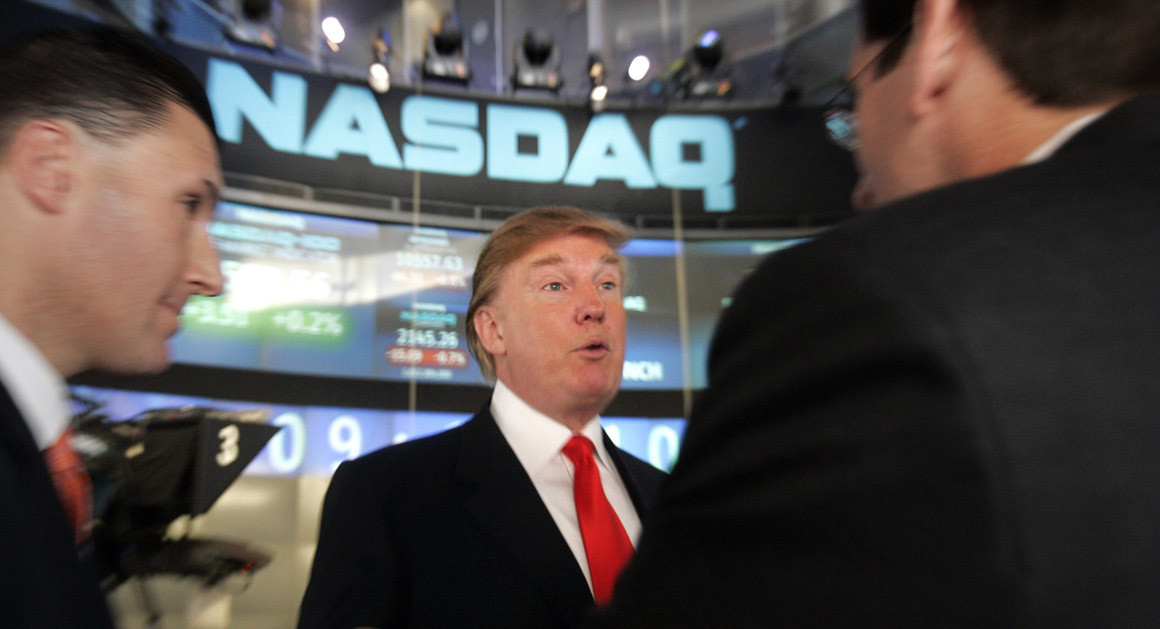
The major U.S. index futures are currently pointing to a lower opening on Wednesday, with stocks likely to see further downside after turning lower over the course of the previous session.
A further inversion of the yield curve may weigh on Wall Street, with the inversion seen as an indicator that a U.S. recession is looming.
The yield on the benchmark ten-year note has fallen further below the two-year yield, with the spread widening to its lowest level since 2007.
The White House has sought to downplay recession concerns, although the inverted yield curve combined with the escalating U.S.-China trade war have generated considerable uncertainty on Wall Street.
News that new U.K. Prime Minister Boris Johnson is preparing to suspend parliament, paving the way the way for a no-deal Brexit, may also weigh on Wall Street.
Overall trading activity may be somewhat subdued, however, as a lack of major U.S. economic data may keep some traders on the sidelines.
In the coming days, a revised reading on second quarter GDP may attract attention along with reports on weekly jobless claims, pending home sales and personal income and spending.
After failing to sustain an early move to the downside, stocks moved mostly lower over the course of the trading session on Tuesday. The major averages pulled back well off their highs of the session and into negative territory.
The major averages ended the day in the red but off their lows of the session. The Dow slid 120.93 points or 0.5 percent to 25,777.90, the Nasdaq fell 26.79 points or 0.3 percent to 7,826.95 and the S&P 500 dropped 9.22 points or 0.3 percent to 2,869.16.
The early strength on Wall Street came as traders continued to pick up stocks at relatively reduced levels following the sell-off seen last Friday.
Buying interest waned shortly after the start of trading, however, as traders expressed uncertainty about the escalating U.S.-China trade war.
President Donald Trump has claimed top Chinese officials called asking for the resumption of trade talks, but Chinese Foreign Ministry spokesman Geng Shuang continues to say he has not heard of any recent call.
Geng told reporters at a press briefing on Tuesday that China hopes the U.S. will return to rationality, stop its wrong practices and create conditions for the two sides to resume talks on the basis of mutual respect.
The yield curve between the ten-year and two-year yields inverting to its worst level since 2007 also led to renewed concerns about a looming recession.
Meanwhile, traders largely shrugged off a report from the Conference Board showing only a slight deterioration in U.S. consumer confidence in the month of August.
The Conference Board said its consumer confidence index edged down to 135.1 in August after surging up to 135.8 in July. Economists had expected the index to show a much more substantial decrease to 130.0.
“Consumer confidence was relatively unchanged in August, following July’s increase,” said Lynn Franco, Senior Director of Economic Indicators at the Conference Board. “While other parts of the economy may show some weakening, consumers have remained confident and willing to spend.”
She added, “However, if the recent escalation in trade and tariff tensions persists, it could potentially dampen consumers’ optimism regarding the short-term economic outlook.”
Tobacco stocks showed a substantial move to the downside on the day, dragging the NYSE Arca Tobacco Index down by 4.7 percent to its lowest closing level in over six months.
Philip Morris (PM) and Altria Group (MO) posted steep losses after the companies confirmed they are in discussions about reuniting in a potential all-stock, merger of equals.
Significant weakness also emerged among biotechnology stocks, with the NYSE Arca Biotechnology Index falling by 1.3 percent to a seven-month closing low.
Natural gas, steel, and transportation stocks also saw considerable weakness, while gold stocks bucked the downtrend amid a notable increase by the price of the precious metal.
Economy
BNB Price Reflects Changing Dynamics in the Digital Asset Market
Economy
NASD Unlisted Security Index Crosses 4,000-point Benchmark Again
By Adedapo Adesanya
The NASD Over-the-Counter (OTC) Securities Exchange achieved a milestone on Friday, April 24, 2026, after five securities on the platform helped with a 1.85 per cent growth.
Data showed that the NASD Unlisted Security Index (NSI) again crossed the 4,000-point benchmark yesterday.
The index chalked up 73.64 points during the trading day to close at 4,052.59 points compared with the preceding session’s 3,978.95 points, while the market capitalisation added N5.38 billion to finish at N2.424 trillion versus Thursday’s closing value of N2.380 trillion.
The price gainers were led by Okitipupa Plc, which grew by N25.00 to sell at N305.00 per share compared with the previous price of N280.00 per share. Central Securities Clearing System (CSCS) Plc gained N6.92 to close at N76.26 per unit versus N69.34 per unit, Afriland Properties Plc appreciated by N1.00 to N17.00 per share from N18.00 per share, FrieslandCampina Wamco Nigeria Plc improved by 55 Kobo to N99.55 per unit from N99.00 per unit, and Food Concepts Plc increased by 5 Kobo to N2.70 per share from N2.65 per share.
However, there was a price loser, MRS Oil, which dipped by N21.75 to N195.75 per unit from N217.50 per unit.
During the final session of the week, the value of securities jumped 75.2 per cent to N41.3 million from N23.6 million units, and the number of deals expanded by 62.9 per cent to 44 deals from 27 deals, while the volume of securities declined marginally by 0.9 per cent to 447,403 units from 451,522 units.
At the close of trades, Great Nigeria Insurance (GNI) Plc was the most traded stock by volume (year-to-date) with 3.4 billion units worth N8.4 billion, trailed by Resourcery Plc with 1.1 billion units valued at N415.7 million, and Infrastructure Guarantee Credit Plc with 400 million units traded for N1.2 billion.
GNI was also the most active stock by value (year-to-date) with 3.4 billion units sold for N8.4 billion, followed by CSCS Plc with 59.6 million units transacted for N4.0 billion, and Okitipupa Plc with 27.8 million units exchanged for N1.9 billion.
Economy
Naira Slips to N1,358/$1 as FX Reserves, Policy Uncertainty Concerns
By Adedapo Adesanya
It was not a good day for the Nigerian Naira in the currency market on Friday, April 24, as its value depreciated against the major foreign currencies at the close of transactions.
In the Nigerian Autonomous Foreign Exchange Market (NAFEX), it lost N4.53 or 0.33 per cent against the United States Dollar yesterday to trade at N1,358.44/$1, in contrast to the N1,353.91/$1 it was exchanged on Thursday.
Equally, the domestic currency slipped against the Pound Sterling in the official market during the session by N8.14 to close at N1,834.02/£1, compared with the previous rate of N1,825.88/£1 and dropped N8.01 against the Euro to sell at N1,590.73/€1 versus N1,582.72/€1.
Also, the Naira depreciated against the US Dollar at the GTBank FX desk on Friday by N4 to quote at N1,370/$1 compared with the previous session’s N1,366/$1, and at the parallel market, it depleted by N5 to settle at N1,380/$1 versus the preceding day’s N1,375/$1.
Data published by the Central Bank of Nigeria (CBN) indicated that NFEM interbank turnover surged to N43.562 million across 68 deals, up from N28.117 million the previous day.
Despite the CBN’s reassurance that the recent drop in external reserves is not worrisome, the market remains unsettled by persistent concerns over liquidity constraints, policy transparency, and weakening confidence in Nigeria’s FX market as gross reserves continue to decline to $48.4 billion.
The outlook for the Dollar appears supported by broader macro risks, including elevated oil prices tied to the tanker traffic disruptions in the Strait of Hormuz and a continued US-Iran standoff over ceasefire negotiations.
A look at the digital currency market showed that investors are sitting on the edge as the US Dollar rebounded amid geopolitical and inflation risks despite continued inflows into US spot bitcoin Exchange Traded Funds (ETFs).
Solana (SOL) rose by 1.2 per cent to sell $86.45, Cardano (ADA) appreciated by 1.1 per cent to $0.2517, Dogecoin (DOGE) grew by 0.9 per cent to $0.0989, Ripple (XRP) improved by 0.3 per cent to $1.43, Ethereum (ETH) soared by 0.2 per cent to $2,316.83, and Binance Coin (BNB) chalked up 0.1 per cent to sell for $637.44.
However, TRON (TRX) depreciated by 1.3 per cent to $0.3235, and Bitcoin (BTC) lost 0.2 per cent to close at $77,562.27, while the US Dollar Tether (USDT) and the US Dollar Coin (USDC) closed flat at $1.00 each.
-
Feature/OPED6 years agoDavos was Different this year
-
Travel/Tourism10 years ago
Lagos Seals Western Lodge Hotel In Ikorodu
-
Showbiz3 years agoEstranged Lover Releases Videos of Empress Njamah Bathing
-
Banking8 years agoSort Codes of GTBank Branches in Nigeria
-
Economy3 years agoSubsidy Removal: CNG at N130 Per Litre Cheaper Than Petrol—IPMAN
-
Banking3 years agoSort Codes of UBA Branches in Nigeria
-
Banking3 years agoFirst Bank Announces Planned Downtime
-
Sports3 years agoHighest Paid Nigerian Footballer – How Much Do Nigerian Footballers Earn