Education
Sixty Years and Still Growing Stronger as UN University
By Kester Kenn Klomegah
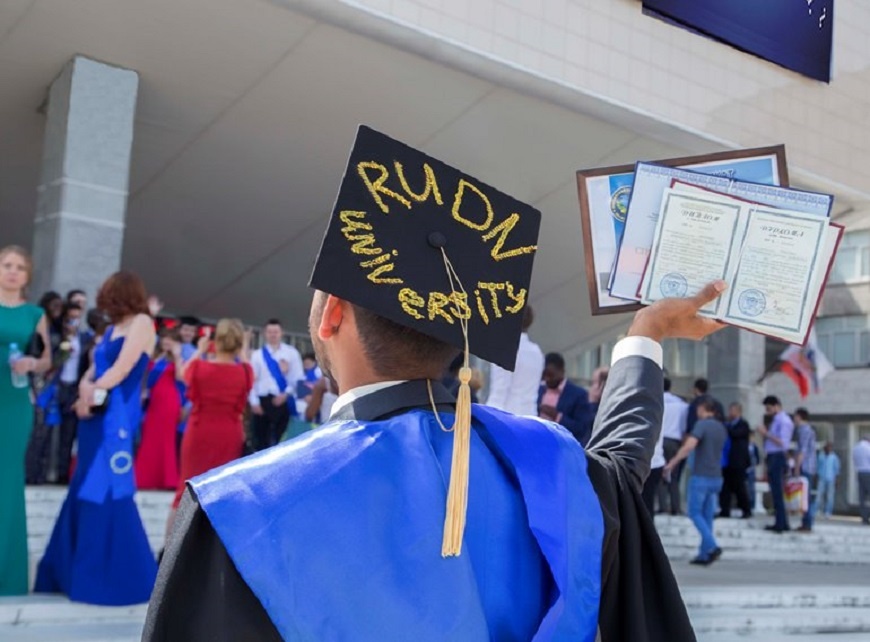
Peoples’ Friendship University of Russia, one of Russia’s largest internationally oriented, educational and research institutions, has marked the 60th year of its establishment with series of activities including an evening of congratulatory speeches, culminating with a grand multinational cultural concert in the Kremlin.
The congratulatory messages came from the Kremlin, Russian government, Federation Council, State Duma, Ministries and Departments, Soviet and Russian Graduates’ Associations in Latin America, Asia and Africa, and international organizations such as UNESCO and the United Nations.
From the highest officialdom, Russian President Vladimir Putin sent his greetings to the faculty and staff, postgraduate and undergraduate students and alumni of Peoples’ Friendship University of Russia (RUDN) on the academic institution’s anniversary.
The message reads: “Exactly 60 years ago, Peoples’ Friendship University of Russia opened its doors to young people arriving in Moscow from the newly independent countries of Asia, Africa and Latin America, offering them a second home. I strongly believe that many graduates hold warm memories of the years they spent studying in our country, their teachers and friends.
Over these years, the university has trained tens of thousands of qualified professionals in economics, agriculture, medicine, law, history, philology and other disciplines, making a unique contribution to strengthening friendship and mutual understanding between people of various ethnic and cultural backgrounds.
It is marvellous that the university treasures these traditions and maintains a high standard of education as one of Russia’s best higher education institutions. Its noble mission helps attract talented, proactive and dedicated young people from across the world who are receptive to progressive ideas and are ready to undertake advanced programmes and projects.”
In a congratulatory message, Antonio Guterres, Secretary-General of the United Nations, noted that the university has long been known for fostering understanding between countries and cultures.
Respect for diversity is one of the strengths. This anniversary comes at a time of test for that vital work. Today’s global landscape is scared by protracted conflicts, a climate crisis and the spread of hatred and disquiet. In such times, the pursuit of knowledge remains more necessary than ever.
It is encouraging to know that the mission of “uniting people of different cultures by knowledge” echoes the aim of key United Nations initiatives, including UN Academic Impact, of which the university is a valued member.
“As we mark the 75th anniversary of the United Nations and embark on a Decade of Action to deliver the Sustainable Development Goals by 2030, we look forward to continued partnership in shaping a peaceful and prosperous future for all,” stressed Secretary-General Antonio Guterres.
Professor Vladimir Filippov, Rector of the Peoples’ Friendship University of Russia, traced the history of its establishment emphasizing the fact that the significant decision to establish the university was made 60 years ago. It has worked the way from a higher educational institution, mainly trained staff for developing countries to a comprehensive research university – from Peoples’ Friendship University to RUDN University, the scientific and educational centre well-known and recognized in Russian and world rankings.
Today the university brings together students from 158 countries, and the number of RUDN University alumni increases by 5-6 thousand year by year, graduates work in almost all countries.
In 2020, RUDN University alumni are to hold events devoted to the RUDN University anniversary in dozens of countries of the world. RUDN University and its alumni are planting Trees of Friendship in many countries to commemorate its anniversary.
Professor Filippov concluded: “We are still young, up-and-coming and individual – our university is really the only one. RUDN University is more than just a degree you obtain, more than research, more than collaborations, more than creative environment. RUDN University generation is beyond standards, we create our own history – history of a university of the new type – We are different, we are equal, we are leaders!”
Additional historical notes: The Soviet government founded the university on 5 February 1960. Its stated objective during the height of the Cold War was to help developing nations. Many students from developed countries also attended the university. On 22 February 1961, the university was named Patrice Lumumba University after the Congolese independence leader Patrice Lumumba, who had been killed in a coup that January.
The stated purpose for establishing the university was to give young people from Asia, Africa and Latin America, especially from poor families, an opportunity to be educated and to become qualified specialists. The organizations, as founders of the university, are the All-Union Central Soviet of Trade Unions, the Soviet Afro-Asian Solidarity Committee, and the Soviet Associations Union of Friendship and Intercultural Relationship.
The university’s current Russian name is “Российский университет дружбы народов”, which could be translated as “Peoples’ Friendship University of Russia” or, more directly, as “Russian University of the Friendship of Nations”.
The English-language version of the university’s website, however, uses the name “RUDN University” with the acronym RUDN derived from the Russian name transliterated into English (“Rossiiskii Universitet Druzhby Narodov”). Nonetheless, it remains most common in English to use the name “Peoples’ Friendship University of Russia” or the abbreviation “PFUR” used in official documents.
Kester Kenn Klomegah is an independent research writer and policy consultant on African affairs in the Russian Federation and Eurasian Union.
Education
FG Halts Proposed Fee Hike for 2027 WASSCE, NECO Examinations
By Adedapo Adesanya
The federal government has suspended the proposed review of registration fees for the 2027 West African Senior School Certificate Examination (WASSCE) and the National Examinations Council (NECO) Senior School Certificate Examination (SSCE).
The Federal Ministry of Education made the announcement on Monday in a statement signed by the Director of Press and Public Relations, Mrs Boriowo Folasade.
The ministry announced that the letter conveying the proposed fee adjustment, dated June 18, 2026, has been withdrawn to allow for a comprehensive review and broader consultations with all relevant stakeholders before a final decision is taken.
The Minister of Education, Mr Tunji Alausa, directed that the proposal be placed on hold, with the Ministry acknowledging the concerns and constructive feedback received from the public since the planned increase became known.
The Ministry said the proposed fee review was driven by rising operational costs that have accumulated over several years without a corresponding adjustment to examination registration fees.
It said the current fees have remained largely unchanged for several years despite significant increases in costs covering logistics, security, printing of examination materials, technology deployment, quality assurance and other services required to maintain the integrity of public examinations.
“The proposed review was informed by the prevailing economic realities and the rising cost of conducting credible national examinations,” the statement said.
“The current examination registration fees have remained largely unchanged for several years despite significant increases in operational costs,” the Ministry added.
The ministry said the proposed fee hike will no longer take effect as earlier planned, while acknowledging that the concerns raised by Nigerians warranted a pause in the process.
“The proposed review of examination registration fees will not take effect, as earlier communicated, pending the conclusion of the consultation process,” the statement confirmed, adding that the June 18 letter conveying the proposed adjustment has been formally withdrawn.
“This decision underscores the Ministry’s determination to ensure that policies affecting millions of Nigerian students and their families are carefully considered, socially responsive and reflect the collective interest of the nation,” it said.
The Ministry outlined a fresh stakeholder engagement process that must be concluded before any decision on examination fees is made, signalling that the review has been delayed rather than permanently shelved.
The Ministry said it will engage extensively with examination bodies, state ministries of education, school proprietors and administrators, parents’ associations, organised labour and other education stakeholders as part of the renewed consultation process.
It said the goal of the consultation is to ensure that any future decision is “fair, sustainable, transparent and responsive to prevailing realities while safeguarding access to education,” framing the suspension as a course correction rather than an outright reversal of policy intent.
“The Ministry acknowledges the concerns and constructive feedback received from the public and appreciates the keen interest shown by Nigerians in matters relating to access to quality education,” the statement read.
The Ministry assured Nigerians it would keep the public fully informed throughout the consultation process, saying the welfare of students and equitable access to quality education “remain at the heart of the Renewed Hope Agenda of President Bola Ahmed Tinubu for the education sector.”
Education
FG Raises WAEC, NECO Examination Fees by 82% to N50,000
By Modupe Gbadeyanka
The examination fees of Senior School Certificate Examinations (SSCE) conducted by the West African Examinations Council (WAEC) and the National Examinations Council (NECO) have been increased by the federal government by about 82 per cent to N50,000 from N27,500.
A circular signed by the Director of Senior Secondary Education in the Federal Ministry of Education, Mr Adeniji Ibrahim, disclosed that the new fees would become effective in 2027.
In the notice, it was disclosed that the government approved the upward review of the fees following a request by WAEC.
It was further disclosed that the decision to jack up the fees was reached after a March 31, 2026, meeting between the Minister of Education and examination bodies, where the need to review examination fees was discussed.
“You may recall that at a meeting of examination bodies held with the Minister of Education on March 31, 2026, where the need for upward review of examination fees was discussed, the Minister directed that WAEC and NECO should adopt a uniform fee for the conduct of WAEC and NECO SSCE,” the statement read.
“Consequently, I am directed to convey the Minister of Education’s approval of the sum of N50,000 only, as the new examination fee per candidate, with effect from NECO SSCE (Internal), 2027,” it added.
Education
FIRST E&P Backs Next Generation of Nigerian Engineers at Olympiad Finale
**Modibbo Adama University Emerges Grand Prize Winner, Secures N50m
A leading integrated independent exploration and production company with full-cycle upstream delivery capability, FIRST Exploration & Petroleum Development Company (FIRST E&P), has reaffirmed its commitment to developing Nigeria’s next generation of engineers.
This commitment was highlighted during the grand finale of the maiden edition of the Nigerian Engineering Olympiad (NEO), held on Tuesday, June 30, 2026, at Eko Hotel & Suites, Victoria Island, Lagos.
The event recognised outstanding student innovators whose engineering solutions addressed real-world challenges, marking the culmination of months of regional qualifiers, prototype development, mentorship and boot camp sessions that equipped students from universities and polytechnics across Nigeria with practical skills in engineering, innovation and entrepreneurship.
The Olympiad attracted 984 participants across 375 teams from more than 80 tertiary institutions representing all six geopolitical zones of the country.
Delivering the sponsor’s address, the General Manager, Engineering and Capital Projects, FIRST E&P, John Alamu, emphasised that the competition reflects the company’s commitment to equipping students with the practical knowledge and innovative mindset required to excel in engineering and strengthen Nigeria’s future workforce.
Alamu, noting that initiatives such as the Engineering Olympiad provide a structured platform for young talent to transform innovative ideas into practical solutions that contribute to the country’s technological and industrial advancement, stated that, “FIRST E&P believes that developing STEM capacity is an investment in this country’s ability to solve its own problems. The Nigerian Engineering Olympiad has taken young engineers and taught them to think beyond the drawing board, and FIRST E&P is proud to have been a funding partner for this initiative. I commend NCDMB for championing the Olympiad and Enactus Nigeria for successfully delivering a platform that is helping shape the next generation of Nigerian engineers and innovators.”
In his address, the Executive Secretary of the Nigerian Content Development and Monitoring Board (NCDMB), Engr. Felix Omatsola Ogbe, represented by the Acting Director, Planning, Research and Statistics, Silas Ajimijaye, expressed appreciation to FIRST E&P for their unwavering support in successfully delivering the Olympiad.
Ajimijaye added that the initiative aligns with the Federal Government’s Nigeria First Policy, which aims to build indigenous engineering capacity and equip young Nigerians with the knowledge and skills needed to drive industrial competitiveness, technological advancement, and sustainable national development.
The competition concluded in the awarding of prizes, with Team Mavericks of the Modibbo Adama University of Technology, Adamawa State, winning the grand prize of N50 million and a Centre of Excellence building for its Faculty of Engineering.
The team’s winning innovation, Ubuntu Sapphire, is a community-powered rapid alert system that uses affordable devices to instantly notify neighbouring households and emergency responders during emergencies, offering a practical solution aimed at strengthening community security and emergency response infrastructure.
Speaking after receiving the award, Team Lead, Dr David Patrick, expressed gratitude to the organisers and sponsors for providing a platform that fostered innovation and practical learning.
The University of Ibadan emerged as the first runner-up, receiving N30 million and N75 million worth of engineering equipment for its Faculty of Engineering. The University of Nigeria, Nsukka, secured third place and was awarded N20 million and N50 million worth of engineering equipment. The University of Jos finished fourth, receiving N10 million.