Feature/OPED
Alliance of Sahel States Stepping Forward With Common Economic and Security Aspirations
By Kestér Kenn Klomegâh
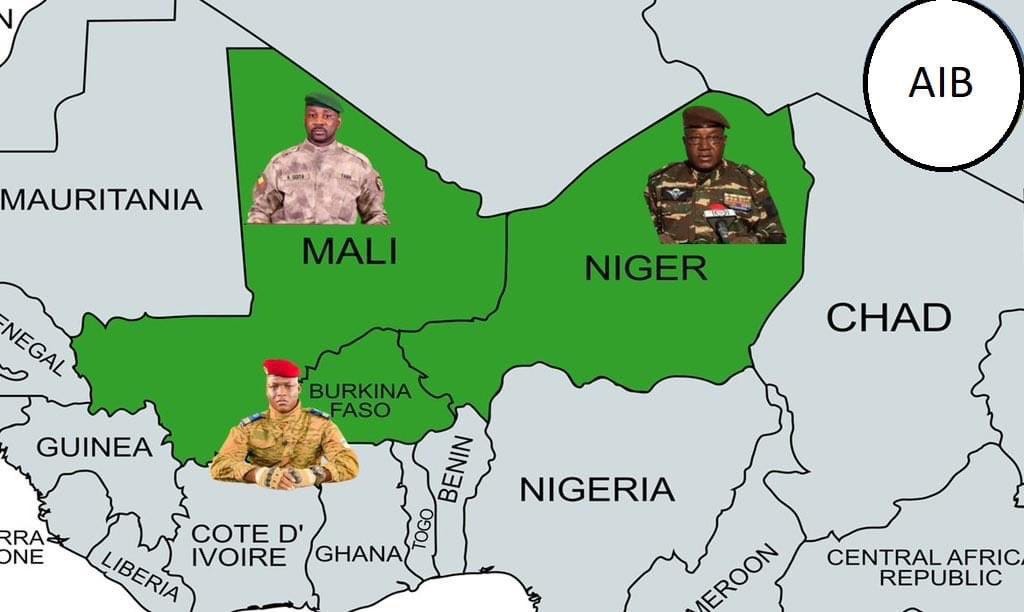
On January 29, 2025, within rapidly geopolitical changes in West African region, three landlocked countries namely Burkina Faso, Mali and Niger, members of the newly created Alliance of Sahel States (AES), declared their withdrawal from the most influential bloc – Economic Community of West African States (ECOWAS).
The first implication was that 2025 marks the 50th year of the establishment of ECOWAS. Undoubtedly, it will simultaneously remain in history of the Alliance of Sahel States (AES) as the period of their exit from the 50-year-old regional bloc, established by the Treaty of Lagos in May 1975.
Perhaps, ECOWAS has been fractured with uncertain future. On the other side, the AES will seemingly grow in strength as republics of Côte d’Ivoire, Chad, Ghana and Senegal have shown signs of unswerving support for the newly-created security organisation in the region. Despite broader criticisms and emerging challenges, AES has the capacity to forge expected integration and to tackle existing diverse obstacles while navigating further for strategic external collaboration.
The Alliance of Sahel States (AES) was established on September 16, 2023 with the signing of the Liptako-Gourma Charter by the States of Burkina Faso, Mali and Niger. These three countries share the cross-border region of West Africa and the Sahel called “Liptako-Gourma” from which it derives the symbolic name of the Charter. It is a collective defense bloc aimed at countering any military intervention or any external threat including terrorism and with the ambition of economic integration.
Since last year, the AES has focused on structuring projects in the fields of energy, infrastructure, transport and food security. The trio aims to create an economic and monetary union, as well as its own currency which should be based on the natural resources of the member countries in the Confederation.
The collective initiatives undeniably are at the formative stage, fostering consciousness on structuring operations and functional directions notwithstanding the multiple roadblocks from ECOWAS. That however, worthy to indicate here that particular concern emerging from different regional organisations and the African Union underscores the rising assertiveness of AES.
At a glance, Burkina Faso is a driving force, while Mali and Niger have, in practical sense, shown the pathways for evolutionary influence as well as shaping a codified dynamism to hold the alliance in form towards achieving its primary security objectives and economic development aspirations.
For over a year, their joint effective strategy has been working, and the collective divorce from ECOWAS late January 2025 was an irreversible factor, that was based on the fact that ECOWAS has unprecedented weaknesses, combined with historical record-breaking failure in its mandate to maintain regional security.
In short, the rising insecurity situation has undermined regional cooperation, set the stage for dissatisfaction among the member states. With the sudden withdrawal from the 15-member ECOWAS, it is understandable Burkina Faso, Mali and Niger have attained the collective independence, and prepared to form this new forward-looking regional partnership bloc popularly referred to AES.
ECOWAS and African Union’s Reactions
Reactions from both the ECOWAS and African Union (AU) were ‘business as usual’ characterized by official administrative statements. Late January after the three French-speaking West African States officially exited, the Peacekeeping and Regional Security Commission of ECOWAS said the remaining members tentatively had agreed to ‘keep ECOWAS doors open’ by recognizing national passports and identity bearing the bloc’s logo from the countries, to continue trade under existing regional agreement, and to continue diplomatic cooperation with the countries.
The statement noted that the withdrawal of Burkina Faso, the Republic of Mali and the Republic of Niger from ECOWAS has become effective on 29th January 2025. While the Regional Security Commission has set up a structure to facilitate discussions on these modalities with each of the three countries, its official statement categorically noted the following:
- a) recognize National passports and identity cards bearing ECOWAS logo held by the citizens of Burkina Faso, the Republic of Mali and the Republic of Niger, until further notice.
- b) continue to treat goods and services coming from the three countries in accordance with the ECOWAS Trade Liberalization Scheme (ETLS) and investment policy.
- c) allow citizens of the three affected countries to continue to enjoy the right of visa free movement, residence and establishment in accordance with the ECOWAS protocols until further notice.
- d) provide full support and cooperation to ECOWAS officials from the three countries in the course of their assignments for the Community.
In addition to above-mentioned developments, the Political, Peace and Security Council (PSC) of the African Union (AU) headquartered in Addis Ababa, capital of Ethiopia, has also expressed high-level concern over the deteriorating standing of ECOWAS as a regional bloc and the security situation in West Africa region.
The AU, of course, raised an unequivocal condemnation of the final decision and withdrawal of Burkina Faso, Mali and Niger from ECOWAS. But factually, the AU’s reaction was distinctively similar, in terms of administrative and bureaucratic wording of the official statement, mostly for the sake of filling in the space, under-estimated the long-term repercussions and impact on the developments in the region.
Reaffirming solidarity by the African Union with ECOWAS in enforcing its mandate and high-lightening the importance durable peace, security, and sustainable development as enshrined or stipulated in the documents. The AU employed such phrases as ‘respecting the sovereignty, independence, unity and territorial integrity’ contained their established documents of ECOWAS.
Endowed Natural Resources
In any case, understanding economic potentiality and sustainability is crucial at this stage. The economic potential is huge, as Burkina Faso, Mali and Niger put together holds tremendous untapped resources.
According to various sources, Burkina Faso, Mali and Niger territorially share borders together and are landlocked countries in West Africa, in the Sahel region. They are geographically bio-diverse, which includes plentiful reserves of gold, manganese, copper and limestone, and other invaluable natural resources. The land mass is huge for traditional agriculture, but public infrastructures are poorly developed across the region of their location. Predominantly, the system of state governance combined with gross lack of finance are the main obstacles to sustaining development.
As known in these African countries, the French adopted a form of indirect rule, allowing existing native structures to continue to exist within the colonial framework of governance. But now reawakening to the neo-colonial administration and opaque system of government control have a significant impact on current political development. Burkina Faso, Mali and Niger, to some considerable extent have the human capital.
The 2024 estimates of population have revealed that Burkina Faso has 22.5 million, Mali which is the eighth-largest country in Africa, has approximately 21.9 million people while Niger has 26.5 million. The UN Development Program Report (2024) ranked Burkina Faso, Mali and Niger as the Sahel countries with the lowest category of development index in the world.
The future growth may only be sustained by the exploitation of natural resources and that must necessarily be tied to the development of the economy, building infrastructure and focus on reducing poverty in these French-speaking West African countries.
Future Economic Implications
AES has the capacity and commitment to address development shortfalls. Several development initiatives were already taken in this direction to stimulate the economic sectors, particularly in the priority areas of agriculture, livestock, health, and energy infrastructure.
Burkina Faso currently stepping efforts in agricultural sector, while Mali and Niger restructuring roles of foreign players in exploiting mineral resources suc as gold and uranium. This allows greater economic and political autonomy in order to strengthen their sovereignty. Perhaps, they will further have the opportunity to pursue more economic policies in line with the existing realities dictated by the political environment and to bolster aspirations of maintaining stability across their landlocked region.
Obviously, the AES is getting oriented towards multi-polarity, which is intended to be a more inclusive and concerted approach, where different countries and regions work together to find common solutions. By pursuing the principles of the multipolarity, world, the AES could engage in pragmatic win-win partnerships to advance their interests for the purposes of economic development and growth, and stability.
The AES collective pledge further requires making collaborative efforts and, in a systematic manner, work towards sustainable development, find better chances for practical solutions to existing economic deficiencies. Burkina Faso, Mali and Niger have to adopt strategic positions, first, in West Africa, and generally in Africa.
Feature/OPED
Nigerian Opposition: What You Have to Do
By Prince Charles Dickson, PhD
“And Jesus said to Judas… what you are going to do, do quickly.”
There is a hard, almost rude lesson in that line. History does not wait for the timid to finish their committee meeting. Politics, especially Nigerian politics, is not kind to hesitation dressed as strategy. It rewards those who understand timing, nerve, structure, and the brutal arithmetic of power. That is where the Nigerian opposition now stands: not at the edge of impossibility, but at the edge of urgency.
The first truth is the one opposition politicians do not enjoy hearing at rallies where microphones are loud, and introspection is scarce. They are not getting it right. The evidence is not only in Tinubu’s strength, but in their own disorder. INEC said on February 5, 2026, that there were now 21 registered political parties and warned that persistent internal leadership crises within parties pose a serious threat to democratic consolidation. Eight days later, the commission formally released the notice and timetable for the 2027 general elections. In other words, this is no longer the season of abstract grumbling. The whistle has gone. The race is live.
Yet the opposition often behaves like students who entered the examination hall with righteous anger but forgot their pens. Too much of its energy is spent on lamentation, rumours, courtroom oxygen, personality feuds, and that old Nigerian hobby of mistaking noise for architecture. You cannot defeat an incumbent machine by forming a WhatsApp coalition of wounded egos and calling it national salvation. Voters may clap for drama, but they still ask the unromantic question: who is in charge, what is the plan, and why should we trust you with the keys?
Now comes the more uncomfortable truth. The opposition is not facing an ordinary incumbent. It is facing Bola Ahmed Tinubu, a man whose political DNA was forged in opposition. He is not merely benefiting from power; he understands opposition as craft, pressure, infiltration, timing, persistence, and theatre. In his June 12, 2025, Democracy Day speech, he taunted rivals by saying it was “a pleasure to witness” their disarray, while also reminding Nigerians that he once stood almost alone against an overbearing ruling machine. This was not casual banter. It was a warning shot from a politician who knows both the grammar of resistance and the machinery of incumbency.
That is why copying Tinubu’s old template will not be enough. Yes, the coalition instinct is understandable. In July 2025, major opposition figures, including Atiku Abubakar and Peter Obi, aligned under the ADC banner, presenting themselves as a bulwark against one-party drift, with David Mark as interim chairman. But here is the problem: Tinubu’s own coalition history worked not simply because men gathered in one room and glared at the ruling party. It worked because there was a disciplined merger logic, state-level anchoring, message coordination, and a ruthless understanding of elite bargaining. What the present opposition sometimes offers instead is photocopy politics with low toner: a coalition of convenience trying to frighten a man who practically wrote the Nigerian handbook on political accommodation, defection management, and patient conquest.
This is also why the opposition’s moral complaint, though not baseless, cannot be its only language. Yes, concerns about democratic shrinkage are real. Tinubu himself publicly denied that Nigeria is moving toward a one-party state, even as defections from opposition parties to the APC intensified and his own party welcomed them. But to say “democracy is in danger” is not yet the same thing as building a democratic alternative. Nigerians do not eat constitutional anxiety for breakfast. They want a credible opposition that can protect pluralism and still explain food prices, jobs, security, power supply, transport costs, and what exactly it would do on Monday morning after taking office.
On the government’s side, the picture is mixed enough to make both triumphalism and apocalypse look unserious. Reuters reported this week that the World Bank expects Nigeria’s economy to grow by about 4.2% in 2026, with external buffers improving and the debt-to-GDP ratio falling for the first time in a decade. Inflation had eased to 15.06% in February from roughly 33% in late 2024. Those are not imaginary numbers, and any fair-minded analysis must admit that Tinubu’s reforms have altered the macroeconomic conversation. But the same report warned that the Iran war has pushed fuel prices up by more than 50%, with obvious consequences for transport, food, and household pain. Add the continuing insecurity, underscored again this week by the killing of a Nigerian army general in Borno, and the government begins to look like a man who has repaired the roof but left half the house still flooding. That is not a collapse. It is not a command either. It is a meandering reform under political stress.
So, what must the opposition do, and do quickly? First, it must stop making Tinubu the only subject of the campaign. Anti-Tinubu is not a manifesto. It is a mood. Moods trend; structures win. Second, it must settle leadership questions early and publicly, because no voter wants to hire a rescue team still fighting over the steering wheel. Third, it needs an issue coalition, not just an elite coalition. Security, inflation, youth jobs, electricity, federalism, and institutional reform must become a coherent national offer, not a buffet of press conference talking points. Fourth, it must build from the states upward. Presidential romance without subnational organisation is political karaoke: loud, emotional, and usually off-key by the second verse.
Fifth, it must look seriously at the legal terrain. The Electoral Act 2026 has made party organisation even more central. PLAC notes that the new law tightens party registration rules, removes deemed registration, expands INEC’s regulatory discretion, and preserves the fact that candidates still need political parties as the vehicle for contesting most elective offices because independent candidacy is not permitted. In plain language, parties matter even more now. A fragmented opposition is therefore not just aesthetically untidy. It is strategically suicidal.
Still, there are dangers in the opposite direction, too. A desperate anti-Tinubu mega-bloc could become a cargo truck of incompatible ambitions. If all it offers is the promise to defeat one man, it may reproduce the same habits it condemns once power arrives. Nigeria does not need a ruling party so swollen that democracy gasps for air. But it also does not need an opposition whose only ideology is turn-by-turn revenge. The health of democracy lies somewhere between monopoly and mob. It requires competition with content, not merely competition with bitterness. Tinubu himself, in that same June 12 speech, defended multiparty politics even while mocking the opposition’s disorder. That irony should not be wasted. He has thrown them both an insult and an assignment.
So, yes, the opposition is right to worry. But worry is not a strategy. Outrage is not an organisation. The coalition is not coherent. And history is not sentimental. The man they are up against is ruthless, seasoned, and intimate with the dark arts of democratic combat. He knows the game. Some of his opponents are still learning the rules from old newspaper cuttings.
Which brings us back to the scripture. What you are going to do, do quickly. Not recklessly. Not hysterically. Quickly. Settle your house. Name your purpose. Offer something fresher than recycled indignation. Build a machine that is not merely anti-Tinubu but pro-Nigeria in a way ordinary Nigerians can feel in their pockets and in their pulse. Otherwise, the opposition will keep arriving at battle dressed in borrowed armour, only to discover that the tailor works for the man they came to unseat—May Nigeria win!
Feature/OPED
The Digital Imperative for Women-Led Businesses in Nigeria
By Gloria Onosode
Nigeria is targeting an ambitious $1 trillion economy by 2030. To achieve this, women-led businesses must transition from mere passive observers to primary growth drivers at the heart of the economy and strategic participants in their respective industries.
According to the National Bureau of Statistics (NBS), the increased ownership rate of MSMEs by women represents a significant contribution to economic growth and job creation. Digital empowerment for these enterprises must move from being a social responsibility or gender support initiative to contributing to broader economic development.
To reach the $1 trillion GDP milestone, women-led businesses must be positioned to operate at a macroeconomic scale. This requires moving beyond subsistence trading and into the digital value chain. For instance, a fashion designer in Aba, through digital positioning, can access broader markets and commercial networks and thereby facilitate better record-keeping and data-driven decision-making, supporting improved financial record-keeping, which may be considered in credit assessments by financial institutions.
FairMoney Microfinance Bank (MFB), a bank licensed and regulated by the Central Bank of Nigeria, contributes to the digital transitioning of small businesses in Nigeria by providing tools specifically designed for the realities of the Nigerian entrepreneur. For women, whose businesses often fluctuate with seasonal demands or family needs, the ability to protect and grow capital is paramount. FairMoney MFB offers features that empower women to move from informal ‘under-the-mattress’ savings to digitised interest-bearing savings products. By embracing digital transition, tech-based saving platforms can enable business owners to set specific goals, such as purchasing new equipment, saving towards business goals in a disciplined manner, while earning interest at applicable rates.
For that business owner who requires immediate liquidity, our flexible savings feature offers interest while allowing for withdrawal access that is subject to applicable terms and conditions to cover emergency restocks. For longer-term scaling, our fixed-term savings feature allows entrepreneurs to lock away funds for a fixed period and accrue interest based on product terms, subject to terms and conditions. By automating savings and providing interest at applicable rates, FairMoney MFB is designed to support financial planning and resilience over time for women-led SMEs.
Nigerian women are among the most entrepreneurial globally, consistently defying structural barriers to build enterprises from the ground up. According to the Small and Medium Enterprise Development Agency of Nigeria (SMEDAN), Nigeria has approximately 39.6 million nano, micro, small, and medium enterprises. Charles Odii, Director General at SMEDAN in 2024, also recently shared that approximately 72% of these enterprises are now classified as being owned or led by women. This is a significant jump from previous years, which hovered around 40–43%, largely due to the surge in ‘nano’ and ‘micro’ home-based businesses. These female-led enterprises are the primary engines of job creation and community stability.
Despite this drive, women entrepreneurs face a unique set of structural hurdles that stifle their ability to scale. The ‘financing gap’ remains the most formidable obstacle. The World Bank IFC Nigeria2Equal initiative reports that while Nigeria has one of the highest female entrepreneurship rates globally, the credit gap for these women is estimated at over 2.9 trillion Naira, forcing them into the ‘savings and family’ funding model.
The case for supporting these businesses extends beyond equity; it is rooted in the ‘multiplier effect’. Research demonstrates that women reinvest up to 90% of their income into their families and communities, specifically in education, healthcare, and nutrition. Supporting these enterprises is, therefore, a direct investment in Nigeria’s human capital. By bringing these businesses into the formal sector, the accuracy of economic planning will be improved. When a woman-led SME flourishes, the benefits ripple across the entire socioeconomic landscape.
The future of the Nigerian economy is intrinsically tied to the success of its women. When we prioritise women-led businesses, we are not merely fulfilling a gender quota; we can contribute to unlocking economic potential across sectors. By bridging the digital gap and providing robust financial tools for saving and credit to women-led businesses, Nigeria can begin to support the growth of micro-enterprises over time. A $1 trillion Nigeria is not just a dream; it represents a significant opportunity that can be progressively realised by the resilient women entrepreneurs of our nation.
Gloria Onosode is the Director of Enterprise Sales at FairMoney Business
Feature/OPED
Premium Entertainment Without the Premium Price Tag
These days, surviving in Nigeria feels like a full-time job on its own.
Before the month even properly begins, salary has already been divided into transport, fuel, food, bills, subscriptions, and every other expense that somehow keeps increasing. For many 9–5ers, the routine has become painfully familiar: wake up early, battle traffic, survive the stress of work, battle traffic again, and get home completely drained, only to realise even the simple things that help you unwind now have to be carefully budgeted for.
Because in this economy, everybody is cutting costs. People are thinking twice before ordering food. They are postponing shopping plans. They are reducing unnecessary spending. And for many, one of the first things to go has been entertainment.
The same streaming platforms and premium subscriptions people once paid for without thinking have now become part of the “maybe next month” list. Not because people suddenly stopped loving movies, series, football, or reality TV, but because when inflation keeps rising, and fuel costs continue to affect everything, entertainment starts to feel like a luxury.
But that is exactly why affordability in entertainment matters now more than ever and why GOtv continues to stand out as a brand that genuinely keeps everyday Nigerians in mind.
Rather than assuming quality entertainment should only be accessible to people willing to spend heavily, GOtv has consistently positioned itself as a platform built with everyday Nigerians in mind, creating options that allow people to still enjoy premium entertainment without having to break the bank.
Take the GOtv Smallie package, for example.
For as low as ₦1,900 a month, subscribers get access to over 35 channels, including approximately 19 to 21 local channels, sports content, and 15+ channels across news, music, movies, lifestyle, kids, and general entertainment.
And for those who prefer longer payment plans, it is also available in:
-
Quarterly – ₦5,100
-
Annual – ₦15,000
What makes this even better is that, despite being the most affordable package, Smallie still offers something for everyone.
It is not one of those basic plans where you pay less and get almost nothing. Whether you are the family member who loves African movies, the sports enthusiast who never wants to miss a match, the parent looking for kids’ content, or the person who just wants background TV after a stressful day, there is something to watch.
And for viewers who want even more variety, GOtv has other packages across different price points:
-
GOtv Jinja – ₦3,900
-
GOtv Jolli – ₦5,800
-
GOtv Max – ₦8,500
-
GOtv Supa – ₦11,400
-
GOtv Supa Plus – ₦16,800
So, whether you’re going for the most affordable option or something with a more premium feel, there’s always a GOtv package that fits comfortably into different lifestyles and budgets.
At a time when everyday decisions are increasingly shaped by cost, GOtv quietly fills an important gap by keeping quality entertainment within reach for more people, because beyond the hustle, the traffic, the deadlines, and the constant pressure of trying to keep up with life in today’s economy, there is still a need for simple moments of joy and escape. Those small pauses in the day where you can switch off, relax, and just enjoy something light without overthinking it.
And that’s really the point: entertainment shouldn’t feel like another financial burden.
-
Feature/OPED6 years agoDavos was Different this year
-
Travel/Tourism10 years ago
Lagos Seals Western Lodge Hotel In Ikorodu
-
Showbiz3 years agoEstranged Lover Releases Videos of Empress Njamah Bathing
-
Banking8 years agoSort Codes of GTBank Branches in Nigeria
-
Economy3 years agoSubsidy Removal: CNG at N130 Per Litre Cheaper Than Petrol—IPMAN
-
Banking3 years agoSort Codes of UBA Branches in Nigeria
-
Banking3 years agoFirst Bank Announces Planned Downtime
-
Sports3 years agoHighest Paid Nigerian Footballer – How Much Do Nigerian Footballers Earn