Feature/OPED
Can Urban Farming Contribute Meaningfully to Nigeria’s Food Security?
By Diana Tenebe
Nigeria, Africa’s most populous nation, faces a complex web of food security challenges. Soaring food inflation, exacerbated by climate extremes, persistent insecurity in food-producing regions, and an inadequate supply of nutritious foods, has pushed millions into acute hunger. Despite vast agricultural resources, the country ranks low on the Global Food Security Index, underscoring a critical need for innovative solutions. Amidst this backdrop, urban farming, often dismissed as a niche activity, is gaining traction as a strategy to enhance food security, create income opportunities, and promote sustainable practices in urban areas.
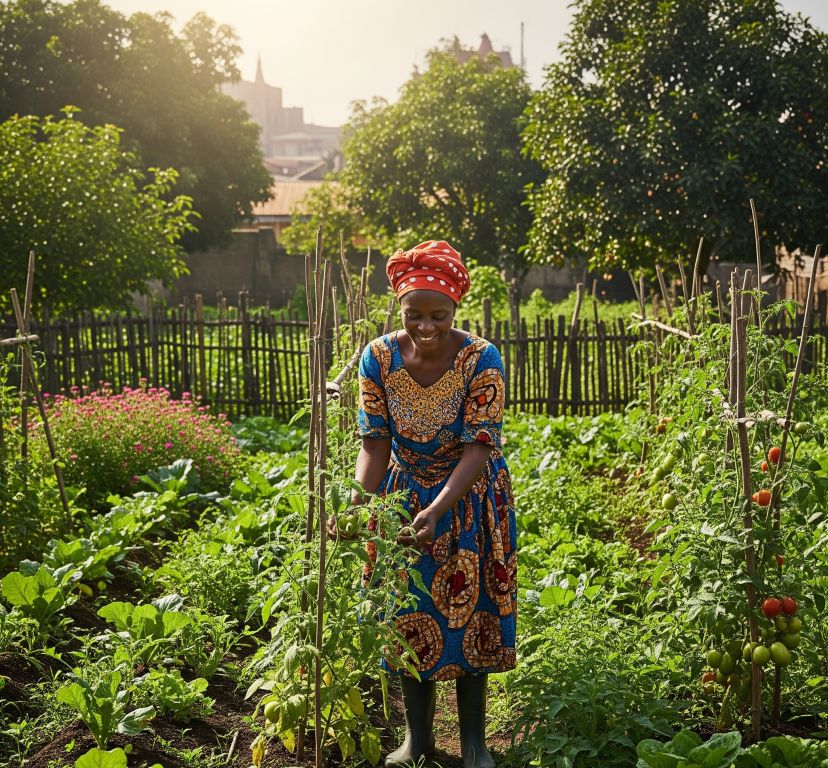
Urban farming, encompassing a range of practices from rooftop gardens and vertical farms to community plots and aquaculture, offers the potential to localise food production, reduce reliance on distant supply chains, and enhance access to fresh, nutritious produce. As Nigerian cities continue to urbanise, converting agricultural land to other uses, the importance of maximizing food production within urban limits becomes crucial.
One of the most immediate and impactful contributions of urban farming is its ability to enhance food availability and access. By cultivating crops within city limits, fresh produce can reach consumers more quickly, drastically reducing post-harvest losses and transportation costs. This localised production directly addresses issues of food scarcity, especially for vulnerable urban populations who often struggle with the high cost and limited availability of fresh food. Successful initiatives in Lagos for instance have demonstrated how urban farms can become reliable sources of fruits, vegetables, and even protein through urban livestock and aquaculture for surrounding communities.
Beyond mere availability, urban farming plays a crucial role in improving nutritional outcomes and dietary diversity. Access to fresh, diverse produce encourages healthier eating habits, helping to combat prevalent issues like protein-energy malnutrition and micronutrient deficiencies. When families cultivate their own food, they gain greater control over its quality and freshness, often opting for more nutritious varieties. This direct link between cultivation and consumption can lead to a measurable increase in dietary diversity within urban households.
Urban farming is not just about subsistence; it holds substantial economic promise and fosters job creation. It directly generates employment opportunities in various stages, including planting, harvesting, processing, and distribution. Small-scale urban farmers can sell their surplus produce at local markets, generating income and fostering entrepreneurship. This can be particularly impactful for Nigeria’s large youth population, offering a viable path to employment and self-reliance in a landscape of high unemployment. Initiatives that provide training and access to markets, like “FarmInTheCity” in Lagos, exemplify how urban farming can blossom into full-scale enterprises.
Urban farming contributes significantly to environmental sustainability and climate resilience. Innovative urban farming techniques, such as hydroponics and vertical farming, are inherently resource-efficient, using less land and water compared to traditional agriculture. They also reduce “food miles,” significantly lowering carbon emissions associated with long-distance transportation. Additionally, urban green spaces created by farming initiatives can help mitigate the urban heat island effect, improve air quality, and enhance urban biodiversity. This makes urban farming a crucial component of climate adaptation strategies, helping cities become more resilient to the impacts of climate change, such as erratic rainfall patterns and prolonged droughts that affect traditional agriculture.
Finally, community gardens and collaborative urban farming projects serve as powerful tools for fostering community cohesion and social impact. They provide shared spaces where residents can connect, build knowledge, and foster a sense of community pride and ownership. These initiatives can also serve as educational platforms, promoting sustainable practices and raising awareness about local food systems. This collaborative spirit can be particularly beneficial in diverse urban settings, breaking down social barriers and strengthening community bonds.
For Urban farming to work in Nigeria, policy support and integration are crucial. Governments at all levels need to recognize urban farming as a legitimate and vital part of the food system. This involves developing supportive policies, streamlining land-use regulations, and integrating urban agriculture into city planning. Second, capacity building and education are essential. Investing in education and training programs is vital. Access to finance and technology is a significant factor for urban farmers. Innovative financing models, perhaps incorporating “pay-as-you-grow” schemes for technology adoption, are needed. Also, leveraging technology like mobile apps for market access can significantly boost productivity. Lastly, adequate infrastructure, including reliable energy sources and efficient storage facilities, is crucial to minimize post-harvest losses and ensure the economic viability of urban farms.
Urban farming in Nigeria is more than just a passing trend; it can represent a tangible and impactful pathway towards enhanced food security. By embracing innovative approaches, fostering supportive policies, and empowering urban communities with the necessary resources and knowledge, Nigeria can unlock the immense potential of its cities to feed their populations, create economic opportunities, and build a more resilient and sustainable future. The revolution of urban farming, if nurtured effectively, can indeed contribute meaningfully to Nigeria’s quest for food security.
Diana Tenebe is the Chief Operating Officer of Foodstuff Store
Feature/OPED
What Does Nigeria’s $51bn Reserves Milestone Mean if Most New Foreign Money Can Leave Quickly?
Nigeria’s foreign reserves have climbed to about $51 billion, a decade-plus high, according to the Central Bank of Nigeria (CBN). EBC Financial Group (EBC) notes that this reflects stronger investor confidence, but the second half may show whether it holds, as the build rests on three cyclical drivers: oil earnings, short-term foreign money and a narrowing official-to-street naira gap.
Reserves rose from about $32 billion in April 2024, during a dollar shortage, to about $51 billion now, near the CBN’s target. Much came from two cyclical sources, strong oil earnings and money chasing high-yielding naira assets, so EBC expects the pace to slow or reverse. Fitch Ratings, a major international credit rating agency, expects a marginal decline to about $47 billion by the end of 2026, citing higher spending and external pressures.
David Precious, Senior Market Analyst at EBC Financial Group, said, “Nigeria’s reserve build is real but may not be durable yet, because nearly all of the new money is the kind that can leave quickly. Of the $10.37 billion that came in over the first quarter, the overwhelming majority was short-term portfolio funds rather than long-term investment, so a shift in oil prices, global interest rates or confidence in the naira might pull a large part of it straight back out.”
Most New Money Can Still Leave Quickly
The composition of the foreign inflows explains the caution over how long the build can last. The country attracted $10.37 billion in foreign investment in the first quarter of 2026, up 83.83 per cent year-on-year, according to the National Bureau of Statistics (NBS). Of that, $9.86 billion or 95.09 per cent, was portfolio money, largely short-term naira debt such as Treasury bills that investors can sell at the next auction, while foreign direct investment, the long-term kind that builds factories and jobs, was $135.08 million, or 1.30 per cent. Put simply, of each dollar coming in, about 95 cents can leave quickly, and barely one cent stays.
That money supports reserves while it stays. Dollars brought in to buy naira assets add to market supply, letting the CBN hold more reserves and steady the naira. It leaves when conditions change. Nigeria earns most of its export dollars from oil and gas, so lower oil prices mean fewer dollars, and as a member of the Organisation of the Petroleum Exporting Countries (OPEC), it cannot simply produce more, output capped by quota and reduced by theft and ageing fields. Higher global interest rates draw money toward safer returns abroad, and a weakening naira prompts investors to sell early. When oil fell in 2016 and 2020, foreign investors withdrew and could not convert naira to dollars as supply dried up, leaving the CBN to clear more than $7 billion in trapped obligations into 2024.
The Oil Boost is No Longer Certain
Oil looked like a dependable source of the dollars behind the reserves only months ago. Earlier in 2026, concern over disruption around the Strait of Hormuz lifted crude prices, and stronger receipts flowed in, with crude oil export earnings of $8.11 billion in the first quarter in the CBN’s balance-of-payments data. That support is now easing. The tension has subsided, and Brent traded near $72 on June 29, down about 24 per cent over the month, back to pre-conflict levels. With the price boost gone and output constrained, reserves are more exposed, leaning on non-oil earnings and investor patience rather than oil.
The Naira Still Trades at Two Prices
The naira has traded at two prices, an official rate and a higher parallel-market rate, and closing that gap into one trusted price is what many investors might watch most. Before committing funds, they may want assurance they can convert naira to dollars at a fair rate when they exit, and a wide gap revives the fear of being trapped that lingers from earlier shortages. The gap has narrowed to roughly N20 to N30, with the CBN’s official rate near N1,380 per dollar on June 26 against parallel-market quotes around N1,400. The International Monetary Fund (IMF) 2026 Article IV review urged Nigeria to depend less on this fast-moving portfolio money and to keep phasing out its multiple exchange-rate practices. The CBN’s Foreign Exchange Manual, in force from 1 June, is intended to make the market clearer, though such rules build confidence only once investors can freely trade dollars at the posted rate.
What could Make the Build Durable
A few signs that may show the build turning durable include a smaller gap between the official and street naira rates, more long-term foreign investment, and steadier oil earnings. A gap that stays small, now roughly N20 to N30, may mean investors trust the official rate and no longer need the street market. A clear rise in foreign direct investment, only $135 million last quarter against $9.86 billion of short-term money, might mean lasting capital is replacing funds that can leave at the next auction. Oil earnings that hold up, rather than sliding from the low $70s, should help keep reserves steady, since oil and gas bring in most of Nigeria’s export dollars.
“Reserves built on money chasing high yields can fall as fast as they rose, as they did after the last two oil shocks, when investors left, and the CBN spent years clearing a foreign-exchange backlog,” Precious added. “What holds through a downturn is slower money, direct investment, steady oil and non-oil export earnings and one credible naira rate, and that is the shift Nigeria has yet to make.”
Feature/OPED
Rethinking How Nigeria Supports SME Growth
By Olajumoke Bello
Across Nigeria, small and medium enterprises remain the backbone of economic activity. They drive trade, create jobs, and sustain millions of livelihoods. Yet, despite their importance, many SMEs continue to operate below their full potential due to persistent structural challenges.
Access to finance remains one of the most cited constraints. However, the issue today goes beyond the availability of capital. Many businesses struggle with financial readiness, weak documentation, and limited understanding of what lenders require. This often leads to missed opportunities, even when funding options exist.
At the same time, SMEs face gaps in market access and visibility. Business owners operate in highly localised environments, with limited exposure to broader networks that can unlock partnerships, new markets, and growth opportunities. This isolation can constrain scalability and reduce long-term competitiveness.
Equally important is the capability gap. Many entrepreneurs grow through resilience and experience but lack structured knowledge on critical areas such as financial management, export readiness, and digital adoption. Without this, even well-capitalised businesses can struggle to sustain growth.
These challenges point to a clear need for a more practical and integrated approach to SME support. It is no longer sufficient to offer standalone solutions. SMEs require ecosystems that combine knowledge, access, and direct engagement in ways that reflect how they actually operate.
A key shift is the move from centralised interventions to localised engagement. SMEs are deeply influenced by their immediate environments, whether markets, industrial clusters, or trade corridors. Solutions must therefore be brought closer to where these businesses function, allowing for more relevant support and stronger relationships.
Another important shift is from awareness to action. Business owners do not only need information; they need insights that they can apply immediately. This includes understanding how to structure their finances, how to access trade opportunities, and how to connect with the right partners to scale their operations.
There is also a growing need for continuity. Many SME-focused initiatives deliver strong initial impact but lack follow-through. For support to be effective, it must extend beyond one-off engagements into sustained relationships, with clear pathways for onboarding, advisory, and growth.
For financial institutions, this presents both responsibility and an opportunity. Supporting SMEs now requires moving beyond transactional banking to deeper partnership models. It requires understanding businesses at a granular level and co-creating solutions that evolve with their needs.
At Stanbic IBTC, this perspective continues to shape our approach to SME development. Our focus is on delivering practical support that translates into real business outcomes, helping enterprises grow, compete, and contribute more meaningfully to the economy.
As part of this commitment, we are extending our SME engagement to the regions through the Nigeria Business Summit Regional Tour. The tour will take structured, on-ground activations into key commercial hubs, where SMEs can access funding guidance, trade insights, advisory support, and direct engagement with financial experts.
The regional tour will take place across five strategic locations, bringing these solutions closer to business owners in Aba, Onitsha, Ibadan and Kano.
This approach reflects an important principle. When support moves closer to businesses and when solutions are delivered in ways that are practical and continuous, SMEs are better positioned to grow sustainably. In turn, this strengthens not only individual enterprises but the broader economy.
Olajumoke Bello is the Head of Enterprise Banking at Stanbic IBTC Bank
Feature/OPED
How Data Deconstructs the Myth of the ‘High-Risk’ Nigerian Borrower
By Winston Osuchukwu
The average Nigerian borrower is widely considered high-risk – a claim repeated in credit committees, priced into retail loans, and largely treated as settled fact. Every credit market accepts that an individual loan may not be repaid; this is ordinary, priced risk. The high-risk claim, however, is applied to whole segments – the informal trader, the gig economy earner whose income is steady but split across several accounts, the remote worker paid by an overseas client into a fintech FX wallet. What the assessment establishes is not whether they are likely to repay, but how they fit into an arbitrary segment. Having spent years building decisioning systems for this market, my thesis is a specific one: “high-risk” does not mean “no credit” – it simply requires that the lender embrace alternative datasets to price the risk appropriately.
This is not a criticism of the institutions that built their frameworks around collateral and documentation; those were rational responses to the tools available at the time. When data is scarce, prudence means defaulting to the status quo. The limitation is not that this approach is wrong, but that it leaves a blind spot – excluding fundamentally sound borrowers whose economic lives simply are not captured on the bank’s ledger. A market trader who has moved consistent, growing volumes of cash through mobile money for three years is not, in any meaningful sense, unknowable. Their financial behaviour is observable and patterned; it simply occurs outside the traditional banking system, rendering it invisible to conventional underwriting.
This is the gap technology is now positioned to close – not by replacing institutional judgment, but by augmenting it. When AI-driven analysis is applied rigorously to the financial behaviour these borrowers generate, a far more complete picture of their repayment ability emerges – and a meaningful share presents a risk profile that compares favourably with segments the traditional system has long considered safe. The “high-risk” label, applied broadly to an entire category of borrower, was never a risk pricing tool so much as the limit of what the available tools could see.
For banks, this is the opportunity to extend capital with confidence beyond the borrowers who fit their stringent criteria. Nigerian banks are highly liquid; the constraint on credit growth has rarely been capital, but the ability to assess and price the borrowers who sit outside the traditional file. Close that gap, and the whole ecosystem strengthens: banks grow their loan books into segments they have long wanted to serve, and the real economy gets the capital it needs to expand.
This is precisely what we focus on at Mathesis Analytics: building AI-powered credit decisioning that gives lenders a fuller, more defensible picture of the individuals long excluded as high-risk when they were simply misjudged. The Nigerian credit gap has never been a non-lendable population problem, but one of incomplete visibility. By unifying varied data sources and partnering with the institutions that hold the capital and scale to move the market, we translate out-of-ecosystem behaviour into reliable, bank-grade risk scores. Closing this gap is one of the clearest, highest-leverage opportunities in Nigerian financial services today.
Winston Osuchukwu is the founder & CEO of Mathesis Analytics