Feature/OPED
Foreign Post Graduate Scholarship Programme: Celebrating NDDC, PAP’s Enduring Intervention
By Jerome-Mario Utomi
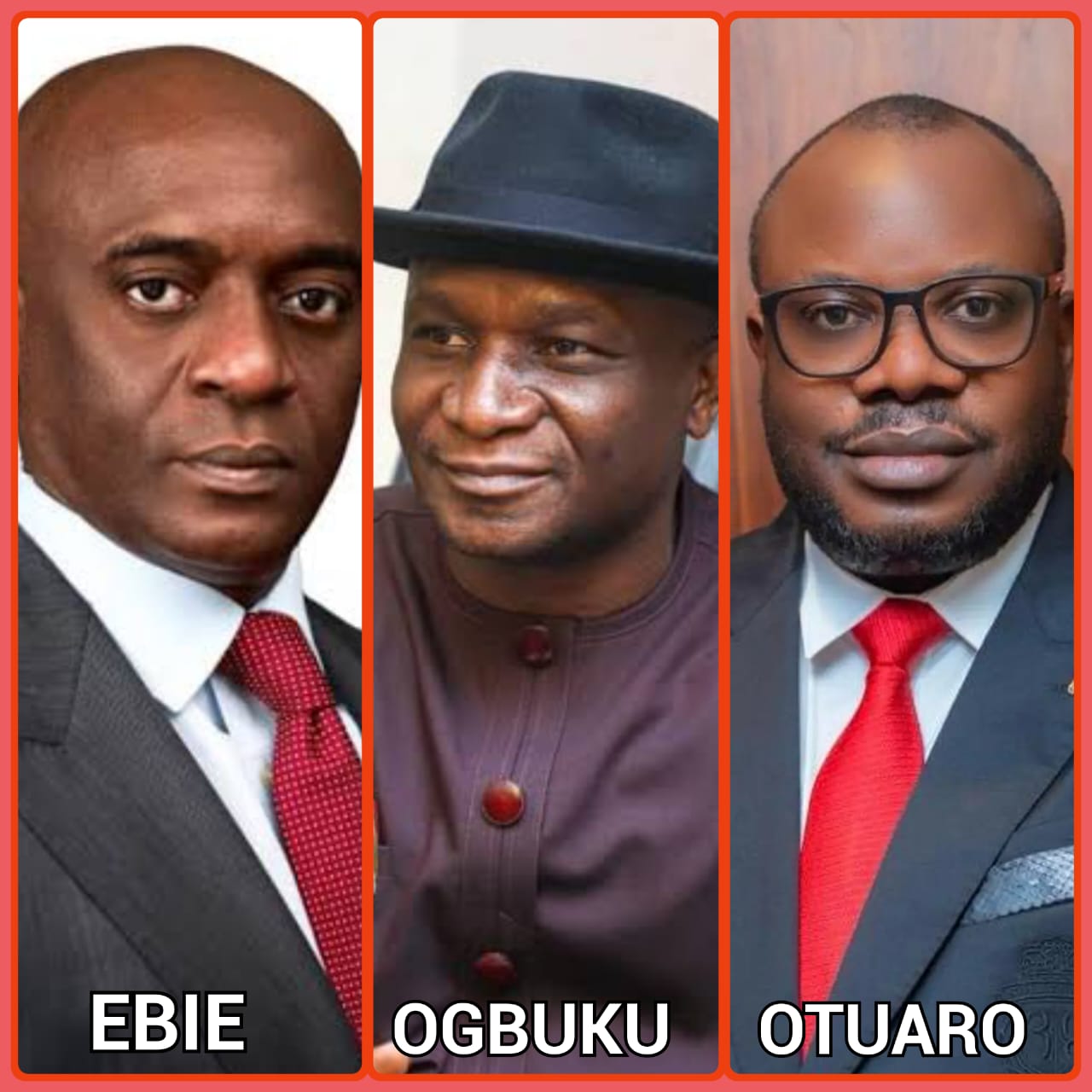
If you believe that education is the main bedrock of development – socio-economic, infrastructural and human capital development – then you are in good company with Mr. Chiedu Ebie, Chairman, Governing Board of the Niger Delta Development Commission (NDDC), Dr. Samuel Ogbuku, Managing Director, NDDC and Dr Dennis Otuaro, Special Adviser/Coordinator, Presidential Amnesty Programme (PAP). The steadfast commitment of this trio to foreign post graduate scholarship programmes for people of the Niger Delta region is unmatched. It stands as a testament of their firm conviction that with sound education, a country is as good as made – as education will in turn produce all rounded manpower to continue with the development of the society driven by well thought out ideas, policies, programmes.
Ebie, Ogbuku and Otuaro are undoubtedly apostles of foreign scholarship programme; they are at the vanguard of its advocacy. They believe that if there is anything that the people of the region wish that the Federal Government accomplishes for them quickly without much ado, it is giving them, particularly the youths, optimal access to world class education as this will help to bring democratized human capital development, help limit underdevelopment while enhancing economic empowerment of the region and its people.
Newspaper reports that PAP has sponsored 161 beneficiaries to pursue postgraduate studies in the United Kingdom for the 2025/2026 academic year reinforces the above argument. The Administrator of PAP, Dr Otuaro, in a statement signed by his media aide, Igoniko Oduma, said that the initiative aligned with President Bola Tinubu’s Renewed Hope Agenda, which focuses on closing the human capacity development gap in the Niger Delta and fostering socio-economic growth in the region.
“I believe that if we sustain the high number of scholarship deployments within and outside the country, the issue of the human capacity development gap in our region will be decisively tackled. I am eternally grateful to His Excellency, President Bola Tinubu, for graciously supporting the Presidential Amnesty Programme as we deploy foreign scholarship beneficiaries for the academic session. But for the President’s magnanimity, it would not have been possible for us to send 161 beneficiaries to universities in the UK. I am highly encouraged by the President’s backing of our formal education and vocational training initiatives, and his strong desire for the socio-economic growth and development of our region,” Otuaro stated.
While the beneficiaries and their families celebrate, noteworthy is that this is coming just before the dust of excitement raised by similar effort could settle.
Recall that a few months ago, after an intense and rigorous selection process largely driven by technology, the NDDC, in a similar fashion awarded scholarships to 200 successful candidates from the region to pursue Master’s Degrees overseas, a programme which of course is an important component of the Commission’s human capital development drive that seeks leverage on education to change the fortunes of the region. While the entire process may have climaxed with presentation of letters by Ebie, the NDDC board Chairman, to the prospective scholars at a pre-departure and award ceremony held recently in Port Harcourt, the Rivers State capital, it is gratifying to note that, given transparency of the process and fairness which characterized the entire exercise, the pre-condition for sustainable development now exists in NDDC. This can only happen when honest, dedicated and selfless persons man critical agencies of government such as NDDC.
The NDDC Foreign Postgraduate Scholarship programme which started in 2010 was designed to produce top level professionals with technical knowledge, capacity and expertise to compete in the oil and gas industry, as well as other sectors. So far, the Commission has sponsored 2,708 scholars at both Masters and Ph.D levels since the inception of the programme.
Aside the high level of transparency which branded the process, and made it possible for most of the beneficiaries to be those that never knew anyone from the NDDC or anyone that works there, this unique outcome and other positive vibes recently coming out from the Commission, have significantly made Niger Deltans to conclude and rightly too, that the NDDC has finally got a people-centered Board and Management that take the welfare of Niger Delta communities seriously, a board that is interested in the vision and aspirations of the people. Of course, the NDDC board under the Chairmanship of Ebie is irrevocably committed to the economic growth, education, health, security, stability and comfort of the people. The NDDC will not relent in creating a conducive atmosphere to achieve targets and opportunities that guarantee welfare and a bright future for the people.
Worthy of commendation too is the declaration by the NDDC board that the Commission is promising Ph.D scholarship for any of these 200 recipients who gets Distinction.
The gesture becomes even more appreciated when one recalls that education is the catalyst for development. It also points to the fact that the selection process was not a tea party but made possible by a Board Peopled by leaders imbued with practical experience, transparent and honest. This was why it was possible to effectively and meticulously review over 20,000 applications that were received in 2023, out of which 5,000 were selected for a Computer Based Test conducted. The number was further trimmed down to 1,500 who were orally interviewed by panels of academia.
One salutary feature of the NDDC that other government agencies, in my view, should emulate, is the absence, to use a common Nigerian slang “man know man” in selecting candidates for sponsorship of any kind or award of favour of any kind.
Said Ebie: “Most of these people never knew anyone from the NDDC or anyone that works here, they applied by themselves, they created their platforms. Some of them, not these ones but some people did upload fake documents. Out of those 20,000, we pruned it down to 5000 that wrote the CBTs and were given their scores immediately”
And in a press statement, the NDDC assured it was leaving nothing to chance in ensuring that the scholarship programme met its set objective of increasing human capital development in the Niger Delta. Part of such steps, the agency added, includes adequate provision for fees and stipends.
“It is not the intention of the Board and Management of NDDC to send you abroad and keep you stranded. We will try our best to see that whenever it is time to pay your fees, we will do that”, the Managing Director NDDC said
As this piece celebrates and applauds the NDDC leadership over its milestones, two silent points must be noted and commended: The rancor-free relationship between the Board and the Management of the agency. The humility of, and unflinching belief in productive collaboration by the Governing Board Chairman, Mr. Chiedu Ebie.
The above points resonate with Ebie’s recent praises for the NDDC Managing Director (MD) and the management of NDDC for sustaining and ensuring that the scholarship program was as transparent as possible and merit-based.
This, to me, should be emulated by boards of other government agencies.
Finally, I believe that those in positions of authority must recognize that the development of a third world country is a shared responsibility and therefore, must learn to acknowledge as well as give honour to whom honour is due!
Utomi, a Media Specialist writes from Lagos, Nigeria. He could be reached via [email protected]
Feature/OPED
Nigeria’s Booming Growth Leaves Citizens Trapped in Deeper Poverty
By Blaise Udunze
With the chanting of the ‘Renewed Hope’, it appears to be Uhuru in Nigeria, following the recent World Economic Outlook presented by the International Monetary Fund, which projected that Nigeria’s economy would expand by 4.1 per cent in 2026. Though this specifically shows an economy faster than economies like the United States and the United Kingdom, as it handed the administration of President Bola Tinubu a powerful narrative. No doubt, the projection happens to be a narrative of progress, of reform, of a nation supposedly turning the corner after years of instability and setting the kind of moment that reassures investors, quiets critics and signals competence.
But once its statistical sheen is put aside, the weight of reality takes centre stage. The truth is, while Nigeria may be growing on paper, it is simultaneously shrinking and does not in any way reflect the lived experience of its citizens, as the populace can attest to. With the current lived experience, nowhere is this contradiction more glaring than in the widening gulf between macroeconomic projections and the daily economic suffering of over 200 million people.
The truth is uncomfortable, but it must be said plainly that a country where poverty is deepening, inflation is persistent, debt is rising, and basic survival is becoming more difficult cannot meaningfully claim economic success, no matter what the growth figures suggest.
The most damning evidence against the “fastest-growing economy” narrative, as enumerated by the Special Adviser to President Tinubu on Policy Communication, Daniel Bwala, comes not from opposition voices or political critics, but this time it is coming from the World Bank itself. Alarming to this is that according to its latest Nigeria Development Update, poverty in the country rose to 63 per cent barely months back, translating to roughly 140 million Nigerians living below the poverty line. This is not just a statistic; it is a humanitarian crisis unfolding in real time, which in a real sense calls for quick interventions.
Even more troubling is the trend. Poverty has not plateaued; it is accelerating, worsening and not stabilising at all. From 56 per cent in 2023 to 61 per cent in 2024, and now 63 per cent in 2025, the trajectory is unmistakable, as can be seen the data shows a clear upward trend over time that calls for concern. And projections from PwC suggest that the numbers will climb even higher, with an estimated 141 million Nigerians expected to be poor in 2026.
It would surprise many that these figures expose a fundamental contradiction; it is a total irony that an economy is growing while its people are becoming poorer, hence, while no one would hesitate to say that the type of growth taking place is flawed. Well, without jumping to a hasty conclusion, the answer lies in that growth. To say that the economic growth taking place is imbalanced, it is uneven, exclusionary, and not absolutely linked or largely disconnected from the sectors that sustain the majority of Nigerians. Growth driven by services and capital-intensive industries does little for a population whose livelihoods depend heavily on agriculture and informal enterprise. When growth bypasses the poor, it ceases to be development and becomes mere arithmetic.
The government’s defence often leans on the argument that inflation is easing and that reforms are beginning to stabilise the economy. But even this claim is increasingly fragile, as reported that the recent data from the National Bureau of Statistics shows that inflation has begun to rise again. This now shows that the headline inflation is ticking up to 15.38 per cent in March 2026, alongside a sharp month-on-month increase of 4.18 per cent. The pain Consumer Price Index climbed to 135.4, underscoring sustained pressure on household spending.
Another aspect that raises further questions is that the most critical component for ordinary Nigerians, which is the food inflation, skyrocketed to 14.31 per cent, with a similar month-on-month surge. It must be made known that these are not just numbers on a chart; they represent the escalating cost of survival, mostly for the common man. The ripple effect of this, which is yet to change, is that families are compelled to pay more for basic meals, more for transportation, and more for the essentials of daily life.
Noteworthy is that even when inflation showed signs of moderation in previous months, the fact is that it did little to reverse the damage already inflicted. The World Bank has been clear on this point when it said that household incomes have not kept pace with price increases. The underlying point is that the earlier spikes in inflation eroded purchasing power to such an extent that any subsequent easing has been insufficient to restore real income levels, and this is where the figures churned out were misleading.
This explains the inconsistency at the heart of Nigeria’s economy, where nominal indicators are improving, but real conditions are deteriorating. Nigerians are earning more in absolute terms but are able to afford less. This is further confirmed by data showing that while nominal household spending increased significantly, real consumption declined, while it would be said that people are spending more money, but they are consuming less. That is not growth; but the right word for it is economic suffocation.
The structural consequences of ongoing reforms compound the situation. The removal of fuel subsidies, which was the gift to Nigerians for electing President Tinubu and the liberalisation of the foreign exchange market were framed as necessary steps toward long-term stability. And in theory, they are defensible policies. But in practice, the result has been an extraordinary cost-of-living crisis, especially for the larger section of struggling Nigerians.
Speaking of the fuel subsidy removal, which has driven up transportation costs across the country, affecting both urban commuters and rural farmers, the pain has been further intensified by the geopolitical conflict in the Middle East. The second policy shift, which was the exchange rate liberalisation, has led to currency depreciation, with the experiences biting hard across the board, making imported goods more expensive and fueling inflationary pressures. These policy choices, which were perhaps deemed necessary, and without further ado have imposed immediate and severe burdens on households that were already vulnerable.
The International Monetary Fund has warned that these pressures are far from over. Rising global tensions, particularly in the Middle East, are pushing up the cost of energy, food, and transportation. For Nigerians, especially those at the lower rung in society, this translates into even higher living costs and deeper economic strain to contend with.
In this context, the government’s insistence on celebrating growth projections begins to appear not just disconnected, but insensitive. For millions of Nigerians, the economy is not an abstract concept measured in percentages. It is a daily struggle defined by whether they can afford food, transport, and shelter.
Compounding these challenges is Nigeria’s growing debt burden. Unexpectedly, public debt has climbed to over N159 trillion, with projections indicating a continued rise in the coming years because of the government’s appetite for borrowing. While the debt-to-GDP ratio may appear moderate compared to global averages, this comparison is totally misleading. The question is why the debt is ballooning when Nigeria’s revenue base is narrow, heavily reliant on oil, and constrained by a large informal sector that contributes little to tax income.
The current position of things is that debt servicing consumes a disproportionate share of government revenue, leaving limited fiscal space for investment in infrastructure, healthcare, education, and social protection, which has continued to expose the majority of Nigerians to untold hardship. It is a precarious position, one where the government is borrowing more while having less capacity to translate that borrowing into meaningful development outcomes, and the part that is also critical is that Nigeria’s rising debt profile is entering discomforting quarters, as concerns shift from the sheer size of borrowings to the growing risks associated with refinancing existing obligations.
Even more troubling are the emerging questions around fiscal transparency and governance. Only recently, there were allegations by Peter Obi on the missing N34 trillion in federation revenue that remains unaccounted. This, according to him, has intensified concerns about systemic leakages and institutional corruption. The fact is, even though these claims remain contested, they resonate deeply in a country where public trust in government financial management is already fragile and has remained a subject of discussion for many Nigerians.
The truth is that if even a fraction of such resources were effectively managed and invested, the impact on infrastructure, social services, and poverty reduction could be transformative, but this has yet to be embarked upon. Instead, the persistence of such allegations reinforces the perception of an economy where wealth exists but is inaccessible to the majority, which brings to bare if there will ever be a respite in a situation like this.
Adding another layer to this complexity is the excessive contradiction of oil revenue. With global crude prices that were once sold above $113 per barrel and currently hovering around $85-$90, which is still far exceeding Nigeria’s budget benchmark, the country stands to hugely benefit from a significant windfall, as was the case in the past. You know that history is more revealing than ever; it suggests that such opportunities are often squandered.
Analysts repeatedly have continued to warn that without disciplined fiscal management, these revenues may be absorbed by debt servicing or recurrent expenditure rather than being invested in productive sectors. The risk is that Nigeria once again experiences a boom without transformation, a cycle that has defined its economic history for decades.
Meanwhile, the irony in all of this is that, despite having plenty, every day Nigerian continues to bear the brunt of systemic inefficiencies. As the people bear the brunt, the country’s transportation costs are rising, food prices remain volatile, and access to basic services is increasingly strained, while the rural areas are not left out of the equation, as insecurity continues to disrupt agricultural production. This has further constrained food supply and driven up prices. In urban centres, the cost of living is pushing more households into financial distress.
The cumulative, as well as the ripple effects of these pressures, are a society under strain. Lest we mistake this, economic hardship is not just a financial issue; it has social and psychological consequences, while unbeknownst to many, its resultant effect fuels frustration, erodes trust in institutions, which also leads to fertile ground for instability.
What makes the current situation particularly troubling is the widening disconnect between official narratives and lived reality. There are two instances in which it was noted that, on the one hand, the government points to IMF projections and macroeconomic indicators as evidence of progress. On the other hand, citizens experience rising poverty, declining purchasing power, and limited opportunities. Another good example stems from when President Tinubu declared in September of last year that the federal government had met its 2025 non-oil income goal by August.
However, the former Minister of Finance, Wale Edun, stated that the Federal Government lacked sufficient funds to appropriately fund its capital budget during a public hearing at the National Assembly late last year. The minister stated that in order to pay the N54.9 trillion “budget of restoration,” which was intended to stabilise the economy, ensure peace, and create prosperity, the federal government had estimated N40.8 trillion in income for 2025.
These two reports sounded and appeared contradictory, and it was probably one of many factors responsible for the fallout.
This disconnect is more than a communication gap; it is a credibility crisis. When people’s lived experiences contradict official claims, trust erodes. And without trust, even well-intentioned policies struggle to gain acceptance.
The claim that Nigeria is growing faster than advanced economies may be technically accurate, and perhaps it must be seen as an absolute insult to Nigerians and it must be noted that it is fundamentally irrelevant to the country’s core challenges. This key fact must be taken into cognisance that growth rates, in isolation, do not capture the quality, inclusiveness, or sustainability of economic progress, and this is because they do not reflect whether growth is creating jobs, reducing poverty, or improving living standards. Note that in Nigeria’s case, the evidence suggests otherwise, in which the reality continues to dominate outcomes, and this is not the case.
For growth to be meaningful, it must translate into tangible improvements in people’s lives. At this point, it is necessary to understand that it must create jobs, raise incomes, and expand opportunities. Another important factor that must not be left out is that it must be inclusive, reaching not just the top tiers of society but the millions at the base of the economic pyramid. At present, Nigeria falls short on all these counts.
The path forward requires more than optimistic projections and reform rhetoric. It demands a fundamental rethinking of economic priorities. Policies must be designed not just for macroeconomic stability but for human welfare, and while investment must be directed toward sectors that generate employment and improve productivity, particularly agriculture and manufacturing. Social safety nets must be strengthened to protect the most vulnerable from economic shocks, which has yet to be considered by the government of the day.
Equally important is the need for transparency and accountability in public finance. Without trust in how resources are managed, even the most ambitious economic plans will struggle to gain legitimacy.
Nigeria is not lacking in potential, and this is one of the ironies of it all since it has a young population, abundant natural resources, and a dynamic entrepreneurial spirit. But potential, without effective governance and inclusive policies, remains unrealised.
The uncomfortable reality is that Nigeria is at risk of normalising a dangerous illusion, which connotes that growth on paper is equivalent to progress in practice. The truth is that it is not and cannot be contested. And until this illusion and deception are confronted, the gap between economic narratives and human realities will continue to widen.
In the end, the true measure of an economy is not how fast it grows, but how well it serves its people. By that standard, Nigeria’s current trajectory raises serious questions, take it or leave it. Because in a nation where over 140 million people live in poverty, where inflation continues to erode incomes, where debt is rising and where basic survival is becoming more difficult, the claim of being a “fast-growing economy” is not just misleading. Yes, it is a mirage!
And for millions of Nigerians struggling to get by each day, it is a mirage that offers no relief, no hope, and no future.
Blaise, a journalist and PR professional, writes from Lagos and can be reached via: [email protected]
Feature/OPED
Nigerian Opposition: What You Have to Do
By Prince Charles Dickson, PhD
“And Jesus said to Judas… what you are going to do, do quickly.”
There is a hard, almost rude lesson in that line. History does not wait for the timid to finish their committee meeting. Politics, especially Nigerian politics, is not kind to hesitation dressed as strategy. It rewards those who understand timing, nerve, structure, and the brutal arithmetic of power. That is where the Nigerian opposition now stands: not at the edge of impossibility, but at the edge of urgency.
The first truth is the one opposition politicians do not enjoy hearing at rallies where microphones are loud, and introspection is scarce. They are not getting it right. The evidence is not only in Tinubu’s strength, but in their own disorder. INEC said on February 5, 2026, that there were now 21 registered political parties and warned that persistent internal leadership crises within parties pose a serious threat to democratic consolidation. Eight days later, the commission formally released the notice and timetable for the 2027 general elections. In other words, this is no longer the season of abstract grumbling. The whistle has gone. The race is live.
Yet the opposition often behaves like students who entered the examination hall with righteous anger but forgot their pens. Too much of its energy is spent on lamentation, rumours, courtroom oxygen, personality feuds, and that old Nigerian hobby of mistaking noise for architecture. You cannot defeat an incumbent machine by forming a WhatsApp coalition of wounded egos and calling it national salvation. Voters may clap for drama, but they still ask the unromantic question: who is in charge, what is the plan, and why should we trust you with the keys?
Now comes the more uncomfortable truth. The opposition is not facing an ordinary incumbent. It is facing Bola Ahmed Tinubu, a man whose political DNA was forged in opposition. He is not merely benefiting from power; he understands opposition as craft, pressure, infiltration, timing, persistence, and theatre. In his June 12, 2025, Democracy Day speech, he taunted rivals by saying it was “a pleasure to witness” their disarray, while also reminding Nigerians that he once stood almost alone against an overbearing ruling machine. This was not casual banter. It was a warning shot from a politician who knows both the grammar of resistance and the machinery of incumbency.
That is why copying Tinubu’s old template will not be enough. Yes, the coalition instinct is understandable. In July 2025, major opposition figures, including Atiku Abubakar and Peter Obi, aligned under the ADC banner, presenting themselves as a bulwark against one-party drift, with David Mark as interim chairman. But here is the problem: Tinubu’s own coalition history worked not simply because men gathered in one room and glared at the ruling party. It worked because there was a disciplined merger logic, state-level anchoring, message coordination, and a ruthless understanding of elite bargaining. What the present opposition sometimes offers instead is photocopy politics with low toner: a coalition of convenience trying to frighten a man who practically wrote the Nigerian handbook on political accommodation, defection management, and patient conquest.
This is also why the opposition’s moral complaint, though not baseless, cannot be its only language. Yes, concerns about democratic shrinkage are real. Tinubu himself publicly denied that Nigeria is moving toward a one-party state, even as defections from opposition parties to the APC intensified and his own party welcomed them. But to say “democracy is in danger” is not yet the same thing as building a democratic alternative. Nigerians do not eat constitutional anxiety for breakfast. They want a credible opposition that can protect pluralism and still explain food prices, jobs, security, power supply, transport costs, and what exactly it would do on Monday morning after taking office.
On the government’s side, the picture is mixed enough to make both triumphalism and apocalypse look unserious. Reuters reported this week that the World Bank expects Nigeria’s economy to grow by about 4.2% in 2026, with external buffers improving and the debt-to-GDP ratio falling for the first time in a decade. Inflation had eased to 15.06% in February from roughly 33% in late 2024. Those are not imaginary numbers, and any fair-minded analysis must admit that Tinubu’s reforms have altered the macroeconomic conversation. But the same report warned that the Iran war has pushed fuel prices up by more than 50%, with obvious consequences for transport, food, and household pain. Add the continuing insecurity, underscored again this week by the killing of a Nigerian army general in Borno, and the government begins to look like a man who has repaired the roof but left half the house still flooding. That is not a collapse. It is not a command either. It is a meandering reform under political stress.
So, what must the opposition do, and do quickly? First, it must stop making Tinubu the only subject of the campaign. Anti-Tinubu is not a manifesto. It is a mood. Moods trend; structures win. Second, it must settle leadership questions early and publicly, because no voter wants to hire a rescue team still fighting over the steering wheel. Third, it needs an issue coalition, not just an elite coalition. Security, inflation, youth jobs, electricity, federalism, and institutional reform must become a coherent national offer, not a buffet of press conference talking points. Fourth, it must build from the states upward. Presidential romance without subnational organisation is political karaoke: loud, emotional, and usually off-key by the second verse.
Fifth, it must look seriously at the legal terrain. The Electoral Act 2026 has made party organisation even more central. PLAC notes that the new law tightens party registration rules, removes deemed registration, expands INEC’s regulatory discretion, and preserves the fact that candidates still need political parties as the vehicle for contesting most elective offices because independent candidacy is not permitted. In plain language, parties matter even more now. A fragmented opposition is therefore not just aesthetically untidy. It is strategically suicidal.
Still, there are dangers in the opposite direction, too. A desperate anti-Tinubu mega-bloc could become a cargo truck of incompatible ambitions. If all it offers is the promise to defeat one man, it may reproduce the same habits it condemns once power arrives. Nigeria does not need a ruling party so swollen that democracy gasps for air. But it also does not need an opposition whose only ideology is turn-by-turn revenge. The health of democracy lies somewhere between monopoly and mob. It requires competition with content, not merely competition with bitterness. Tinubu himself, in that same June 12 speech, defended multiparty politics even while mocking the opposition’s disorder. That irony should not be wasted. He has thrown them both an insult and an assignment.
So, yes, the opposition is right to worry. But worry is not a strategy. Outrage is not an organisation. The coalition is not coherent. And history is not sentimental. The man they are up against is ruthless, seasoned, and intimate with the dark arts of democratic combat. He knows the game. Some of his opponents are still learning the rules from old newspaper cuttings.
Which brings us back to the scripture. What you are going to do, do quickly. Not recklessly. Not hysterically. Quickly. Settle your house. Name your purpose. Offer something fresher than recycled indignation. Build a machine that is not merely anti-Tinubu but pro-Nigeria in a way ordinary Nigerians can feel in their pockets and in their pulse. Otherwise, the opposition will keep arriving at battle dressed in borrowed armour, only to discover that the tailor works for the man they came to unseat—May Nigeria win!
Feature/OPED
The Digital Imperative for Women-Led Businesses in Nigeria
By Gloria Onosode
Nigeria is targeting an ambitious $1 trillion economy by 2030. To achieve this, women-led businesses must transition from mere passive observers to primary growth drivers at the heart of the economy and strategic participants in their respective industries.
According to the National Bureau of Statistics (NBS), the increased ownership rate of MSMEs by women represents a significant contribution to economic growth and job creation. Digital empowerment for these enterprises must move from being a social responsibility or gender support initiative to contributing to broader economic development.
To reach the $1 trillion GDP milestone, women-led businesses must be positioned to operate at a macroeconomic scale. This requires moving beyond subsistence trading and into the digital value chain. For instance, a fashion designer in Aba, through digital positioning, can access broader markets and commercial networks and thereby facilitate better record-keeping and data-driven decision-making, supporting improved financial record-keeping, which may be considered in credit assessments by financial institutions.
FairMoney Microfinance Bank (MFB), a bank licensed and regulated by the Central Bank of Nigeria, contributes to the digital transitioning of small businesses in Nigeria by providing tools specifically designed for the realities of the Nigerian entrepreneur. For women, whose businesses often fluctuate with seasonal demands or family needs, the ability to protect and grow capital is paramount. FairMoney MFB offers features that empower women to move from informal ‘under-the-mattress’ savings to digitised interest-bearing savings products. By embracing digital transition, tech-based saving platforms can enable business owners to set specific goals, such as purchasing new equipment, saving towards business goals in a disciplined manner, while earning interest at applicable rates.
For that business owner who requires immediate liquidity, our flexible savings feature offers interest while allowing for withdrawal access that is subject to applicable terms and conditions to cover emergency restocks. For longer-term scaling, our fixed-term savings feature allows entrepreneurs to lock away funds for a fixed period and accrue interest based on product terms, subject to terms and conditions. By automating savings and providing interest at applicable rates, FairMoney MFB is designed to support financial planning and resilience over time for women-led SMEs.
Nigerian women are among the most entrepreneurial globally, consistently defying structural barriers to build enterprises from the ground up. According to the Small and Medium Enterprise Development Agency of Nigeria (SMEDAN), Nigeria has approximately 39.6 million nano, micro, small, and medium enterprises. Charles Odii, Director General at SMEDAN in 2024, also recently shared that approximately 72% of these enterprises are now classified as being owned or led by women. This is a significant jump from previous years, which hovered around 40–43%, largely due to the surge in ‘nano’ and ‘micro’ home-based businesses. These female-led enterprises are the primary engines of job creation and community stability.
Despite this drive, women entrepreneurs face a unique set of structural hurdles that stifle their ability to scale. The ‘financing gap’ remains the most formidable obstacle. The World Bank IFC Nigeria2Equal initiative reports that while Nigeria has one of the highest female entrepreneurship rates globally, the credit gap for these women is estimated at over 2.9 trillion Naira, forcing them into the ‘savings and family’ funding model.
The case for supporting these businesses extends beyond equity; it is rooted in the ‘multiplier effect’. Research demonstrates that women reinvest up to 90% of their income into their families and communities, specifically in education, healthcare, and nutrition. Supporting these enterprises is, therefore, a direct investment in Nigeria’s human capital. By bringing these businesses into the formal sector, the accuracy of economic planning will be improved. When a woman-led SME flourishes, the benefits ripple across the entire socioeconomic landscape.
The future of the Nigerian economy is intrinsically tied to the success of its women. When we prioritise women-led businesses, we are not merely fulfilling a gender quota; we can contribute to unlocking economic potential across sectors. By bridging the digital gap and providing robust financial tools for saving and credit to women-led businesses, Nigeria can begin to support the growth of micro-enterprises over time. A $1 trillion Nigeria is not just a dream; it represents a significant opportunity that can be progressively realised by the resilient women entrepreneurs of our nation.
Gloria Onosode is the Director of Enterprise Sales at FairMoney Business
-
Feature/OPED6 years agoDavos was Different this year
-
Travel/Tourism10 years ago
Lagos Seals Western Lodge Hotel In Ikorodu
-
Showbiz3 years agoEstranged Lover Releases Videos of Empress Njamah Bathing
-
Banking8 years agoSort Codes of GTBank Branches in Nigeria
-
Economy3 years agoSubsidy Removal: CNG at N130 Per Litre Cheaper Than Petrol—IPMAN
-
Banking3 years agoSort Codes of UBA Branches in Nigeria
-
Banking3 years agoFirst Bank Announces Planned Downtime
-
Sports3 years agoHighest Paid Nigerian Footballer – How Much Do Nigerian Footballers Earn

Pingback: Foreign Post Graduate Scholarship Programme: Celebrating NDDC, PAP’s Enduring Intervention – PRIMA NEWS