Connect with us

Feature/OPED

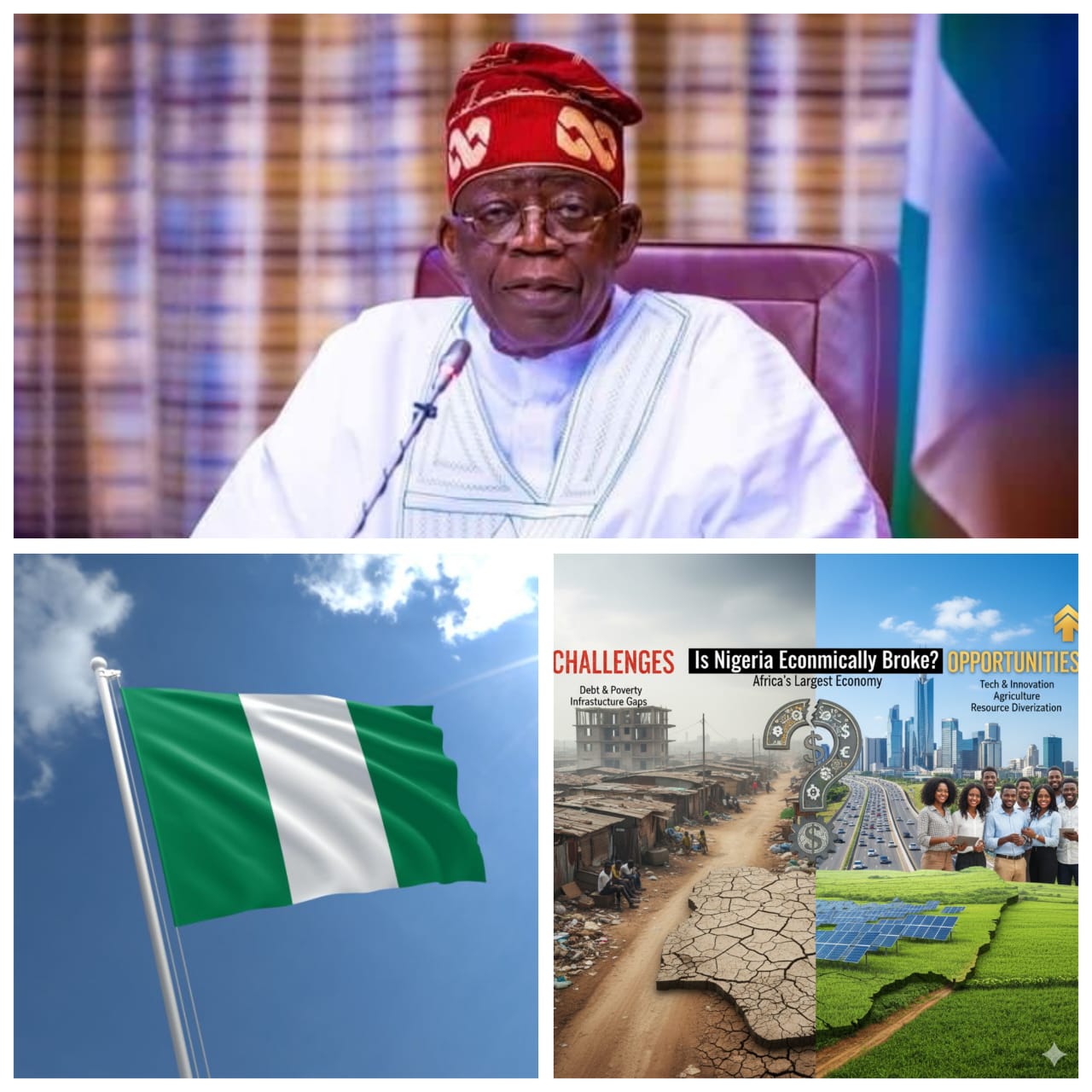
Is Nigeria Economically Broke? Challenges and Opportunities in Africa’s Largest Economy

Published

on

Is Nigeria Economically Broke

By Blaise Udunze

Is Nigeria, Africa’s largest economy, economically broke? It is a question no patriotic citizen wants to confront, yet one that confronts every Nigerian daily at the fuel pump, the market stall, the school gate, the hospital reception, and increasingly, in the national accounts. The country’s fiscal reality is no longer a debate in economic circles alone; it is a lived experience for millions and a gathering storm for future generations.

To understand the gravity of the nation’s situation, one must look beyond political speeches and interrogate Nigeria’s borrowing patterns, revenue profile/debt numbers, public spending, and the economic behavior of both federal and state governments under President Bola Ahmed Tinubu’s. administration. What emerges is a troubling picture as taxation is squeezing small businesses, borrowing is mortgaging the nation’s tomorrow, and shockingly, the trillions shared among federal, state, and local governments every month translate into little visible development. Nigeria’s books show figures, but her streets show a different reality.

Since President Bola Ahmed Tinubu assumed office in June 2023, Nigeria’s public debt has spiraled from N33.3 trillion to N152.4 trillion by mid-2025 which represents a staggering 348.6 percent increase in just two years. Economies do not collapse overnight; they weaken gradually, sending warning signs that only become obvious in hindsight. Nigeria is flashing all the red signals today. Between July and October 2025 alone, the government secured over $24.79 billion, €4 billion, ¥15 billion, N757 billion, and another $500 million in sukuk bonds. These figures, in a functional economy, should translate into expanded electricity capacity, world-class healthcare systems, vibrant industries, better roads, thriving SMEs, and export-oriented value chains. Instead, much of Nigeria’s real sector remains stagnant as energy is unstable, industrial output is weak, and infrastructure remains largely stuck in the realm of political promises.

Borrowing, in itself, is not the crime. Nations borrow to grow. Borrowing becomes a problem when the funds are not directed toward productive, self-liquidating projects capable of paying back the debt through increased economic activity. Nigeria borrows aggressively but produces too little. The loans are not translating into productivity or growth, which is why the debt-servicing burden continues to rise. Today, more than 90 percent of government revenue is spent on servicing old debts. In some quarters, debt servicing now consumes 25 percent of Nigeria’s entire annual revenue. This means that governance has been reduced to fiscal survival, with vital sectors such as education, healthcare, and industrialization competing for the crumbs left after creditors take their share.

Professor Uche Uwaleke of Nasarawa State University captured it aptly: “Nigeria’s debt service ratio is inimical to economic development… The opportunity cost for the country is high.” The tragedy is clear as the country has substituted borrowing for revenue and debt servicing for development. At the 2025 IMF and World Bank Meetings, global leaders lamented Africa’s growing debt, which has now exceeded $1.3 trillion. Sub-Saharan African governments spent over $89 billion servicing debts in 2025 alone. Yet Nigeria’s case stands out because of its size, population, weak industrial base, and persistent revenue leakages. Nigeria continues to borrow through Eurobonds, multilateral loans, bilateral facilities, and sukuk instruments, even without a corresponding rise in productivity. This raises a painful but necessary question: if these loans are development financing, where is the development?

Recently, the House of Representatives approved President Tinubu’s request to borrow $2.35 billion to finance part of the 2025 budget deficit. This is not borrowing to invest, it is borrowing to plug holes, pay salaries, and service existing debts. This is fiscal survivalism, not economic transformation. Countries that borrow to build infrastructure grow out of debt. Countries that borrow to fund recurrent expenditure sink deeper into it. Nigeria is drifting toward the latter.

The African Democratic Congress (ADC) bluntly accused the president of being “addicted to debts,” noting that if all requested loans for 2025 are approved, Nigeria’s debt stock could reach N193 trillion. The Debt Management Office confirmed the possibility. In the ADC’s words: “You cannot claim your house is in order while taking new loans to stop the roof from collapsing.” The loan in question was the N1.15 trillion request by President Tinubu to fund the 2025 budget deficit, which the Senate and House of Representatives gave their approval during last Wednesday’s plenary.

Despite government assurances that inflation is easing by recording 18.02 percent headline inflation and 16.87 percent food inflation, Nigerians feel no relief. Prices remain high, purchasing power continues to collapse, and businesses are shutting down. There is no statistical comfort in an empty dinner plate.

While federal borrowing continues to dominate conversations, an equally critical yet often ignored dimension lies at the state level. Since the fuel subsidy removal in June 2023, state governments have become quiet but major beneficiaries of the enlarged FAAC allocations as a feeding bottle.

NEITI and OAGF/NBS records show that between June 2023 and June 2025, FAAC distributed N25.65 trillion yet few Nigerians can point to commensurate development in their states. Roads remain terrible. State industries are dead. Capital projects are abandoned. Health and education sectors are underfunded. Internally generated revenue remains weak.

Many states have weaponized FAAC allocations into a system of dependence. They line up monthly for their share but fail to harness the natural resources, agricultural potential, tourism corridors, or industrial hubs available within their territories.

Nigeria’s fiscal health is not a function of what federal government collects alone, it is a function of what the states produce. Development is a chain; a weak link breaks the entire system. Many states have become consumption centers instead of production hubs, contributing significantly to the national productivity crisis. Until FAAC allocations are tied to measurable development outcomes, Nigeria will continue to share poverty, not prosperity.

All these realities force Nigerians to ask again if Nigeria is economically broke?

A country is economically broke:

  • when it borrows to survive rather than to grow;
  • when it spends the bulk of its income servicing old debts;
  • when its states depend on allocations instead of productivity;
  • when taxation cripples rather than empowers businesses; and
  • when development is measured by political speeches, not real outcomes.

By these metrics, Nigeria is edging dangerously close to fiscal insolvency, living on borrowed money and borrowed time.

Yet despite this troubling landscape, Nigeria’s economic prospects are not irredeemable. The country possesses immense opportunities that, if harnessed, could transform its economic future to becoming one of the most vibrant in the world.

  1. Diversification: Agriculture, Technology, and Services –

Nigeria’s over-reliance on oil remains its most dangerous economic vulnerability. Oil accounts for more than 90 percent of export earnings and over half of government revenue. A single fluctuation in global oil prices can destabilize the entire economy. Diversification is not optional; it is a national emergency.

Agriculture, however, offers a powerful alternative. With vast arable land, abundant labor, and high domestic demand, agriculture can drive food security, export expansion, and industrial value chains.

Technology stands as another frontier of opportunity. Nigeria’s youthful population, fast-rising digital economy, and growing tech hubs offer pathways for innovation, employment, and global competitiveness.

The services sector which consists of telecommunications, finance, logistics, entertainment, and tourism also holds massive potential to absorb millions of jobs and stimulate economic growth and reduce reliance on oil revenue.

  1. Job Creation and Youth Productivity:

Nigeria’s unemployment and underemployment rates remain dangerously high, particularly among young people. A productive youth population is an economic asset; an idle youth population is a socio-economic risk. Entrepreneurship support, industrial hubs, vocational training, and SME financing can unlock millions of new jobs.

  1. Infrastructure Development:

However, none of these sectors can thrive without addressing Nigeria’s infrastructural deficit. Poor power supply, crumbling roads, inefficient transport systems, and inconsistent regulatory policies continue to choke businesses. Infrastructure is the backbone of any modern economy; without it, productivity remains low regardless of potential.

  1. Governance, Transparency, and Anti-Corruption:

Governance and transparency play an equally critical role. Nigeria cannot build a productive economy on the foundation of corruption, mismanagement, and opaque financial practices. Strengthening institutions, enforcing accountability, digitizing public services, and ensuring full transparency in FAAC disbursements, budget execution, and loan utilization are essential steps toward restoring public trust and investor confidence. Transparency must become the norm not the exception.

The path to a resilient Nigerian economy requires a national reset in fiscal discipline. The following steps are critical:

–       Borrowing must be tied strictly to revenue-generating, self-liquidating projects.

–       Recurrent expenditure borrowing must stop.

–       Debt ceilings should be legally enforced.

–       States must be compelled to boost local productivity and mobilize internal revenue.

–       FAAC allocations should be linked to measurable development benchmarks.

–       Public finance transparency must be non-negotiable

–       Economic diversification must be pursued with urgency, not rhetoric.

Currently, Nigeria stands at an intercession. One path leads to deeper debt, economic stagnation, and a future where the next generation inherits nothing but liabilities. The other path leads to reform, productivity, innovation, and the emergence of a strong, resilient economy capable of withstanding global uncertainties.

So, is Nigeria economically broke? The uncomfortable truth is that Nigeria is not yet bankrupt but it is dangerously close. A nation cannot continue borrowing to survive, consuming more than it produces, or neglecting the engines of real growth. The time for action is now. Nigeria’s challenges are vast, but so are her opportunities. With discipline, transparency, and visionary leadership, Africa’s largest economy can still reclaim its promise and chart a sustainable path toward shared prosperity.

Blaise, a journalist and PR professional writes from Lagos, can be reached via: [email protected]

Advertisement
Click to comment

Leave a Reply

Your email address will not be published. Required fields are marked *

Feature/OPED

The Missing Pieces in Nigeria’s Banking Recapitalisation

Published

on

Nigeria’s Banking Recapitalisation

By Blaise Udunze

Nigeria’s economy will be experiencing yet another round of reform; after the new tax implementation, the banking sector recapitalisation exercise will begin within less than three months until the March 31, 2026, deadline. The Central Bank of Nigeria (CBN) Governor, Olayemi Cardoso, disclosed that 27 banks have tapped the capital market via public offers and rights issues.

The figures show that of 21 the 37 commercial, merchant, and non-interest banks in the country have met or exceeded the revised minimum capital thresholds of N500 billion for internationally authorised banks, N200 billion for national banks, N50 billion for regional banks, and N10-20 billion for non-interest banks. With the developments above, policymakers are betting that stronger balance sheets will help banks withstand macroeconomic shocks, finance growth, and restore confidence in the financial system. On the surface, the logic is sound, capital matters. But history warns us that capital alone is not a cure-all.

Nigeria has been here before, going by the 2004-2005 era of the then-governor of CBN, Charles Soludo, whose banking consolidation dramatically reduced the number of banks from 89 to 25 and created national champions. Yet barely five years later, the system was back in crisis, requiring regulatory intervention, bailouts, and the creation of the Asset Management Corporation of Nigeria (AMCON) to absorb toxic assets. The lesson here is clear, which revealed that recapitalisation that ignores structural weaknesses merely postpones failure.

If the current exercise is to succeed, the CBN must use it not only to raise capital but to repair the deeper fault lines that have long undermined the stability, credibility, and effectiveness of Nigeria’s banking sector.

More Capital isn’t Always Better Capital

The first and most critical issue is the quality of capital being raised. Disclosures made by the banks have shown that the combined capital base of about N5.142 trillion is already locked in by lenders across the different licence categories. Bigger numbers on paper mean little if the capital is not genuinely loss-absorbing. In past recapitalisation cycles, concerns emerged about funds being raised through related parties, short-term borrowings disguised as equity, or complex arrangements that ultimately recycled the same risks back into the system.

This time, the CBN must insist on transparent, verifiable sources of capital. Every naira raised should be traceable, free from conflicts of interest, and capable of absorbing real losses in a downturn. Otherwise, recapitalisation becomes an accounting exercise rather than a resilience-building one.

Why Corporate Governance Remains the Achilles’ Heel

Perhaps the most persistent weakness in Nigeria’s banking sector is corporate governance failure. Many bank crises have not been caused by macroeconomic shocks alone, but by poor board oversight, insider abuse, weak risk culture, and excessive executive power.

Recapitalisation provides a rare regulatory leverage point. The CBN should use it to reset governance standards, not just capital thresholds. Boards must be independent in substance, not just in form. Being one of the critical aspects of the banking challenge, insider lending rules should be enforced without exception. Risk committees in every financial institution must be empowered, not sidelined by dominant executives.

Without the apex bank fixing governance, new capital risks become fresh fuel for old excesses.

The Unresolved Burden of Non-Performing Loans (NPLs)

Data from the CBN’s latest macroeconomic outlook showed that the banking industry’s Non-Performing Loans ratio climbed to an estimated 7 percent, pushing the sector above the prudential ceiling of 5 percent. Nigeria’s banking sector continues to be drowned with high volumes and recurring non-performing loans (NPLs), and this is often concentrated in sectors such as oil and gas, power, and government-linked projects. Though with the trend of events, one may say that regulatory forbearance has helped maintain surface stability in the sector, no doubt it has also masked underlying vulnerabilities.

The truth is that a credible recapitalisation exercise must confront this reality head-on. Loan classification and provisioning standards should reflect economic truth, not regulatory convenience. Banks should not be allowed to carry impaired assets indefinitely while presenting healthy balance sheets to investors and the public.

Transparency around asset quality is not a threat to stability; it is a foundation for it.

How Foreign Exchange Risk Quietly Amplifies Financial Shocks

Few risks have damaged bank balance sheets in recent years as severely as foreign exchange volatility. Many banks continue to carry significant FX mismatches, borrowing short-term in foreign currency while lending long-term to clients with naira revenues.

During periods of FX adjustment, these mismatches can rapidly erode capital, no matter how well-capitalised a bank appears on paper. Recapitalisation must therefore be accompanied by tighter supervision of FX exposure, stronger disclosure requirements, and realistic stress testing that assumes adverse currency scenarios, not best-case outcomes.

Ignoring FX risk is no longer an option in a structurally import-dependent economy.

Concentration Risk and the Narrow Credit Base

Another long-standing weakness is excessive concentration risk. A disproportionate share of bank lending is often tied to a small number of large corporates or government-related exposures. While this may appear safe in the short term, it creates systemic vulnerability when those sectors face stress.

At the same time, the real economy, particularly SMEs and productive sectors, remains underfinanced because, over the years, Nigeria’s banks faced significant concentration risk, particularly in the oil and gas sector and in foreign currency exposure, while grappling with a narrow credit base characterised by limited lending to the private sector. This is due to high credit risk and tight monetary policy. Owing to this trend, recapitalisation should therefore be in alignment with policies that encourage credit diversification, improved credit underwriting, and smarter risk-sharing mechanisms, and not the other way round.

Therefore, it will be right to say that banks that grow larger but remain narrowly exposed do not strengthen the economy; they amplify its fragilities.

Risk Management in a Volatile Economy

The recurring inflation shocks, interest-rate swings, fiscal pressures, and external shocks are frequent features, not rare events, which show that Nigeria is not a low-volatility environment.

Currently, the Nigerian banking sector’s financial performance and investment returns are equally affected by various risks, including credit, liquidity, market, and operational risks.

Today, many banks still operate risk models that assume stability rather than disruption. Time has proven that risk management is essential for mitigating these risks and ensuring stability and profitability.

The apex bank must ensure that the recapitalisation process mandates robust, Nigeria-specific stress testing, and banks must demonstrate resilience under severe but plausible scenarios. This includes sharp currency depreciation, interest-rate spikes and sovereign stress. It must evolve from a compliance function to a strategic discipline.

Transparency and Financial Reporting

Investors, depositors, and analysts must be able to understand banks’ true financial positions without navigating a lack of transparent disclosures or creative accounting. Hence, public trust in the banking sector depends heavily on credible financial reporting.

The CBN should use recapitalisation to strengthen the International Financial Reporting Standard enforcement, disclosure standards, and audit quality. In championing this course, banks’ financial statements should clearly reflect capital adequacy, asset quality, related-party transactions, and off-balance-sheet exposures. Transparency is to enable confidence, not about exposing weakness.

Regulatory Consistency and Credibility

Policy credibility has been one of the greatest challenges for Nigeria’s financial regulators.

Abrupt changes, unclear timelines, and inconsistent enforcement undermine investor confidence and weaken reform outcomes.

Recapitalisation must be governed by clear rules, predictable timelines, and consistent enforcement. Both domestic and foreign investors need assurance that the rules of the game will not change midstream. Regulatory credibility is itself a form of capital.

Consumer Protection and Banking Ethics

While recapitalisation focuses on banks’ balance sheets, the public experiences banking through fees, service quality, dispute resolution, and ethical conduct. Persistent complaints about hidden charges and poor customer treatment erode trust in the system and a stronger banking sector must also be a fairer and more accountable one. It must be noted that strengthening consumer protection frameworks alongside recapitalisation will help rebuild public confidence and reinforce financial inclusion goals.

Too Big to Fail and How to Resolve Failure

Looking at what is obtainable in the system, larger, better-capitalised banks can also become systemically dangerous if failure resolution frameworks are weak. This requires that recapitalisation should therefore be accompanied by credible plans for resolving distressed banks without destabilising the entire system or resorting to taxpayer-funded bailouts, which has been the norm in the Nigerian banking sector today. The cynic might say that recapitalisation simply made big banks bigger and empowered dominant shareholders. However, a more prospective approach invites all stakeholders, including regulators, customers, civil society and bankers themselves, to co-design the next chapter of Nigerian banking; one that balances scale with inclusion, profitability with impact, and stability with innovation.

Clear resolution mechanisms reduce moral hazard and reinforce market discipline.

A Moment That Must Not Be Wasted

Recapitalisation is not merely a financial exercise; it is a governance and trust reset opportunity. If the CBN focuses solely on capital numbers, Nigeria risks repeating a familiar cycle of apparent stability followed by crisis.

The banking sector can lay a solid foundation that truly supports economic transformation if recapitalization is used to address governance failures, asset quality, FX risk, transparency, and regulatory credibility.

Nigeria does not just need bigger banks. It needs better banks, institutions that are resilient, transparent, well-governed, and trusted by the public they serve. Hence, it must be a system that creates a more robust buffer against shocks and positions Nigerian banking as a global competitor capable of funding a $1 trillion economy, as the case may be.

This recapitalisation moment must be about building durability, not just size. The cost of missing that opportunity would be far greater than the cost of getting it right.

Blaise, a journalist and PR professional, writes from Lagos and can be reached via: [email protected]

Continue Reading

Feature/OPED

Why Nigeria’s New Tax Regime Will Fail Without Public Trust

Published

on

Nigeria's New Tax Regime

By Blaise Udunze

Millions of Nigerian citizens are watching with cautious anticipation as the federal government begins implementing its far-reaching 2026 tax reforms. This is to say that the official assurances that the new tax regime will be fairer, simpler, and more humane, as relished by the proponents of the reforms, are being listened to by both low-income workers, small business owners, professionals, and informal sector participants.

Still, behind the optimism is a familiar worry shaped by past experience that reminds us that taxation without accountability undermines both governance credibility and the legitimacy of the tax system, thereby making it hard to believe in.

For many Nigerians, the question is not whether taxes should be paid, but whether the state has earned the moral authority to demand them, judging by the lack of accountability over the years.

The Nigerian Tax Act and the Nigerian Tax Administration Act, two of the four pillars of the 2026 reforms, came into force on January 1, reshaping how individuals and businesses are taxed. According to proponents of the reforms, particularly the Chairman of the Presidential Committee on Fiscal Policy and Tax Reforms, Dr. Taiwo Oyedele, the changes are deliberately pro-poor and pro-growth. Workers earning below N800,000 annually are exempted from personal income tax. Basic food items, healthcare, education, and public transportation have been removed from the VAT net. Small companies with turnovers of N100 million or less are exempt from corporate income tax, capital gains tax, and the new development levy. Multiple tax laws have been consolidated into a unified code to reduce duplication, confusion, and harassment.

On paper, these reforms acknowledge Nigeria’s economic distress and signal a genuine attempt to lighten the burden on the majority of citizens. However, Nigeria’s tax crisis has never been about tax rates alone.

Nigerians have lived through decades of taxation that did not translate into visible development, social welfare, or improved quality of life, as this has succinctly shown that it is fundamentally about trust. No matter how progressive, for this singular reason, Nigerians see the announcement of the reforms via a long memory of disappointment and failure, while Nigerians have increasingly become vocal in demanding accountability from government at all levels, and social media has played a powerful role in amplifying public scrutiny in recent years.

Images and videos of the alleged lavish lifestyles of public office holders and their families are alarming and circulate widely, reinforcing the perception that public funds are misused or siphoned for private gain. While not all such claims are verified, the damage lies in the perception itself since governance credibility suffers when citizens believe that those entrusted with public resources live far above the realities of the people they govern.

The Nigerian Constitution, while not explicitly mandating accountability in narrow terms, establishes in Section 14 that the security and welfare of the people shall be the primary purpose of government. The state is expected to manage the economy in a manner that ensures maximum welfare, freedom, and happiness of citizens on the basis of social justice and equality. The provisions made in Section 22 further empower the media and arm it to the teeth to hold the government accountable to the people and beyond constitutional provisions, Nigeria voluntarily signed up to global transparency initiatives such as the Extractive Industries Transparency Initiative, domesticated through the NEITI Act of 2007. Over the period, NEITI has helped improve disclosure in the extractive sector, as its mandate does not extend to tracking how revenues are spent, leaving a critical accountability gap.

This gap is most evident in the lived experience of Nigerian taxpayers. Intrinsically, the average Nigerian does not experience taxation as a collective investment in shared prosperity. Instead, taxation feels like an added burden layered on top of already crushing personal responsibilities. Nigerians generate their own electricity through generators, source water privately, pay for security, indirectly fund road maintenance through vehicle repairs, and bear healthcare and education costs out of pocket. When citizens pay taxes and still bear the full cost of survival, taxation begins to resemble organized extraction rather than civic contribution.

For instance, the stories of Mr. George and Mr. Kunle reflect this reality. Mr. George, is an earned salary worker who has personal income tax deducted monthly through PAYE. Meanwhile, George also pays for electricity, security, water, road repairs, and private schooling. What about Mr. Kunle, who is a small business owner and chooses not to pay taxes voluntarily with the belief that the government has failed to meet its obligations and other rights? Their frustration is widely shared. According to the IMF, only about 10 million Nigerians out of a labour force of 77 million are registered taxpayers. This low compliance is not a product of ignorance alone, but of a deeply broken social contract.

Over the years, successive governments have attempted to address low compliance through amnesty schemes such as the Voluntary Asset and Income Declaration Scheme. Though these initiatives temporarily expanded the tax base, their long-term impact remains questionable because compliance driven by fear of penalties or temporary incentives does not endure where trust is absent. In Nigeria, tax compliance is often compelled rather than voluntary, just as we are about to experience in this new regime, enforcement tends to replace persuasion. This approach may generate short-term revenue, but it weakens legitimacy and fuels resistance.

Academic studies on taxation and accountability in Nigeria reinforce this conclusion. While global literature suggests a strong relationship between government accountability and voluntary tax compliance, Nigeria’s experience has been distorted by weak institutions and limited political legitimacy. This should be noted by the policymakers that where citizens perceive government as unaccountable, coercion increases, collection costs rise, and evasion becomes normalized. Hence while, the result is a vicious cycle in which low trust breeds low compliance, prompting harsher enforcement that further erodes trust.

Other jurisdictions offer valuable lessons. For instance, today, a country like Sweden has one of the highest tax-to-GDP ratios in the world with remarkably high compliance rates, and this has been the norm despite imposing steep personal income taxes. The reason is simple, in the sense that transparency and visible benefits are not far-fetched. Citizens know how their taxes are spent and experience the returns through quality education, healthcare, social security, and public services. Taxation is viewed not as punishment but as a shared investment. In China, targeted tax deductions for healthcare and education similarly align taxation with social needs, reinforcing compliance through perceived fairness.

Nigeria’s challenge is not to replicate these systems mechanically, but to internalize their core principle that enables the people to comply willingly when they believe the system works and that everyone is treated fairly.

This principle is being tested anew by the recent controversy surrounding the Federal Inland Revenue Service’s (now branded as Nigeria Revenue Service) appointment of Xpress Payments Solutions Limited as a Treasury Single Account collecting agent. Though framed as a technical step toward modernizing digital tax infrastructure, the quiet nature of the appointment, coupled with limited public disclosure, has reignited fears of revenue capture and cartelization. Critics have drawn parallels with past private-sector dominance over state revenue systems, warning against concentrating sensitive national revenue functions in private hands without clear safeguards.

Former Vice President Atiku Abubakar’s reaction captured the broader public unease. He raised an alarm while warning against what he described as the nationalization of a revenue collection model that had previously raised serious transparency concerns and the Nigeria Revenue Service (NRS) has insisted that Xpress Payments is merely an additional option and not an exclusive gatekeeper, the controversy highlights a deeper issue, which authenticates the fact that in a climate of low trust, silence, and lack of clarity, suspicion. Even well-intentioned reforms can falter if citizens feel excluded from the process.

With broader concerns about governance, accountability, and democratic integrity in society, this moment coincides with it. Even the recent calls by leaders such as Rotimi Amaechi and civil society organizations like ActionAid Nigeria underscore the growing demand for responsible, transparent and people-oriented leadership as being raised from different quarters. Governance indices consistently rank Nigeria poorly on accountability, while poverty, unemployment and insecurity remain widespread. That is what, in such a context, asking citizens to trust the tax system without first restoring confidence in governance is unrealistic and unattainable.

At the core of the debate lies a fundamental moral question: when does a government have the right to tax its citizens? Taxation is not charity and it is not magic. It is a contract. Citizens surrender a portion of their income so the state can provide security, infrastructure, justice, and essential services that individuals cannot efficiently provide on their own. When this exchange functions, taxation feels legitimate. When it fails, taxation feels coercive.

No doubt, legally, the Nigerian state retains the power to tax, but morally, legitimacy depends on performance. Security is foundational. Infrastructure enables productivity. The government must understand that healthcare and education protect human capital, while transparency ensures fairness. And, when these pillars are weak, taxation loses its ethical grounding. All that Nigerians demand is not perfection; they demand evidence that their sacrifices matter.

As the implementation of the new tax reforms takes root, Nigeria stands at a defining moment. The reforms offer an opportunity to reset the social contract around taxation, broaden the tax base, and reduce dependence on dwindling oil revenues. But the point being flagged is that reform without accountability will only reproduce old failures in new forms. To buttress this further, taxation without accountability, as being practiced in the past, will invariably undermine governance credibility and erode the legitimacy of the tax system.

And, as the scripture says, you cannot put “old wine in a new wineskin.” Failure to adhere to this instruction will lead to combustion. Yesterday’s methods or mindsets on taxation will rupture new strategies, which cannot thrive or survive because of a lack of accountability.

If the government is serious about improving voluntary compliance, it must go beyond policy announcements. Hence, must demonstrate transparent use of tax revenues, strengthen oversight institutions, limit monopolistic control over revenue collection, and communicate clearly and consistently with citizens. Most importantly, it must deliver tangible improvements in the daily lives of all Nigerians.

When citizens see roads fixed, hospitals working, schools improving, and security strengthened, compliance will follow. Voluntary tax compliance is not an act of generosity; it is a rational response to trust. Fix the system, restore confidence, and Nigerians will pay, not because they are forced, but because the contract finally makes sense.

Blaise, a journalist and PR professional, writes from Lagos and can be reached via: [email protected]

Continue Reading

Feature/OPED

Nigeria’s Year of Dabush Kabash

Published

on

Dabush Kabash

By Prince Charles Dickson PhD

The phrase Dabush Kabash—popularised by the maverick Nigerian preacher Chukwuemeka Cyril Ohanaemere (Odumeje)—was never meant to be a political theory. It was theatre, prophecy-as-performance, the language of shock and spectacle. Yet, as Nigeria inches toward 2027, Dabush Kabash will not just be in the pulpit, it will find a comfortable home in our politics. It will describe the collision of ambition, uncertainty, bravado, confusion, alliances, betrayals, and loud declarations that mean everything and nothing at the same time.

This is a season where everyone is speaking, few are listening, and the ground beneath the republic feels unsettled. A year where political actors are already campaigning without calling it campaigns, negotiating without admitting it, and defecting without shame. Nigeria, once again, is rehearsing power before the curtain officially rises.

As 2027 approaches, the scramble is neither subtle nor dignified. Atiku Abubakar has made it clear—again—that he will not step down for anyone. His persistence is framed by supporters as resilience and by critics as entitlement. Either way, Atiku represents continuity in Nigerian politics: a belief that the centre must always hold him, regardless of shifting public mood.

Then there is Peter Obi, still buoyed by the aftershocks of 2023, where belief momentarily disrupted cynicism. Whether that energy can be sustained, institutionalised, or translated into broader coalitions remains an open question. Charisma without structure has limits; structure without imagination does too.

Rotimi Amaechi, restless and calculating, watches the chessboard from the sidelines, never fully out of the game. Nasir El-Rufai continues to speak as though he is both inside and outside power, simultaneously insider, critic, and ideologue. Rabiu Kwankwaso, with his disciplined base and regional gravitas, remains a reminder that Nigeria is not won on social media alone.

There are new brides—fresh aspirants, technocrats flirting with politics, and business elites suddenly discovering patriotism. There are old grooms—veterans who have contested so often that ambition has become muscle memory. Everyone is at the gate. No one wants to wait their turn.

If Nigerian politics needed a parable, Rivers State has provided one. The public rift between Nyesom Wike and Siminalayi Fubara is less about governance and more about control—who anoints, who obeys, who inherits political machinery.

Like exiles by the rivers of Babylon, both camps sing songs of loyalty and betrayal, each claiming legitimacy, each invoking the people while fighting over structures. It is a reminder that Nigerian politics is rarely ideological; it is intensely personal. Power is not just about winning elections; it is about owning outcomes, narratives, and successors.

The ruling All Progressives Congress is swelling. Defections are marketed as endorsements, and numerical strength is mistaken for moral authority. But Nigeria has seen this movie before. The People’s Democratic Party once enjoyed similar expansion during the Obasanjo years, only to implode under the weight of internal contradictions, ambition overload, and unmanaged succession.

Big tents collapse when they are not anchored by shared values. Congresses meant to unify often become theatres of exclusion. Candidate selection becomes war by other means. The question is not whether APC is growing, but whether it can survive the internal earthquakes that primaries inevitably unleash.

Meanwhile, the Labour Party stands at a crossroads. The reported ambition of Datti Baba-Ahmed to run as a principal candidate raises deeper questions about succession, internal democracy, and the danger of mistaking momentum for permanence. Movements are fragile when institutions are weak.

Coalitions are forming quietly across regions, religions, and old rivalries. Old enemies share tea; former allies exchange barbs. In Nigeria, there are no permanent friends, only temporary arithmetic. North meets South. Centre negotiates with margins. Everyone is counting delegates, governors, influencers, and platforms.

But alliances without memory are dangerous. Nigeria has a habit of forgetting why previous coalitions failed: unresolved grievances, unequal power-sharing, and elite consensus that excludes the citizens. When deals are made above the heads of the people, legitimacy becomes borrowed—and debt always comes due.

While politicians posture, Nigerians are trying to understand a new tax regime, rising costs, shrinking incomes, and policy explanations that sound more academic than humane. Economic anxiety rarely announces itself with protests at first; it shows up as withdrawal, distrust, and apathy.

Every political drama in 2026 will touch the economy. Every economic policy will shape the political mood. You cannot separate the two. The tragedy is that economic suffering is often treated as background noise while political ambition takes centre stage.

So yes; this is the year of Dabush Kabash. Not because it is funny, but because it is revealing. It captures a politics of spectacle without substance, noise without consensus, movement without direction. Everyone is declaring, few are delivering.

Yet within the chaos lies opportunity. Dabush Kabash also means collision, and collisions force choices. Nigeria will have to decide whether it wants politics as performance or politics as responsibility. Whether power remains a private prize or becomes a public trust.

History will not be kind to this season if it produces only loud men and empty alliances. But it may yet redeem itself if citizens begin to ask harder questions; not just who wants power, but for whatwith whom, and at what cost.

Because beyond the theatrics, Nigeria is watching. And this time, the applause is no longer guaranteed—May Nigeria win.

Continue Reading

Trending