

Feature/OPED
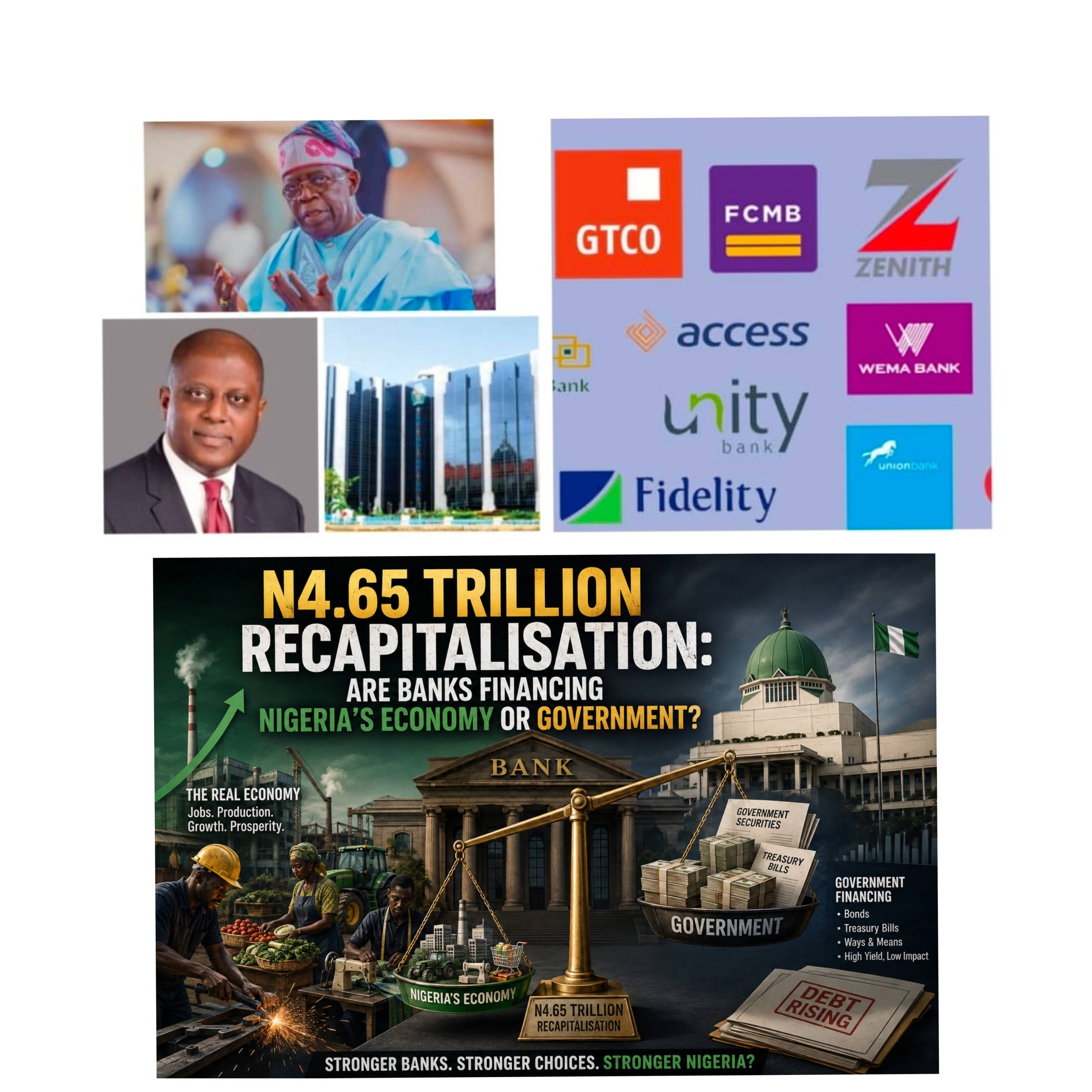
N4.65trn Recapitalisation: Are Banks Financing Nigeria’s Economy or Government?

By Blaise Udunze
Five months after the Central Bank of Nigeria’s banking recapitalisation window closed, Nigerians are justified in asking an uncomfortable question, which is, what exactly did the N4.65 trillion raised by the banks buy for the Nigerian economy?
The banks have become bigger, better capitalised and are making extraordinary profits. But is the Nigerian economy receiving the credit it was promised? That is the question the banking industry can no longer dodge.
The CBN gave banks 24 months to meet new minimum capital requirements, in one of the most consequential banking reforms in recent years. The exercise ultimately mobilised about N4.65 trillion in fresh capital, with 33 banks reportedly cleared to meet the new requirements.
The objective was never simply to make Nigerian banks richer. It was to create stronger institutions capable of absorbing shocks, financing larger transactions and supporting the country’s ambition for a bigger, more productive economy.
Five months on, the banks have certainly demonstrated the ability to make money. Let us take a look at First HoldCo, which reported a sharp drop in full-year financials for 2025 compared to the previous year, and a comeback showed that it made a profit before tax of N653.54 billion in H1 2026, up 83.5 per cent from N356.15 billion in H1 2025. Even its profit after tax rose 81.6 per cent to N526.13 billion, while gross earnings climbed 16.7 per cent to N1.93 trillion.
Wema Bank has a good outlook as it reported gross earnings of N415.09 billion and profit before tax of N154.56 billion. Its loans and advances also increased by 21.73 per cent in the first six months of the year.
Four mid-tier banking groups, FCMB, Wema, Sterling Financial Holdings and Ecobank Transnational recorded a combined after-tax profit of N730.2 billion in H1 2026, compared with N636.4 billion a year earlier.
No doubt, it would be said that these numbers are impressive. But they also expose the uncomfortable at the centre of Nigeria’s post-recapitalisation banking story. The banks are getting richer. Is the economy getting richer with them? That distinction matters.
One fact is that nobody should begrudge banks their profits, which is not in contest. Banks must be profitable to remain solvent, protect depositors, reward investors, invest in technology and withstand economic shocks. But bank profitability cannot become the sole measure of banking success.
A bank can report record earnings while a manufacturer shuts down because credit is unaffordable. A bank can grow its balance sheet while an SME cannot secure working capital. A bank can strengthen its capital base while an entrepreneur abandons a viable business because the cost of borrowing makes expansion impossible. This is where the recapitalisation debate becomes uncomfortable.
Capital is only useful to an economy when it is productively deployed. And Nigeria now has to ask whether its newly strengthened banks are deploying enough of that capital into the economy or whether government remains the easiest and most attractive borrower in the room.
Consider the numbers. About N40.38 trillion in banking credit had been advanced to government as of May 2026, compared with N22.99 trillion a year earlier. That is not a trivial number. It should provoke a national conversation.
Again, there is nothing inherently wrong with banks investing in government securities. Treasury bills, FGN bonds and other government instruments are legitimate components of bank liquidity and balance-sheet management. Banks have a fiduciary responsibility to protect depositors’ money and manage risk prudently.
The problem begins when government paper becomes so attractive that it competes successfully with the productive economy for bank capital. And that is precisely where Nigeria should be looking.
A bank deciding between a government security with relatively predictable returns and a manufacturing loan exposed to power shortages, foreign-exchange volatility, infrastructure deficits, weak consumer demand and repayment risk is not making a difficult philosophical decision.
It is making a risk-management decision. The government is often the safer borrower. The manufacturer is the riskier borrower. The consequence, however, is that what makes sense for an individual bank can become dangerous for the economy when replicated across the banking system.
If banks find government easier and more profitable to finance than businesses, who ultimately pays the price? The answer is the real economy. The factory. The farm. The exporter. The SME. The property developer. The technology company. The young entrepreneur trying to turn an idea into a business.
This is why Nigeria must stop measuring banking-sector strength simply by capital adequacy, asset growth and profit.
The more important question is capital productivity. Where is the money going? What is it producing? How many factories has it helped build? How many jobs has it created? How much export capacity has it financed? How much agricultural production has it supported? How many SMEs have moved from survival to expansion? How much housing has it financed? How much infrastructure has it supported? These are the questions that should define the post-recapitalisation era.
To be fair to all parties involved, Nigerian banks are lending. Wema Bank’s customer loans and advances rose from N1.74 trillion at the end of 2025 to N2.12 trillion by June 2026, and its interest income increased by 42.69 per cent year-on-year to N342.64 billion within the period under review.
FCMB, Wema, Sterling and Ecobank also expanded their combined loan books by approximately 6.5 per cent during the first half of 2026, reaching N6.23 trillion from N5.85 trillion at the end of 2025.
So, this is not a simplistic story about banks refusing to lend. It is a more troubling story about what kind of lending Nigeria is getting, at what price, and for what economic purpose. Because credit growth is not automatically economic growth.
A N1 billion loan that finances a manufacturing plant, creates 500 jobs and generates export revenue is not economically equivalent to N1 billion deployed into short-term financial activity. The difference is productivity. And that is precisely what Nigeria desperately needs. The irony is that the banking industry itself has legitimate reasons to remain cautious.
The withdrawal of regulatory forbearance has exposed weaknesses in some loan portfolios. One of the worries of the apex bank is that the industry’s non-performing loan ratio rose to 8.03 per cent in January 2026, above the CBN’s five per cent prudential threshold.
Ten major Nigerian banks also reportedly recognised approximately N3.2 trillion in impairment charges in their 2025 audited accounts, reflecting the recognition of credit losses after regulatory forbearance expired.
Banks therefore face a genuine dilemma. Nigeria wants them to lend more. The regulator wants them to lend responsibly. Shareholders want stronger returns. Depositors expect their money to be protected. And borrowers want cheaper credit. There is no magic formula that satisfies all four simultaneously.
That is why the CBN’s March 12, 2026 circular restricting banking services to non-performing large-ticket obligors is significant. Banks were directed not to extend additional credit to large borrowers with non-performing facilities recorded in the Credit Risk Management System or licensed private credit bureaus.
The message is definitely clear, which means that Nigeria needs more credit, but it does not need another bad-loan crisis. That is entirely reasonable. But the solution cannot simply be to make government the default destination for bank capital.
This is where monetary and fiscal policy become inseparable from the banking debate. This is explicit with the CBN retaining the Monetary Policy Rate at 26.5 per cent at its July 2026 meeting. Although inflation has moderated, monetary conditions remain restrictive.
For banks, this environment can support substantial interest income. For businesses, it can make credit prohibitively expensive. For government, however, the same financial environment can make domestic securities attractive to investors seeking relatively safer returns.
And therein lies the danger. The government can crowd out the very businesses that recapitalised banks were expected to finance.
Nigeria cannot simultaneously demand that banks finance economic transformation while creating a financial environment in which financing government is safer, easier and potentially more attractive than financing production. That is not a banking failure alone. It is a policy contradiction.
The government cannot complain about expensive private-sector credit while remaining a dominant borrower in the domestic financial market. The CBN cannot expect banks to dramatically reduce lending rates while monetary policy remains tight to control inflation. And banks cannot expect Nigerians to celebrate extraordinary profits indefinitely if those profits are not accompanied by a visible increase in productive economic activity.
The first phase of banking reform was about capital. That phase is largely over. The next phase must be about accountability.
Banks should be required, at least through stronger disclosure and supervisory scrutiny, to demonstrate what their additional capital is achieving in the real economy. Not just how much they raised. Not just how much they earned. Not just how much their assets grew. But where the money went.
Nigeria should be asking every major bank: How much of your post-recapitalisation balance-sheet expansion is financing manufacturing? How much is financing agriculture? How much is financing SMEs? How much is financing exports? How much is financing housing? How much is financing infrastructure? And how much is ultimately financing government?
These are uncomfortable questions. They are also unavoidable questions. Because Nigeria did not embark on a N4.65 trillion recapitalisation exercise simply so banks could emerge with larger balance sheets and bigger profit numbers.
The whole point was to build financial institutions capable of supporting economic transformation. Nigeria cannot recapitalise its way into prosperity. Capital strengthens banks. Credit builds businesses. Businesses create jobs. Jobs create incomes. Productivity creates wealth.
That is the economic transmission mechanism. Break that chain and recapitalisation becomes little more than a balance-sheet exercise. The banks have already passed one test. They raised the money. They survived the capital requirement. They are generating impressive profits.
Now comes the test that matters more. Can they turn that capital into productive credit? Because Nigeria does not need banks that merely become bigger repositories of financial wealth.
It needs banks that help Nigerian businesses become bigger. It does not need a banking system that becomes increasingly profitable while the productive economy remains trapped in expensive credit. It needs a banking system whose profitability is transmitted through investment, production, employment, exports and rising household incomes.
The N4.65 trillion recapitalisation was supposed to increase the capacity of Nigerian banks to finance the economy. If a disproportionate share of that capacity ends up chasing government securities instead of productive investment, Nigeria will have to confront an uncomfortable conclusion: It may have strengthened the banks without sufficiently strengthening the economy.
And that would be the ultimate irony of the recapitalisation exercise. Nigeria spent two years asking banks to raise more capital. Now Nigerians have the right to ask what that capital is doing.
Nigeria did not spend two years recapitalising banks merely to create a more efficient machine for financing government. It recapitalised them to finance an economy. The banks have shown us they can make money. Now they must show us that the money they make is helping Nigeria make money too.
Blaise, a journalist and PR professional, writes from Lagos and can be reached via: [email protected]


