

Feature/OPED
The Subtle Alchemy of Kaduna’s Human Capital Development

By Sani Abdulrazak, PhD
There is a certain irony in how we, as a society, conceptualise youth empowerment. We celebrate the distribution of material things, bags of rice, sewing machines and tricycles as though empowerment begins and ends with the act of possession. Yet, beneath the razzmatazz of such interventions lies a more enduring truth: a person is not truly empowered by what he receives, but by what he is capable of producing after the gift has been exhausted.
It is against this philosophical backdrop that the graduation of over 4,000 trainees from Governor Uba Sani’s vocational training centres in Kaduna State deserves a more discerning reading. Beyond the ceremony, the photographs and the certificates, something considerably more consequential is taking place. The state is investing in an asset that neither inflation can easily erode nor political seasons readily extinguish: human capability.
More than 4,000 young people have now crossed an important threshold, from dependence to the possibility of productive autonomy. They are emerging not with certificates only, but with practical skills capable of being converted into livelihoods, enterprises and, potentially, employment for others. That distinction is profound.
For a state still grappling with the familiar albatrosses of unemployment, underemployment, poverty and youth restiveness, vocational education is not a peripheral policy ornament. It is an economic instrument. It attacks the problem from a different direction, not by asking government to create a salaried position for every young person, an undertaking no government can sustainably accomplish, but by expanding the number of people capable of creating value within the economy. This is perhaps one of the most underappreciated dimensions of Governor Uba Sani’s human-capital intervention.
The governor’s vocational centres are premised on an idea that Nigeria has historically struggled to embrace with sufficient conviction: that technical competence is not the poor cousin of university education. A nation requires doctors and engineers, certainly, but it equally requires electricians who can wire buildings safely, welders who can fabricate industrial components, plumbers who understand modern installations, technicians who can repair machines, artisans who can build businesses and young people who can translate technical knowledge into commercial value. The economy, after all, does not run on certificates. It runs on competence. And competence has no tribe, religion or political party.
A young man who acquires the skill to install solar systems can illuminate a household in a community far removed from the corridors of government. A trained technician can keep machinery functioning. A tailor can transform fabric into an enterprise. A competent welder can move from apprenticeship to ownership and, eventually, become an employer. This is how economic transformation often begins, not with grandiloquent declarations, but with one individual acquiring the capacity to solve a problem for which somebody is willing to pay. The significance of graduating thousands of such individuals, therefore, extends beyond the arithmetic of the occasion. It is about multiplying economic agency.
There is also a cultural dimension to this intervention that deserves attention. For too long, Nigeria has cultivated an educational hierarchy in which university degrees are sometimes regarded as the apogee of intellectual accomplishment, while vocational and technical education is relegated to those perceived to have failed academically. That mindset is increasingly untenable in a world where economies are desperately seeking people who can actually build, repair, install, fabricate, operate and innovate. The dignity of labour must consequently be restored, not just as a slogan, but as an economic ethic. A society cannot aspire to industrialisation while simultaneously denigrating the people who possess the practical skills required to industrialise it.
This is where Kaduna’s experiment becomes particularly interesting. If sustained and properly connected to markets, vocational training can become a fulcrum around which a broader ecosystem of entrepreneurship is constructed. Training is the foundation, but it cannot be the terminus. The graduate needs tools, access to finance, mentorship, workspace, markets and opportunities to deploy the competence acquired. That is the next frontier.
The real measure of these graduates will not be the number of certificates handed out at a ceremony. It will be the number who establish enterprises, secure sustainable employment, train apprentices, participate in value chains and become economically productive citizens. If one trained graduate eventually employs five others, the original intervention begins to acquire a multiplier effect that no graduation statistic can adequately capture. This is why government must resist the temptation to regard graduation as the conclusion of the journey. It should be treated as the commencement of the more difficult phase.
A welder without welding equipment remains constrained. A solar technician without access to capital and customers remains underutilised. A fashion entrepreneur without market access may possess extraordinary skill and still struggle to survive. The challenge, therefore, is to construct the bridges between skill and opportunity, competence and capital, training and enterprise. Governor Uba Sani’s administration has already taken the first important step. The task ahead is to ensure that the thousands emerging from these centres do not become another generation of trained but economically stranded young people. That would be a tragedy.
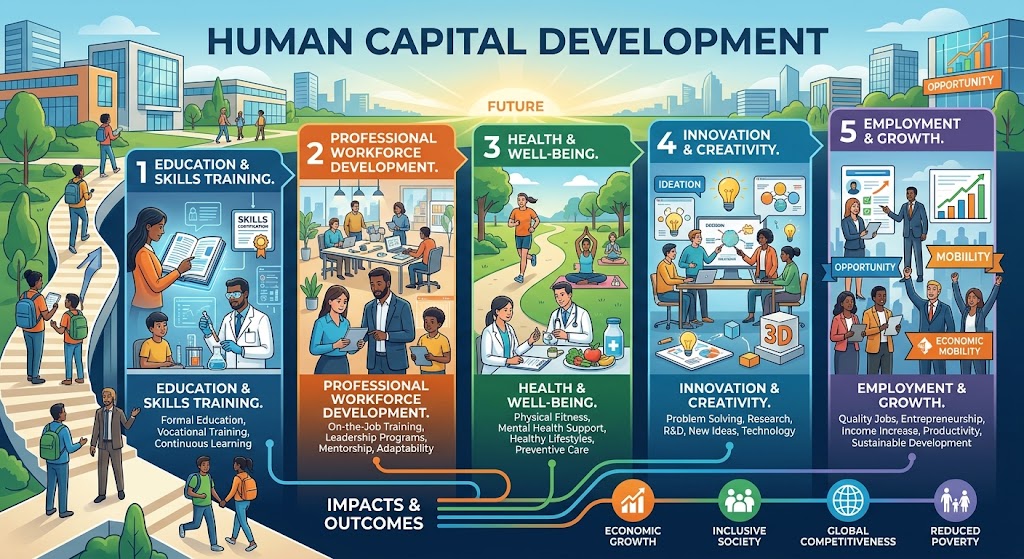
But if the state succeeds in connecting vocational graduates to finance, private-sector opportunities, government procurement, industrial value chains and entrepreneurial support, the ramifications could be substantial. Today’s trainees could become tomorrow’s artisans, technicians, entrepreneurs, employers and mentors. Their collective productivity could gradually seep into communities, households and local economies. This is the quiet alchemy of human-capital development: knowledge becomes skill; skill becomes productivity; productivity becomes income; income becomes dignity; and dignity becomes stability.
Interestingly, that is the most compelling way to understand what has happened in Kaduna. The graduation of over 4,000 young people is that the most consequential investment a state can make in its youth is not a handout that vanishes with consumption but a capability that reproduces itself. That is why the real story of these graduates is not the parchment they now hold but the chance Kaduna has given them to become economically consequential, for while the applause will eventually fade into silence, the photographs will surrender to the patina of memory, and the certificates will find their quiet repose in drawers and offices, if these skills are transformed into livelihoods, businesses and jobs, their impact will endure, quietly, stubbornly, imperceptibly at first, like water wearing down stone, building the human infrastructure upon which a more prosperous Kaduna must ultimately rest; for in the final analysis, the true measure of governance lies not in what it distributes but in what it cultivates, not in what it gives but in what it enables its people to become, and in that quiet alchemy of human possibility, Kaduna may have stumbled upon the most enduring wisdom of all: that the seed of development is not sown in warehouses but in hands, not stored in silos but carried in the sinew of a people who have been given not a gift, but a future.
Sani Abdulrazak, PhD, is a writer, researcher and public affairs analyst based in Zaria, Kaduna State


