Connect with us

General

800 More Nigerians Arrive Nigeria from Warring Sudan

Published

on

More Nigerians

By Adedapo Adesanya

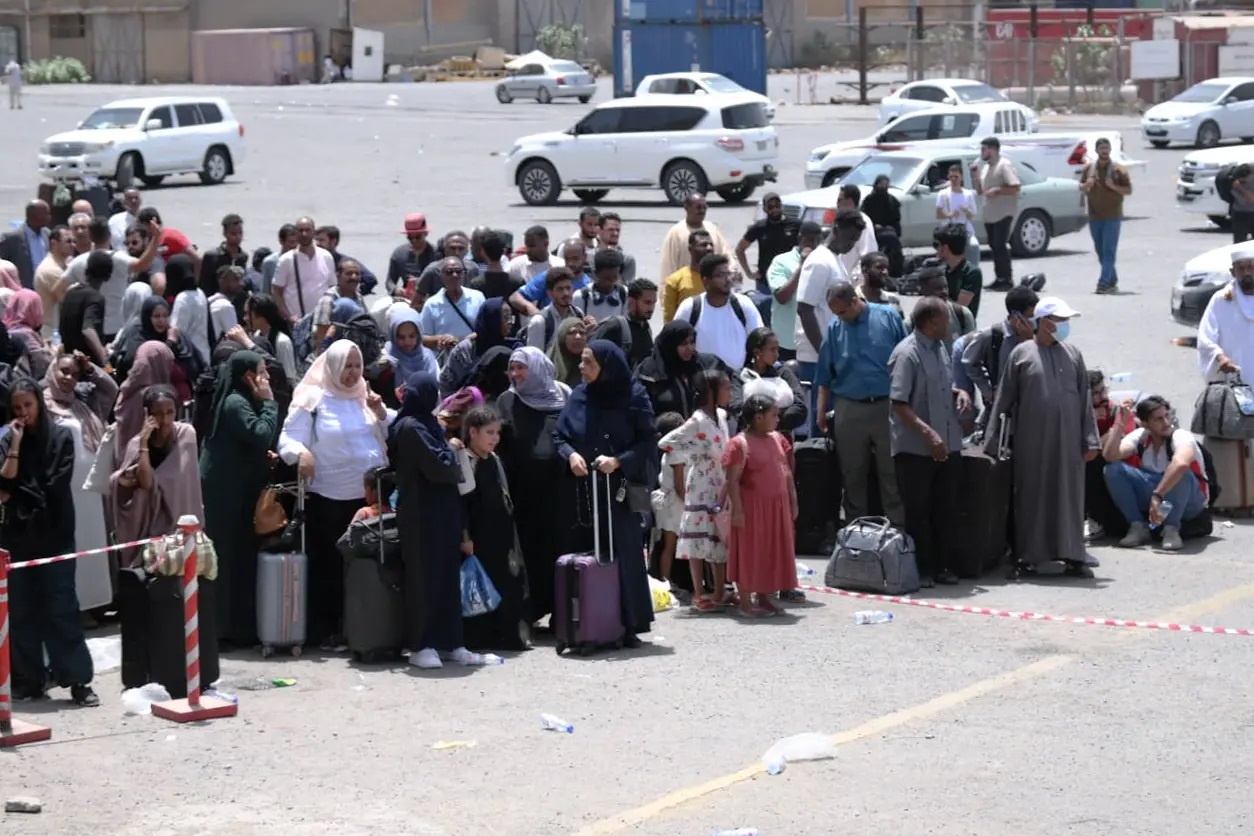
More Nigerians arrived from war-torn Sudan on Sunday, May 7, as the federal government airlifted them into the nation’s capital, Abuja.

In all, over 800 Nigerians fleeing war-torn Sudan arrived in Abuja today. They were airlifted via Max Air, Azman and Tarco Airlines.

On the ground to receive them at the airport are officials of the National Emergency Management Agency (NEMA), the Nigerians in Diaspora Commission (NIDCOM), as well as security officials.

About 102 Nigerians came in onboard the Tarco Airlines that departed Port Sudan, and another 322 Nigerians onboard the Asman Air from Aswan, Egypt, while others came aboard Max.

It was gathered that returnees left Port Sudan International Airport around 5:25 am on Sunday and landed at the Nnamdi Azikiwe International Airport around 12:40 pm.

Business Post had reported that a first batch of Nigerians fleeing the conflict in Sudan arrived at the country’s capital, Abuja, late on Wednesday, May 3, and received N100,000 cash each for transportation to their various homes.

The batch comprised 376 persons out of the 5,500 disclosed by the federal government as against the expected 2,600 announced by the National Emergency Management Agency (NEMA).

The Minister of Humanitarian Affairs, Ms Sadiya Farouq, received the evacuees at the Nnamdi Azikiwe International Airport, Abuja, in the early hours of Thursday, May 4.

Besides the N100,000 cash, the Minister disclosed that the returnees also got other gift items.

Meanwhile, representatives from Sudan’s warring armies have arrived in Saudi Arabia for their first face-to-face negotiations.

The pre-negotiation talks, sponsored by the US and Saudi Arabia, between the Sudanese army and the paramilitary Rapid Support Forces (RSF) were due to start on Saturday in Jeddah but were delayed.

Several ceasefires have broken down since the fighting began weeks ago.

Both sides have said they will discuss a humanitarian truce but not an end to the conflict.

For the past three weeks, the North African country has been engulfed in a conflict (since April 15) as General Abdel Fattah Burhan, head of the armed forces, and General Mohammed Hamdan Dagalo, the leader of a paramilitary group known as the RSF that grew out of Darfur’s notorious Janjaweed militias, seek to seize control of Sudan.

The fighting, which began as the country attempted to transition to democracy, has killed hundreds of over 500 people and left millions trapped in urban areas, sheltering from gunfire, explosions and looters.


Adedapo Adesanya is a journalist, polymath, and connoisseur of everything art. When he is not writing, he has his nose buried in one of the many books or articles he has bookmarked or simply listening to good music with a bottle of beer or wine. He supports the greatest club in the world, Manchester United F.C.

Click to comment

Leave a Reply

Your email address will not be published. Required fields are marked *

General

Nigeria, Ghana Sign Bilateral Maritime Cooperation

Published

on

Nigeria and Ghana

By Adedapo Adesanya

The Nigerian Maritime Administration and Safety Agency (NIMASA) and the Ghana Maritime Authority (GMA) have signed a Memorandum of Understanding (MoU) to strengthen bilateral maritime cooperation, enhance regional maritime governance, and promote the sustainable development of the Blue Economy across West Africa.

Speaking during the signing ceremony in Lagos, the Director General of NIMASA, Mr Dayo Mobereola, expressed appreciation to Ghana for its support during Nigeria’s successful re-election to the International Maritime Organisation (IMO) Category C Council, noting that the longstanding relationship between both countries continues to advance maritime development within the region.

He stated that the MoU provides a practical framework for deeper collaboration in maritime safety and security, mutual recognition of Certificates of Competency (CoC), institutional capacity building, knowledge sharing, comparative research, joint enforcement initiatives, and regional cooperation at international maritime fora.

According to Mr Mobereola, the partnership must be driven by measurable outcomes through a structured implementation process.

“We will continue to work together to grow our economies and make the maritime sector safer. This Memorandum of Understanding is a commitment to do better. NIMASA will fully play its part in implementing the agreement, while both institutions must establish annual implementation agendas to monitor progress and deliver tangible results,” he said.

The NIMASA DG noted that Nigeria and Ghana, as leading maritime nations in the sub-region, have a shared responsibility to shape the future of maritime development in West and Central Africa.

He added that the partnership should generate benefits that extend beyond both countries by fostering regional and sub-regional collaboration capable of unlocking the enormous potential of the Blue Economy.

Under the agreement, both maritime administrations will establish a Joint Consultative Team (JCT) to develop action plans, coordinate implementation, and monitor agreed programmes through designated focal persons.

The JCT will meet twice yearly, with meetings hosted alternately by Nigeria and Ghana to review implementation progress, evaluate cooperation activities, and strengthen bilateral engagement.

The MoU is expected to improve maritime governance, strengthen institutional capacity, promote evidence-based policymaking through comparative research, enhance regulatory effectiveness, and reinforce collaborative efforts to combat piracy, armed robbery at sea, and maritime terrorism, particularly within the Gulf of Guinea.

Earlier in his remarks, the Director General of the Ghana Maritime Authority, Mr Kamal-Deen Ali, described the agreement as a significant milestone in the longstanding relationship between both maritime administrations.

He acknowledged Nigeria’s leadership role within the region, noting that Ghana has over the years drawn valuable lessons from several Nigerian maritime initiatives, including the country’s Cabotage regime, ship registry, and regulatory frameworks.

“This Memorandum of Understanding consolidates an already mutually beneficial relationship. Ghana remains fully committed to implementing every aspect of the agreement as we continue to learn from one another and work together to strengthen maritime administration across the region,” he said.

The signing of the MoU underscores the commitment of both maritime administrations to advancing regional integration, improving maritime safety and security, and promoting sustainable economic growth through stronger institutional collaboration.

Continue Reading

General

SERAP Questions NASS on N1.3bn Budgetary Allocation to Phantom Presidential Council

Published

on

SERAP

By Adedapo Adesanya

The Socio-Economic Rights and Accountability Project (SERAP) has asked Senate President Godswill Akpabio and Speaker of the House of Representatives Tajudeen Abbas to explain how over N1.3 billion was allocated in the 2026 Appropriation Act to a presidential council that the Presidency has described as non-existent.

In a Freedom of Information (FoI) request dated July 4, 2026, and signed by its Deputy Director, Mr Kolawole Oluwadare, SERAP demanded certified copies of all documents relating to the approval of the N1,302,978,784 allocation to the Presidential Foreign Intervention Promotion Council (PFIPC), also referred to in the budget as the Presidential Economic Advisory Council.

The organisation also urged the leadership of the National Assembly (NASS) to immediately invoke its investigative powers under Sections 88 and 89 of the 1999 Constitution (as amended) to probe the circumstances surrounding the allocation and identify those responsible for any irregularities.

SERAP further requested records identifying the lawmakers and committees that considered and approved the allocation, as well as the public officials who appeared before the committees to defend the proposed funding.

It also asked the parliament to clarify whether the allocation formed part of the Executive’s original 2026 Appropriation Bill or was inserted during the legislative process. The group also sought to know whether any lawmaker questioned the legal status or operational mandate of the council before the budget was passed.

According to the group, the request became necessary following conflicting claims over the existence of the council, noting that while the 2026 Appropriation Act reportedly earmarked more than ₦1.3 billion for the PFIPC/Presidential Economic Advisory Council, the Presidency has since publicly stated that the body was never established by the Federal Government and is fictitious.

The rights organisation said the contradiction raises serious concerns about the integrity of Nigeria’s budget process, legislative oversight, public financial management and accountability.

“Nobody has a more sacred obligation to obey the law than those who make the law,” SERAP said, stressing that the National Assembly has a constitutional duty not only to approve budgets but also to thoroughly scrutinise Executive proposals before authorising public spending.

It argued that Nigerians have a right to know whether public funds were appropriated for an entity that was not lawfully established and, if so, how the allocation found its way into the national budget.

According to the organisation, making the requested documents public would enable citizens to determine whether the National Assembly fulfilled its constitutional responsibilities in scrutinising and approving the allocation.

SERAP warned that if the requested information is not provided within seven days of receipt or publication of the FoI request, it would initiate legal proceedings to compel the National Assembly to disclose the records.

It maintained that releasing the documents would strengthen public confidence in the credibility of the National Assembly, enhance transparency in the appropriations process and promote accountability in the management of public funds.

The group also cited the Freedom of Information Act, the Nigerian Constitution and Nigeria’s obligations under international human rights instruments, arguing that public institutions are required to proactively disclose information of significant public interest, particularly where allegations of financial impropriety or misuse of public resources have arisen.

Continue Reading

General

Higher Allocations to States, Renewed Investments Thrill Tinubu

Published

on

Tinubu kill Abu-Bilal Al-Manuki

By Adedapo Adesanya

President Bola Tinubu has said state governments are now receiving substantially higher allocations to drive development, while renewed investor confidence is attracting fresh investments into Nigeria.

Speaking at the maiden State House Media Dinner in Abuja on Thursday, the president described the development as evidence that his administration’s economic reforms are beginning to deliver positive results.

He defended the reforms introduced by his administration, acknowledging that they were difficult but necessary to reposition the economy for sustainable growth.

According to Mr Tinubu, stronger public revenues have enabled increased allocations to states, while improvements in the investment climate have boosted confidence among domestic and foreign investors.

“The difficult but necessary reforms undertaken by this administration are yielding results. Our economy is stabilising. Public revenues have strengthened significantly,” he said.

“State governments are receiving substantially higher allocations to support development. Investor confidence is returning.

“Our foreign reserves have improved considerably. The oil and gas sector is attracting renewed investment. The stock market has witnessed remarkable growth. Key economic indicators are moving in the right direction,” Mr Tinubu stated.

The president also said the administration was laying the groundwork for long-term prosperity through a combination of tax and fiscal reforms, infrastructure development and improvements to the business environment.

“Through tax reforms, fiscal reforms, infrastructure investments, and improvements in the business environment, we are laying the foundations for a more competitive, productive, and prosperous economy,” he said.

Although acknowledging that more work remains, Mr Tinubu maintained that the country was firmly on the path to sustainable economic growth.

“The journey is not yet complete, but the direction is clear, and the foundations for long-term growth are being firmly established,” he added.

On security, the president said his administration had sustained a multi-dimensional strategy that has produced measurable gains across different parts of the country.

He noted that intensified military operations, improved intelligence gathering, stronger inter-agency coordination, and expanded regional and international cooperation had led to the neutralisation of thousands of terrorists and criminal elements, the rescue of numerous hostages, and the recovery of communities previously under siege.

President Tinubu reiterated his administration’s commitment to ensuring peace and security across the country, saying every Nigerian should be able to live, work and prosper without fear.

The president also commended the media for its contribution to Nigeria’s democratic development while urging journalists to uphold professionalism by reporting accurately and responsibly.

“We are adversaries only in the democratic sense, as the media constantly distrust those in power. In nation-building, we are partners,” he said.

He described government and the media as institutions with complementary responsibilities, noting that while government serves through leadership and public policy, the media serves by holding those in power accountable on behalf of the people.

Continue Reading

Trending