Connect with us

General

AI Adoption: Businesses Express Worry Over Trust, Ethics, Data Security

Published

on

ai adoption

By Aduragbemi Omiyale

Though the adoption of artificial intelligence (AI) is growing by the day, business owners and organisations still nurse some resentment against it because of a few issues.

Research recently conducted by Salesforce showed that 77 per cent of business leaders interviewed cited nagging issues around trusted data and ethics that could grind their deployments to a halt.

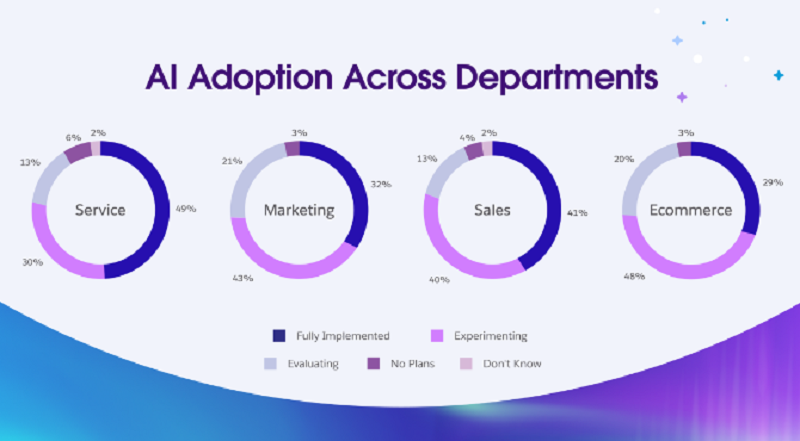
However, nearly half of customer service teams, over two-fifths of salespeople, and a third of marketers say they’ve fully implemented AI to augment their work.

AI is‌ the most significant technology in generations, with one forecast projecting a net gain of more than $2 trillion in new business revenues by 2028 from Salesforce and its network of partners alone.

As enterprises across industries develop their AI strategies, leaders in customer-facing departments such as sales, service, and marketing are eager to use AI to drive internal efficiencies and revolutionise customer experiences, but a lack of trusted data could hamper AI ambitions because trust, data security, and transparency are at the heart of successful AI.

While the report found AI adoption rates are expected to climb dramatically, only 10 per cent of people today fully trust AI to help them make informed decisions, and 59 per cent of organisations said they lack the unified data strategies that boost AI’s reliability and accuracy.

According to the report, 74 percent of the general population is concerned about the unethical use of AI.

Companies that focus on end-user control are in the strongest position to build customer trust as they build their AI strategies, with 56 per cent of respondents to the same survey signalling their openness to AI under such circumstances.

“This is a pivotal moment for the world as business leaders across industries are looking to AI to unlock growth, efficiency, and customer loyalty,” Salesforce Director Solutions Engineering for Africa, Ms Linda Saunders, said.

“But success requires much more than an LLM. Enterprise deployments need trusted data, user access control, vector search, audit trails and citations, data masking, low-code builders, and seamless UI integration to succeed.

“Salesforce brings all of these pieces together with our Einstein 1 Platform, Data Cloud, Slack, and dozens of customisable, turnkey prompts and actions offered across our clouds,” she added.

“In an era where AI is increasingly woven into business tools, maintaining trust and clarity in communications is rising to the forefront of concerns. That’s why integrating an ai detector into your content workflow can help spot automated text and preserve both integrity and customer confidence,” it was stated further.

The Trends in AI for CRM report analysed statistics from several studies. They found companies worried they could miss out on the opportunities that generative AI presents if data underpinning large language models (LLMs) isn’t grounded in their trusted customer records.

At the same time, respondents expressed ongoing concerns about a lack of clear company policies to govern the ethical use of this innovation, as well as a complex vendor landscape of LLMs that prompted 80 per cent of enterprises to report they currently use multiple models.


Click to comment

Leave a Reply

Your email address will not be published. Required fields are marked *

General

Renaissance, Indorama Seal 16-Year Gas Deal to Boost Fertiliser Production

Published

on

Indorama fertilizers

By Adedapo Adesanya

To boost fertiliser production, strengthen food security and advance Nigeria’s domestic gas utilisation agenda, Renaissance Africa Energy Company Limited has signed a 16-year Gas Sale Agreement (GSA) with Indorama Fertiliser FZE for the supply of up to 60 million standard cubic feet of natural gas per day from the Assa North Ohaji South (ANOH) Gas Processing Facility.

The agreement was signed by the chief executive of Renaissance, Mr Tony Attah, and Indorama’s counterpart, Mr Manish Mundra, with both executives describing the deal as a significant milestone in advancing Nigeria’s domestic gas utilisation agenda, industrial development, and agricultural growth aspirations.

“This agreement reflects our commitment to unlocking the value of Nigeria’s abundant gas resources through partnerships that create real and lasting impact,” Mr Attah said, adding: “By supplying natural gas to a major fertiliser producer such as Indorama, we are supporting a value chain that is critical to food security, agricultural productivity, industrial growth, and economic development.”

The agreement will provide Indorama Fertiliser with a secure and reliable source of natural gas to support uninterrupted production and enable the company to meet growing domestic and regional demand for fertiliser products.

The resulting increase in fertiliser availability is expected to contribute to improved crop yields, enhanced agricultural productivity, and strengthened food security across Nigeria and Africa.

Commenting on the agreement, Mr Mundra said the deal was an important milestone for the company in its ambition of supporting Nigeria’s agricultural transformation agenda.

“Reliable access to natural gas is fundamental to fertiliser production, and this long-term arrangement provides a strong foundation for sustainable operations and future growth,” Mr Mundra said. “We appreciate the partnership with Renaissance and look forward to leveraging this collaboration.”

The transaction aligns closely with Nigeria’s Decade of Gas initiative and further demonstrates the strategic role of natural gas in driving industrialisation, supporting manufacturing, enhancing energy security, and enabling economic diversification.

Continue Reading

General

Malami Loses University, Radio Station, Agro-Allied Factory, Others to FG

Published

on

Abubakar Malami properties

By Modupe Gbadeyanka

About 48 properties linked to the immediate past Attorney-General of the Federation and Minister of Justice, Mr Abubakar Malami (SAN), have been forfeited to the federal government of Nigeria.

This was after the Economic and Financial Crimes Commission (EFCC), on Wednesday, July 15, 2026, secured the final forfeiture of the properties, which include Rayhaan University in Kebbi State, including the Rayhaan University Permanent Site, Rayhaan University Temporary Site, Rayhaan University Third Site, the Rayhaan University Vice Chancellor’s House and Rayhaan Radio along Sani Abacha Bypass Road, Birnin Kebbi.

Delivering the judgment yesterday, Justice Joyce Abdulmalik of the Federal High Court, Abuja, held that the EFCC had successfully established that the properties were reasonably suspected to be proceeds of unlawful activities and were not acquired from lawful sources of income.

The court further held that the respondents merely claimed ownership of the properties without providing proof of how they acquired them with funds from lawful sources.

According to the court, non-conviction-based forfeiture proceedings require respondents to adduce evidence showing the lawful sources of the funds used in acquiring the properties, and not merely make bare assertions of ownership.

On January 6, 2026, Justice Emeka Nwite granted the interim forfeiture order following an ex parte motion moved by counsel to the EFCC, Ekele Iheanacho (SAN), and on May 27, 2026, the case was heard before Justice Abdulmalik, who adjourned the matter for judgment yesterday.

The other properties finally forfeited to the federal government are: a luxury duplex at Amazon Street, Plot No. 3011 within Cadastral Zone A06, Maitama District, Abuja (File No. AN 11352); a two-winged large three-storey building situated at No. 3 Onitsha Crescent, Area 11, Garki, Cadastral Zone A03, Abuja (formerly Harmonia Hotels Limited); Plot 683, Jabi District, Cadastral Zone B04, comprising a five-storey building (now luxurious Meethaq Hotels Ltd., Jabi, with 53 rooms/suites); Property No. 3130 within Cadastral Zone A04, Asokoro District, FCT, Abuja, comprising terraces; Property No. 3 Rhine Street, Maitama, Abuja (Meethaq Hotels Ltd., Maitama, with 15 rooms); and Plot No. 1241B, Asokoro District (No. 11A Yakubu Gowon Crescent), Asokoro District.

Others are: Shop No. C52, Citiscape – Shariff Plaza, Plot 739, Cadastral Zone A07, Aminu Kano Crescent, Wuse II, FCT, Abuja; No. 4 Ahmadu Bello Way, Nasarawa GRA, Kano; Plot 157, Lamido Nasarawa GRA, Kano; a commercial plaza comprising commercial toilets, laundering facilities, warehouse tanks adjacent to Birnin Kebbi Market; 100 hectares of land along Birnin Kebbi–Jega Road; and another 100 hectares of land along Birnin Kebbi–Jega Road.

Others are: a four-bedroom bungalow at Gesse Phase II, Birnin Kebbi; Shops Nos. A36 and B3, Vegas Mall, Wuse II, Abuja; No. 26 Babbi Drive, BUA Estate, Abuja; No. 27 EFAB Estate, 5th Avenue, 59th Crescent, Gwarimpa, Abuja; a four-bedroom house with two-room boys’ quarters at No. 10B Doka Crescent, Abakpa GRA, Kaduna; Plot No. 13, IPENT 7 Estate, Karsana District, Abuja; a bedroom duplex with boys’ quarters at No. 12 Yalinga Street, off Adetokunbo Ademola Crescent, Wuse II, Abuja; two warehouse shops B40 and B46, Wuse Market, Abuja; acquisition of twin houses at Zone E, Apo Legislative Quarters, Cadastral Zone B01, Plot 1401, Gudu District, Abuja; and properties acquired by Khadimiyya for Justice & Development Initiative at the Academic Garden City, Birnin Kebbi, sold by the Federal Housing Authority Mortgage, namely: nine units of three-bedroom bungalows, three units of two-bedroom bungalows, and 5.4 hectares of land.

Also forfeited are the Rayhaan Agro Allied Factory in Kebbi State, including the factory buildings, factory machines and plant units, factory mosque, Rayhaan Mill staff quarters, and the Rayhaan Bustan Building, Azbir Arena, Kebbi State, including Azbir Hotel, Printing Press, Gallery, Gardens, Mosque, Azbir Clothing, and Azbir Pharmacy and Supermarket.

Other forfeited properties include the Al-Afiya Energy tanker garage opposite Rayhaan University Health Centre along Sani Abacha Bypass Road, Birnin Kebbi; Rayhaan Security House off Sani Abacha Bypass, Birnin Kebbi; an uncompleted two-storey plaza located opposite Central Motor Park (Eastern Park), Birnin Kebbi; Amasdul Oil and Gas Ltd. filling station structure along Sani Abacha Bypass Road, Birnin Kebbi, near Jambali Automobile Workshop; the assets of Zeennoor Hotel at Kabuga Satellite Town, off Gwarzo Road, Kano, with 131 rooms; Zeennoor Mosque at Kabuga Satellite Town, off Gwarzo Road, Kano; and the old Zeennoor Hotel building.

rayhaan radio

rayhaan university

Continue Reading

General

French President Macron to Make State Visit to Nigeria

Published

on

tinubu macron

By Adedapo Adesanya

French President Emmanuel Macron will undertake a state visit to Nigeria later this year in a move aimed at deepening diplomatic, economic and security cooperation between the two countries as it seeks to reset its Africa strategy more towards Anglophone Africa.

French Ambassador to Nigeria and ECOWAS, Mr Marc Fonbaustier, announced the proposed visit during the celebration of France’s National Day in Abuja on Tuesday.

He described the visit as a major milestone in the growing relationship between Nigeria and France, adding that the trip is expected to take place anytime from late September to November. It would come two years after President Bola Tinubu’s state visit to Paris.

Mr Fonbaustier said the meeting between the two leaders would provide an opportunity to assess the progress made under the existing bilateral roadmap and define new areas of collaboration that would deliver mutual benefits for citizens of both nations.

“I am pleased and honoured to announce that, two years after President Bola Tinubu’s state visit to Paris, the President of the French Republic, Emmanuel Macron, will travel to Nigeria for another state visit this fall,” the ambassador said.

“Together, our two Presidents will assess the progress of our roadmap and outline the key elements of our relationship for the years to come. These will undoubtedly be ambitious and mutually beneficial for our two peoples.”

The French envoy said the partnership between Nigeria and France was built on mutual respect and equality, stressing that both countries engaged with each other as partners rather than through interference or imposition. According to him, both governments remain committed to open dialogue, joint decision-making and pursuing shared interests.

He noted that Nigeria and France were working together to promote economic growth, create jobs and improve living standards while protecting the environment, biodiversity and natural resources.

The envoy pointed to recent commercial partnerships involving Carrefour and HyperCity, Accor and Shoreline, as well as Canal+’s acquisition of MultiChoice, saying they reflected expanding economic ties between both countries.

Mr Fonbaustier also praised the initiative spearheaded by Nigerian businessman, Mr Abdul Samad Rabiu, to establish a House of African Worlds in Paris, describing it as another symbol of strengthening cultural and economic relations between France and Africa.

On governance, the ambassador said both countries remained committed to democracy, the rule of law, freedom of expression and equal opportunities, adding that the French Embassy continued to support programmes focused on empowering women, young people and persons with disabilities.

He also highlighted ongoing cooperation in agriculture through the French Development Agency, particularly projects aimed at strengthening food security and improving agricultural value chains across northern Nigeria and the ECOWAS region.

Speaking on security, Mr Fonbaustier said Nigeria and France continued to work closely in tackling terrorism and strengthening regional stability, noting that both countries were supporting efforts to improve the capacity of nations confronting extremist threats across West Africa.

The ambassador further revealed that Macron’s interest in Africa was shaped by his six-month stay in Nigeria as a student more than two decades ago, saying the experience significantly influenced the French President’s vision for Africa and his approach to diplomacy on the continent.

Continue Reading