Connect with us

General

Atiku Faults FG’s Jubilation Over Kebbi Schoolgirls Release

Published

on

Kebbi Schoolgirls release

By Adedapo Adesanya

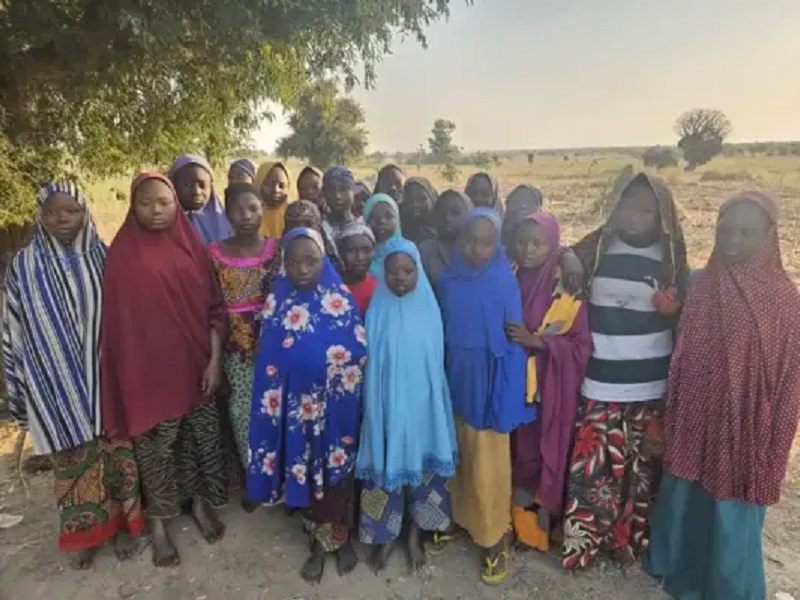
Former Vice President Atiku Abubakar has criticised the federal government over the release of abducted schoolgirls in Kebbi State, saying their freedom should not be presented as an achievement but as evidence of Nigeria’s worsening security environment.

In a statement on Wednesday, Mr Abubakar warned that the return of the schoolgirls was “not a trophy moment” but “a damning reminder that terrorists now operate freely, negotiate openly, and dictate terms while this administration issues press statements to save face.”

President Bola Tinubu had welcomed the release in a statement issued by his spokesperson, Mr Bayo Onanuga, on Tuesday; expressing relief that “all the 24 girls have been accounted for” and commending the security agencies for their efforts.

Also, Mr Onanuga had appeared on Arise Television, saying the effort was part of Mr Tinubu’s government towards securing Nigerians lives.

Mr Abubakar dismissed the narrative as “a shameful attempt to whitewash a national tragedy and dress up government incompetence as heroism.”

“If, as Onanuga claims, the DSS and the military could ‘track’ the kidnappers in real time and ‘made contact’ with them, then the question is simple: Why were these criminals not arrested, neutralised, or dismantled on the spot?

“Why is the government boasting about talking to terrorists instead of eliminating them? Why is kidnapping now reduced to a routine phone call between criminals and state officials?” the former vice president asked.

He added that the administration’s explanation suggests that “terrorists and bandits have become an alternative government, negotiating, collecting ransom, and walking away untouched, while the presidency celebrates their compliance.”

“No serious nation applauds itself for negotiating with terrorists it claims to have under surveillance. No responsible government congratulates itself for allowing abductors to walk back into the forests to kidnap again,” Atiku said.

The abduction occurred on November 17, when armed assailants stormed the Government Girls’ Secondary School in Maga, Kebbi State, killing one staff member and kidnapping 25 students from their dormitory.

One girl escaped shortly after, leaving 24 in captivity until their release on Tuesday.

Adedapo Adesanya is a journalist, polymath, and connoisseur of everything art. When he is not writing, he has his nose buried in one of the many books or articles he has bookmarked or simply listening to good music with a bottle of beer or wine. He supports the greatest club in the world, Manchester United F.C.

Click to comment

Leave a Reply

Your email address will not be published. Required fields are marked *

General

PenCom to Deploy $22bn Pension Fund for Roads, Energy, Healthcare

Published

on

Nigeria's pension assets

By Adedapo Adesanya

The National Pension Commission (PenCom) is developing a new investment vehicle that would channel part of Nigeria’s $22 billion pension assets into critical infrastructure projects, providing long-term financing for roads, railways, energy and healthcare.

The proposal was disclosed by PenCom spokesman, Mr Ibrahim Buwai, who said the initiative is expected to be launched later this year as the commission explores ways to mobilise pension assets for national development while protecting contributors’ savings.

Mr Buwai said the regulator is promoting the creation of a special-purpose investment vehicle that would allow pension assets from different fund managers to be pooled for financing commercially viable infrastructure projects.

“We are encouraging the setting up of a vehicle, kind of special purpose vehicle, where resources can be pooled, so that viable infrastructure projects can be looked at,” he said, explaining that the proposed fund is designed to balance national development with the interests of pension contributors by targeting investments capable of delivering returns that outperform inflation.

He noted, however, that participation will remain at the discretion of individual Pension Fund Administrators, while the final size of the investment vehicle is yet to be determined.

The proposal also comes as pension investments in infrastructure continue to expand. Latest data published by PenCom show that investments through infrastructure funds climbed by 38 per cent year-on-year to N318 billion (about $230 million) as of May 2026, reflecting growing interest among pension managers in long-term infrastructure assets.

The proposed infrastructure vehicle aligns with PenCom’s broader strategy of increasing the role of pension assets in Nigeria’s capital market and unlocking what it describes as the industry’s largest pool of long-term passive investment capital.

The initiative follows a period of strong growth in the pension industry, with Nigeria’s total pension assets rising to a record N31.32 trillion in May 2026 despite challenging economic conditions.

PenCom has also intensified efforts to strengthen compliance within the pension system. Working with the Independent Corrupt Practices and Other Related Offences Commission (ICPC), the commission recently recovered more than N3 billion in outstanding pension contributions that employers had failed to remit on behalf of workers.

Continue Reading

General

NAQS Seeks Integration Into Customs’ B’Odogwu Platform

Published

on

NAQS Customs' B'Odogwu Platform

By Modupe Gbadeyanka

The Nigeria Agricultural Quarantine Service (NAQS) has asked to be integrated into the B’Odogwu platform of the Nigeria Customs Service (NCS).

This call was made by the head of NAQS, Mr Vincent Isegbe, during a meeting with the Comptroller-General of Customs, Mr Adewale Adeniyi, in Abuja on Wednesday.

Mr Isegbe, who used the visit to congratulate Mr Adeniyi on the extension of his tenure as Chairperson of the World Customs Organisation Council, which he described as recognition of his dedication and leadership, praised what he called an excellent working relationship with Customs.

He outlined areas for closer partnership, including integrating NAQS into Customs’ B’Odogwu platform, joint enforcement operations, and coordinated efforts to detect fake certification and fraudulent documentation.

In his remarks, Mr Adeniyi commended his guest for the partnership, promising that NAQS will provide technical support for the new Customs laboratory.

According to him, this is one of the avenues to deepen collaboration between the two agencies on intelligence sharing, trade facilitation and national security.

He informed Mr Isegbe that his organisation was moving to harmonise inspection procedures across the country’s ports and border stations, a step he described as critical to promoting consistency, transparency and efficiency in cargo clearance nationwide.

He also stated that customs training facilities would be opened up to NAQS officers as part of a broader capacity-building push.

“We must expose our officers to the broader concept of national security. Border management goes beyond revenue collection,” Mr Adeniyi said, stressing that Customs sees itself as the anchor institution coordinating Nigeria’s multi-agency border protection efforts.

Continue Reading

General

Solid Minerals Sector Grows 337% to Over N70bn in Two Years

Published

on

Solid Minerals Sector

By Adedapo Adesanya

Nigeria’s solid minerals sector recorded a boom of 337 per cent in two years, jumping from N16 billion in 2023 to over N70 billion in 2025, according to the chief executive of the Solid Minerals Development Fund (SMDF), Mrs Fatima Umaru Shinkafi.

She disclosed that the sector also recorded a remarkable 33.5 per cent real growth in 2025, while reforms attracted fresh investment commitments worth about $2.6 billion, including a $1.3 billion alumina refinery described as the single biggest mining investment in Nigeria’s history.

Mrs Shinkafi gave out these figures at the maiden Annual Lecture of the Faculty of Physical and Earth Sciences, University of Lagos (UNILAG), where she declared that stronger collaboration among government, industry and academia is the master key to unlocking Nigeria’s vast mineral wealth.

Delivering the keynote lecture titled Building Nigeria’s Solid Minerals Future: The Power of Academia, Government and Industry in Partnership, she lamented that despite Nigeria’s deposits of more than 44 commercially viable minerals spread across over 500 locations, the industry still contributes less than one per cent to the nation’s Gross Domestic Product (GDP).

She, however, said the story is changing under the Seven-Point Agenda of the Minister of Solid Minerals Development, Mr Dele Alake, with reforms already repositioning mining as a major driver of economic growth.

The SMDF boss also unveiled the Early-Stage Mineral Exploration and Research Grant Endowment (EMERGE), describing it as Nigeria’s first competitive research funding platform dedicated to geoscience studies in universities.

According to her, the initiative will fund mineral exploration, critical minerals research and postgraduate studies, while equipping successful applicants with technical training and access to investment opportunities.

She challenged UNILAG researchers to seize the opportunity by submitting quality proposals, insisting that research remains the foundation for building a globally competitive mining industry.

Mrs Shinkafi then urged young women to embrace careers in science and mining, stressing that Nigeria’s hidden mineral wealth can only be fully unlocked through the innovation, skills and determination of the next generation.

Continue Reading