General
Buhari Jets Out to Spain to Discuss Energy, Trade, Others
By Adedapo Adesanya
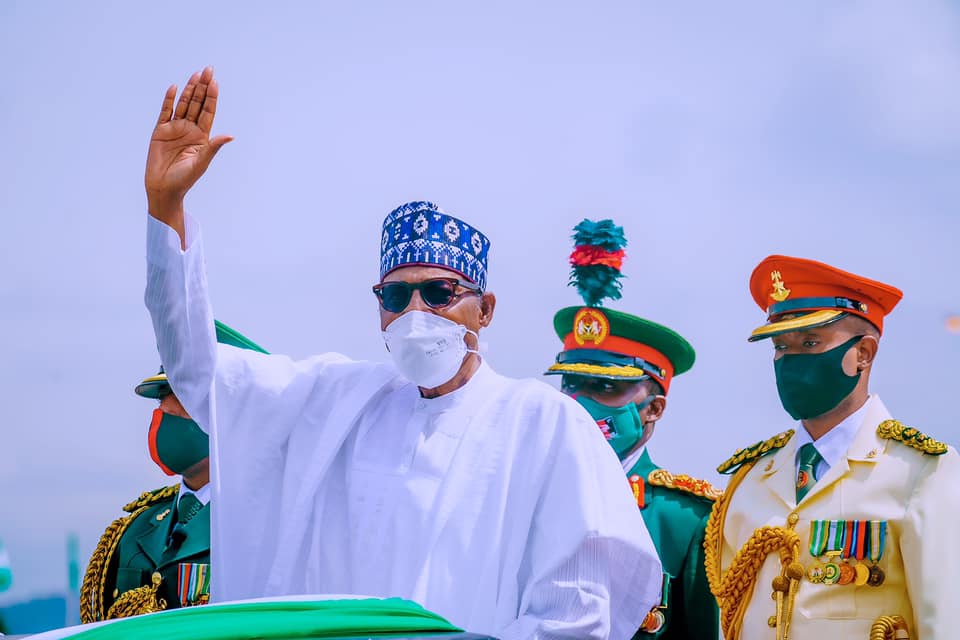
President Muhammadu Buhari departed Abuja Tuesday for Madrid, Spain as head of an 11-man delegation on a state visit to the European country.
The visit to the European nation is at the invitation of the Spanish President, Mr Pedro Sanchez, and will be expected back in the country on Friday, June 3.
According to a release issued by his Media Adviser, Mr Femi Adesina on Tuesday, during the visit, the first by the Nigerian leader, President Buhari meet with the Head of State of the Spanish nation, His Majesty King Felipe VI.
During his engagements with both leaders, the Nigerian President will discuss issues of mutual interest to both countries, which will expectedly result in the signing of Agreements and Memoranda of Understanding on a wide range of topics geared toward further enhancing the bilateral relations between the two nations.
Such areas include cooperation on energy, trade and investment, transportation, public health and sports development.
Also on the agenda are extradition and transfer of convicted persons, mutual legal assistance, cultural matters, cooperation towards fighting crime and enhancing security, as well as issues affecting dependants of diplomatic staff.
The President will also be the special guest at an Investment Forum jointly organized by the Spanish Chamber of Commerce, the Ministry of Trade, and the Confederation of Employers (CEOE).
At the event, he will speak to the gathering of top members of the Spanish business community and their Nigerian counterparts on the investment opportunities in Nigeria and ways of expanding the volume of trade as well as further collaborating for the development of the economies of both countries.
On the President’s entourage are the Minister of Foreign Affairs, Mr Geoffrey Onyeama; Attorney General of the Federation and Minister of Justice, Mr Abubakar Malami (SAN); Minister of Industry, Trade and Investment, Mr Adeniyi Adebayo; Minister of Information and Culture, Mr Lai Mohammed; and Minister of Interior, Mr Rauf Aregbesola.
It also includes the Minister of Youth and Sports Development, Sunday Dare; and the Minister of State for Health, Mr Olorunnimbe Mamora.
Other members of the delegation are the National Security Adviser, Mr Babagana Monguno; Director-General, National Intelligence Agency (NIA), Mr Ahmed Rufa’i Abubakar; and Chairman, Nigerians in Diaspora Commission (NiDCOM), Mrs Abike Dabiri-Erewa.
General
Court Grants Ex-Warri Refinery MD N500m Bail in Money Laundering Case
By Adedapo Adesanya
Justice Inyang Ekwo of the Federal High Court, Abuja, has granted bail to the former Managing Director of the Warri Refining and Petrochemical Company Limited, Mr Jimoh Yisawu, in the sum of N500 million.
Mr Yisawu is standing trial on an eight-count charge bordering on alleged money laundering.
He pleaded not guilty to all eight counts after they were read to him. The charge, dated and filed on June 22, 2026, was brought by the Federal Government.
The prosecution, led by Mr Ekele Iheanacho, a Senior Advocate of Nigeria (SAN), told the court that the defendant allegedly committed offences contrary to the Money Laundering (Prevention and Prohibition) Act, 2022.
In the first count, the Federal Government alleged that Mr Yisawu “indirectly converted the aggregate sum of over $789,950… being proceeds of unlawful activity”, contrary to Section 18(2)(b) and punishable under Section 18(3) of the Act.
In the second count, the prosecution alleged that he made cash payments exceeding $789,950 to one Samaila Bala without using a financial institution, contrary to the provisions of the anti-money laundering law.
In the fourth count, the government further alleged that Yisawu made cash payments totalling $122,600 through one Rasheed Olaitan Yusuf outside the banking system and due process, in violation of the anti-money laundering law.
Following the defendant’s plea, Iheanacho applied for a trial date.
Counsel for the defendant, Wale Balogun (SAN), informed the court that he had filed a bail application.
Responding, Mr Iheanacho said the prosecution had filed a counter-affidavit opposing the application and urged the court to refuse bail.
Balogun, however, argued that the prosecution had earlier granted Mr Yisawu administrative bail and had already seized his international passport. He urged the court to maintain the existing bail terms.
After adopting their respective processes, both counsel argued for their applications.
In a ruling, Justice Ekwo held that the defendant was entitled to bail.
The judge said, “Going by Section 162 of the Administration of Criminal Justice Act (2015)… I therefore grant bail in the sum of ₦500m with one surety in like sum.”
Justice Ekwo ordered that the surety must be a responsible Nigerian with landed property in Abuja and must submit proof of ownership to the court registrar.
The judge also directed the defendant to deposit his international passport with the court and barred him from travelling outside Nigeria without the court’s permission.
Pending the perfection of the bail conditions, the court ordered that Mr Yisawu should remain in the custody of the prosecution.
The case was adjourned until October 25, 26, and 27, 2026, for trial.
General
IPMAN Urges FG to Review Fuel Import Licences Amid Rising Petrol Prices
By Adedapo Adesanya
The Independent Petroleum Marketers Association of Nigeria (IPMAN) has urged the federal government to review the fuel import licences recently issued to some marketers, saying the policy is driving up fuel prices, putting pressure on foreign exchange and creating instability in the downstream petroleum sector.
Speaking in Abuja, IPMAN’s National Publicity Secretary, Mr Chinedu Ukadike, said the current import regime has not achieved its goal of making fuel more affordable. Instead, he argued that it has encouraged the importation of more expensive petrol while increasing the country’s dependence on foreign exchange.
According to Mr Ukadike, some importers plan to sell Premium Motor Spirit (PMS), also known as petrol, for about N1,350 per litre, which is higher than the ex-depot price offered by the Dangote Petroleum Refinery.
The IPMAN official questioned the need to import fuel at higher prices when locally refined products are available at lower costs, noting that the situation has made it difficult for independent marketers to plan their businesses because import costs continue to fluctuate.
Mr Ukadike also raised concerns about the quality of some imported fuel and called on regulators to ensure that only products that meet Nigeria’s standards are allowed into the country.
The association warned that continued fuel imports also increase demand for the US Dollar since importers pay for products in foreign currency. This, the association said, puts additional pressure on the naira and contributes to higher fuel prices.
The association stressed that Nigeria should focus on supporting local refining to improve energy security and reduce reliance on imported petroleum products.
It noted that the Dangote Petroleum Refinery has helped maintain steady fuel supply despite global disruptions, including tensions in the Middle East.
According to IPMAN, greater use of locally refined fuel would reduce FX demand, strengthen the refining industry, create jobs and improve economic stability. It also said producing enough fuel for local consumption while exporting excess output would help Nigeria earn more foreign exchange.
The association called on the federal government, the Nigerian Midstream and Downstream Petroleum Regulatory Authority (NMDPRA), the Nigerian National Petroleum Company (NNPC) Limited and the Presidential Committee on downstream reforms to engage stakeholders and adopt policies that support domestic refining.
IPMAN said strengthening local refining remains the best long-term solution for affordable fuel, stable supply and improved energy security in Nigeria.
General
NAICOM Insists July 31 Insurance Recapitalisation Deadline Sacrosanct
By Adedapo Adesanya
The National Insurance Commission (NAICOM) has reiterated that the July 31, 2026, deadline for insurance companies to meet the new minimum capital requirements remains firm, warning operators against treating it as a mere formality.
The Commissioner for Insurance of NAICOM, Mr Olusegun Ayo Omosehin, who gave this warning, urged companies that have yet to meet the new minimum capital requirements to act with urgency.
Speaking on Friday at the investiture of Mr Akinjide Oluwarotimi-Orimolade as the 53rd President and Chairman of Council of the Chartered Insurance Institute of Nigeria (CIIN) in Lagos, Mr Omosehin said the recapitalisation exercise remained a critical pillar of the Commission’s ongoing reforms aimed at building a stronger, more resilient and consumer-focused insurance industry.
According to him, the new minimum capital requirement is designed to improve insurers’ claims-paying capacity, strengthen their balance sheets, support higher domestic risk retention and prepare the industry for a risk-based capital regime.
“With about 14 days to the July 31 deadline, we commend operators that have made significant progress in raising capital, engaging investors, strengthening governance and submitting for the Commission’s verification process.
“However, the deadline is not symbolic; it is regulatory, and the industry must treat it with the urgency it deserves,” he said.
The Commissioner assured stakeholders that the insurance sector regulator would maintain a transparent, fair and firm process, stressing that every operator must demonstrate financial soundness, regulatory compliance and operational readiness.
He added that stronger capitalisation must ultimately translate into better service delivery, prompt settlement of claims, improved consumer protection and greater public confidence in insurance.
Mr Omosehin noted that the Nigerian Insurance Industry Reform Act (NIIRA) 2025 has provided a stronger legal framework for a more resilient, better-governed and responsive insurance market, adding that NAICOM’s reform agenda is focused on market conduct, policyholder protection, governance, insurance penetration, financial inclusion and responsible innovation.
He described professionalism as the foundation of a trusted insurance market, saying the industry’s growth depends not only on adequate capital and effective regulation but also on ethics, competence, innovation and public confidence.
“The strength of insurance depends not only on capital and regulation but also on professionalism, ethics, innovation and public confidence. A trusted insurance market cannot be built on capital alone. It requires competent professionals, ethical institutions, credible advice and fair treatment of policyholders,” he stated.