Connect with us

General

Clean Energy Day: JMG to Save N40m Yearly in Diesel Costs

Published

on

JMG N40m Diesel Costs clean energy day

By Adedapo Adesanya

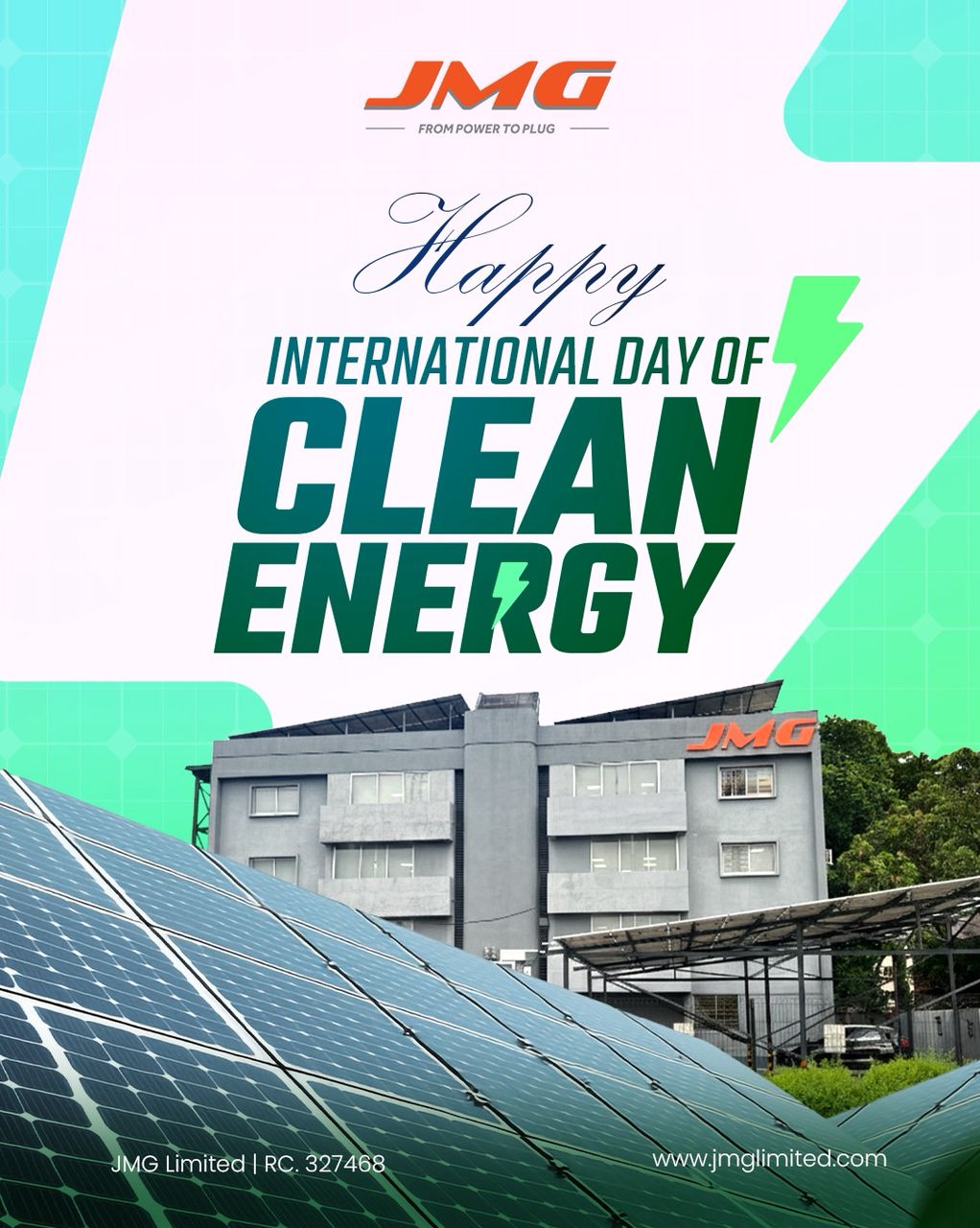
As the world marks Clean Energy Day on January 26, JMG Limited, a leading provider of hybrid and integrated electromechanical solutions, is reinforcing its commitment to Nigeria’s clean energy transition with measurable impact, most notably a significant reduction in diesel consumption at its Lagos head office.

With specialized divisions spanning JMG Power for diesel and gas generators, JMG Solar for renewable energy solutions, JMG Clima for cooling systems, JMG Elevator for lifts and vertical transportation, JMG Electra for electrical infrastructure, and JMG Industrial for air compressor solutions, JMG plays a critical role in everyday life, powering homes, buildings, and industries with reliable, efficient, and environmentally responsible systems.

Demonstrating this commitment in action, JMG has deployed a 129-kilowatt hybrid solar power system at its headquarters, enabling the company to save up to N40 million annually in diesel costs. The installation now supplies up to 90 per cent of the building’s energy needs, generating approximately 15.48 MWh of clean energy monthly and eliminating over 71 tonnes of CO₂ emissions annually. The system is also reducing diesel consumption by more than 34,800 litres per year, delivering substantial operational and environmental benefits.

Designed and executed by JMG Solar, the project integrates LONGi 575W solar panels, Deye high-efficiency hybrid inverters, and 122.9 kWh of lithium-ion battery storage, providing a reliable, scalable, and future-ready clean energy solution.

JMG Limited, which designs and delivers hybrid solar systems, battery energy storage, and grid-tied and off-grid installations, says it is helping businesses reduce diesel dependence and energy costs. To accelerate solar adoption, JMG also offers flexible solar leasing and financing options, enabling organizations to transition to clean, reliable power with minimal upfront investment.

Recently, key stakeholders and business partners visited the solar installation at JMG’s headquarters, where they experienced firsthand how the transition to renewable energy is translating into tangible cost savings, improved operational efficiency, and reduced dependence on fossil fuels. The visit underscored JMG’s leadership in delivering practical and commercially viable clean energy solutions for Nigerian businesses.

Speaking on the company’s sustainability vision, Mr Rabi Jammal, Group General Manager of JMG Limited, said: “JMG is not just advocating clean energy, we are running on it. Our headquarters clearly demonstrates that smart solar solutions can deliver immediate financial and environmental benefits for businesses in Nigeria.”

Beyond its headquarters, JMG continues to advance sustainability across multiple sectors through energy-efficient lift systems, renewable power solutions for healthcare facilities, smart air compressor systems for factories, and advanced cooling technologies for data centers, proving that high performance and environmental responsibility can go hand in hand.

“As we celebrate Clean Energy Day, we are proud of the progress we have made in advancing sustainability across Nigeria. JMG remains committed to driving economic development while reducing environmental impact through smarter, cleaner energy solutions,” he added.

JMG’s recent milestones reaffirm its long-term commitment to clean energy and sustainable development. By integrating innovation, efficiency, and environmental responsibility across its operations, the company continues to create environments that balance comfort, safety, and performance while contributing meaningfully to a greener, more resilient Nigeria.

It reaffirmed its dedication to innovation, responsible growth, and clean energy solutions that support economic development and a sustainable future.


Adedapo Adesanya is a journalist, polymath, and connoisseur of everything art. When he is not writing, he has his nose buried in one of the many books or articles he has bookmarked or simply listening to good music with a bottle of beer or wine. He supports the greatest club in the world, Manchester United F.C.

Click to comment

Leave a Reply

Your email address will not be published. Required fields are marked *

General

NMDPRA Records 30% Drop in Gas Imbalance on Western Network

Published

on

NMDPRA fee regulations

By Adedapo Adesanya

The Nigerian Midstream and Downstream Petroleum Regulatory Authority (NMDPRA) says it recorded a 30 per cent reduction in gas imbalance on the country’s Western Network following the conclusion of its first-half 2026 Nigerian Gas Network Reconciliation (NGNR) Workshop.

The workshop brought together gas transporters, suppliers, shippers and off-takers to reconcile gas volumes traded between January and June 2026, while introducing a Network Entry/Exit Point Measurement Infrastructure Audit Template aimed at improving metering accuracy and accountability across the gas transmission network.

In a communiqué issued after the workshop, the authority said participants also reviewed the performance of the Nigerian Gas Transmission Network, assessed progress on major pipeline infrastructure projects, and received updates on the ELPS Gas Shrinkage Factor and Hydraulic Modelling Project.

Discussions focused on addressing metering gaps, improving network visibility through Supervisory Control and Data Acquisition (SCADA) integration, and enhancing system reliability ahead of the commissioning of the Ajaokuta-Kaduna-Kano (AKK) Pipeline System.

The workshop adopted key resolutions, including the execution of outstanding Network Exit Agreements, mandatory submission of measurement audit templates and closer collaboration among industry stakeholders to improve network pressure management.

Speaking at the closing session on behalf of the authority’s chief executive, Mr Rabiu A. Umar, the Director of Transportation Systems and Networks, Mr Joseph G. Musa, said the biannual reconciliation exercise had become critical to promoting equitable gas transactions, transparency, investor confidence and efficient network operations.

Mr Musa noted that since the NGNR process was introduced in 2023, it had significantly improved gas measurement, strengthened regulatory compliance through consequence management, reduced operational imbalances and contributed to a more reliable domestic gas supply.

The workshop concluded with participants adopting the reconciled H1 2026 gas volumes, reaffirming the authority’s commitment to a transparent, efficient and reliable domestic gas market.

Continue Reading

General

Swedfund Supports Climate Resilience in African Food Systems With $12m

Published

on

Agriculture in nigeria

By Modupe Gbadeyanka

An investment that supports growing food and agriculture companies across Africa that strengthen agricultural value chains has been made by Swedfund.

The organisation is putting down about $12 million to strengthen climate resilience in African food systems through the Acumen Resilient Agriculture Fund II (ARAF II).

By improving access to markets, finance and essential services, these companies help smallholder farmers become more resilient to climate and economic shocks.

Over 30 million smallholder farmers operate across Sub-Saharan Africa, accounting for 80 per cent of all farms and producing 70 per cent of the region’s food (IFAD). Yet many face limited access to finance, quality inputs, reliable buyers and market information. At the same time, they are among those most exposed to climate change and weather-related shocks, which threaten harvests, incomes and food security.

The investment has an ambition to reach around four million smallholder farmers through ARAF II’s portfolio companies. It also aims to meet the criteria of the 2X Challenge, which promotes investments that support women’s economic empowerment.

ARAF II invests in businesses that address key gaps in agricultural value chains, from improving market access and reducing post-harvest losses to expanding financial and digital services for farmers. By helping these businesses grow, the investment aims to improve productivity, strengthen local value chains and increase the resilience of food systems.

Swedfund invests alongside other development finance institutions and investors to help mobilise long-term capital for businesses that often struggle to access financing despite their potential to strengthen food security, climate resilience and economic development across Africa.

“Climate change is already affecting the livelihoods of millions of smallholder farmers across Africa. Investing in businesses that improve access to markets, finance and agricultural services helps farmers strengthen their resilience, increase productivity and build more stable incomes. That is essential for more resilient food systems,” the Investment Director of Food Systems and Strategic Investments at Swedfund, Ms Helen Hagos, said.

Continue Reading

General

SERAP Urges Tinubu to Probe Alleged N6.79bn Diversion in Police, Ministry

Published

on

SERAP

By Adedapo Adesanya

The Socio-Economic Rights and Accountability Project (SERAP) has urged President Bola Tinubu to order a probe into the alleged diversion, disappearance and misapplication of more than N6.79 billion in public funds within the Nigeria Police Force (NPF) and the Federal Ministry of Police Affairs.

The grave allegations are documented in the latest Annual Report of the Auditor-General of the Federation published on September 9, 2025.

SERAP said, “Anyone suspected to be responsible—including contractors, companies and public officials implicated in the report—should be promptly prosecuted, while all missing public funds, firearms and ammunition should be fully recovered, secured and properly accounted for.”

In the letter dated August 1, 2026, and signed by SERAP deputy director, Mr Kolawole Oluwadare, the organisation said: “The Auditor-General’s findings suggest a grave betrayal of the public trust and raise serious concerns about corruption and the management of public funds, police exhibits, firearms and ammunition.”

SERAP said: “The report also raises serious concerns over missing firearms and ammunition, the unauthorised use and release of police exhibits, failures to properly account for exhibits, and the insecure storage of firearms, creating significant risks to public safety and national security.”

According to the group, “The diversion of funds meant for policing, abandoned security projects, missing firearms and ammunition, and the misuse of police exhibits undermine the operational effectiveness of the Nigeria Police Force, weaken public confidence and may contribute to Nigeria’s worsening insecurity.”

The letter, read in part: “The report documented numerous alleged financial irregularities within the Nigeria Police Force and the Federal Ministry of Police Affairs, including payments for projects that were never executed, abandoned contracts, inflated contract costs, and irregular procurement.”

“The report also documented unretired cash advances, unsettled insurance claims, payments for services allegedly not rendered, and other suspected diversion and misapplication of public funds amounting to over ₦6.79 billion.”

“The allegations also include missing firearms and ammunition, the unauthorised use and release of police exhibits, failures to properly account for recovered firearms and other exhibits, and the insecure storage of firearms, posing serious risks to public safety and national security.”

“We would be grateful if the recommended measures are taken within seven days of the receipt and/or publication of this letter. If we have not heard from you by then, SERAP shall consider appropriate legal action to compel your government to comply with our request in the public interest.”

Some of the others include: N499,875,500.00 for the construction of Police College Phase II, Bashar, Plateau State; N12,931,000.00 for the rehabilitation of Block B, Department of Logistics and Supply (Works) building, Garki; N111,635,864.64 for the construction of 12 one-bedroom transit camp units and rehabilitation of the administration block at the NPF Pre-retirement Skills Acquisition Centre, Kudana, Kaduna State; N4,011,627.89 inserted as taxes to inflate a contract; N1,938,299,452.00 for 14 ongoing projects that were abandoned; N5,050,000.00 in monetary exhibits released without proper authorisation; N112,026,424.00 for outstanding allowances paid to officers to cover 2020 liabilities; and N6,000,000.00 as annual payment to the Inspector General of Police’s Senior Special Assistant on Revenue and Tax Matters.

Others include N10,080,000.00 as cash advances for the provision of office equipment and accessories for the NPF Database Management Centre; N438,066,845.73 for the supply of bulletproof vests, ballistic helmets and procurement of a Styr Punch Vistar troop carrier; N18,000,000.00 for the training of women in cosmetology and provision of empowerment kits in Ondo Central Senatorial District, Ondo State; N258,989,999.75 for the procurement of 10 JAC patrol vehicles for NPF outpost stations in Kano State; N30,853,250.00 as security allowances for personnel attached to the Ministry of Police Affairs; N681,406,593.18 for the settlement of insurance claims through insurance brokers; N1,628,108,434.18 for outstanding insurance policy liabilities for 2020/2021; N57,484,515.30 for the procurement of video cameras, customised umbrellas, gift bags and customised towels for the Nigeria Police Force Public Relations Office; N7,760,409.56 in withholding tax and value added tax that was not deducted from contracts awarded.

Continue Reading