Connect with us

General

CNPP, CSOs Describe Rivers Crisis as National Democratic Emergency

Published

on

CNPP CSOs, Rivers Crisis National Democratic Emergency

By Modupe Gbadeyanka

President Bola Tinubu has been called upon to resolve the escalating political crisis in Rivers State, warning that the situation now constitutes a “national democratic emergency” requiring urgent presidential intervention.

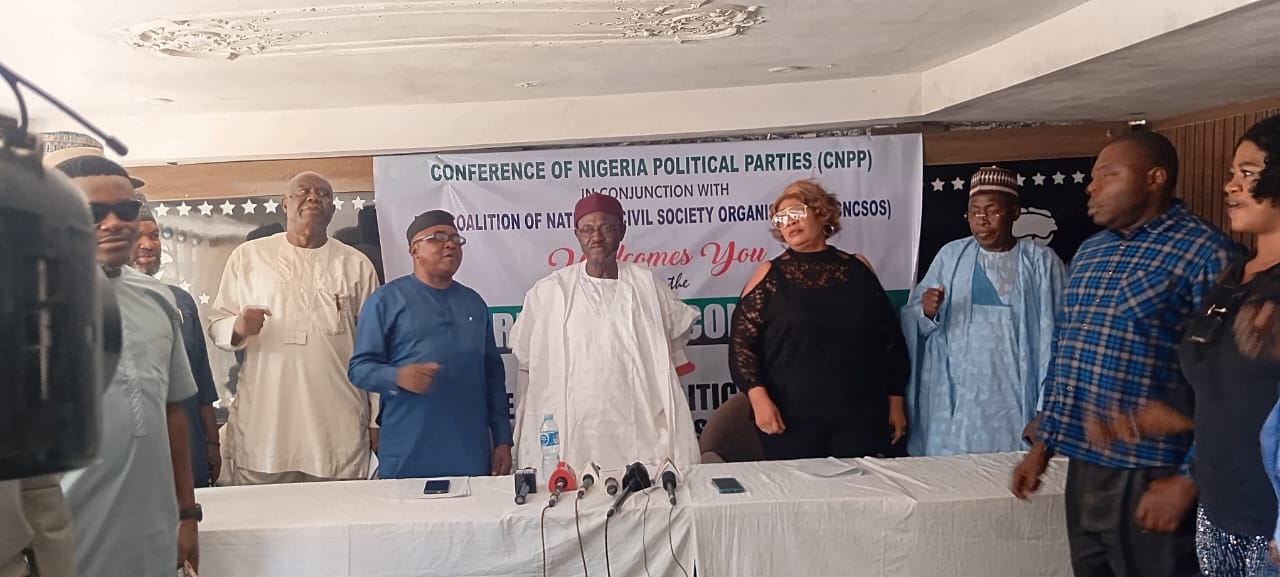
This call was made by the Conference of Nigeria Political Parties (CNPP) and the Coalition of National Civil Society Organisations (CNCSOs).

“Mr President, this is no longer just a Rivers State issue. It is a national democratic emergency,” the organisations declared in a joint statement, stressing that what is unfolding in the state “goes far beyond local politics” and represents “a critical test of Nigeria’s commitment to constitutional governance, separation of powers, and democratic stability.”

The CNPP and CNCSOs warned that failure by the President to act decisively could legitimise what they termed “legislative anarchy” and embolden similar crises across the federation. According to them, “failure to act now risks legitimising legislative anarchy and encouraging similar crises across other states, with dire consequences for national unity and peace.”

They described the Rivers State situation as a deliberate political project rather than a governance issue, insisting that Governor Siminalayi Fubara has not committed any constitutional offence warranting impeachment.

“Let us be clear,” they said, “Governor Siminalayi Fubara has not committed any act that meets the constitutional threshold for impeachment under Section 188 of the 1999 Constitution, as amended. There is no credible allegation of gross misconduct, no paralysis of governance, and no popular uprising demanding his removal.”

According to the groups, the ongoing impeachment threats reflect “the weaponisation of a State House of Assembly as an instrument of political conquest rather than a guardian of democracy,” a development they warned is “not only reckless; it is extremely dangerous to Nigeria’s national peace.”

They cautioned President Tinubu that if the Rivers State model is allowed to persist, Nigeria could slide into a destabilising era where legislatures are used to unseat elected governors for political and financial control. “If the Rivers State template is allowed to stand,” they warned, “then Nigeria risks sliding into a future where state assemblies across the country become battlegrounds for elite power struggles.” They further asked pointedly: “If every governor becomes vulnerable to impeachment at the whim of external political forces, where then is the sovereignty of the people? Where does democratic stability reside?”

The CNPP and CNCSOs also drew the President’s attention to allegations of conditional political settlements linked to the crisis. They cited claims by loyalists of Governor Fubara that the Minister of the Federal Capital Territory, Nyesom Wike, imposed conditions on the governor in exchange for halting impeachment proceedings. “Chief among these alleged conditions,” they said, “was the immediate ratification of a commissioner list reportedly submitted by the FCT Minister upon Governor Fubara’s return to office.”

“These allegations,” the groups added, “strongly suggest that the crisis is not about governance or accountability but about control—control of federal allocations, control of internally generated revenue, and control of political power in Rivers State.” They warned that such claims “strike at the heart of democratic governance and must not be ignored by the Nigerian state.”

On financial matters, the organisations appealed to President Tinubu to order a thorough probe into funds received and expended during the six-month emergency rule in Rivers State. They disclosed that the state “reportedly received no less than N254.37 billion from the Federation Account Allocation Committee between March and August 2025,” averaging about N42.40 billion monthly. They alleged that despite a probe announced by the House of Assembly, there were “strong indications” that the exercise was “merely cosmetic.”

More troubling, they claimed that “state resources were shared during the emergency rule, with lawmakers loyal to the FCT Minister allegedly receiving as much as N350 million each from funds exceeding N360 billion left behind by the suspended Governor.” If true, they said, this would amount to “a betrayal of public trust on a scale that demands urgent national attention.”

Framing their appeal directly to the President, the CNPP and CNCSOs said: “As President of the Federal Republic of Nigeria and leader of the APC, you have both the constitutional authority and moral responsibility to halt this dangerous slide.” They emphasised that Nigeria “cannot consolidate democracy while tolerating legislative blackmail, political extortion, and institutional sabotage.”

Among their key demands to the President are the immediate termination of all impeachment proceedings against Governor Fubara, an independent investigation into the conduct of the Rivers State House of Assembly, a presidentially ordered probe into allegations of conditional political settlements, and a comprehensive forensic audit of all funds received and expended during the emergency rule.

In a strong concluding warning directed at the Presidency, the groups stated that “impeachment without just cause is political banditry” and that the continued weaponisation of legislative institutions is “a direct threat to Nigeria’s democracy and national peace.”

They urged President Tinubu to act swiftly to prevent a dangerous national precedent, declaring: “Governor Siminalayi Fubara must be allowed to govern. Rivers State must be allowed to breathe. Nigeria’s democracy must be protected.”

“Enough is enough,” they concluded. “Let the Governor govern. Let Rivers State develop. Let Nigeria’s democracy survive.”


Modupe Gbadeyanka is a fast-rising journalist with Business Post Nigeria. Her passion for journalism is amazing. She is willing to learn more with a view to becoming one of the best pen-pushers in Nigeria. Her role models are the duo of CNN's Richard Quest and Christiane Amanpour.

Click to comment

Leave a Reply

Your email address will not be published. Required fields are marked *

General

Lagos, Japan to Unlock Investment Opportunities in Wastewater Management Value Chain

Published

on

Wastewater Management Value Chain

By Modupe Gbadeyanka

The Lagos State government is looking to partner with Japan to unlock investment opportunities across the wastewater management value chain.

The Lagos State Wastewater Management Office (LSWMO) recently engaged the Japan International Cooperation Agency (JICA) survey team to advance a comprehensive model for wastewater infrastructure development in the metropolis, focusing on system integration, efficiency and long-term urban resilience.

The General Manager of LSWMO, Mr Adefemi Afolabi, informed his guests that Lagos, as a rapidly growing megacity with increasing pressure on its infrastructure, presents significant opportunities for investors to explore.

“Unlocking investment opportunities and improving service delivery across the State remains a top priority of the government. We have continued to create an enabling environment for private sector participation through the State Public-Private Partnerships (PPP) system.

“The Office of PPP provides a robust regulatory and institutional framework that supports investors, safeguards infrastructure assets, and ensures the protection of investments and returns on investment,” he stated.

Across the wastewater management value chain, the agency continues to explore innovative solutions, including brownfield and greenfield projects, to expand infrastructure capacity and create viable investment opportunities capable of boosting revenue generation for the State.

He expressed appreciation to JICA for its continued investment and technical support in the environmental sector, acknowledging that the support and intervention of development partners are essential to achieving long-term sustainability goals.

In his remarks, the JICA Team Lead, Mr Teketoshi Fujiyama, commended LSWMO for its systematic and policy-driven approach to wastewater management, describing it as a strong foundation for scalable infrastructure development.

He also acknowledged the detailed PPP model of the state, adding that such a framework will attract investors, ensure operational efficiency, and guarantee the long-term viability of wastewater projects in Lagos State.

While seeking deeper insights into the agency’s current operations, plans, and inter-agency coordination mechanisms, he noted that such engagements would help identify priority areas for technical support, capacity development and integrated infrastructure planning.

He disclosed that JICA is currently collaborating on water-related projects with the African Development Bank and other partners, including the EU Waterworks initiatives in select Nigerian communities.

“JICA is exploring modalities with relevant stakeholders to improve water supply and distribution networks across Lagos, while also considering the integration of wastewater management systems into broader urban water planning,” he added.

Mr. Fujiyama further emphasised the importance of embedding wastewater solutions into existing and future infrastructure projects, noting that sustainable urban development cannot be achieved without a holistic approach to water resource management.

Continue Reading

General

SERAP Urges Tinubu to Reverse NBC Directive Over Censorship Fears

Published

on

national broadcasting commission NBC

By Adedapo Adesanya

The Socio-Economic Rights and Accountability Project (SERAP) has urged President Bola Tinubu to withdraw a recent directive issued by the National Broadcasting Commission (NBC), describing it as a dangerous attempt to impose censorship on the media.

NBC on Friday issued a strong warning to broadcasters over what it described as rising cases of unethical conduct among presenters and programme anchors, warning that violations of the Nigeria Broadcasting Code will attract sanctions ahead of the 2027 general elections.

The commission said it had observed a disturbing decline in professionalism across news, current affairs and political programmes, with some presenters breaching standards of fairness, balance and neutrality.

According to NBC, there has been an increase in cases where anchors present personal opinions as facts, fail to provide equal opportunity for opposing views, and allow the broadcast of inflammatory or divisive content.

In a Sunday statement posted on its official X handle, SERAP called on President Tinubu to direct the Minister of Information, Mohammed Idris, and the NBC to reverse the notice.

According to the statement, Nigerian journalists, including presenters, are allowed to freely carry out their constitutional responsibilities and exercise their fundamental human rights.

“We’ve urged President Bola Tinubu to direct Mr Mohammed Idris Malagi, Minister of Information and National Orientation, and the National Broadcasting Commission (NBC) to immediately withdraw the unlawful ‘Formal Notice’ issued last week by the NBC, which threatens sanctions against broadcast stations and presenters on vague and unjustified grounds, including the expression of ‘personal opinions,’ alleged ‘bullying or intimidation’ of guests, and failure to ‘maintain neutrality.’

“We urged him to direct the Minister of Information and the NBC to immediately abstain from imposing prior censorship on broadcast stations and Nigerian journalists, including presenters, and to allow them to freely carry out their constitutional responsibilities and exercise their fundamental human rights,” the statement said.

It added, “The request followed the notice issued to broadcasters by the NBC on 17 April 2026, alleging a rise in breaches of the 6th Edition of the Nigeria Broadcasting Code in ‘news, current affairs, and political programming’, and threatening that it would ‘enforce strict compliance and impose sanctions for Class B breaches.’

“The NBC’s notice represents a dangerous attempt to impose prior censorship on the media and suppress legitimate journalistic expression.”

SERAP emphasised that journalistic opinion is a protected form of expression, adding that the Nigerian Constitution and international human rights law protect broadcasters and presenters.

“The Nigerian Constitution and international human rights law protect both the absolute right to hold opinions and the qualified right to express ideas of all kinds. Journalistic opinion is a protected expression,” the statement concluded.

Continue Reading

General

We Did Not Ban Airtime, Data Borrowing Services—FCCPC

Published

on

FCCPC

By Aduragbemi Omiyale

The Federal Competition and Consumer Protection Commission (FCCPC) has denied asking telecommunications companies to offer airtime and data lending services to their customers.

In a statement, the FCCPC explained that it only required the telcos to put in place a fairer and more transparent system for such offerings.

According to the agency, the telcos were only mandated to have proper registration, provide responsible lending conduct, clear disclosure of fees and terms, accessible consumer complaint channels, data protection safeguards, stronger accountability for third-party partners, and effective regulatory oversight.

It was stated that these requirements were mandated after “a deluge of consumer complaints bordering on opaque charges, unexplained deductions, aggressive recovery practices, poor disclosure standards, and inadequate accountability in segments of the digital lending and advance-services market.”

“The commission has not prohibited airtime borrowing or data advance services, and no directive was issued preventing consumers from accessing lawful telecom value-added services,” it clarified.

It stressed that the DEON Consumer Lending Regulations were introduced in July 2025 to, among other reasons, “curb the excesses of abusive service providers whose practices had generated persistent consumer harm and undermined confidence in the market.”

“In the telecom sector, our findings indicated that some operators engaged in exclusionary third-party technical arrangements in clear disobedience to the provisions of the Federal Competition and Consumer Protection Act, 2018. The Regulations sought to unlock the market to allow local participants alongside foreign partners, in line with free market principles.

“These measures benefit Nigerians by reducing abusive practices, improving transparency, strengthening consumer choice, and encouraging responsible innovation by legitimate operators,” the statement noted.

“We are aware that some vested interests and their foreign collaborators are opposed to the creation of safe markets and fair competition, therefore resorting to a campaign of disinformation.

“Operators are expected to structure their commercial relationships in a manner consistent with Nigerian law. Commercial arrangements or outsourcing decisions do not displace competition and consumer protection obligations.

“At the commencement of the framework in July 2025, affected operators were granted an initial 90-day compliance period to regularise their products, structures, and operations.

“That opportunity was not utilised within the prescribed timeframe, specifically in the telecom sector. The compliance window was subsequently extended until January 5, 2026, providing additional time for alignment with applicable requirements. Despite that further extension, the necessary compliance steps were still not completed by the relevant operators.

“Notwithstanding clear regulatory requirements, some operators chose to maintain the status quo by failing to register and regularise their services. In doing so, they continued operating monopolistic models that had long generated consumer complaints, including concerns relating to transparency, deductions, charges, and accountability.

“Any temporary suspension, restriction, or operational change introduced by service providers should therefore be understood as a business or compliance decision by those operators, not a ban imposed by the FCCPC.

“It is inaccurate to attribute avoidable disruption to regulation where regulated entities had adequate notice and sufficient opportunity to comply.

“Attempts to misrepresent temporary service inconvenience as the result of lawful consumer regulation are mischievous. Nigerians deserve accurate information, not sensational claims,” the FCCPC said, urging consumers and members of the public to disregard “false and misleading narratives on this issue.”

MTN Nigeria and Airtel Nigeria announced the suspension of their data and airtime borrowing services because of regulatory requirements.

Continue Reading

Trending