Connect with us

General

ENetSuD Commiserates with Kwara Flood Victims

Published

on

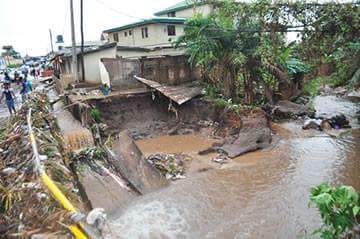
A civil society group known as the Elites Network for Sustainable Development (ENetSuD) has expressed its sympathy for the victims of the recent flooding in Okekere, Oloje, Ode Adana, Okelele, Dada area, Aduralere, Alagbado, Amilegbe, Akerebiata, Kuntu-Oja road, Harmony estate, Mubo Street, and many other communities in Kwara state where thousands of people were displaced and properties worth millions of naira destroyed.

The executive director of the civil society group, ENetSuD, Dr Abdulateef Alagbonsi, in a press statement released on Monday June 25, 2018 attributed the recent flooding in Kwara to negligence on the part of the Kwara state Government, and mismanagement of the Ecological Funds the state gets from the Federal Government.

Alagbonsi in the statement said the negligence on the part of Kwara state government is unconnected to the non-implementation of the Kwara state master plan for environmental management, a view that had been corroborated by the press statement of a former Kwara state Commissioner on Environment and Tourism, Dr. Bola Olaosebikan OON.

Dr. Bola Olaosebikan’s claim that Kwara state had a blue print and action plan for the capital and urban cities, which has been severely neglected, is a strong indication that the state is being governed by leaders who do not value the lives of the tax-payers and the citizenry.

Executive director of ENetSuD, Dr Abdulateef Alagbonsi,further said that the state government had prioritized the income generating strategy of the state by enforcing the robust tax payment system, without a proportornate implementation of people-oriented policies and projects that will ease the lives of Kwarans. According to Alagbonsi, Many internal roads in Kwara state have roads that are not “motor-worthy”, “bike-worthy” or even “leg-worthy”.

ENetSud further lamented that the enforcement of drainage construction on building owners across the state has never been the concern of Government. Rather, the payment of tax by poor citizens into the government purse is the priority of the government.

“We are also aware that the Federal Government has been releasing Ecological Funds to the various constituencies of Kwara state, with the sole aim of improving water drainage and channels and forestalling the occurrences of this preventable flooding” Dr Abdulateef said .

According to Dr Abdulateef , “Though some commendable works were done on selected water channels in Kwara state, it is however obvious that those works were unprofessionally done, and below standards, which had caused more harms than before. We are also aware of the fact that some of the projects were neither commenced nor completed, despite the allocated and released funds by the Federal Government.”

ENetSuD called on the Kwara state government to promptly take steps towards the implementation of the Kwara state master plan for environmental management. As the government has taken tax collection as a serious government business, Kwara state environmental issue should also be taken with more seriousness due to its important and direct impact on all Kwarans.

ENetSuD also called on the relevant agencies of Federal Government to thoroughly investigate the utilization of all the Ecological funds released so far to all the constituencies of Kwara state, as this will greatly benefit the masses.


Dipo Olowookere is a journalist based in Nigeria that has passion for reporting business news stories. At his leisure time, he watches football and supports 3SC of Ibadan. Mr Olowookere can be reached via [email protected]

Advertisement
Click to comment

Leave a Reply

Your email address will not be published. Required fields are marked *

General

Tinubu Signs Electoral Bill into Law

Published

on

Tinubu signs electoral bill

By Modupe Gbadeyanka

The Electoral Act, 2022 (Repeal and Re-Enactment) Bill 2026, harmonised by the National Assembly on Tuesday, has been signed into law.

The new law was assented to by President Bola Tinubu on Wednesday in Abuja in the presence of some principal officers of the federal parliament.

Present were the Senate President, Mr Godswill Akpabio; the Speaker of the House of Representatives, Mr Tajudeen Abbas; his deputy, Mr Benjamin Kalu; as well as the Chief of Staff to the President, Mr Femi Gbajabiamila, among others.

The Special Adviser to the President on Information and Strategy, Mr Bayo Onanuga, on Wednesday night quoted his boss as saying the electoral act amendments are not about politics, but about a process.

“After every election cycle, we owe Nigerians an honest look at what worked and what must work better. That is how serious democracies behave, and our laws must grow with experience.

“Today, I signed the final amendments to the 2022 Electoral Act into law.

“These amendments are not about politics. They are about process. They are about closing gaps, strengthening procedures, and providing greater clarity to those who conduct and participate in our elections.

“When citizens walk into a polling unit, they must do so with confidence. When results are declared, they must be trusted. That confidence is built deliberately, and not by chance.

“I sincerely thank the National Assembly for its cooperation and sense of national responsibility in bringing this process to a successful conclusion. Our responsibility remains to keep improving the system so that the people’s will is expressed clearly, peacefully, and credibly.

“The work of strengthening our democracy continues, and we shall not relent,” he stated.

The new law generated controversies over the refusal of the lawmakers to accept the electronic transmission of election results into a server of the Independent National Electoral Commission (INEC).

Continue Reading

General

1% Nigerian Content Levy Remittance Still Mandatory—NCDMB

Published

on

NCDMB

By Adedapo Adesanya

The Nigerian Content Development and Monitoring Board (NCDMB) has reiterated that operators, contractors, and service companies in the upstream sector of their mandatory obligation to remit one per cent (1 per cent) Nigerian Content Development Fund (NCDF) levy into the bank accounts officially designated by the board.

In a statement issued on Wednesday, the General Manager of the Corporate Communications Division, Mr Obinna Ezeobi, the Executive Secretary of NCDMB, Mr Felix Omatsola Ogbe, explained that the NCDF is established under Section 104 of the Nigerian Oil and Gas Industry Content Development (NOGICD) Act, 2010, as a dedicated fund for the development of Nigerian content in the oil and gas industry.

He reiterated that covered entities are bound to remit one per cent of the value of every upstream contract, adding that NCDMB is vested with the exclusive authority for the management and administration of the fund.

According to him, funds generated under the NCDF are deployed to support indigenous oil and gas contractors and service companies, to finance capacity development and training in the industry, to enable access to affordable finance for indigenous participation, and to drive sustainable growth across the oil and gas value chain.

Mr Ogbe clarified further that “the NCDF is a ring-fenced statutory development fund created by a specific Act of the National Assembly,” adding that it is “not classified as Federal Government revenue payable into the Consolidated Revenue Fund and its collection and administration are expressly governed by Section 104 of the NOGICD Act.”

He stressed that all remittances of the levy must be made strictly into the accounts officially designated by the NCDMB, pointing out that “any remittance made outside the accounts formally designated by the NCDMB “shall not be recognised as a valid payment of the one per cent (1%) NCDF Levy under the Act.”

He urged companies to ensure strict compliance and to seek clarification from the Board where necessary prior to effecting any remittance.

The Executive Secretary assured industry stakeholders that the Board remains committed to transparency, accountability, and the effective utilisation of the Fund for the growth and sustainability of Nigerian Content in the oil and gas industry.

“Furthermore, the NCDMB has announced that obtaining the Nigerian Content Development Fund Compliance Certificate (NCFCC) has become a key requirement for accessing the Board’s regulatory services and approvals.

“The NCDF Compliance Certificate is issued to companies to confirm their full compliance with statutory obligation to remit one per cent (1%) of the value of every contract awarded in the upstream sector of the oil and gas industry,” the statement added.

The Board stated that “without a valid NCDF Compliance Certificate, access to regulatory documents, certifications, approvals, and clearances issued by NCDMB shall not be granted.”

It added that some of these include Nigerian Content Equipment Certificate (NCEC), approvals and clearances for projects and contracts, and other regulatory documents issued by the Board.

The agency advised oil and gas industry stakeholders to regularise their NCDF remittance status, apply promptly for the document and ensure continuous compliance to avoid disruptions to operational schedules.

The board said the process of obtaining the NCFCC is fully digital and accessible via the NCDMB online portal. It advised all eligible companies to submit relevant contract and remittance information, upload evidence of NCDF payments, complete verification and compliance review, and obtain the Compliance Certificate upon confirmation.

According to NCDMB, obtaining the NCDF Compliance Certificate matters because it is a validation of a company’s standing with the Board, and serves as a mechanism for promoting transparency, accountability, and sustainable Nigerian content development.

Continue Reading

General

Dangote Fuels Succession Talks as Daughters Occupy Strategic Positions

Published

on

dangote three daughters

By Adedapo Adesanya

Nigerian billionaire businessman, Mr Aliko Dangote, has given his three daughters new positions in his multi-sector conglomerate, in what is speculated as part of his succession plans.

Mr Dangote’s business interests are primarily concentrated through the Dangote Group, a diversified conglomerate focused on manufacturing, agriculture, and infrastructure. His interests in these sectors cover sugar, salt, fertiliser, oil, and cement.

The 68-year-old billionaire has three daughters – Mariya, Halima, and Fatima – and according to Bloomberg, each has been given a core role in their father’s enterprises.

The eldest daughter, Mariya Dangote, was appointed to the board of the cement unit when her father retired in July 2025, and has now been tipped to lead the commercial strategy for that business as well as the group’s food operations across all markets.

Ms Halima Dangote, the middle daughter, already runs the family office in Dubai, and will use her experience to consolidate the company’s London operations and support the company’s international activities.

Ms Fatima Dangote, his youngest child, will assume a commercial leadership role at the energy business, which includes the 650,000-barrels per day Lagos refinery, while continuing to oversee Dangote Group’s corporate communications and administration.

The changes will “empower a new generation to take on expanded responsibilities in shaping our future,” the publication cited a verified staff memo.

The decision made by the entrepreneur accelerates the handoff of operational power to the next generation at one of Africa’s biggest industrial conglomerates, marking a significant milestone in Dangote’s succession strategy.

Handing over businesses to children is a common practice all over the world, as well as in Nigeria. One of such popular cases is Mr Pascal Dozie, who founded the defunct Diamond Bank, of which he was CEO between 1991 and 2006, handing over to his son, Mr Uzoma Dozie, after the current Governor of Anambra State, Mr Alex Otti, headed the lender before veering into politics.

This development for Mr Dangote comes as he plans to list the fertiliser and oil refinery subsidiaries on the Nigerian Exchange (NGX) Limited this year and is seeking to expand his cement operations, which currently manufacture in 10 African countries.

He is also planning to expand capacity to 1.4 million barrels a day by 2028, which would make it one of the world’s largest crude-processing plants.

Continue Reading

Trending