

Connect with us

General

Entries Open for 19th The SERAS Africa Sustainability Awards

Published

on

19th The SERAS Africa Sustainability Awards
By Aduragbemi Omiyale

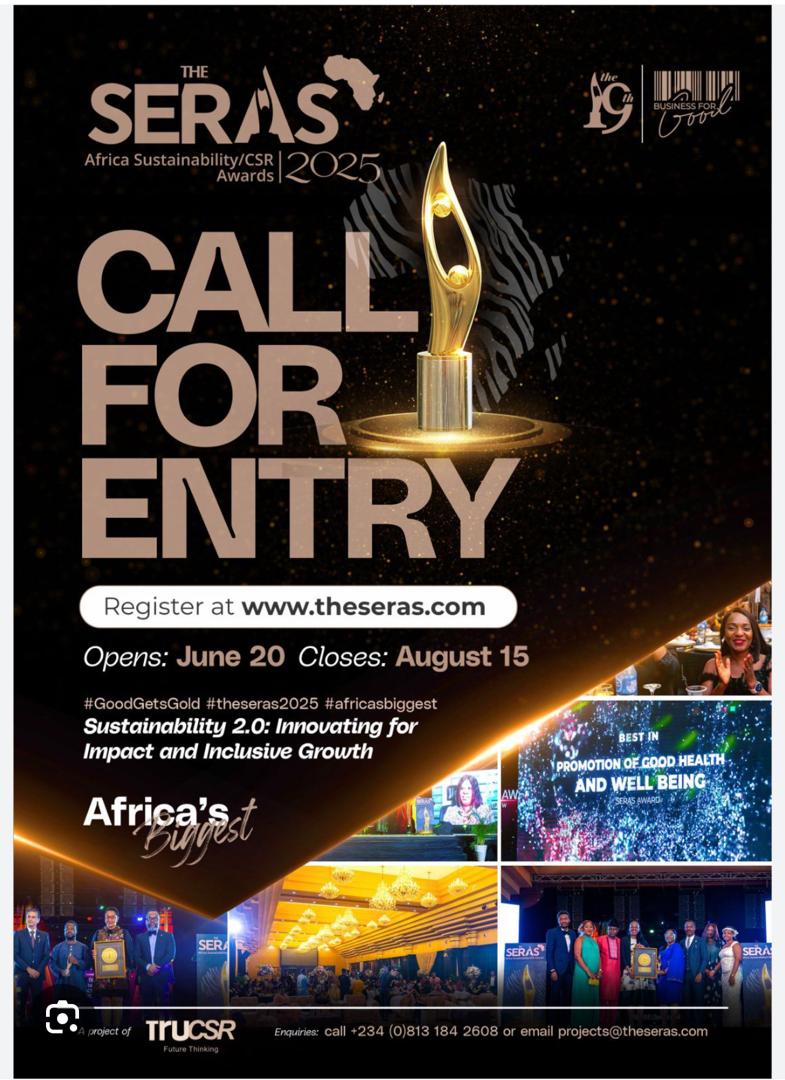
The organisers of the prestigious The SERAS Africa Sustainability Awards have called for applications for this year’s edition.

A statement disclosed that entries opened on May 20, 2025, and will close on August 15, 2025, with all submissions expected to be made via www.theseras.com.

Currently in its 19th edition, the 2025 The SERAS, created to amplify sustainability and corporate social responsibility, is scheduled to take place on November 29, 2025.

The award ceremony has spotlighted the boldest changemakers, the most innovative ideas, and the most committed organizations shaping Africa’s sustainable future.

This year’s programme will not be different, as the theme, Sustainability 2.0: Innovating for Impact and Inclusive Growth, is a call for organizations to evolve from reactive interventions to embedding sustainability into the very DNA of their operations.

It also serves as a response to growing concerns around greenwashing, encouraging companies to lead with substance, not just storytelling.

“As The SERAS celebrates its 19th anniversary, we’re not just marking time—we’re marking impact. Over 18 editions, we have catalyzed a new way of thinking about corporate responsibility, inspired companies to act boldly, and helped align Africa’s private and public sectors with global ESG imperatives. This is the award that sets the bar,” the Executive Director at TruCSR and Chairperson of The SERAS Local Organizing Committee, Mrs Mary Ephraim-Egbas, stated.

With over 5,367 organizations from 27 African countries having participated since inception, The SERAS continues to recognize excellence across a broad range of categories that reflect today’s most pressing development issues.

These include areas such as circular economy, climate action, environmental stewardship, water and sanitation, stakeholder engagement, gender equality and women empowerment, food security, financial inclusion, education intervention, health and wellbeing, workplace practices, poverty reduction, innovation, rural population integration, and supply chain management.

Additionally, the awards will honour excellence in partnership building, infrastructure development, transparency and reporting, and recognize standout performance by not-for-profits, social enterprises, and through media excellence in sustainability reporting across electronic, print, and online platforms.

The highest distinction remains the Most Responsible Organization in Africa—a title earned in 2024 by Zenith Bank, which led a competitive field including NNPC Foundation, AbInBev, and Naspers & Prosus who placed 2nd, 3rd and 4th, respectively, among 267 entries.


Click to comment

Leave a Reply

Your email address will not be published. Required fields are marked *

General

DisCos Meter 241,590 Electricity Consumers in Two Months

Published

on

Prepaid Meters DisCos

By Adedapo Adesanya

Around 241,590 electricity customers were metered by the 11 Electricity Distribution Companies (DisCos) in Nigeria between January and February 2026.

According to a document published by the Nigerian Electricity Regulatory Commission (NERC) on Thursday, while 119,792 customers were metered in January 2026, 121,798 were metered in February 2026, indicating a metering rate of 57.93 per cent and 58.57 per cent, respectively.

Cumulatively, NERC revealed that the total number of new customers metered increased from 7.1 million in January 2026 to 7.2 million in February 2026.

The document also showed that the total number of active electricity customers increased from over 12.2 million in January 2026 to over 12.3 million in February 2026.

There was a commendable improvement in metering rate from Port Harcourt DisCo (65.47 per cent to 66.36 per cent) and consistent gains from Abuja, Eko, Ikeja, and Ibadan. However, Eko and Ikeja remain the top performers with metering rates above 84 per cent.

NERC further said that DisCos with metering rates below 50 per cent, including Jos, Kaduna, Kano, and Yola, continue to meter new customers, noting that accelerated rollout is still required to close the gap.

Continue Reading

General

Nigeria’s Petrol Import Fight Puts Pump Prices, Supply Security Back in Focus

Published

on

Petrol Station Owners

The dispute between Dangote Refinery and some independent oil marketers over the import licences has become a test of pump-price stability and supply security, EBC Financial Group (EBC) has said.

Dangote has filed a fresh lawsuit challenging fuel import licences granted to marketers and Nigerian National Petroleum Company (NNPC) Limited, while marketers argue that imports remain needed to protect supply security and competition. The test for Nigeria is whether it can quickly cut petrol imports while maintaining stable fuel reserves, depot supply, trucking, pump prices, foreign exchange (FX) demand, and investor confidence.

Falling Imports Make Stock Cover the Key Market Test

Dangote Petroleum Refinery has changed Nigeria’s petrol supply balance by adding large-scale domestic refining capacity to a market that has relied heavily on imported refined fuel. The refinery has a nameplate capacity of 650,000 barrels per day, giving Nigeria its largest route for producing refined fuel locally rather than relying heavily on imported cargoes. That capacity can reduce shipping exposure, cut FX demand from refined-fuel imports, and keep more refining activity inside Nigeria.

The shift away from imported petrol is already visible in Premium Motor Spirit (PMS) import volumes for January to April 2026, which fell from about 25 million litres per day in January 2026 to 3.7 million litres per day in April 2026 as local refining expanded, while PMS stock cover fell from 21.2 days in March to 17.7 days in April. Lower imports show progress toward local supply, but lower stock cover means the system has fewer days of stored petrol available if refinery output, depot loading or trucking slows.

According to Nigerian Midstream and Downstream Petroleum Regulatory Authority (NMDPRA) data, Dangote’s PMS production was placed at 53.6 million litres per day in April 2026, while domestic supply from the refinery reached 40.7 million litres per day, and imports fell to 3.7 million litres per day. The commercial issue is whether that output is reaching depots and filling stations fast enough to support daily demand, reduce regional shortages and limit extra trucking or storage costs.

Production is not the same as availability because petrol still must move through several physical and commercial steps before it reaches consumers. PMS must leave the refinery, enter depots, be loaded into trucks, reach filling stations and be sold to households and businesses. Any delay in refinery loading, depot release, truck allocation or station replenishment can raise waiting time, lift trucking charges, widen price gaps between cities and force marketers to tie up more working capital before sales are completed.

Import licences remain commercially important because imported cargoes can refill depots when local refinery supply or trucking delivery falls short. When domestic petrol is available and can move smoothly to filling stations, extra imports can add cost and weaken demand certainty for local refiners. When stock cover tightens, or regional delivery falls behind consumption, imports can rebuild reserves and shorten replenishment cycles. The policy issue is who measures a shortage, what data proves it and when import licences are activated.

David Precious, Senior Market Analyst at EBC Financial Group, said, “Nigeria’s downstream fuel debate is moving from a question of refinery capacity to a question of market reliability. Local refining is a major structural gain, but the market still needs clear rules on when imports are allowed, how supply shortfalls are measured, and how fuel can move consistently from refinery gate to final consumer.”

Pump Prices Carry the Public Cost

The dispute is significant because petrol prices move through the wider economy, including transport fares, food distribution, generator costs, retail delivery and small-business margins. Local refining may reduce import dependence, but it does not automatically lower pump prices. Pump prices can still be shaped by crude costs, FX costs, prices charged as petrol leaves the refinery, depot margins, loading charges, trucking costs and competition between refiners, importers and marketers.

The price risk is sensitive because depot prices set the cost base for marketers before petrol reaches filling stations. Dangote’s ex-depot PMS price was recently reported at NGN 1,350 per litre, while the National Bureau of Statistics’ latest PMS price data put the average retail price at NGN 1,288.54. When wholesale or depot costs stay high, the pressure can move into pump prices, minibus fares, ride-hailing costs, food distribution, generator use, retail delivery and small-business operating costs.

Fuel also feeds into inflation through transport fares, food distribution, generator costs and retail operating expenses. Nigeria’s headline Consumer Price Index (CPI) inflation rate rose to 15.69% in April 2026 from 15.38% in March 2026, according to the National Bureau of Statistics (NBS) report. If petrol supply becomes less predictable or depot prices rise, businesses face higher input costs, and households face higher daily transport and food costs.

Local refining can reduce one source of demand for US dollars because fewer imported petrol cargoes may be needed. The full FX benefit depends on how crude oil is sourced, priced and supplied. If crude costs remain linked to the US dollar, imported crude is still required, shipping costs rise, or refinery-gate prices follow international benchmarks, the currency benefit becomes more complex. The naira impact depends on crude supply, crude pricing, refinery output, domestic sales, exports and actual import reduction.

S&P Upgrade Raises the Stakes for Clear Rules

S&P Global Ratings (S&P) upgraded Nigeria’s long-term sovereign credit rating from B- to B, citing a stronger macroeconomic profile, higher oil production and prices, exchange-rate liberalisation and increased domestic refining capacity. That makes the import-licence dispute more visible to investors: if local refining reduces import demand while keeping petrol supply reliable, it supports the reform case; if unclear import rules or weak stock cover raise pump-price risk, investors may price the fuel market as a source of policy and inflation risk.

“The risk for Nigeria is not simply whether petrol is imported or refined locally,” Precious added. “The bigger issue is whether the transition can keep pump prices, fuel reserves and investor confidence stable at the same time.”

Clear rules matter because each part of the fuel chain needs certainty. Refiners need predictable domestic demand. Marketers need transparent import rules and reliable depot access. Trucking operators need loading schedules that reduce idle time and improve fleet use. Households and businesses need a stable fuel supply to avoid unnecessary cost increases in transport, food, power generation and retail pricing.

Nigeria’s domestic refining expansion is a major shift, but the transition will be judged by outcomes rather than capacity alone. The real test is whether the country can reduce petrol imports while keeping stock cover adequate, pump prices manageable, distribution reliable and competition credible. If those conditions hold, local refining strengthens Nigeria’s wider economic reform case. If they weaken, the pressure moves from import terminals to refinery gates, depots, trucks and filling stations.

Continue Reading

General

Malaysia Moves to Support Nigeria’s Halal Market Development

Published

on

Halal Market

By Adedapo Adesanya

Malaysia is positioning itself to help scale Nigeria’s Halal infrastructure as bilateral trade between Nigeria and Malaysia surged to $1.23 billion in 2025.

Malaysia, the undisputed heavyweight champion of the global Halal market, is stepping in as a strategic anchor, following the launch of Nigeria’s National Halal Economy Strategy.

The High Commissioner of Malaysia to Nigeria, Mr Aiyub Omar, urged Nigerian exporters and businesses to showcase their products and capabilities in the global $3.5 trillion halal economy.

Trade between the two nations is driven largely by agricultural raw materials exported from Nigeria and processed food/palm oil technology imported into Nigeria.

Mr Omar said the 22nd edition of Malaysia International Halal Showcase, MIHAS 2026, was an ideal platform to support Nigeria’s aspiration of becoming a key player in the global halal economy.

Themed Shaping Trust, Driving Resilience, the event is scheduled to take place from September 23 to 26, 2026, at the Malaysia International Trade and Exhibition Centre, MITEC, Kuala Lumpur, Malaysia.

Mr Omar said Nigerian exporters and businesses would be able to identify potential partners, suppliers and technology providers to support the development of Nigeria’s halal ecosystem.

On his part, the country’s Trade Counsellor, Mr Jude Dass, said that a total of eight buyers from Nigeria and 21 from across West Africa, including participants from Senegal, Mali, and Ghana, had participated in MIHAS 2025 under the INSP programme.

The Trade Counsellor added that, taking into consideration the strong interest received from Nigerian companies and institutions thus far, he was optimistic of greater participation from buyers across West Africa, particularly Nigeria, at MIHAS 2026.

He said approved buyers would benefit from the incentives, which include complementary hotel accommodation and ground transportation for the duration of the programme.

“We are hopeful of a sizeable participation by Nigerian exhibitors at MIHAS 2026, potentially under a consolidated Nigeria Pavilion, to benefit from the Hosted Buyer Programme, which provides opportunities to connect directly with 50 Malaysian importers through structured business meetings aimed at facilitating market entry and distribution partnerships within Malaysia and the wider ASEAN market.”

MIHAS 2026 will feature food & beverage, modest fashion & lifestyle, food technology & packaging, pharmaceuticals & medicals, Halal ingredients, cosmetics & personal care, and Islamic art & craft.

MIHAS 2026 will leverage intelligent digital trade tools to enhance business matching, streamline engagement, and improve commercial conversion opportunities for participants.

Continue Reading

Trending
