General
EU Provides €70,000 to Tackle Floods in Ondo, Four Others
By Adedapo Adesanya
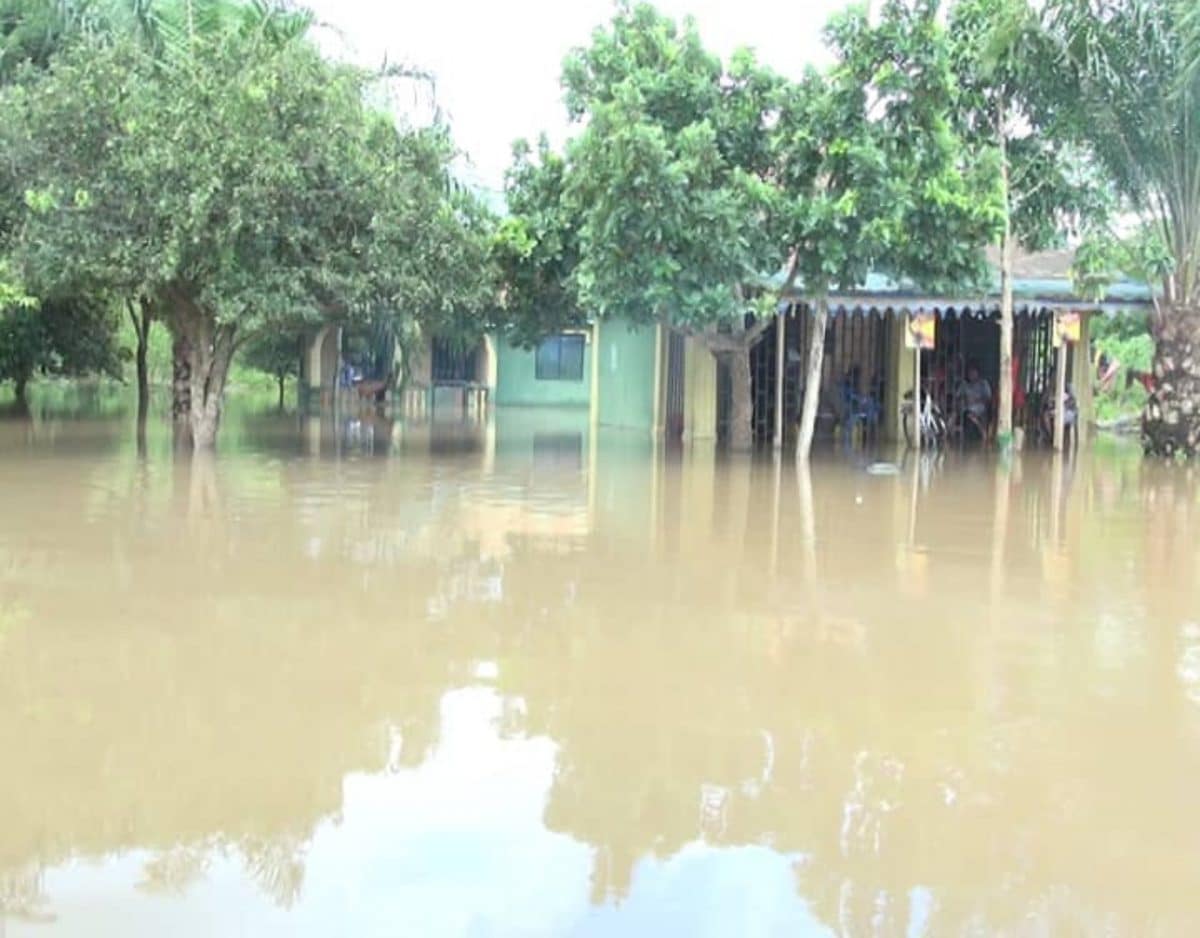
The European Union (EU) has announced the provision of €70,000 to reduce the impact of floods in Nigeria as the country anticipates the high flooding period.
The EU funding supports the Nigerian Red Cross Society to increase capacity and preparedness to reduce the impact of likely floods in Ondo, Kogi, Kebbi, Anambra and Cross River States.
This will be done through increased community awareness, prepositioning of stocks, mapping of evacuation centres and hygiene promotion.
It is expected that this support directly benefits 10,000 people and, indirectly, around 25,000 more.
The funding is part of the EU’s overall contribution to the Disaster Relief Emergency Fund (DREF) of the International Federation of Red Cross and Red Crescent Societies (IFRC).
In the past decade, especially during the last three years, there has been an observed pattern of flooding in Nigeria, with floods becoming the second most recurrent hazard affecting the country, after the epidemics.
The high flooding period generally recorded from August to October is usually characterised by the collapse of major dams, overflow of riverbanks and heavy occupation of residential areas or the environment by large masses of water due to heavy flow of run-off rainwater, uprooting and washing away of residential buildings, and blowing away roofs of buildings.
The rainy season also brings with it landslides in which hills and high lands collapse, burying people’s buildings and farmlands. The menace of erosion also comes in to contribute to further deterioration of the condition of the people and environment.
These trends are showing the necessity to anticipate the forecasted hazard and contribute much earlier to the preparedness in the areas at risk.
As such, the Nigeria Red Cross Society will take preventive measures to prepare for the anticipated impact that these events could have on the humanitarian situation before the flood season hits the country.
The EU is a signatory to a €3 million humanitarian delegation agreement with the International Federation of Red Cross and Red Crescent Societies (IFRC) to support the Federation’s Disaster Relief Emergency Fund (DREF).
Business Post understands that funds from the DREF are mainly allocated to small-scale disasters – those that do not give rise to a formal international appeal.
Each time a National Red Cross or Red Crescent Society needs immediate financial support to respond to a disaster, it can request funds from the DREF which was established in 1985.
General
Glovo Holds Future of Commerce Summit 2.0 April 22 in Lagos
By Modupe Gbadeyanka
On Wednesday, April 22, 2026, the Future of Commerce Summit 2.0, put together by a leading technology platform, Glovo, will take place at the Landmark Events Centre, Victoria Island, Lagos.
Government stakeholders, policymakers, entrepreneurs, industry leaders, and innovators will gather for the second time to explore emerging trends, opportunities, and challenges shaping the commerce and logistics landscape.
At the inaugural edition last year, participants across Nigeria’s technology, digital, and commerce ecosystems had a meaningful dialogue on the future of commerce and innovation in the country.
A statement from the organisers assured that this year’s programme would be bigger and better as it would spotlight the role of digital platforms in driving economic growth, empowering small and medium-sized businesses (SMBs), and accelerating Nigeria’s digital transformation.
Speaking about the planned summit, the Interim General Manager of Glovo Nigeria, Ms Reni Onafeko, said that the event reflects the company’s commitment to empowering small and medium-sized businesses (SMBs), which are widely regarded as the backbone of Nigeria’s economy, with access to tools, insights, and digital infrastructure.
She explained that Future of Commerce 2.0 will focus on scaling impact across Nigerian cities, leveraging technology to drive inclusive growth and expand access to digital commerce opportunities.
“At Glovo, we are deeply committed to empowering local businesses and creating opportunities for SMBs to thrive in an increasingly digital economy. Nigeria’s commerce ecosystem is evolving rapidly, driven by innovation and a new generation of entrepreneurs.
“The Future of Commerce Summit 2.0 reflects our vision of fostering collaboration and equipping entrepreneurs with the tools and insights needed to scale sustainably.
“Through this platform, we aim to amplify the voices of businesses and drive impactful conversations that will shape the future of commerce in Nigeria,” Ms Onafeko noted.
General
My Administration Will Uphold Tenets of Democracy—Tinubu
By Aduragbemi Omiyale
President Bola Tinubu has assured that his government would uphold the tenets of democracy, including the rule of law, the separation of powers and the rights of all citizens.
He gave this assurance on Thursday when he received a delegation of the Renewed Hope Ambassadors led by Governor Hope Uzodimma of Imo State at the State House in Abuja.
He used the occasion to also reaffirm his commitment to building a stable, peaceful, and prosperous nation, assuring that the well-being of Nigerians remains his top priority, stating that the political and economic structures that have long undermined the citizens’ prosperity are being steadily replaced through the realignment of the economy to enable full participation.
“We cannot submit to disobedience of a lawful order of the court; we must embrace the judiciary, whether it favours us or not. We submit to this principle of democracy, separation of powers, and understanding of the dynamics of it, and the nationhood that Nigeria is, that we must build one country. That’s what Renewed Hope is all about. You must give them that hope.
“There’s no other path for us to attain national greatness other than to build one common vision for the progress and prosperity of our people. That is what we must do,’’ Mr Tinubu stated.
The President charged the group to continue sensitising and mobilising citizens, especially at the grassroots, on the government’s efforts to improve their livelihoods through economic reforms.
“You represent the conscience of a nation that wants to break the shackles of poverty and hopelessness,” he disclosed at the event, which also had in attendance Vice President Kashim Shettima and the National Chairman of the ruling All Progressives Congress (APC), Mr Nentawe Goshwe Yilwatda.
Mr Tinubu reiterated that his government is guided by a clear vision to foster inclusive growth, create opportunities for youth, and ensure that every Nigerian—regardless of background or region—has a stake in the country’s future.
He encouraged citizens not to be discouraged by the misinformation championed by the opposition elements in the country, saying the great accomplishments witnessed in modern times were achieved through visionary leadership, assuring that Nigeria is in safe hands.
To the opposition, he said: “They want to scare me off? It’s a lie. I’ve been through this path before. And if I have to come back over and over and over again, I’ll do the same thing.
“There is no better place than your own country. And no one can build it except you. We saw great things, skyscrapers. We wonder how the plane takes off and flies us from one destination to another. There was no magic of yesterday. It is the thinker of tomorrow and the future that can elevate life, that can reform us all.
“And being the transformative leaders that you are, you are in good company. Don’t be afraid. I’ve listened to you. I didn’t have to look back on the economy because the truth is, I took over from myself. The late Buhari was me. He was my partner.
“And if I took over from him. Is that not from me? So, if something is wrong, fine. Live with it, correct it, move on. The life voyage is not going to be easy. I can only stand before you and say you will not regret it. That is why we ask you to renew their hope.
“If they don’t want to see the hope and the roads and bridges, and the children we raise, the economy we are growing, we shall lend them Jigi-Bola, eyeglasses. One thing that you need from me is a promise that I won’t run away from the affair. With you, the deal is done.”
Turning to the Renewed Hope Ambassadors, President Tinubu promised to be their greatest champion, noting that, “We act as one family. You represent a conscience, a nation that wants to break the shackles of poverty, ignorance, and hopelessness. You are in a good company. That’s all I can say. And all I can promise is I won’t give up.”
General
Nigerians Turn to Solar Energy as Petrol Prices Bite Harder
By Adedapo Adesanya
Nigerians continue to seek alternative power sources, primarily solar, causing the consumption of Premium Motor Spirit (PMS), also known as petrol, to fall by 16.9 per cent in March 2026.
Prices of the petroleum products have been up since last month as a result of the US-Israel attack on Iran and its blowback.
According to data from the Nigerian Midstream and Downstream Petroleum Regulatory Authority (NMDPRA), daily petrol consumption dropped from 56.9 million litres in February to 47.3 million litres in March, marking one of the steepest month-on-month declines in recent times.
This fall is significant not just for its size, but for what it signals in a country where petrol has long remained the dominant fuel for transport and off-grid electricity generation, which has been epileptic.
The drop of over 9 million litres per day suggests that households, transport operators and small businesses had to adjust their consumption patterns in response to sustained fuel price pressure, which rose to as high as N2,000 in some parts of the country, following the blockade of the Strait of Hormuz.
At the same time, total PMS supply rose marginally from 39.5 million litres per day in February to 40.1 million litres in March, representing a 1.5 per cent increase. This contrast between rising supply and falling demand points to a market that is not constrained by availability but increasingly shaped by affordability and substitution effects.
Prices of petrol in Nigeria typically rise due to global market conditions since the government removed fuel subsidy, which led to changes in the cost of buying the fuel weekly.
Also, Dangote Refinery, which handles a chunk of Nigeria’s domestic supply, relies on international markets to get crude feedstock due to shortages from the Nigerian National Petroleum Company (NNPC) Limited. This comes into play when pricing for the local market.
Also, the March figures could suggest rising renewable energy adoption as residential estates, businesses and commercial buildings are gradually expanding, driven largely by the need to escape rising diesel and petrol costs.
However, adoption is slow because of how expensive a solar power setup is, with the cost running into millions of Naira.
Energy experts told Business Post that, beyond cost, there are several factors, such as holding false beliefs as well as a lack of energy management.
Mr Danieel Anomfueme, a Port Harcourt-based solar expert, told this newspaper, “While going solar is a much better alternative to fuel-based generation (napkin maths puts it at ~3 years fuel cost ), most can’t make the move because they lack the upfront money. While there are solar financing companies, the credit cost and options don’t make it attractive.”
“We are wasteful energy-wise because we grew up with it being heavily subsidised electricity, and we don’t bother to know about energy conservation or efficiency of appliances. This is why someone will be spending 400k+ monthly on band A, but expect their “#6m setup” to power all those appliances 24/7 daily,” he added.
For the expert, interested Nigerians can design a solar setup, have an overview of it and get to build it up little by little as the money comes.
“They don’t have to deploy everything at once.”
-
Feature/OPED6 years agoDavos was Different this year
-
Travel/Tourism10 years ago
Lagos Seals Western Lodge Hotel In Ikorodu
-
Showbiz3 years agoEstranged Lover Releases Videos of Empress Njamah Bathing
-
Banking8 years agoSort Codes of GTBank Branches in Nigeria
-
Economy3 years agoSubsidy Removal: CNG at N130 Per Litre Cheaper Than Petrol—IPMAN
-
Banking3 years agoSort Codes of UBA Branches in Nigeria
-
Banking3 years agoFirst Bank Announces Planned Downtime
-
Sports3 years agoHighest Paid Nigerian Footballer – How Much Do Nigerian Footballers Earn