General
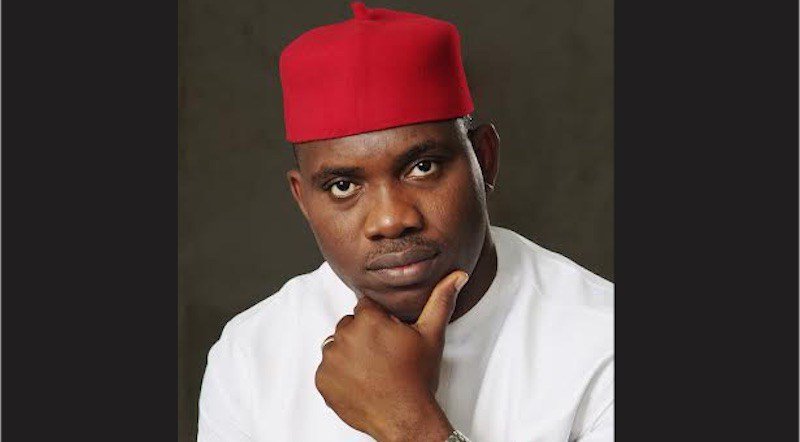
Group Rebukes Former Ebonyi SSG Prof Bernard Odoh
By Dipo Olowookere
The resignation of Prof Bernard Odoh as the Secretary to the Ebonyi State Government has generated mixed reactions with some analysts claiming his exit would greatly affect the second term ambition of Governor Dave Umahi.
However, an aide to the Governor, Lady Monica Chidinma Eze, who doubles as President of David Umahi Nweze Akubaraoha Ebonyi Transformation Agenda (DUNAETA), said there is nothing to worry about.
She described as unfortunate and unnecessary the noise being generated by the development, saying Mr Odoh “doesn’t deserve such attention.”
Leader of the Abakaliki-based group said, “This is a man who contested a senatorial post in an opposing political platform, All Progressives Grand Alliance (APGA) and failed woefully and Governor Umahi, in demonstration of his magnanimity, appointed such a character to the sensitive and key office of the SSG.”
Lady Eze described Mr Odoh as a “modern Judas Iscariot, for having the audacity and impetus to attempt to disparage the person and personality of Governor Umahi in his good for nothing letter instead of being grateful to the Governor for resituating and reviving his political fortunes after failing woefully in his senatorial bid.”
Speaking in a statement, Lady Eze congratulated the new SSG, Dr Hygenius Nwokwu, who she described as a better and thorough politician whose inputs towards the PDP success during the 2015 general elections need not be overemphasized.
According to her, Dr Nwokwu’s wealth of experience is what is needed at this period to revive and oil the once dormant office of the SSG during the inglorious era of Prof Odoh.
“We as an organization is convinced that Dr Nwokwu will bring to bear his past enviable experiences to regenerate the engine room of this administration based on his previous appointments as Commissioner for Education, Commissioner for Rural Development and Commissioner in the Ebonyi Civil Service Commission and as a Permanent Member in Ebonyi Secondary Education Board (SEB),” she highlighted.
DUNAETA is a group formed to ensure the re-election of Governor Umahi in the 2019 general elections and leader of the organisation said in the spirit of equity, justice and fairness, Governor Umahi must be allowed to complete his eight-year tenure, describing the gang up to truncate this move as “the highest injustice against the Southern senatorial zone of Ebonyi State after that both the Northern zone of the State through Senator Sam Egwu and the Central Senatorial zone through Chief Martins Elechi were all allowed to complete their two terms bid.”
General
Nigeria, Ghana Sign Bilateral Maritime Cooperation
By Adedapo Adesanya
The Nigerian Maritime Administration and Safety Agency (NIMASA) and the Ghana Maritime Authority (GMA) have signed a Memorandum of Understanding (MoU) to strengthen bilateral maritime cooperation, enhance regional maritime governance, and promote the sustainable development of the Blue Economy across West Africa.
Speaking during the signing ceremony in Lagos, the Director General of NIMASA, Mr Dayo Mobereola, expressed appreciation to Ghana for its support during Nigeria’s successful re-election to the International Maritime Organisation (IMO) Category C Council, noting that the longstanding relationship between both countries continues to advance maritime development within the region.
He stated that the MoU provides a practical framework for deeper collaboration in maritime safety and security, mutual recognition of Certificates of Competency (CoC), institutional capacity building, knowledge sharing, comparative research, joint enforcement initiatives, and regional cooperation at international maritime fora.
According to Mr Mobereola, the partnership must be driven by measurable outcomes through a structured implementation process.
“We will continue to work together to grow our economies and make the maritime sector safer. This Memorandum of Understanding is a commitment to do better. NIMASA will fully play its part in implementing the agreement, while both institutions must establish annual implementation agendas to monitor progress and deliver tangible results,” he said.
The NIMASA DG noted that Nigeria and Ghana, as leading maritime nations in the sub-region, have a shared responsibility to shape the future of maritime development in West and Central Africa.
He added that the partnership should generate benefits that extend beyond both countries by fostering regional and sub-regional collaboration capable of unlocking the enormous potential of the Blue Economy.
Under the agreement, both maritime administrations will establish a Joint Consultative Team (JCT) to develop action plans, coordinate implementation, and monitor agreed programmes through designated focal persons.
The JCT will meet twice yearly, with meetings hosted alternately by Nigeria and Ghana to review implementation progress, evaluate cooperation activities, and strengthen bilateral engagement.
The MoU is expected to improve maritime governance, strengthen institutional capacity, promote evidence-based policymaking through comparative research, enhance regulatory effectiveness, and reinforce collaborative efforts to combat piracy, armed robbery at sea, and maritime terrorism, particularly within the Gulf of Guinea.
Earlier in his remarks, the Director General of the Ghana Maritime Authority, Mr Kamal-Deen Ali, described the agreement as a significant milestone in the longstanding relationship between both maritime administrations.
He acknowledged Nigeria’s leadership role within the region, noting that Ghana has over the years drawn valuable lessons from several Nigerian maritime initiatives, including the country’s Cabotage regime, ship registry, and regulatory frameworks.
“This Memorandum of Understanding consolidates an already mutually beneficial relationship. Ghana remains fully committed to implementing every aspect of the agreement as we continue to learn from one another and work together to strengthen maritime administration across the region,” he said.
The signing of the MoU underscores the commitment of both maritime administrations to advancing regional integration, improving maritime safety and security, and promoting sustainable economic growth through stronger institutional collaboration.
General
SERAP Questions NASS on N1.3bn Budgetary Allocation to Phantom Presidential Council
By Adedapo Adesanya
The Socio-Economic Rights and Accountability Project (SERAP) has asked Senate President Godswill Akpabio and Speaker of the House of Representatives Tajudeen Abbas to explain how over N1.3 billion was allocated in the 2026 Appropriation Act to a presidential council that the Presidency has described as non-existent.
In a Freedom of Information (FoI) request dated July 4, 2026, and signed by its Deputy Director, Mr Kolawole Oluwadare, SERAP demanded certified copies of all documents relating to the approval of the N1,302,978,784 allocation to the Presidential Foreign Intervention Promotion Council (PFIPC), also referred to in the budget as the Presidential Economic Advisory Council.
The organisation also urged the leadership of the National Assembly (NASS) to immediately invoke its investigative powers under Sections 88 and 89 of the 1999 Constitution (as amended) to probe the circumstances surrounding the allocation and identify those responsible for any irregularities.
SERAP further requested records identifying the lawmakers and committees that considered and approved the allocation, as well as the public officials who appeared before the committees to defend the proposed funding.
It also asked the parliament to clarify whether the allocation formed part of the Executive’s original 2026 Appropriation Bill or was inserted during the legislative process. The group also sought to know whether any lawmaker questioned the legal status or operational mandate of the council before the budget was passed.
According to the group, the request became necessary following conflicting claims over the existence of the council, noting that while the 2026 Appropriation Act reportedly earmarked more than ₦1.3 billion for the PFIPC/Presidential Economic Advisory Council, the Presidency has since publicly stated that the body was never established by the Federal Government and is fictitious.
The rights organisation said the contradiction raises serious concerns about the integrity of Nigeria’s budget process, legislative oversight, public financial management and accountability.
“Nobody has a more sacred obligation to obey the law than those who make the law,” SERAP said, stressing that the National Assembly has a constitutional duty not only to approve budgets but also to thoroughly scrutinise Executive proposals before authorising public spending.
It argued that Nigerians have a right to know whether public funds were appropriated for an entity that was not lawfully established and, if so, how the allocation found its way into the national budget.
According to the organisation, making the requested documents public would enable citizens to determine whether the National Assembly fulfilled its constitutional responsibilities in scrutinising and approving the allocation.
SERAP warned that if the requested information is not provided within seven days of receipt or publication of the FoI request, it would initiate legal proceedings to compel the National Assembly to disclose the records.
It maintained that releasing the documents would strengthen public confidence in the credibility of the National Assembly, enhance transparency in the appropriations process and promote accountability in the management of public funds.
The group also cited the Freedom of Information Act, the Nigerian Constitution and Nigeria’s obligations under international human rights instruments, arguing that public institutions are required to proactively disclose information of significant public interest, particularly where allegations of financial impropriety or misuse of public resources have arisen.
General
Higher Allocations to States, Renewed Investments Thrill Tinubu
By Adedapo Adesanya
President Bola Tinubu has said state governments are now receiving substantially higher allocations to drive development, while renewed investor confidence is attracting fresh investments into Nigeria.
Speaking at the maiden State House Media Dinner in Abuja on Thursday, the president described the development as evidence that his administration’s economic reforms are beginning to deliver positive results.
He defended the reforms introduced by his administration, acknowledging that they were difficult but necessary to reposition the economy for sustainable growth.
According to Mr Tinubu, stronger public revenues have enabled increased allocations to states, while improvements in the investment climate have boosted confidence among domestic and foreign investors.
“The difficult but necessary reforms undertaken by this administration are yielding results. Our economy is stabilising. Public revenues have strengthened significantly,” he said.
“State governments are receiving substantially higher allocations to support development. Investor confidence is returning.
“Our foreign reserves have improved considerably. The oil and gas sector is attracting renewed investment. The stock market has witnessed remarkable growth. Key economic indicators are moving in the right direction,” Mr Tinubu stated.
The president also said the administration was laying the groundwork for long-term prosperity through a combination of tax and fiscal reforms, infrastructure development and improvements to the business environment.
“Through tax reforms, fiscal reforms, infrastructure investments, and improvements in the business environment, we are laying the foundations for a more competitive, productive, and prosperous economy,” he said.
Although acknowledging that more work remains, Mr Tinubu maintained that the country was firmly on the path to sustainable economic growth.
“The journey is not yet complete, but the direction is clear, and the foundations for long-term growth are being firmly established,” he added.
On security, the president said his administration had sustained a multi-dimensional strategy that has produced measurable gains across different parts of the country.
He noted that intensified military operations, improved intelligence gathering, stronger inter-agency coordination, and expanded regional and international cooperation had led to the neutralisation of thousands of terrorists and criminal elements, the rescue of numerous hostages, and the recovery of communities previously under siege.
President Tinubu reiterated his administration’s commitment to ensuring peace and security across the country, saying every Nigerian should be able to live, work and prosper without fear.
The president also commended the media for its contribution to Nigeria’s democratic development while urging journalists to uphold professionalism by reporting accurately and responsibly.
“We are adversaries only in the democratic sense, as the media constantly distrust those in power. In nation-building, we are partners,” he said.
He described government and the media as institutions with complementary responsibilities, noting that while government serves through leadership and public policy, the media serves by holding those in power accountable on behalf of the people.
-
Feature/OPED6 years agoDavos was Different this year
-
Travel/Tourism10 years ago
Lagos Seals Western Lodge Hotel In Ikorodu
-
Showbiz4 years agoEstranged Lover Releases Videos of Empress Njamah Bathing
-
Banking8 years agoSort Codes of GTBank Branches in Nigeria
-
Economy3 years agoSubsidy Removal: CNG at N130 Per Litre Cheaper Than Petrol—IPMAN
-
Banking3 years agoSort Codes of UBA Branches in Nigeria
-
Banking3 years agoFirst Bank Announces Planned Downtime
-
Sports3 years agoHighest Paid Nigerian Footballer – How Much Do Nigerian Footballers Earn


2 Comments