General
How Government Can Avert High-Rise Buildings Disasters
By Dipo Olowookere
One of the recent high-rise buildings disasters that shook the nation was the collapse of a 21-storey building in Ikoyi, Lagos, which was still under construction.
It drew the attention of many Nigerians because it claimed the lives of several persons, including the owner of the property as well as casual workers on the project said to cost billions of Naira.
It was later gathered that one of the reasons for the unfortunate incident was because the owner did not allegedly get approval to construct a 21-storey building as the approval was for a lesser number.
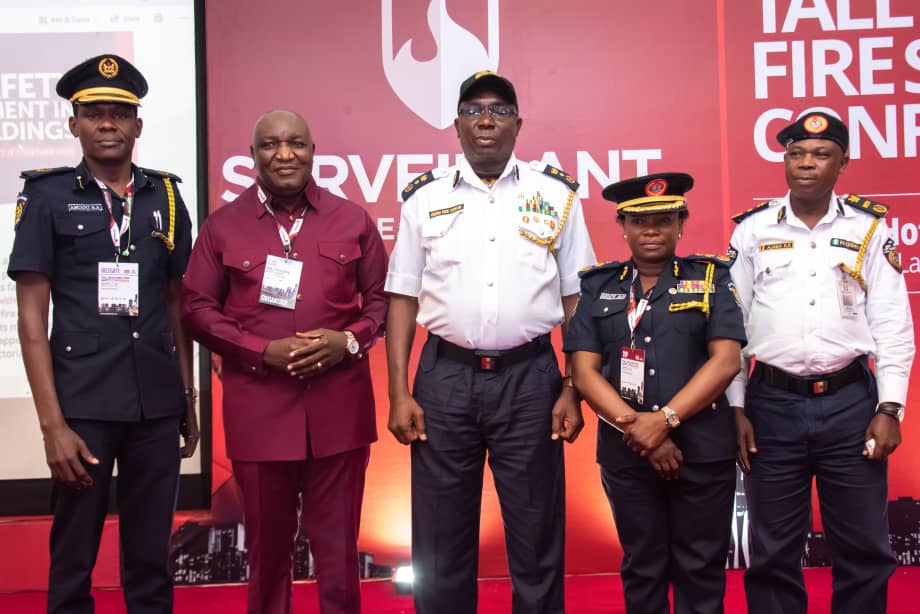
At a 2-day Tall Building Fire Safety Conference in Lagos, the Chief Executive Officer of Surveillant Fire Limited, Mr Adejola Jumade, advised the government to pay attention to the designs of high-rise buildings.
“When you talk of disaster, the first thing is design. What are the steps we take to ensure that the design we have for tall buildings is tailored toward safety?
“Aside from that, government agencies like Physical and Urban Planning need to ensure that mechanical and electrical designs are looked into critically to ensure that the fire design they have tailored to curtain fire in case of any issue,” he said.
He used the occasion to call for more partnership and collaboration for firefighters in the country to enable optimal performance, stressing the need for more investment in the fire service.
“Honestly speaking, the firefighters are trying their best with the limited capacity and facility they have. The local, state and federal agencies need to work together to ensure that people that need to follow regulations do so. Interagency rivalry needs to stop; we need serious collaboration,” he submitted.
On his part, Minister of Interior, Mr Rauf Aregbesola, said that the federal government was working out modalities for an armed escort for firemen on assignment to deter touts and miscreants’ attacks.
“There is the unique challenge of touts and miscreants attacking firemen and their equipment in a fire scene. This is deplorable. We are working out modalities for an armed escort for firemen on assignment to deter these undesirable elements,” the Minister, who was represented by the Acting Comptroller-General of the Federal Fire Service, Mr Samson Karebo, disclosed.
He said the government procured DG54 Aerial Platform Fire Fighting Truck with 54 metres height capacity to reach the 18th floor of high-rise buildings, which is “stationed in Lagos where we have the largest concentration of high rise buildings in Nigeria.”
“We are also working with the Nigeria Air Force to be able to deploy planes for aerial fire-bombing of bushfires, high rise buildings or other wildfires requiring aerial attacks. Between 2015 and 2020, the federal government provided 106 modern fire-fighting trucks to the FSS.
“Last year, the Federal Executive Council (FEC) also approved infrastructure upgrade comprising 44 fire-fighting engines, 15 water tankers, 15 rapid intervention fire engines (not conventional ones) that can go into the nooks and crannies to respond to distress calls and 20 basic life support ambulances,” Mr Aregbesola said.
Corroborating his views, the Director, Lagos State Fire and Rescue Service, Mrs Margaret Abimbola Adeseye, appealed to Nigerians to be very conscious of things that can trigger fire outbreaks.
“Endeavour to switch off all electrical gadgets after use. We advise that people should be careful with cooking in the marketplace. Some people will leave their iron on the table without removing it from the socket when electricity come back it can result in a fire outbreak,” she said.
Mrs Adeseye called for more understanding with firefighters, saying it is not acceptable to attack firefighters, “regrettably, in some cases hoodlum use to attack firefighters without putting into consideration the distance they are coming from.”
“To tackle some of these challenges, the state government has commenced the renovation of 16 fire service stations with the construction of additional five fire service stations. This is the first of its kind that I am witnessing in my 25 years in service. This will help us to address the challenges of proximity,” she stated.
General
FG Declares Friday, Monday Public Holidays for Easter
By Adedapo Adesanya
The federal government has declared Friday, April 3, and Monday, April 6, 2026, as public holidays to mark this year’s Easter celebration.
April 3 is Good Friday, while April 6 is Easter Monday.
The Minister of Interior, Mr Olubunmi Tunji-Ojo, in a statement on Wednesday, congratulated Christians in Nigeria and the diaspora on the occasion.
Mr Tunji-Ojo urged Nigerians to reflect on the virtues associated with the season, saying, “I congratulate all Christians in Nigeria and in the diaspora on the joyous occasion of Easter. I urge Nigerians to imbibe the virtues of selflessness, forgiveness, forbearance and love as exemplified by the life and teachings of Jesus Christ.”
He further called for unity among citizens, stressing the importance of peaceful coexistence.
“Easter is a period that reminds us of the values of tolerance and community that keep us together as a nation. Nigerians should remain committed to these ideals for the progress of our country,” the minister said.
Mr Tunji-Ojo also reiterated the federal government’s commitment to policies aimed at national development.
“The goal of the government remains taking decisions that would bring about national rebirth, economic growth, and shared prosperity for all Nigerians,” he added.
The minister wished Christians a peaceful and joyous Easter celebration.
General
Adelabu Refutes Resignation Claims, Affirms Oyo Governorship Ambition
By Adedapo Adesanya
The Minister of Power, Mr Adebayo Adelabu, has denied rumours of his resignation circulating on social media following the expiration of a March 31 deadline.
According to reports by Channels Television, Mr Adelabu noted that the letter in circulation was fake as he had written such a letter.
However, he affirmed his interest in running for the Oyo State governorship race in 2027, adding that he would act at the appropriate time.
Mr Adelabu, reacting to the need for clarity about the said letter and his ambition on the platform of the All Progressives Congress (APC), said, “Of course, yes, I am very much in the race.
“But I will act at the appropriate time, and you will be duly informed, but will be with the consent of Mr President.
“For now, I’m committed to my present assignment. It’s still about service, whether national or sub-national,” he told the broadcaster.
President Bola Tinubu had directed all political appointees in his administration who intend to contest elective positions in the 2027 elections to resign from their posts on or before March 31.
He hinged his decision on Section 88(1) of the Electoral Act 2026 and the timetable released by the Independent National Electoral Commission (INEC) for party primaries ahead of the 2027 polls.
Only three of President Tinubu’s cabinet members stepped away from office to pursue their ambition. First among these was the Minister of Foreign Affairs, Mr Yusuf Tuggar, he prepares to seek the APC ticket to be the next governor of Bauchi State.
Mr Tuggar, who confirmed his resignation later on Monday, said his resignation letter was formally submitted to the president earlier that day through the Office of the Secretary of Government in Abuja.
Also, the Minister of Transportation, Said Ahmed Alkali, resigned to pursue his ambition of contesting the 2027 governorship election in Gombe State.
“The President has accepted the resignation and thanked the minister for his dedicated service to the nation,” his media aide said in the statement on Tuesday.
Similarly, the Minister of State for Humanitarian Affairs and Poverty Reduction, Mr Yusuf Sununu, also resigned to contest a senatorial seat in Kebbi State.
Mr Sununu, who assumed office in the humanitarian ministry in November 2024 after serving as Minister of State for Education, said his deployment was aimed at restoring the ministry’s image before deciding to pursue legislative office.
Also, the Chairman of the Governing Board of the Federal Mortgage Bank of Nigeria (FMBN), Mr Nasiru Gawuna, resigned from his position and defected to the African Democratic Congress (ADC).
General
NERC Seeks Coordination, Harmonisation to Bridge Metering Gap
By Adedapo Adesanya
The Nigerian Electricity Regulatory Commission (NERC) has called for enhanced stakeholder coordination to rapidly expand electricity meter installations and narrow Nigeria’s persistent metering gap.
This push emerged from the NESI Metering Stakeholders’ Meeting held in Lagos on March 27, 2026, where regulators, industry players, and international partners converged to tackle rollout bottlenecks.
According to a post on NERC’s X handle, key attendees included representatives from the World Bank, Meristem, Nigerian Communications Commission (NCC), NEMSA, Distribution Companies (DisCos), and Meter Asset Providers (MAPs).
NERC highlighted a strategic pivot from merely financing metering initiatives to fostering seamless collaboration.
With four separate metering programmes currently underway, the commission stressed the urgency of aligning efforts to avoid duplication and accelerate deployment.
“Greater synergy among DisCos, meter providers, and other stakeholders is essential to ramp up installations,” a NERC spokesperson noted. This coordinated approach aims to deliver accurate billing, eradicate estimated charges that frustrate consumers, and boost overall market efficiency.
The meeting also underscored the need for a unified communication strategy to heighten public awareness and encourage consumer uptake, as part of NERC’s broader drive for transparency in Nigeria’s electricity sector.
Nigeria currently operates four parallel metering programmes aimed at closing the country’s metering gap and improving efficiency across the power sector. These include the World Bank–funded Nigeria Distribution Sector Recovery Programme (DISREP), which targets about 3.2 million end-user meters, and the Federation-funded initiative designed to deliver roughly 3.8 million meters alongside about 130,000 distribution transformer (DT) meters.
Also in operation are the DisCo-funded Meter Acquisition Fund (MAF), which provides around 125,000 meters to fill coverage gaps, and the Advanced Metering Infrastructure (AMI), a technology-driven framework focused on smart metering, improved billing accuracy, and enhanced grid management. The Nigerian Electricity Regulatory Commission (NERC) is now working to harmonise these initiatives to prevent duplication and accelerate metering deployment nationwide.
-
Feature/OPED6 years agoDavos was Different this year
-
Travel/Tourism10 years ago
Lagos Seals Western Lodge Hotel In Ikorodu
-
Showbiz3 years agoEstranged Lover Releases Videos of Empress Njamah Bathing
-
Banking8 years agoSort Codes of GTBank Branches in Nigeria
-
Economy3 years agoSubsidy Removal: CNG at N130 Per Litre Cheaper Than Petrol—IPMAN
-
Banking3 years agoSort Codes of UBA Branches in Nigeria
-
Banking3 years agoFirst Bank Announces Planned Downtime
-
Sports3 years agoHighest Paid Nigerian Footballer – How Much Do Nigerian Footballers Earn