Connect with us

General

How Skye Bank Rendered 3000 Lagos Residents Homeless

Published

on

By The Witness Newspaper

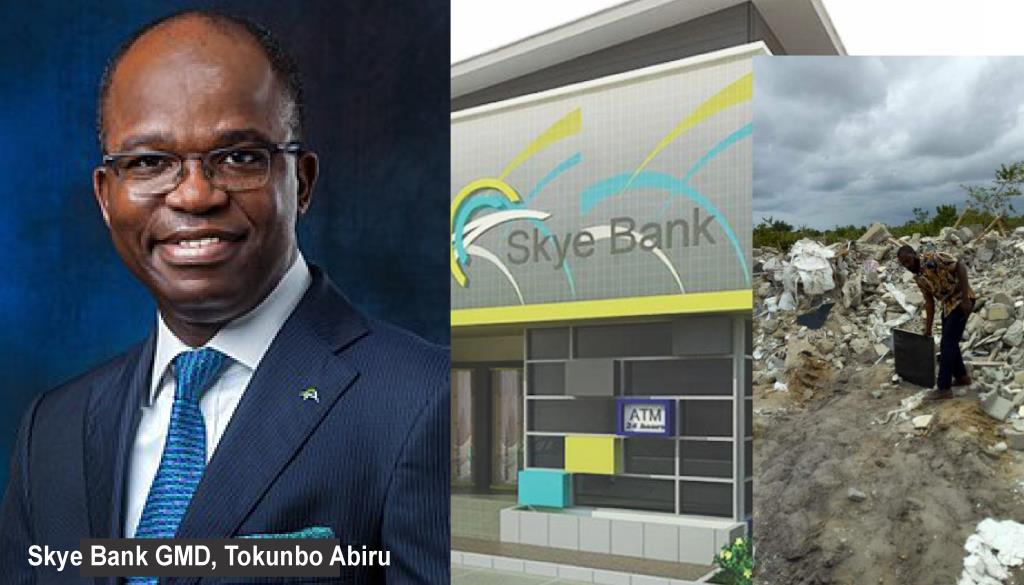
Skye Bank Plc and its subsidiary, Skye Trustees Limited, are currently enmeshed in fresh controversy following the demolition of more than 200 houses at the instance of the two organisations in Lagos, THE WITNESS reports.

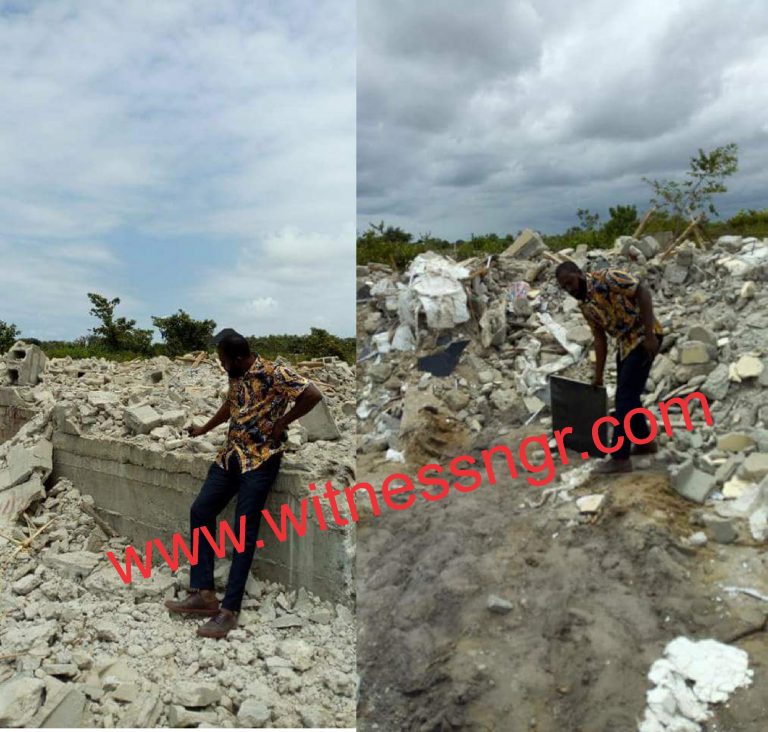
While the President Muhammadu Buhari administration is striving so hard to achieve its target of delivering affordable housing to the people, the Tokunbo Abiru-led financial institution and its subsidiary on Thursday, July 26th 2018 visited hardship on the Glorious Villa Community in Ibeju Lekki Local Government Area of Lagos State which housed over 3000 inhabitants when they demolished the properties.

THE WITNESS reliably learnt that trouble started when Skye Bank was discreetly sold a large expanse of land allegedly belonging to about 55 families by four of the families in Abule Parapo Phase 2, Awoyaya area of Ibeju Lekki.

It was further gathered that after winning the land dispute case from initial land grabbers, another set of family unit had three years earlier sold some plots located behind the famous Greenspring International School for the sum of N1.5 million each to the occupants who are now homeless after the destruction which gave them no chance to salvage their belongings.

Unknown to these family units, the four family units had also obtained a court judgment behind the scene and went ahead to sell the entire 200.184 hectares of land plus the court judgment to Skye Bank and Skye Trustees Limited which rushed to the Lagos State government through high-powered officers for the authentication of the lands in their company name.

Skye Bank, THE WITNESS learnt, reached out to the lawyers of the property owners to come over for ratification and demanded that they should pay sums of money ranging between N4 million and N8 million for the ratification of each of the plots in contention.

The property owners had suggested further negotiation and had reached a compromise with the bank, but Skye Bank allegedly went ahead with the demolition of the properties with the backing of about 300 armed operatives from various security outfits that harassed the residents and seized their belongings including phones and cameras.

The Skye Bank-ordered demolition has thrown the residents of the area into a state of distress and agony as majority of them now take refuge in uncompleted buildings outside of the community. Others have resorted to talking solace under the bridges around the area while some have moved in with their relations as squatters pending when luck will smile at them to acquire new accommodations.

Affected residents, most of who are customers of the Skye Bank have been counting their post-demolition losses, lamenting the suffering they are forced to go through.

“This pain is too much to bear, and to think that it comes from a bank I hitherto held so dear is worrying to me,” lamented a woman who did not provide her name.

Mr Wise Iyanla while narrating his ordeal to THE WITNESS correspondent said: “I, my friends, my comrades and my families, we are closing all our accounts in Skye Bank. This is a trying moment but we will win this battle!

“As a young man in the corporate world, I strove harder to do some expensive things. One of the things I did was to strive to build a bungalow here in Ibeju Lekki axis (Awoyaya) and my land was properly acquired from the legitimate owners who originally acquired the landed properties from their forefathers as inheritance.

“All of a sudden, just last month here, I was at work when I received a WhatsApp message from a co-landlord, informing me that our properties built with our hard-earned sweat were being demolished by Skye Bank and their agent, Lekki Gardens Estate Limited  with a battalion of security personnel to protect their heinous action.

“What can I say as a young father and hustler? I said to my co-landlord, man can never be hurt. What took us years to stand, as struggling young Nigerians, were demolished in minutes.

“The most painful aspect of the story is the fact that our buildings were demolished in error because there was no court judgment that warranted the destruction of our properties and I doubt that the IG was aware of the illegal police officers outing during the criminal and malicious destruction of our properties and now that it is established, 10 billion for the accounts is feasible.”

Another affected resident, a 64-year-old widow and retired civil servant, Mrs Oyekunle Azeez, said ever since the incident, she has been living in a church and her blood pressure had risen. “In tears, the elderly woman said: I laboured so hard before I retired to build this house, how have I offended the bank and their directors? This was all I had. Why do they want to send me to an early grave?” Mrs Azeez lamented.

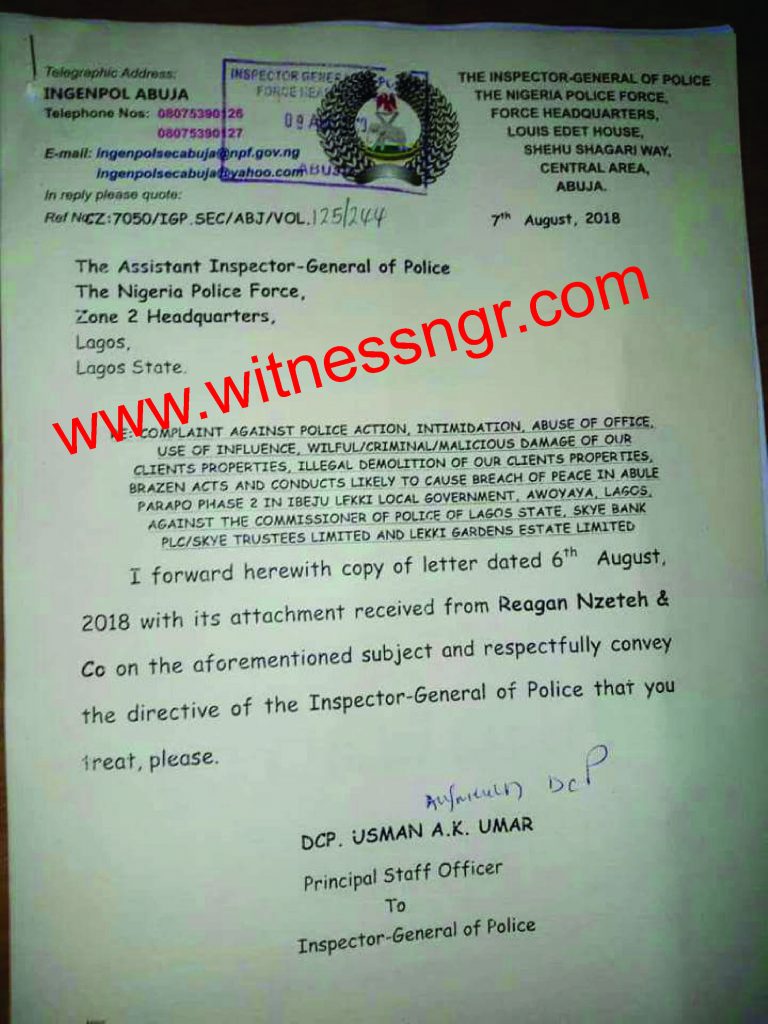
The lawyers representing Glorious Villa Community Development Association, Reagan Nzeteh & Co. has written Lekki Gardens demanding the sum of N10 billion from Skye Bank Plc and Skye Trustees Ltd for what it called trespass to land, willful/criminal/malicious damage of its client’s properties and illegal demolition of the properties in Abule Parapo Phase 2 by the two organisations. They have also threatened to sue the trio if the money is not paid within a stipulated period of time.

In the same vein, the inspector general of police has been petitioned regarding the illegal use of over 300 police officers in the operation.

Efforts by our reporter to reach the management of Skye Bank and Skye Trustees for their angle to the development proved futile as enquiries sent to the bank were not responded to as at press time.

Culled from The Witness Newspaper
Dipo Olowookere is a journalist based in Nigeria that has passion for reporting business news stories. At his leisure time, he watches football and supports 3SC of Ibadan. Mr Olowookere can be reached via [email protected]

Click to comment

Leave a Reply

Your email address will not be published. Required fields are marked *

General

Tinubu Confirms Killing of Abu-Bilal Al-Manuki by Nigerian, US Forces

Published

on

Tinubu kill Abu-Bilal Al-Manuki

By Modupe Gbadeyanka

President Bola Tinubu on Saturday confirmed the killing of a senior ISIS leader, Mr Abu-Bilal Al-Manuki, in an overnight operation carried out by the United States and Nigeria.

President Donald Trump had earlier announced the elimination of the notorious terrorist via a post on his Truth Social.

Later, in a statement today, Mr Tinubu praised the action, describing it as “a significant example of effective collaboration in the fight against terrorism.”

“Our determined Nigerian Armed Forces, working closely with the Armed Forces of the United States, conducted a daring joint operation that dealt a heavy blow to the ranks of the Islamic State,” he said in the statement.

According to him, early assessments confirm the elimination of the wanted IS senior leader, Abu-Bilal Al-Manuki, also known as Abu-Mainok, along with several of his lieutenants, during a strike on his compound in the Lake Chad Basin.

He commended the partnership between Nigeria and America in waging war against terrorists, thanking his US counterpart “for his leadership and unwavering support in this effort.”

“I commend the personnel involved on both sides for their professionalism and courage, and I look forward to more decisive strikes against all terrorist enclaves across the nation,” the Nigerian leader added.

Continue Reading

General

Nigeria Steps up AI Surveillance, Anti-Drone Systems for National Security

Published

on

Anti-Drone Systems

By Adedapo Adesanya

Nigeria is set to strengthen its defence architecture by deploying artificial intelligence-powered surveillance systems and advanced anti-drone technology as part of efforts to modernise the country’s military capabilities, according to the Minister of Defence, Mr Christopher Musa.

He disclosed this during a high-level visit to Monaco, where he led a Nigerian delegation to conclude discussions on the multi-domain Hybrid Intelligence Shield (HIS) project.

According to Mr Musa, the initiative is designed to enhance border security, protect urban centres and improve the country’s response to emerging security threats.

The project is expected to introduce AI-driven surveillance systems capable of identifying threats rapidly through smart algorithms, while anti-drone technology will be deployed to intercept and neutralise unmanned aerial threats.

The government also plans to establish national and regional command-and-control centres to improve real-time coordination and response to security incidents across the country.

Mr Musa said the initiative would place strong emphasis on technology transfer and local capacity development through the establishment of a military Centre of Excellence in Nigeria.

He added that the federal government would leverage partnerships with international firms, including Marss UK Ltd, while simultaneously building indigenous capabilities to address insurgency, illegal mining, piracy and other security threats.

Nigeria has continued to battle multiple security challenges in recent years, including insurgency in the North-East, banditry and kidnappings in the North-West, farmer-herder clashes in the North-Central region, crude oil theft in the Niger Delta and piracy in the Gulf of Guinea.

Nigeria is stepping up its defence as the border region of Nigeria, Benin and Niger on the southern edge of the Sahel region is becoming a new stronghold for jihadists, as militants turn forests and pastoral networks in West Africa into bases for recruitment and international attacks.

Attacks in Nigeria have also risen, with data from the website of the Armed Conflict Location & Event Data (ACLED), a conflict-monitoring group, affirming that the number of suicide bombings in Nigeria by March already matched the annual average over the past six years.

The Nigerian military has also been dealt a blow to its military bases and senior figures targeted. In April, Brigadier-General Oseni Omoh Braimah was killed when Islamist fighters attacked a base in Borno State.

To also meet the defence goal, Nigeria is stepping up efforts to build domestic arms-manufacturing capacity.

Continue Reading

General

Nigeria, Morocco to Seal Atlantic Gas Pipeline Deal by Q4 2026

Published

on

nigeria morocco

By Adedapo Adesanya

Nigeria and Morocco are set to sign a major intergovernmental agreement later this year to push forward the long-delayed Nigeria-Morocco Gas Pipeline project, a multi-billion-dollar energy corridor expected to reshape gas trade across West Africa and Europe.

The agreement, expected to be signed in the fourth quarter of 2026 by President Bola Tinubu and King Mohammed VI of Morocco, follows the completion of preliminary technical studies for the ambitious project, according to officials from both countries.

The pipeline, also known as the African Atlantic Gas Pipeline, is projected to stretch about 6,900 kilometres along offshore and onshore routes across West Africa, making it one of the largest gas infrastructure projects on the continent.

With an estimated cost of $25 billion, the pipeline is designed to transport up to 30 billion cubic metres of gas annually once completed.

Discussions on the project gained fresh momentum during a telephone conversation between Nigeria’s Minister of Foreign Affairs, Mr Bianca Odumegwu-Ojukwu, and her Moroccan counterpart, Mr Nasser Bourita.

The project would not only strengthen energy cooperation between the two countries but also improve regional economic integration and expand Africa’s access to European energy markets.

According to Morocco’s hydrocarbons and mining agency, ONHYM, part of the gas supply will support Morocco’s domestic energy demand, while large export volumes will be directed to Europe.

The project, first proposed about a decade ago, is seen as a strategic alternative gas supply route amid rising global energy security concerns and Europe’s search for more diversified energy sources.

Beyond the pipeline, Nigeria and Morocco are also exploring broader economic partnerships, particularly in fertiliser production and distribution to support food security across Africa.

Both countries also agreed on the need to revive the Nigeria-Morocco Business Council to strengthen trade and investment relations under the African Continental Free Trade Area framework.

Analysts noted that the project could significantly boost gas monetisation opportunities for Nigeria, expand regional infrastructure development, and deepen economic ties between West African nations and Europe if successfully executed.

Continue Reading

Trending