General
IFC Report Recognises MTN Nigeria for Gender Equality in Workplace
By Modupe Gbadeyanka
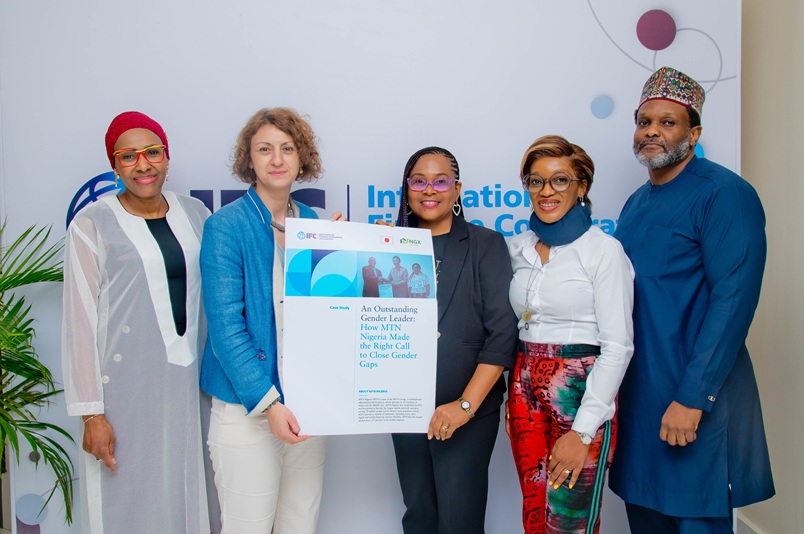
The International Finance Corporation (IFC) has used MTN Nigeria Communications Plc as a case study in a report on gender equality in the workplace.
According to the IFC publication, MTN Nigeria built on its existing diversity and inclusion framework by adopting a more structured and data-driven approach to gender equality.
With IFC’s advisory support, the company undertook diagnostics to identify gaps, introduced targeted policies, and aligned its practices with global standards.
A major milestone outlined in the report is MTN Nigeria’s attainment of the EDGE MOVE certification in 2023, a globally recognised benchmark for workplace equity.
This achievement made it the first wireless telecommunications company in Africa and the second organisation in Sub-Saharan Africa to reach this level, reflecting progress across leadership representation, pay equity, organisational culture, and flexible work policies.
The case study also details a range of initiatives implemented by the company, including targeted recruitment and promotion of women, strengthened mentorship programmes, expanded parental leave policies, and deliberate efforts to increase the participation of women-led businesses within its value chain.
These actions contributed to measurable improvements in female representation, including achieving gender balance at the executive level.
The chief executive of MTN Nigeria, Mr Karl Toriola, in the case study, was quoted as saying, “A diverse, inclusive, and equitable workforce is critical to the success and sustainability of our business.
“We are committed to promoting gender inclusiveness, equality, and empowerment internally as well as across our ecosystem to ensure that interventions are holistic and position women to thrive effortlessly.
“If we must narrow the gender gap and address the disproportionate representation of women in the private sector, I believe that business leaders and CEOs must disproportionately allocate resources to support women across all levels.”
MTN Nigeria is one of the leading companies advancing gender equality through practical, business-led actions under its Nigeria2Equal programme.
The telco has become a top performer in workplace gender equality following its participation in the programme between 2021 and 2023, moving from 13th position to become the top-performing organisation from the 30 most capitalised companies listed on the Nigerian Exchange (NGX) Limited.
The report was based on an independent assessment conducted by Equileap and verified by PwC.
Implemented in partnership with the NGX, the Nigeria2Equal programme is designed to reduce gender gaps across leadership, employment, and entrepreneurship in Nigeria’s private sector.
MTN Nigeria joined the initiative in 2021, making commitments across these areas while strengthening its broader advocacy for gender equality. It has expanded its role in advancing gender equality through advocacy and transparency, becoming a signatory to the UN Women’s Empowerment Principles and now reports gender-focused initiatives and targets in its annual disclosures.
General
NAQS Seeks Integration Into Customs’ B’Odogwu Platform
By Modupe Gbadeyanka
The Nigeria Agricultural Quarantine Service (NAQS) has asked to be integrated into the B’Odogwu platform of the Nigeria Customs Service (NCS).
This call was made by the head of NAQS, Mr Vincent Isegbe, during a meeting with the Comptroller-General of Customs, Mr Adewale Adeniyi, in Abuja on Wednesday.
Mr Isegbe, who used the visit to congratulate Mr Adeniyi on the extension of his tenure as Chairperson of the World Customs Organisation Council, which he described as recognition of his dedication and leadership, praised what he called an excellent working relationship with Customs.
He outlined areas for closer partnership, including integrating NAQS into Customs’ B’Odogwu platform, joint enforcement operations, and coordinated efforts to detect fake certification and fraudulent documentation.
In his remarks, Mr Adeniyi commended his guest for the partnership, promising that NAQS will provide technical support for the new Customs laboratory.
According to him, this is one of the avenues to deepen collaboration between the two agencies on intelligence sharing, trade facilitation and national security.
He informed Mr Isegbe that his organisation was moving to harmonise inspection procedures across the country’s ports and border stations, a step he described as critical to promoting consistency, transparency and efficiency in cargo clearance nationwide.
He also stated that customs training facilities would be opened up to NAQS officers as part of a broader capacity-building push.
“We must expose our officers to the broader concept of national security. Border management goes beyond revenue collection,” Mr Adeniyi said, stressing that Customs sees itself as the anchor institution coordinating Nigeria’s multi-agency border protection efforts.
General
Solid Minerals Sector Grows 337% to Over N70bn in Two Years
By Adedapo Adesanya
Nigeria’s solid minerals sector recorded a boom of 337 per cent in two years, jumping from N16 billion in 2023 to over N70 billion in 2025, according to the chief executive of the Solid Minerals Development Fund (SMDF), Mrs Fatima Umaru Shinkafi.
She disclosed that the sector also recorded a remarkable 33.5 per cent real growth in 2025, while reforms attracted fresh investment commitments worth about $2.6 billion, including a $1.3 billion alumina refinery described as the single biggest mining investment in Nigeria’s history.
Mrs Shinkafi gave out these figures at the maiden Annual Lecture of the Faculty of Physical and Earth Sciences, University of Lagos (UNILAG), where she declared that stronger collaboration among government, industry and academia is the master key to unlocking Nigeria’s vast mineral wealth.
Delivering the keynote lecture titled Building Nigeria’s Solid Minerals Future: The Power of Academia, Government and Industry in Partnership, she lamented that despite Nigeria’s deposits of more than 44 commercially viable minerals spread across over 500 locations, the industry still contributes less than one per cent to the nation’s Gross Domestic Product (GDP).
She, however, said the story is changing under the Seven-Point Agenda of the Minister of Solid Minerals Development, Mr Dele Alake, with reforms already repositioning mining as a major driver of economic growth.
The SMDF boss also unveiled the Early-Stage Mineral Exploration and Research Grant Endowment (EMERGE), describing it as Nigeria’s first competitive research funding platform dedicated to geoscience studies in universities.
According to her, the initiative will fund mineral exploration, critical minerals research and postgraduate studies, while equipping successful applicants with technical training and access to investment opportunities.
She challenged UNILAG researchers to seize the opportunity by submitting quality proposals, insisting that research remains the foundation for building a globally competitive mining industry.
Mrs Shinkafi then urged young women to embrace careers in science and mining, stressing that Nigeria’s hidden mineral wealth can only be fully unlocked through the innovation, skills and determination of the next generation.
General
Dangote Cement CEO Tasks Africa to Balance Cement Growth with Climate Goals
By Modupe Gbadeyanka
The chief executive of Dangote Cement Plc, Mr Arvind Pathak, has championed net-zero cement production at the Global Cement and Concrete Association (GCCA) CEO Strategic Dialogue in Madrid, Spain.
He specifically charged African producers to lead the next phase of sustainable industrial growth by accelerating decarbonization while expanding cement production to meet the continent’s rising infrastructure needs.
“With Africa’s infrastructure demand continuing to rise, the sector must pursue growth while embracing innovative pathways to reduce carbon emissions,” Mr Pathak said.
“A key takeaway, especially for the African cement sector in the context of the evolving global economic and regulatory landscape, is the need to accelerate our decarbonization pathway through increased utilisation of alternative fuels, reduction of clinker content in cement and investment in innovative cement technologies suited to local realities,” he added.
Mr Pathak said the forum reinforced the opportunity for Africa’s cement industry to deliver sustainable growth while reducing carbon emissions, stressing that Dangote Cement remains committed to reducing its carbon emissions intensity by 20 per cent by 2030, using 2021 as the baseline year.
It was gathered that the two-day event allowed participants to discuss strategies to achieve net-zero emissions and drive sustainable growth across the cement and concrete value chain.
The meeting also highlighted the industry’s growing role in global climate action, particularly through the GCCA’s engagement at international climate platforms and its efforts to advance collaborative solutions for sustainable infrastructure development.
It also provided a platform for industry leaders to address critical priorities, including low-carbon construction, industry outlook, policy advocacy and financing mechanisms needed to accelerate the transition to net-zero.
Participants also reviewed GCCA’s global climate leadership efforts, particularly its engagement at COP30, where the industry is positioning itself as a key partner in climate solutions through initiatives such as the Cement Breakthrough and other multi-stakeholder collaborations.
Discussions underscored the growing importance of innovation, technology and strategic partnerships in supporting the cement and concrete sector’s net-zero ambitions while helping to meet global infrastructure needs.
Dangote Cement pledged to reduce its carbon emissions intensity by 20 per cent by 2030 from a 2021 baseline, as part of a broader strategy that includes increased use of alternative fuels, renewable energy investments, improved operational efficiency and clinker optimisation.