Connect with us

General

NRS Rolls Out Rev360 to Enhance Revenue, Tax Collection, Compliance

Published

on

NRS Rev360

By Adedapo Adesanya

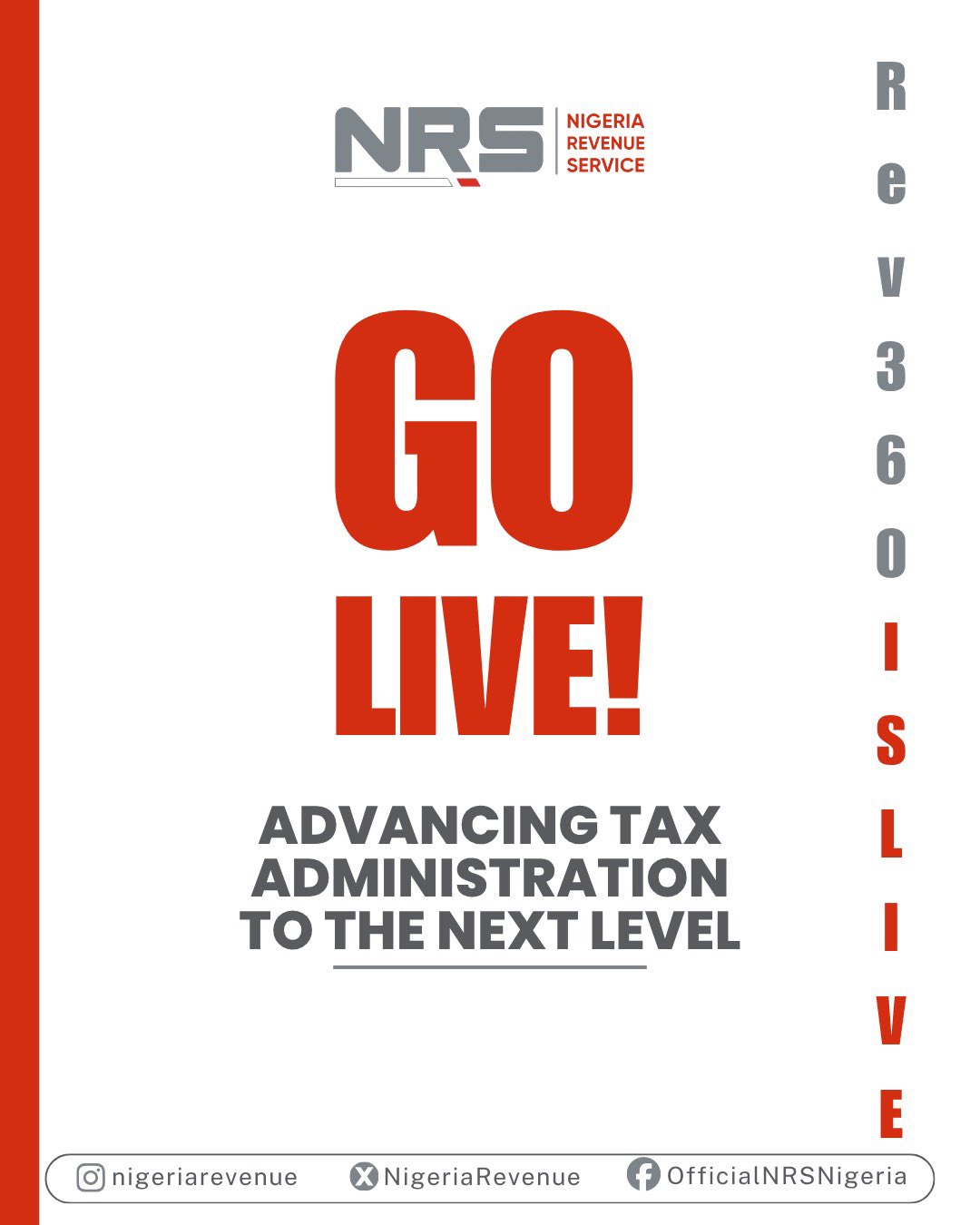
The Nigeria Revenue Service (NRS) on Thursday announced the official go-live of Rev360, its next-generation tax administration platform, marking a major step in the agency’s digital transformation drive aimed at improving revenue collection, enhancing taxpayer experience, and strengthening compliance monitoring.

The platform is designed to streamline end-to-end tax processes, including registration, filing, payment, and audit, while providing real-time data analytics to support more efficient decision-making.

Rev360 is the agency’s latest effort to reduce manual bottlenecks, curb leakages, and broaden Nigeria’s tax net by integrating multiple taxpayer databases into a unified system.

In a statement on Thursday, titled Nigeria Revenue Service Launches Rev360, Marking Transition to Tax Administration 3.0, it was stated that the platform will be implemented in phases, beginning with medium and emerging taxpayers, marking a significant milestone in the evolution of Nigeria’s tax system.

As the NRS is transitioning from manual and digitised processes to a fully integrated, intelligent, and taxpayer-centric system, it explained that Rev360 builds on previous advancements in digital tax administration and introduces a more seamless, transparent, and efficient approach to managing tax obligations.

Commenting on the significance of the launch, the chairman of NRS, Mr Zacch Adedeji, stated: “Rev360 reflects the service’s commitment to building a tax system that works seamlessly for every Nigerian, strengthens trust in public institutions, and supports the growth of our economy.

“This is about creating a future where tax administration is not a burden, but an enabler of national development.”

The NRS added that it successfully completed a comprehensive nationwide readiness programme designed to prepare stakeholders across the tax ecosystem ahead of the go-live.

The service noted that the aforementioned efforts are aimed at ensuring that taxpayers, consultants, and all users of the platform are not only aware of Rev360 but are also fully prepared and supported in its use.

However, the Service added that “the transition to Rev360 will be implemented in phases, beginning with medium and emerging taxpayers, and subsequently extending to government and large taxpayers, ensuring a structured and effective rollout.”

“The platform is expected to improve compliance, strengthen revenue administration, and enhance the overall taxpayer experience,” the service added.

With the rollout, the NRS said it expects to boost transparency, simplify interactions for individuals and businesses, and align Nigeria’s tax administration framework with global best practices in digital governance.


Adedapo Adesanya is a journalist, polymath, and connoisseur of everything art. When he is not writing, he has his nose buried in one of the many books or articles he has bookmarked or simply listening to good music with a bottle of beer or wine. He supports the greatest club in the world, Manchester United F.C.

General

Supreme Court Affirms David Mark’s Leadership of ADC

Published

on

david mark adc chairman

By Modupe Gbadeyanka

The Supreme Court has recognised Mr David Mark as the National Chairman of the African Democratic Congress (ADC).

In a judgment on Friday, the apex court restored the leadership of the former Senate President, after an appellate court had ordered a status quo ante bellum.

The Supreme Court held that the decision of the Appeal Court on status quo ante bellum was improper and unwarranted.

It also refused to uphold the preliminary objections by counsel to Mr Nafiu Bala, who is challenging the leadership of Mr Mark, directing that the suit should head back to the trial court for determination. Mr Bala went to court to seek an ex parte to stop Mr Mark and his team from parading themselves as leaders of the opposition party.

The ADC, which was asked to put on notice to explain why the injunction should not be given, appealed the matter, but the parties were asked to maintain the status quo ante bellum. This was interpreted to mean the ADC was without a leader.

The matter went to the apex court, which decided it today, affirming Mr Mark as the party’s chairman, which seeks to eject President Bola Tinubu from Aso Rock via the 2027 presidential election.

Continue Reading

General

Egbin Power Station Collapse Triggers Extended Outage in Lagos

Published

on

power outage

By Adedapo Adesanya

Residents and businesses in Lagos will face an extended power outage following the sudden shutdown of the Egbin Power Station and a simultaneous transmission line outage.

The Nigerian Independent System Operator (NISO) in a statement on Thursday said that the Egbin Power Station suffered a major operational disturbance, leading to a complete loss of generation and worsening supply constraints in the nation’s commercial capital.

According to reports, the incident led to the death of a contractor. However, the company has yet to confirm the cause or provide an official account of what transpired.

In the statement, the system operator said the incident occurred at about 8:21 pm on April 28, when the plant’s output dropped from about 641 megawatts to zero.

It attributed the shutdown to critical equipment failure within the plant.

“The Nigerian Independent System Operator wishes to inform the general public of a significant reduction in power generation currently affecting electricity supply across the country, particularly within the Lagos region.

“Egbin Power Station, which is the largest electricity-generating plant on the national grid and a major contributor to daily power supply in Nigeria, experienced a major operational disturbance.

“At approximately 8:21 p.m. on April 28, 2026, Egbin Power Station recorded a total loss of generation, dropping from about 641MW to zero output.

“This incident was caused by the failure of the plant’s central compressor, in addition to a malfunction of the circulating water pump system, which necessitated an immediate shutdown of all generating units to safeguard the facility,” the statement partly read.

The operator explained that the impact of the generation loss was compounded by a transmission constraint affecting power delivery into Lagos.

“Power supply to the Lagos region is currently further restricted due to the forced outage of the Osogbo–Ikeja West 330kV transmission line, thereby limiting the evacuation of available generation into the Lagos load centre,” it added.

The dual disruption, according to the system operator, has created a significant supply gap, forcing authorities to ration electricity to prevent a total system collapse.

“Consequently, this loss of generation has created a significant supply shortfall, necessitating immediate load-shedding measures to maintain grid stability and prevent a wider system disturbance,” the statement added.

The agency said emergency measures had been activated to manage the situation and minimise the impact on consumers.

“System operators have since deployed contingency measures, including the reallocation of available load across distribution companies, with priority given to critical national infrastructure.

“In addition, efforts are ongoing to optimise generation from other available power plants to mitigate the impact of this development on electricity consumers,” it stated.

The operator apologised to consumers, particularly in Lagos and neighbouring areas, where outages have been more pronounced.

“We acknowledge the inconvenience this situation has caused electricity consumers, especially within Lagos and surrounding areas, and we assure the public that all relevant stakeholders are working closely to resolve the situation as quickly as possible,” it added.

The Egbin Power Station, located in Ikorodu, Lagos, is the largest thermal power plant on Nigeria’s national grid, with an installed capacity of over 1,300MW, although actual generation fluctuates due to gas supply, maintenance, and grid constraints.

Its central role means any major outage often has an immediate and widespread impact on electricity supply, particularly in Lagos, which accounts for a significant share of national power consumption.

The disruption highlights the fragility of Nigeria’s electricity grid, where single-point failures in generation or transmission infrastructure can trigger extended supply shortages.

Continue Reading

General

Nigeria Records Milestone with OB3 River Niger Crossing

Published

on

OB3 River Niger Crossing

By Adedapo Adesanya

Nigeria has recorded a major milestone with the successful implementation of the River Niger crossing on the Obiafu-Obrikom-Oben (OB3) gas pipeline, a development that significantly advances Nigeria’s gas infrastructure and energy distribution network.

The Nigerian National Petroleum Company (NNPC) Limited, in a statement on Thursday, said the achievement, executed by the NNPC Gas Infrastructure Company (NGIC), marks the completion of one of the most technically challenging segments of the 130-kilometre pipeline project.

The crossing, constructed approximately two kilometres beneath the River Niger using advanced horizontal directional drilling (HDD) technology, effectively unlocks the full capacity of the OB3 pipeline, which is designed to transport up to 2 billion standard cubic feet of gas per day.

The OB3 pipeline itself has a long development history, conceived as a strategic backbone project to bridge Nigeria’s eastern and western gas networks. Initiated over a decade ago under the former Nigerian National Petroleum Corporation, the project faced multiple delays due to funding constraints, technical complexities—particularly around the River Niger crossing—and security concerns in parts of the Niger Delta. Over time, it evolved into a priority national infrastructure under successive administrations, forming a key part of Nigeria’s gas master plan and its push toward a more integrated and resilient domestic gas grid.

With the successful crossing now completed, Nigeria’s eastern and western gas networks are fully interconnected, strengthening supply reliability and enhancing domestic gas utilisation.

The project is also expected to unlock over 500 million standard cubic feet of incremental gas supply in the near term, supporting power generation, industrial expansion, and broader economic growth.

Speaking on the development, the Group Chief Executive Officer of NNPC Limited, Mr Bayo Ojulari, described the development as a defining milestone for the country’s gas infrastructure, noting that it reflects disciplined execution and technical excellence.

He added that the project builds on previous engineering successes, including the AKK River Niger crossing completed in 2025, and demonstrates the company’s growing capacity to deliver complex energy infrastructure.

The OB3 pipeline serves as a critical backbone linking key gas-producing regions across the country and extending connectivity to the northern corridor through the Ajaokuta-Kaduna-Kano (AKK) pipeline. By enabling seamless gas transmission across regions, the infrastructure is expected to deepen domestic supply, reduce flaring, and support Nigeria’s long-term energy security goals.

He commended President Bola Tinubu as well as project partners and host communities for their role in delivering the milestone.

The successful implementation of the River Niger crossing aligns with the government’s broader target of increasing gas production to 12 billion standard cubic feet per day by 2030, while positioning Nigeria as a stronger player in both domestic and regional energy markets.

Continue Reading

Trending