General
Insecurity: Government Not Overwhelmed—Lai Mohammed
**Begs Media to Tone Down Reportage
By Aduragbemi Omiyale
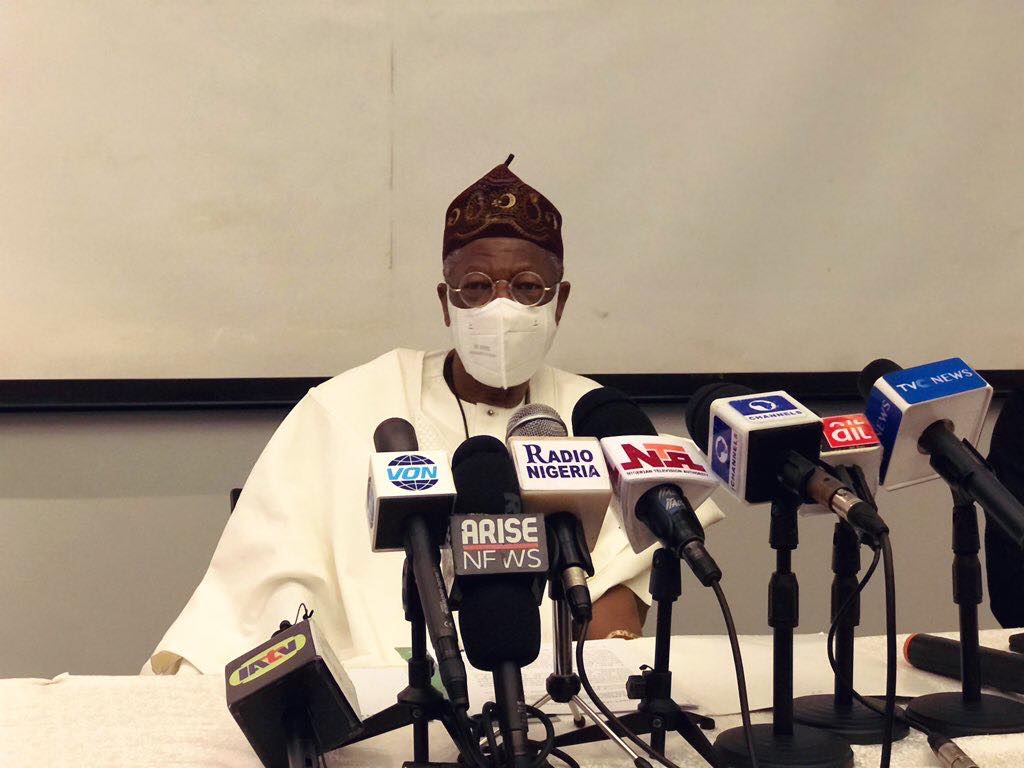
The Minister of Information and Culture, Mr Lai Mohammed, has disclosed that the federal government is not overwhelmed by the rising insecurity in the country.
Mr Mohammed, while addressing journalists in Lagos on Tuesday, also appealed to the media to assist the administration of President Muhammadu Buhari by “dousing the pervasive tension and not allow their platforms to be used uncompromising separatists and die-hard pessimists about the survival of our nation can only overheat the polity and aggravate the security challenges.”
He stressed that “this is not a call for censorship. It is a call for responsibility, in the national interest” as the media “must also realize that it can only carry out this responsibility in an atmosphere of peace and security.”
The Minister assured Nigerians that “in the days ahead,” the federal government will “confront the challenges headlong and restore law and order, peace and security.”
He said “while the government acknowledges the security challenges we face at this time, from terrorism to kidnapping, banditry and farmer-herder conflict, it is definitely not overwhelmed.”
Mr Mohammed explained that the security operatives have not been able to overcome the crisis because “one of the most difficult things to do, for a democratically-elected government, is to use the instruments of coercion against its own people.”
“For example, while the nation’s military has superior firepower over the ragtag band of Boko Haram and ISWA, the terrorists most often than not operate among the populace, either in our villages or towns, hence the military, in tackling them, is usually careful to avoid collateral damage. The same applies to the kidnappers who abduct our school children.
“Usually, the location of the kidnappers is not unknown to the security forces, but they still have to exercise caution in order not to hurt the same children they are trying to rescue. Despite these inhibitions, the security forces have the wherewithal to decisively tackle the challenges,” he added.
He lamented the “growing dangerous trend” of “launching deadly attacks against the nation’s security personnel.”
“Soldiers, as well as the police, customs and other security agents, have been killed and maimed in some parts of the country in this growing trend of targeting security forces.
“I want to say, unequivocally, that any attack on our security men and women is an attack on the state and a declaration of war against the nation.
“It follows, therefore, that this will be countered with overwhelming force. When those whose responsibility it is to protect us are themselves being subjected to mindless attacks, it can only be for one reason only: to instil fear and evoke a sense of pervasive insecurity among the people, whether known or unknown gunmen, those engaged in this dastardly act will pay dearly for their actions,” he stated.
General
Finding a Way Forward Through Life’s Challenges
Life is full of unexpected moments that test our patience, strength, and perspective. Everyone experiences setbacks, disappointments, and periods of uncertainty. While these moments can feel overwhelming, they also provide opportunities for personal growth and self-discovery.
One of the most valuable lessons we learn is that difficult situations rarely last forever. Time, reflection, and a willingness to adapt often help us move beyond even the toughest circumstances. Maintaining a positive outlook and focusing on practical solutions can make a significant difference.
Relationships also play an important role in overcoming hardships. Support from family, friends, or mentors reminds us that we are not alone. At the same time, learning to let go of anger and resentment can free us from emotional burdens that prevent us from moving forward.
The only way out of the labyrinth of suffering is to forgive. It is nothing to die. It is frightful not to live. Everything was beautiful and nothing hurt.
Personal growth is not about avoiding challenges but about responding to them with resilience and wisdom. Every experience, whether positive or negative, contributes to the person we become. By embracing change and practicing gratitude, we can create a more meaningful and fulfilling life.
In the end, moving forward requires courage, forgiveness, and hope. When we choose to focus on what we can control instead of dwelling on the past, we open ourselves to new opportunities and a brighter future.
General
Tinubu Okays Four New Army Divisions, Recruitment of 28,000 Personnel
By Modupe Gbadeyanka
The establishment of four new army divisions has been approved by President Bola Tinubu, bringing the total to 12.
In a statement on Thursday by the Special Adviser to the President on Information and Strategy, Mr Bayo Onanuga, it was stated that the President also authorised the recruitment of 28,000 additional personnel to strengthen national security.
The new divisions created include 5 Division, with the headquarters in Makurdi covering Benue, Nasarawa and Kogi States; 9 Division, with the headquarters in Ilorin covering Kwara and Niger States; 10 Division, with the headquarters in Jalingo covering Taraba and Adamawa States; and 83 Division, with the headquarters in Benin City covering Edo, Delta and Bayelsa States.
It was disclosed that the establishment of the new Divisions in Makurdi, Ilorin, Jalingo and Benin City will significantly improve command and control, decentralise operational decision-making, strengthen border security, enhance the protection of critical national infrastructure, improve counter-insurgency and internal security operations, and ensure faster military response to emerging threats nationwide.
Implementation of the new force structure will be done in two phases. The first phase, covering the establishment of the 5, 9, and 10 Divisions and the reorganisation of existing formations, will be completed by September 2026. The second phase, involving the establishment of the 83 Division and further reorganisation, is expected to be completed by December 2026.
The statement said the expansion of the Nigerian Army’s structure from eight to twelve divisions will improve the operational effectiveness of the security agency and strengthen national defence capabilities further.
Before now, the Nigerian Army operated 1 Division, with the headquarters in Kaduna covering Kaduna, Kano, Katsina and Jigawa States; 2 Division, with the headquarters in Ibadan covering Oyo, Osun, Ekiti and Ondo States; 3 Division, with the headquarters in Jos covering Plateau, Bauchi and Gombe States; 6 Division, with the headquarters in Port Harcourt covering Rivers, Akwa Ibom and Cross River States; 7 Division, with the headquarters in Maiduguri covering Borno and Yobe States; 8 Division, with the headquarters in Sokoto covering Sokoto, Kebbi and Zamfara States; 81 Division, with the headquarters in Lagos covering Lagos and Ogun States; and 82 Division, with the headquarters in Enugu covering Enugu, Anambra, Abia, Ebonyi and Imo States.
Mr Tinubu reaffirmed his administration’s determination to continue investing in the Armed Forces, ensuring they remain adequately equipped, highly motivated, and fully capable of protecting the nation and guaranteeing the safety and security of all Nigerians.
He lauded the Chief of Army Staff, Lieutenant General Waidi Ibrahim Shuaibu, and all officers and soldiers of the Nigerian Army for their dedication, professionalism, and steadfast commitment to defending Nigeria’s sovereignty and territorial integrity.
General
Sahara Group Triggers New Thinking on Energy, Investment, Journalism at Asharami Square 3.0
By Dipo Olowookere
The need for new thinking on energy transition, infrastructure financing and energy journalism has been emphasised by a leading energy company, Sahara Group.
The organisation, at the 2026 Asharami Square held in Lagos on Wednesday, July 22, stressed the need for solution-based journalism for better results.
At the event themed Energising Africa’s Future: Legacy, Impact and Transformation, the Director of Governance and Sustainability at Sahara Group, Ms Ejiro Gray, in her opening remarks, noted that Africa’s energy future must be shaped by local realities, calling for more balanced, evidence-based journalism capable of interrogating the complexities of energy transition, development and sustainability.
“Effective journalism should not only tell us what happened; it should help us understand why it matters, whose interests are affected and what perspectives are missing from the conversation,” she posited.
The Special Adviser to the President on Power Infrastructure, Mr Sadiq Wanka, in his keynote address, highlighted the opportunities emerging within Nigeria’s electricity sector as reforms continue to open new pathways for investment.
He stated that reforms across the sector were creating opportunities in embedded generation, mini-grids, renewable energy, transmission infrastructure and industrial power solutions, while urging journalists to delve deeper into policy reforms, investment opportunities and implementation outcomes.
“The issue is no longer technology. The real challenge is mobilising capital at scale, structuring bankable opportunities and creating an ecosystem that attracts long-term financing,” Mr Wanka said.
At a panel session featuring the Director of Institute of Continuing Education of the University of Lagos, Prof. Abigail Ogwezzy-Ndisika; the chief executive of the Lagos State Electricity Regulatory Commission (LASERC), Ms Temitope George; and the Managing Director of Chapel Hill Denham, Ms Kemi Awodein, it was echoed that Africa possesses significant pools of capital capable of supporting infrastructure development, but that unlocking investment requires stronger governance, investor confidence and better project preparation.
“Energy reporting must go beyond headline events and announcements. Journalists need to ask deeper questions, examine the evidence and connect policy decisions to their impact on communities and everyday lives,” Prof Ogwezzy-Ndisika stated at the panel moderated by the Associate Editor for Africa at Argus Media, Mr Adebiyi Olusolape.
Ms Awodein, during the panel which explored the question: Who is financing Africa’s energy future? Pointed out that “Nigeria has demonstrated that domestic capital can finance transformational infrastructure at scale. The real differentiator is governance, transparency and a clear pathway to value creation.”
Business Post reports that one of the major highlights of the programme was the unveiling of the Asharami Square Energy Reporting Fellowship, which the Head of Corporate Communications at Sahara Group, Mr Bethel Obioma, said was designed to deepen journalists’ understanding of the technical, commercial, environmental and policy issues shaping the energy sector.
He disclosed that this aligns with Sahara Group’s Beyond XXX vision of investing in people and platforms that will help shape Africa’s future, adding that Prof Ogwezzy-Ndisika will serve as the lead assessor for the programme.
“Through the Asharami Square Energy Reporting Fellowship, we are investing in the capacity of journalists to tell more solutions and evidence-based stories that reflect the realities, opportunities and challenges of Africa’s energy transition,” he stated.
Since its launch in 2024, Asharami Square has continued to advance informed dialogue, strategic partnerships and practical solutions that support Africa’s evolving energy landscape and reinforce Sahara Group’s commitment to delivering impact beyond its first three decades.