General
Lagos Guber: Wike Snubs PDP Candidate, Backs Sanwo-Olu
By Modupe Gbadeyanka
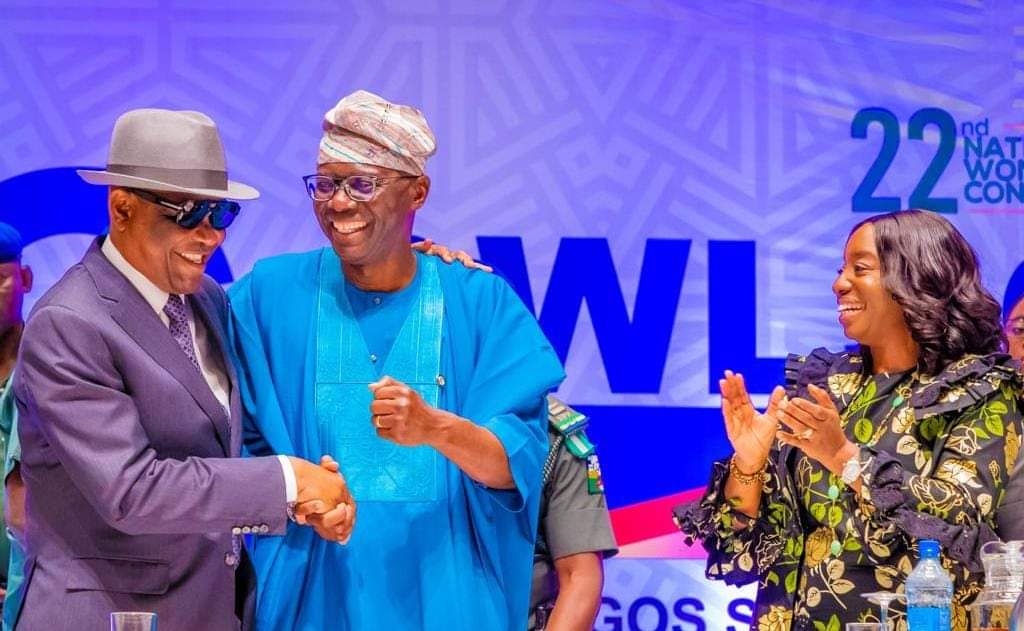
Governor Nyesom Wike of Rivers State has thrown his weight behind the candidate of the All Progressives Congress (APC) in the 2023 governorship election in Lagos State, Mr Babajide Sanwo-Olu, snubbing the candidate of his party, the Peoples Democratic Party (PDP), Mr Jide Adediran, otherwise known as Jandor.
Mr Wike, who was in Lagos on Tuesday for the 22nd National Women’s Conference organised by the Committee of Wives of Lagos State Officials (COWLSO), said any party contesting against the APC in the commercial capital of Nigeria was wasting its time.
The Rivers Governor had been at loggerheads with the leadership of the PDP over the decision of the Chairman of the party, Mr Iyorchia Ayu, to remain in office after the emergence of Mr Atiku Abubakar as the presidential candidate for next year’s poll.
He had contested the slot with the former Vice President but lost.
At the event today themed Spring Forth, Stand Out, Mr Wike said Governor Sanwo-Olu has raised the bar in governance, endorsing him for another term in office.
The Rivers State Governor said he had no regrets for openly endorsing Mr Sanwo-Olu, stressing that his endorsement of his Lagos colleague was borne out of his personal conviction about good governance.
“If Sanwo-Olu is not doing (well), even if he belongs to my party, I will not come here. If you belong to my party and you are not doing well in governance, you won’t see me.
“If you don’t belong to my party and you are doing well, you will see me. Good governance is what I stand for. I will not regret to say that I am in support of you (Sanwo-Olu) for second term. Others should not waste their time,” he said.
“Look at the kind of project coming from this women’s group. Why would any reasonable person not support the Government that is encouraging this?
“Let’s also look at the kind of physical infrastructure being delivered in Lagos. This confirms Lagos as a State of excellence. There are some people who will come here; instead of them to continue to make Lagos improve, they will bring Lagos down. For me, I’m satisfied with what Sanwo-Olu has done, and it doesn’t matter the party he belongs to,” he added.
In his response, Mr Sanwo-Olu described Mr Wike’s endorsement as another example of “politics without bitterness,” saying Lagos and Rivers States had learnt from each other in terms of projects and development, adding that both states would continue to cooperate on shared interest.
“There is no better person that is fit as a guest speaker at the conference other than the hardworking Governor Wike of Rivers State. We brought him here to share in his experience and also for him to see what we are doing in Lagos.
“We are encouraging collaboration without bitterness and without talking about our parties or political differences. If you are doing well, it doesn’t matter where you belong. We should encourage peer review across parties. Gov. Wike had invited me to Rivers for projects’ commissioning in the past. We have challenged ourselves in a positive way; this is good for the growth of our politics and the nation,” he said.
General
NMDPRA Shuts Down Two Petrol Stations in Ogun for Under-Dispensing
By Adedapo Adesanya
The Nigeria Midstream and Downstream Petroleum Regulatory Authority (NMDPRA) has sealed two fuel stations in Ogun State engaging in under-dispensing of petroleum products and non-compliance with the Petroleum Industry Act of 2021.
Leading the enforcement team around the Akute-Ajuwon axis of the state, the Head of Distribution Systems Storage and Retailing Infrastructure, Mr Olufemi Adebowale, said the move became imperative in view of repeated breaches of regulatory requirements by the affected stations and the need to protect the rights of consumers from sharp practices.
According to him, the development is part of its ongoing efforts to enforce compliance with industry regulations, protect consumers from sharp practices, and ensure that petroleum marketers dispense the correct quantity of products across the state.
He explained that records available to the authority showed that the fuel stations have consistently violated regulatory compliance by under-dispensing petroleum products, illegally breaking official seals placed on the facility, and resuming operations without authorisation.
According to him, such actions amount to a violation of the Petroleum Industry Act 2023 and undermine efforts to protect consumers from exploitation.
“The Nigerian Midstream and Downstream Petroleum Regulatory Authority is carrying out a lawful enforcement on this facility. Our records have consistently shown that this company has been violating regulatory compliance.”
“It is high time we made it clear that they cannot continue to under-dispense products, deliberately remove our seals, and believe that nothing will happen; that is why we are here to enforce the provisions of the Petroleum Industry Act 2023 he said.
“When it comes to under-dispensing, they are cheating members of the public by not selling the correct quantity of fuel. Also, once a station is sealed, it has no authorisation to operate. But this station deliberately removed our seal and continued operations, which is against the law.”
Mr Adebowale disclosed that the authority has been monitoring the station’s activities since 2025, describing the violations as persistent despite several enforcement actions.
He revealed that the affected station had been sealed no fewer than six times within the period, but continued to remove the authority’s seals and ignore invitations extended by the regulator.
“From our records, this has been happening since last year. The station has also refused to honour our invitations. It has been sealed not less than six times, yet it keeps removing our seals and resuming operations.”
On the sanctions awaiting the operators, Adebowale said the authority had served the stations with enforcement notices, while the facilities would remain shut until all stipulated conditions are met.
He added that the NMDPRA management would also consider suspending the operating licence of the affected stations, while also sending a strong warning to any fuel station intending to go against the rules of PIA.
“That is against the rules. They do not have any right to operate until we authorise them to do so. This is a clear deviation from regulatory compliance. According to the Petroleum Industry Act (PIA), when this happens, we must carry out enforcement, and that is why we are here today.
Beyond conducting this exercise, we are also using this opportunity to address the public through the media. As long as operators are doing the right thing, they have nothing to fear. However, for those going against compliance levels—whether through under-dispensing or direct violation of our seal—all necessary enforcement, penalties, and sanctions will be strictly applied against such offenders.”
“A letter has been served, the station has been completely shut down, and they must meet all the conditions, including payment of the applicable penalties. We are also looking at suspending the operating licence, subject to management’s approval,” he said, warning that any further attempt to tamper with the seals or resume operations illegally would attract criminal prosecution.
General
NPA Introduces Phased Truck Entry to Ease Apapa Port Congestion
By Adedapo Adesanya
The Nigerian Ports Authority (NPA) says it has moved to reduce port gridlock by releasing trucks into Apapa and Tin Can ports in scheduled batches based on terminal demand, while enforcing strict rules against indiscriminate parking on port access roads.
The General Manager, Lagos Port Complex, Mr Debo Lawal, said the NPA management, led by Managing Director, Mr Abubakar Dantsoho, was committed to ending indiscriminate truck parking around the ports and aligning operations with global best practices.
He said the authority was working with Truck Transit Parks Limited (TTP) to regulate truck movement into terminals through a phased release system.
According to him, trucks will now be released in scheduled batches based on terminal demand, instead of allowing all approved trucks to enter the port corridor simultaneously.
“If a terminal requires 100 trucks, they will not all be released at once. They will come in batches to reduce pressure on the port access roads,” he said in an interview with the News Agency of Nigeria (NAN) on Monday in Lagos.
Mr Lawal said a joint task force had been clearing Apapa and Tin Can port access roads since June 26, 2026, operating until about 8 pm daily to prevent indiscriminate parking.
He added that another clearance exercise would soon be conducted to sustain the gains and prevent a return to the persistent gridlock that previously characterised the port corridors.
The port manager, however, urged truck operators to support the initiative by exiting the port environment immediately after loading or offloading cargo.
He noted that some truck drivers still parked along access roads after completing port operations, despite repeated engagements by the authority.
“We engage truckers and their leadership every day, but enforcement will continue alongside sensitisation to ensure compliance,” he said.
On infrastructure, Mr Lawal said the federal government, through the NPA, had begun payment of the five per cent counterpart funding required for the 726 million dollar port rehabilitation project.
He disclosed that preliminary activities, including borehole drilling and site investigations, had been completed, while contractors were expected to mobilise to the site before the end of July.
According to him, a technical stakeholders’ meeting was held on July 7, while a broader stakeholders’ review was scheduled for July 13 to assess progress and address implementation gaps.
Mr Lawal said the rehabilitation project, alongside ongoing reforms, was aimed at reducing cargo clearance time, eliminating documentation bottlenecks and improving operational efficiency at the nation’s seaports.
He added that the National Single Window project was about 80 per cent completed, with a dedicated office already established near the port to improve inter-agency coordination.
According to him, the digital platform will integrate banks, the Nigeria Customs Service, shipping companies and other government agencies to improve efficiency, plug revenue leakages and enhance revenue collection.
Mr Lawal expressed confidence that improved digitisation, reduced human interference and more efficient truck management would strengthen Nigeria’s trade competitiveness and enhance operations at the Apapa and Tin Can ports.
General
Pension Harmonisation to Restore Fairness for Retirees—PTAD
By Adedapo Adesanya
The Pension Transitional Arrangement Directorate (PTAD) has said the implementation of the Defined Benefit Scheme Pension Harmonisation is a reform meant to advance and enhance pension payment equity in the country.
The chief executive of PTAD, Mrs Tolulope Abiodun Odunaiya, said this initiative was a landmark reform designed to restore fairness, improve retirees’ welfare and strengthen confidence in the administration of the country’s legacy pension system.
The harmonisation exercise marks one of the most significant policy interventions in the Defined Benefit Scheme since PTAD was established in 2013 to take over the management of pensions under the old federal pension arrangement.
Unlike periodic pension increases that merely raise existing benefits by a percentage, she stressed that pension harmonisation was further than that by recomputing pensions using the latest approved salary structures that existed before the closure of the Defined Benefit Scheme.
She noted that the objective is to ensure that retirees who held similar positions and rendered comparable years of service receive equitable pension benefits regardless of their retirement dates.
The initiative comes against the backdrop of years of agitation by pensioners over historical disparities in pension computation.
She added that the PTAD’s harmonisation programme seeks to resolve that challenge by restoring parity within the system. According to her, pension harmonisation is the formal recomputation of pensions using approved salary structures applicable before the DBS cut-off date.
In practical terms, it ensures that pension outcomes are determined by rank, grade level and years of service rather than the year of retirement.
The Directorate believes the exercise will significantly improve social justice by correcting historical inequities that disadvantaged thousands of retirees.
The harmonisation applies primarily to pure Federal Government pensioners as well as eligible retirees under the Parastatals Pension Department (PaPD), Defunct and Transferred Agencies Pension Department (DTAPD), and the Education and Health Pension Department (TEHPD), particularly those who initially served under the Federal Government before their agencies were transferred to state governments.