General
Lagos Takes Lion from Indian Owner to Omu Resorts
By Dipo Olowookere
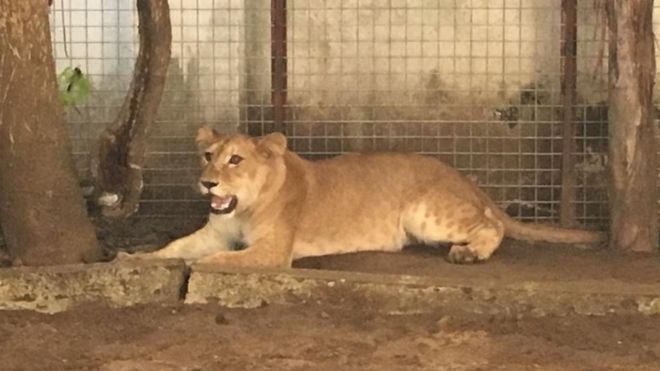
The Lagos State government has taken the lion found at the private residence of its Indian owner around Victoria Island to a zoo in Omu Resorts, Lekki.
Over the weekend, pictures of the wild animal caged in the premises of its owner believed to be an Indian national litered the internet, with many commentators calling for the immediate prosecution of the owner.
On Monday, the state government said officials of the Lagos State Task Force were at the area alongside some medical personnel to evacuate the lion from the residence to the zoo so as to safeguard lives and properties of residents of the metropolis.
According to Chairman of the agency, CSP Olayinka Egbeyemi, the exercise was carried out in conjunction with officials of the Lagos State Ministry of Agriculture and medical personnel from the Faculty of Veterinary Medicine, University of Ibadan led by Dr Ogunmo Bamidele.
Mr Egbeyemi said the doctor had to shoot the lion three times with sedatives before the lion was finally tranquilised and evacuated from the premises to the zoo, where it would be and be taken care of.
He confirmed that the agency responded to a petition from residents while investigations revealed that the lion was brought in from Cameroun by an Indian two years. However, he did not disclose identity of the owner
“Immediately I got the petition, I deployed my officers to the house at No. 229, Muri-Okunola Street, Victoria Island, Lagos, where they kept a close watch for more than 72 hours before the lion was finally removed today,” Mr Egbeyemi said.
He assured residents that the owner of the lion would face the full wrath of the law, warning residents to abstain from harbouring wild animals that endanger the lives of others.
“In as much as we appreciate residents around Victoria Island for their quick action, we urge every member of the public to be observant in their immediate environment and report any strange or unusual activity to appropriate government authority for prompt action,” he stated.
The Director, Veterinary Services, Lagos State Ministry of Agriculture, Dr Macaulay Rasheed, also advised members of the public to stop rearing wild animals at private homes in order to avoid unnecessary attack and contagious animal diseases.
General
Nigeria Eyes 50% Solar Share in Power Mix by 2029
By Adedapo Adesanya
Nigeria is targeting that solar power will account for 50 per cent of the power generation mix by 2029, according to the Rural Electrification Agency (REA).
According to REA’s managing director, Mr Abba Abubakar Aliyu, solar power generation has risen dramatically in the last few years to about 20 per cent of Nigeria’s electricity supply.
He said this could further reach 50 per cent by 2029 if current deployment and private-sector partnerships continue, speaking during the just-concluded 25th Nigerian Oil and Gas (NOG) Energy Week in Abuja on Thursday.
Mr Aliyu, during an energy panel titled Re-Engineering Africa’s Power Market – Driving Reliable Energy Systems, said solar’s share of national generation has risen rapidly, and that sustained momentum would push it toward half of the country’s power mix within the next three years.
Mr Aliyu said the growth was driven by increasing deployment and stronger collaboration with private investors.
“Solar currently constitutes 20 per cent of the nation’s total generation capacity, and with the pace of deployment we are seeing, it is closing in on 50 per cent,” he projected.
The REA chief told delegates that Nigeria was shifting from being primarily a consumer of clean-energy equipment to becoming a regional supplier of renewable technology.
He said manufacturers in the Lagos–Sagamu industrial corridor were building capacity to meet demand across West Africa.
Mr Aliyu said Lagos-made solar photovoltaic (PV) panels were already being exported to neighbouring countries.
He added that a pipeline of about 3.7 gigawatts of PV manufacturing capacity was under development to support further expansion.
“If you go to the Lagos–Sagamu axis, you will see manufacturing companies coming up,” he said.
He, however, noted that despite the rapid expansion in solar deployment and local manufacturing, he clarified that conventional gas-fired thermal plants would remain necessary to stabilise Nigeria’s electricity grid.
He joined other panellists to advocate for a dual-track investment strategy that would continue to expand solar generation and domestic manufacturing while also maintaining and upgrading gas-fired plants.
General
PenCom to Deploy $22bn Pension Fund for Roads, Energy, Healthcare
By Adedapo Adesanya
The National Pension Commission (PenCom) is developing a new investment vehicle that would channel part of Nigeria’s $22 billion pension assets into critical infrastructure projects, providing long-term financing for roads, railways, energy and healthcare.
The proposal was disclosed by PenCom spokesman, Mr Ibrahim Buwai, who said the initiative is expected to be launched later this year as the commission explores ways to mobilise pension assets for national development while protecting contributors’ savings.
Mr Buwai said the regulator is promoting the creation of a special-purpose investment vehicle that would allow pension assets from different fund managers to be pooled for financing commercially viable infrastructure projects.
“We are encouraging the setting up of a vehicle, kind of special purpose vehicle, where resources can be pooled, so that viable infrastructure projects can be looked at,” he said, explaining that the proposed fund is designed to balance national development with the interests of pension contributors by targeting investments capable of delivering returns that outperform inflation.
He noted, however, that participation will remain at the discretion of individual Pension Fund Administrators, while the final size of the investment vehicle is yet to be determined.
The proposal also comes as pension investments in infrastructure continue to expand. Latest data published by PenCom show that investments through infrastructure funds climbed by 38 per cent year-on-year to N318 billion (about $230 million) as of May 2026, reflecting growing interest among pension managers in long-term infrastructure assets.
The proposed infrastructure vehicle aligns with PenCom’s broader strategy of increasing the role of pension assets in Nigeria’s capital market and unlocking what it describes as the industry’s largest pool of long-term passive investment capital.
The initiative follows a period of strong growth in the pension industry, with Nigeria’s total pension assets rising to a record N31.32 trillion in May 2026 despite challenging economic conditions.
PenCom has also intensified efforts to strengthen compliance within the pension system. Working with the Independent Corrupt Practices and Other Related Offences Commission (ICPC), the commission recently recovered more than N3 billion in outstanding pension contributions that employers had failed to remit on behalf of workers.
General
NAQS Seeks Integration Into Customs’ B’Odogwu Platform
By Modupe Gbadeyanka
The Nigeria Agricultural Quarantine Service (NAQS) has asked to be integrated into the B’Odogwu platform of the Nigeria Customs Service (NCS).
This call was made by the head of NAQS, Mr Vincent Isegbe, during a meeting with the Comptroller-General of Customs, Mr Adewale Adeniyi, in Abuja on Wednesday.
Mr Isegbe, who used the visit to congratulate Mr Adeniyi on the extension of his tenure as Chairperson of the World Customs Organisation Council, which he described as recognition of his dedication and leadership, praised what he called an excellent working relationship with Customs.
He outlined areas for closer partnership, including integrating NAQS into Customs’ B’Odogwu platform, joint enforcement operations, and coordinated efforts to detect fake certification and fraudulent documentation.
In his remarks, Mr Adeniyi commended his guest for the partnership, promising that NAQS will provide technical support for the new Customs laboratory.
According to him, this is one of the avenues to deepen collaboration between the two agencies on intelligence sharing, trade facilitation and national security.
He informed Mr Isegbe that his organisation was moving to harmonise inspection procedures across the country’s ports and border stations, a step he described as critical to promoting consistency, transparency and efficiency in cargo clearance nationwide.
He also stated that customs training facilities would be opened up to NAQS officers as part of a broader capacity-building push.
“We must expose our officers to the broader concept of national security. Border management goes beyond revenue collection,” Mr Adeniyi said, stressing that Customs sees itself as the anchor institution coordinating Nigeria’s multi-agency border protection efforts.