General
Lagos to Host 2025 AVCA Conference, Venture Capital Summit
By Modupe Gbadeyanka
The AVCA Conference and Venture Capital Summit in 2025 will take place in Lagos, Nigeria, the organisers have announced.
The programme, which is Africa’s largest private capital gathering, is organised by the African Private Capital Association (AVCA).
The 2024 edition was held in Johannesburg last week and attracted over 700 delegates from more than 60 countries, with panellists discussing the global decline of VC funding and exploring a range of solutions to catalyse growth.
Speakers marked the influence of rapidly emerging technologies shaping African innovation and driving the digital economy, creating new skills and increasing efficiency, such as artificial intelligence, blockchain and quantum computing.
The VC summit saw participation from Africa-focussed venture capital funds, DFIs and global investors, including AfricInvest, African Renaissance Partners, Aves Lair, Altree Capital, Breega, Enza Capital, European Investment Bank (EIB), Flat6Labs, LoftyInc Capital, Lightship Anchor Fund, Octerra Capital, Proparco, Savant, Sango Capital, Sawari Ventures, Standard Bank, TL Com Capital, USAID Prosper Africa, Ventures Platform, 500 Global, and more.
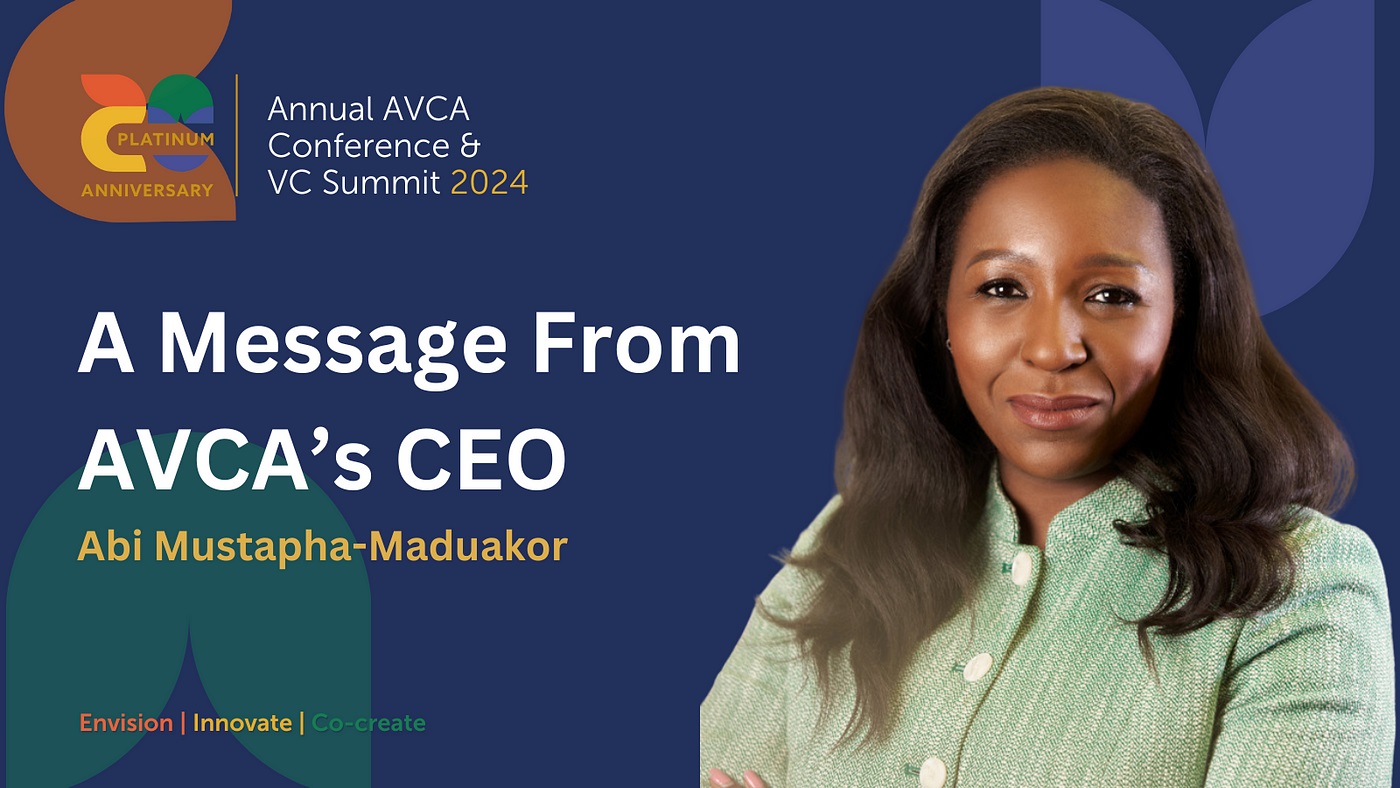
The chief executive of AVCA, Ms Abi Mustapha-Maduakor, said Nigeria’s position at the forefront of venture capital and private equity investment in Africa, backed up by a tech-savvy population and the recent rise in local investment funds and angel investors, sets the scene for a dynamic summit in 2025.
“Nigeria has emerged over the last decade as an investment hotspot in Africa. The country’s entrepreneurial spirit and well-established pools of local capital gave rise to some of Africa’s earliest unicorns, particularly in the payments sector.
“As we wrap up the conference in Johannesburg, we look forward to our next event in a city that has played an equally catalytic role in Africa’s investment landscape,” she stated.
At this year’s event, a Partner at Modus Capital, Andre Jr. Ayotte, while speaking on the panel The DeepTech Potential in African Tech, highlighted how founders can apply technology to build companies solving problems at scale.
Despite progress in tech-enabled sectors, Nick Allen, Managing Partner, Savant, noted that gaps in Africa’s tertiary education system have led to a lack of skilled graduates with sufficient engineering knowledge.
He added that in comparison to more developed markets such as Europe and the US, there is a lack of investors who understand how to finance deep tech in Africa.
While on another panel Seasons Change: Lessons Learned in Winter and the Path to Spring, a seasoned investor and Senior Partner at AfricInvest, Khaled Ben Jilani, raised the importance of active strategies to make businesses less capital intensive in order to anticipate new risks and navigate a lack of liquidity in the market.
Steve Beck, Co-Founder and Managing Partner at Novastar Ventures, expressed that private equity firms and development finance institutions (DFIs) with dedicated VC teams had stepped in to partially fill the funding gaps, particularly in the early stages.
General
Fani-Kayode Cites Ideological Reasons for Choosing S’Africa Over Germany
By Adedapo Adesanya
The former Minister of Aviation, Mr Femi Fani-Kayode, has been redeployed from Germany to South Africa as Nigeria’s ambassador.
Mr Fani-Kayode disclosed in a statement issued on Thursday, stating that President Bola Tinubu has approved his reassignment to South Africa upon his request, contrary to reports that he was rejected by the European nation.
The request, he said, was put forward days after his posting was announced in March alongside that of 64 other ambassadorial appointees.
The former aviation minister said he “personally sought” redeployment due to personal and ideological reasons.
“I expressed the fact that I would rather serve in a country that shares some of my convictions, beliefs and values when it comes to world affairs, that has the biggest economy in Africa, that has closer ties to Nigeria, and that is more proximate to my political thinking when it comes to foreign affairs and a pan-African vision,” Mr Fani-Kayode stated.
He also said, “I was not comfortable with Germany for several personal reasons. Given that I have lived in Europe most of my life, I would prefer to go to South Africa, which is a country that I have never been to and for which I have so much interest.”
He disclosed that he had presented his request and reasons to the then former Minister of Foreign Affairs, Mr Yusuf Tuggar, who was still in his seat at the time.
He said Mr Tuggar considered his request favourably and subsequently presented it to President Tinubu, who approved the redeployment.
The former minister said he had spent much of his life in Europe and wished to serve in a country within Africa that aligns more closely with his views on foreign policy and Pan-Africanism, describing South Africa as a country with strong bilateral ties with Nigeria and as occupying a strategic position on the continent due to its economic influence.
He expressed gratitude to both the president and the foreign affairs minister for what he described as a “gracious” consideration of his request.
He also acknowledged Mr Sam Enang, the appointee initially posted to South Africa, for agreeing to swap places with him. This thereby makes Mr Enang the ambassador-designate to Germany.
He also denied the report that Germany rejected him for previously making tribalist and ethnic slurs. He insisted that the decision to switch was made solely by him.
“Germany never rejected me,” he wrote, adding that the report published by People’s Gazette in March was inaccurate.
The report stated that Germany rejected Mr Fani-Kayode’s ambassadorial posting due to his past “rabid ethnic and religious slurs as well as his erratic behaviour.”
Responding to this, however, Mr Fani-Kayode said, “The story was not only irresponsible and insulting but was also a total and complete fabrication based on hearsay, beer parlour talk and cheap gossip and designed to embarrass me, the President.
“Worse still, they listed a number of clearly outlandish and absurd reasons for this purported and fake ‘rejection’ which they patched together and concocted reflecting the malevolent condition of their perverse imagination.”
The minister claimed that preliminary findings from an internal investigation showed that the report was sponsored and written with malicious intent.
He also added that petitions had been submitted to relevant security agencies regarding the publication and the individuals allegedly responsible for the report.
“I have also briefed my lawyers…and we shall be suing them in a civil action for defamation,” he said.
The former minister maintained that no formal rejection was ever issued by Germany, stating that the report emerged after diplomatic communication relating to his redeployment to South Africa was leaked and misrepresented.
“What actually happened was that the day an “agreement” was sent to South Africa by the Ministry of Foreign Affairs, which was on March 13th, it was leaked to them and they falsely and maliciously reported that it was sent only because I had been formally rejected by Germany, which they knew to be false,” he noted.
He added that he looks forward to serving Nigeria in South Africa, which he described as a country with a “remarkable and inspiring history.”
Meanwhile, Mr Fani-Kayode’s posting to South Africa comes amid growing tension of xenophobia and anti-black immigrant campaigns in the country.
The Foreign Minister, Mrs Bianca Odumegwu-Ojukwu, summoned the South African High Commissioner to Nigeria following the murder of two Nigerian nationals allegedly by officials of the South African National Defence Force (SANDF).
One of Mr Fani-Kayode’s first tasks will likely be addressing the xenophobic violence as it affects the lives and interests of Nigerians in the country.
General
Ogun NSCDC Arrests 210 Suspects for Vandalism, Illegal Mining
By Adedapo Adesanya
The Ogun State Command of the Nigeria Security and Civil Defence Corps (NSCDC) says it arrested 210 suspects for vandalism, fraud, and illegal mining in the last 18 months as part of its anti-vandalism drive.
The Ogun State Commandant, Mrs Remilekun Ekundayo, disclosed this during a courtesy visit to the Nigeria Union of Journalists, NUJ, council in Abeokuta, the state capital.
Mrs Ekundayo said the command had also recovered over N23 million in fraud-related cases for victims and resolved more than 1,700 disputes through alternative dispute resolution mechanisms within the same period.
She added that the command has sustained intelligence-driven operations that have prevented several criminal activities and ensured the protection of pipelines, railway corridors, and power installations across the state.
While stressing that security remains a shared responsibility, Mrs Ekundayo called for stronger collaboration with the media to enhance public awareness and safety in the state.
According to her, the visit was aimed at strengthening cooperation between the corps and the media, describing journalists as critical partners in the state’s security architecture.
“In matters of security, your role becomes even more strategic and impactful,” she said.
“The NSCDC is statutorily empowered to protect critical national assets and infrastructure, prevent vandalism and economic sabotage, and support disaster management and emergency response,” she said.
In his remarks, the Ogun State Chairman of the NUJ, Mr Wale Olanrewaju, assured the commandant of the council’s support and continued partnership through accurate and prompt reporting of security issues.
General
Defence Minister Musa Warns Mali Conflict May Destabilise West Africa
By Adedapo Adesanya
Nigeria’s Minister of Defence, Mr Christopher Musa, says the capture of a key Malian town by rebels poses a threat to West Africa that requires foreign intervention to prevent the insurgency from spreading.
A series of coordinated attacks by militants in late April left Mali’s Defence Minister dead and forced Malian and Russian mercenary forces to withdraw from the northeastern stronghold of Kidal.
Mr Musa, a retired army general, said in an interview with Bloomberg that the international community must come together to deal with the insurgents before they wreak havoc on the region.
The deteriorating situation in Mali may trigger a wider regional crisis, the defence minister said.
His admittance comes as the border region of Nigeria, Benin and Niger on the southern edge of the Sahel region is becoming a new stronghold for jihadists, as militants turn forests and pastoral networks in West Africa into bases for recruitment and international attacks.
“If they allow them to get any foothold in Mali, completely, they are not stopping there,” he warned.
He called for a joint campaign style like that of the United States against the Islamic State in Syria as a way to root out terrorists in West Africa.
General Musa noted that the collapse of states across the region has been the main driver of arms proliferation, with coastal West African states, including Ghana and Togo, becoming increasingly vulnerable.
He cited the fall of former Libyan dictator Muammar Gaddafi in 2011 as a turning point that released vast stockpiles of weapons into circulation, a problem compounded by ongoing instability in Sudan.
The combined crises have created an open corridor across the Sahel, allowing small arms, light weapons and ammunition to flow largely unchecked.
He added that this has worsened due to weak border controls and the ease of movement across the region.
Attacks in Nigeria have also risen, with data from the website of the Armed Conflict Location & Event Data (ACLED), a conflict-monitoring group, affirming that the number of suicide bombings in Nigeria by March already matched the annual average over the past six years.
The Nigerian military has also been dealt a blow to its military bases and senior figures targeted. In April, Brigadier-General Oseni Omoh Braimah was killed when Islamist fighters attacked a base in Borno State.
The minister said disruptions linked to global conflicts, including the war in Ukraine, as well as the ongoing war in Iran, have made it harder to source weapons even when funding is available. To meet its defence goals, Nigeria is stepping up efforts to build domestic arms-manufacturing capacity.
-
Feature/OPED6 years agoDavos was Different this year
-
Travel/Tourism10 years ago
Lagos Seals Western Lodge Hotel In Ikorodu
-
Showbiz3 years agoEstranged Lover Releases Videos of Empress Njamah Bathing
-
Banking8 years agoSort Codes of GTBank Branches in Nigeria
-
Economy3 years agoSubsidy Removal: CNG at N130 Per Litre Cheaper Than Petrol—IPMAN
-
Banking3 years agoSort Codes of UBA Branches in Nigeria
-
Banking3 years agoFirst Bank Announces Planned Downtime
-
Sports3 years agoHighest Paid Nigerian Footballer – How Much Do Nigerian Footballers Earn