Connect with us

General

NDLEA Grabs Sokoto Village Head Over Illicit Drugs

Published

on

village head

By Adedapo Adesanya

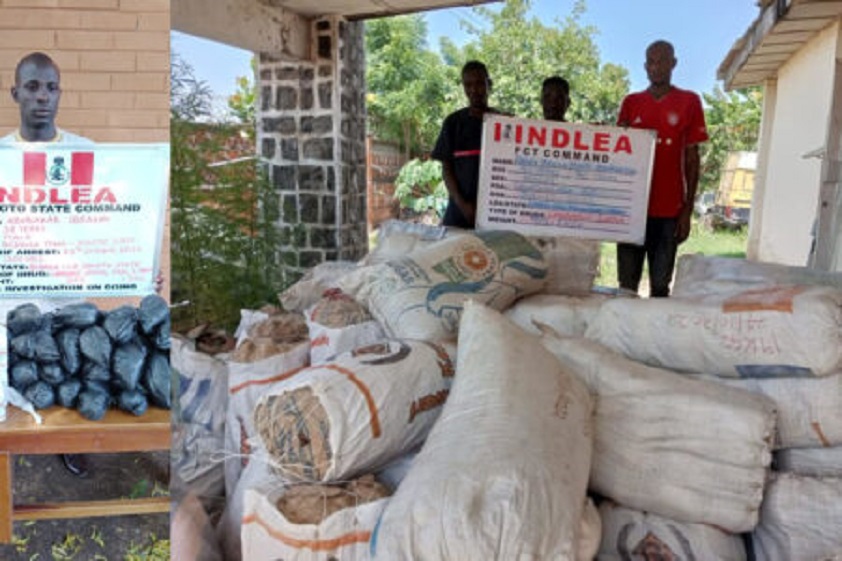
Operatives of the National Drug Law Enforcement Agency (NDLEA) have arrested the village head of Gidan Abba in the Bodinga local government area of Sokoto State, Mr Abubakar Ibrahim, for his alleged role in drug trafficking.

This was disclosed in a statement on Sunday by the spokesman of the NDLEA, Mr Femi Babafemi.

The agency revealed that Mr Ibrahim was among 11 suspects arrested in interdiction operations in which 991,320 pills of pharmaceutical opioids and 1,251kgs of cannabis and khat, as well as 46.637 kilograms of methamphetamine, cocaine and heroin, were recovered by operatives across seven states.

The village head, 38, was arrested in Bodinga town the same day with 3kgs of cannabis Sativa and 4,000 tablets of exol-5.

Operatives seized 146,000 pills of Tramadol 225mg in a buy and bust operation in the Oshodi area of Lagos state on Tuesday, October 25.

It was disclosed that at the Murtala Muhammed International Airport, Ikeja Lagos, NDLEA operatives attached to the SAHCO import shed on Wednesday, October 26, intercepted 15 cartons containing 802,000 pills of Tramadol imported from Dubai, UAE, and Karachi, Pakistan.

Also, 10 cartons of Tramadol 225mg came in from Dubai on an Ethiopian Airlines flight, four cartons of 100mg and a carton of 225mg Tramadol came from Karachi, Pakistan, on another Ethiopian Airlines flight.

On the same day, operatives at the SAHCO export shed intercepted cans of tomato paste going to the United Kingdom. A thorough search of the consignment revealed that the tomato cans were used to conceal 36 pellets of cannabis with a gross weight of 21.30 kilograms, while a cargo agent, Mr Sodehinde Akinwale, has been arrested in connection with the seizure.

In the same vein, a 27-year-old Madu Chukwuemeka Miracle was arrested by operatives at the Akanu Ibiam International Airport, AIIA, Enugu, on arrival from Nairobi, Kenya, via Addis Ababa, Ethiopia, on Wednesday, October 26. A search of his three bags revealed 76 foreign bathing soaps made with cocaine in one of the bags, while another had two plastic bottles containing cream-like liquid, which tested positive for cocaine. The cocaine bars weighed 10.650 kilograms, while the liquid cocaine weighed 2.496 kilograms, bringing the total weight to 13.146 kilograms.

Two days after, on Friday, October 28, operatives attached to the NAHCO import shed of the Lagos airport seized five cartons of dried khat leaves weighing 107.70kgs that came in from Bangkok, Thailand, through Dubai on an Emirates Airline flight.

A follow-up operation on the seizure of 11.90kgs Meth concealed in the heads of dried fish going to Dubai, UAE, on August 5 has led to the arrest of a 30-year-old bricklayer, Mr Babatunde Quadri Mamowora, on Thursday, October 27, in Sango Ota area of Ogun State in collaboration with men of the Nigerian Security and Civil Defense Corps (NSCDC) in the area.

In Kogi state, NDLEA operatives on a stop and search operation along Okene-Abuja highway on Thursday, October 27, intercepted a Chisco branded bus coming from Lagos to Abuja with a consignment of 32.9kgs Meth packaged as tubers of yam; 376 grams of cocaine and 215 grams of heroin. While the bus driver, Chief Pascal Chigozie Nmaram, was promptly arrested, a follow-up operation in Abuja the same day led to the arrest of the recipient of the illicit cargo, Mr Ikenna Jude Akunne who confessed he was detailed to travel with the consignment to Spain the following day, Friday, October 28 through the Nnamdi Azikiwe International Airport Abuja.

Meanwhile, operatives of the state command of the Agency have destroyed five hectares of cannabis farms at Agbonkete, Iyaya Camp, Igalamela/Odolu LGA, where a suspect, Mr Augustine Agbenyo, 34, was arrested with three sacks of both fresh and dried leaves and stems of the illicit substance.

In the FCT, operatives on patrol along the Kwali-Abuja highway on Monday 24th Oct intercepted a truck with 915.8kilograms of cannabis and arrested three suspects: Kabiru Ibrahim, 40; Muhammad Muawiyya, 30, and Adamu Adamu, 24.

In Adamawa state, operatives arrested two trans-border traffickers, Abdullahi Mamuda (aka Mama) and Aliyu Abdullahi (aka Garga), at Skylight Hotel in Jambutu, Yola North. A search of their vehicle, an ash-coloured Toyota Corolla car with registration number JMT 146 TE (Adamawa), revealed 39, 320 tablets of Tramadol 225mg concealed in different compartments of the doors of the car.

Preliminary investigation shows the trans-border traffickers took off from Onitsha in Anambra State and travelled to Jimeta, Adamawa State, where they lodged in the hotel before heading to Belel, a town along the Nigerian – Cameroon border where they would repackage the drugs as ordinary consumables and ferry across the river to Garoa in Cameroon. Operatives in Ondo state on Friday, October 28, stormed a 2-bedroom building in Uso town, where they arrested one Okon Etim, 45, with 12 bags of cannabis Sativa weighing 207kgs.


Adedapo Adesanya is a journalist, polymath, and connoisseur of everything art. When he is not writing, he has his nose buried in one of the many books or articles he has bookmarked or simply listening to good music with a bottle of beer or wine. He supports the greatest club in the world, Manchester United F.C.

Click to comment

Leave a Reply

Your email address will not be published. Required fields are marked *

General

We Prioritised Personal Pension Plan, Others for Robust Pension System— PenCom

Published

on

Personal Pension Plan PenCom DG

By Modupe Gbadeyanka

The Director General of the National Pension Commission (PenCom), Ms Omolola Oloworaran, has highlighted strategies deployed by her organisation to ensure pension coverage is deepened in Nigeria.

Speaking at the ISSA Technical Seminar in Abuja recently, she said the steps taken were to build a more inclusive, transparent, and responsive pension system, where communication serves not just as information, but as a bridge to trust, accessibility, and sustained industry growth.

According to her, the Contributory Pension Scheme (CPS) has, over more than two decades, built a strong institutional foundation, but true inclusion goes beyond coverage to require trust and clear communication.

For this reason, PenCom has prioritised the Personal Pension Plan, strengthened stakeholder engagement, and invested in digital channels that reach contributors in accessible and relatable ways, she stated.

Ms Oloworaran further stressed that, “Effective communication is not a soft complement to regulation; it is a core instrument of coverage expansion, compliance, and public confidence.

“Every circular we issue, every benefit we pay, and every reform we introduce ultimately succeeds or fails on whether our members can understand it and act on it.”

The ISSA Technical Seminar, themed Improving Inclusivity and Accessibility of Social Security Services Through Effective Communication, was organised in collaboration with the International Social Security Association (ISSA).

It brought together key stakeholders across West Africa to advance dialogue on strengthening social security systems through clearer, more inclusive engagement.

Continue Reading

General

Nnaji Expresses Worry Over Lack of Power Plant Financing

Published

on

Gas Power Plant

By Adedapo Adesanya

Former Minister of Power, Mr Barth Nnaji, has run to the rooftop to declare that Nigeria has not secured financing for any major power plant in more than a decade, blaming policy reversals and weak government commitment for the prolonged investment drought.

Speaking at the Nigerian Association for Energy Economics conference in Lagos, Mr Nnaji said the country’s power sector lost momentum after a promising financing framework introduced under his watch was abandoned following a change in administration.

According to him, the partial risk guarantee instrument developed jointly with former Finance Minister, Mrs Ngozi Okonjo-Iweala, had begun attracting international investors by reducing the risks associated with power projects in Nigeria.

“The world was galloping to us to finance power plants because we were getting a service guarantee,” he said, noting that the framework helped secure funding for the Azura-Edo Power Station, one of Nigeria’s most significant independent power projects.

However, he said the policy was scrapped after the administration changed, abruptly halting investor interest.

“Till today, we have not financed any new major power plant in Nigeria. That’s about 11 years ago,” he said.

Mr Nnaji argued that policy inconsistency remains one of the biggest obstacles to power sector growth, without clear, stable and bankable policies.

He said Nigeria will continue to struggle to attract the long-term capital required for large-scale electricity projects.

He also urged Nigeria to adopt a pragmatic approach to energy transition, stressing that natural gas should remain the backbone of the country’s power strategy. With more than 210 trillion cubic feet of proven gas reserves, he said Nigeria is well-positioned to use gas as a bridge fuel for industrialisation and economic growth over the next two decades.

Yet, despite these vast reserves, inadequate infrastructure continues to constrain supply.

Mr Nnaji noted that the Nigeria LNG Limited is operating at only about 60 per cent of capacity due to insufficient gas availability, highlighting the urgent need for greater investment in gas production, processing and transportation.

He also cited the long-delayed Mambilla Hydroelectric Power Station as a symbol of Nigeria’s execution failures. Although technically viable, the project has remained on the drawing board for more than 40 years because of weak political will and inconsistent implementation.

He noted that Nigeria’s power challenge is not a lack of resources but a failure of execution. With an installed generation capacity of about 13,000 megawatts, the country still produces only 4,000 to 5,000 megawatts on average. Until policy becomes consistent and infrastructure investment accelerates, reliable electricity will remain frustratingly out of reach for millions of Nigerians.

Continue Reading

General

Terra Industries Unveils Defence Drones, Robots to Support Nigerian Military

Published

on

Terra Industries

By Adedapo Adesanya

Nigeria-backed startup Terra Industries has launched drones and mine-clearing robots for the country’s military use to fight Islamic militants and reduce reliance on imported defence equipment.

The startup on Monday unveiled interceptor drones, mine-clearing unmanned vehicles and battlefield intelligence software that officials said could help troops confronting insurgents who have increasingly used roadside bombs and drones in recent attacks.

The launch shows a growing effort by Nigeria to reduce dependence on imported military hardware and build domestic defence manufacturing capacity, after years of buying aircraft, armoured vehicles and surveillance systems from countries including China, Turkey, Pakistan and the United States.

However, procurement delays, maintenance bottlenecks and rising foreign exchange costs have strengthened the case for local production, with Terra Industries among the first of such beneficiaries.

Terra Industries had previously focused on civilian drones and security technology before expanding into defence systems. In February, it signed a pact with Defence Industries Corporation of Nigeria (DICON) as part of efforts to boost the country’s defence industrial capacity and advance indigenous high-technology development.

“We are unveiling new defence systems such as our interceptor UAVs, our minesweepers, ground vehicles that can detect IEDs on the ground, and our battlefield intelligence software,” according to Mr Nathan Nwachukwu, the chief executive officer of the firm.

The need for security has risen in recent years, as groups such as Islamic State and al-Qaeda are gaining ground in Africa, converging along a swathe of territory that stretches from Mali to Nigeria, which is also battling with Boko Haram and other cells which remain active despite repeated military offensives.

Militants have stepped up ​attacks against army positions using improvised explosive devices (IEDs) and drones, forcing armies to invest in counter-drone systems, electronic warfare and autonomous ground equipment.

Major General Babatunde Alaya, head of the state-owned DICON, said collaboration with Terra Industries was necessary, given troop casualties caused by hidden explosives and roadside bombs.

DICON has long been central to Nigeria’s ambition to produce more of its own defence equipment, but progress has historically been slow. Partnerships with private firms are increasingly seen as a faster route to innovation and scale.

Terra Industries, which is valued at $100 million, has also announced plans to expand beyond Nigeria, including a manufacturing facility in Ghana, signalling ambitions to serve a wider African market and position itself in the region’s growing security technology industry.

Continue Reading

Trending