General
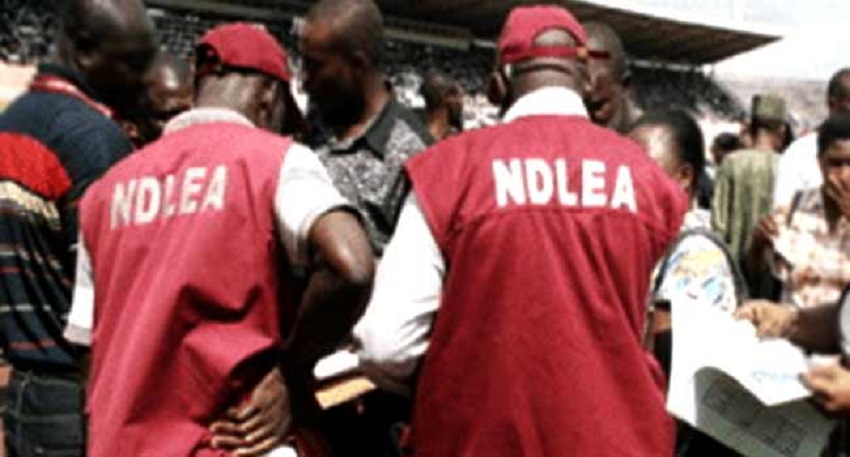
NDLEA Seizes 4.8 Tonnes of Skunk in Imo, Four Others
By Adedapo Adesanya
The National Drug Law Enforcement Agency (NDLEA) says it has intercepted no fewer than 4.8 tonnes of skunk in Imo, Edo, Ondo, Kano, and Ekiti States.
NDLEA’s Director of Media and Advocacy, Mr Femi Babafemi, disclosed this in a statement released on Sunday in Abuja.
Skunk is a generic name given to potent strains of the cannabis plant containing the highest levels of the psychoactive ingredient tetrahydrocannabinol (THC).
NDLEA’s operatives in Imo State intercepted a Mercedes Benz container truck marked ABN 418 YN parked in an isolated area along Owerri – Onitsha expressway on October 15.
The agency said a search of the abandoned truck led to the recovery of 168 bags of skunk weighing 1, 854 kilograms.
“Not less than 1,381.3kgs of the same substance were seized in four interdiction operations in parts of Edo state.
“This includes Ekpon community, Igueben LGA; Iguiye forest in Ovia North East LGA; Iruekpen, Ndokwa West where a suspect, Samuel Nwocha was arrested and Egwalor village in Onwude LGA.
“Also, the duo of Obune Prince and Chika Obi was arrested and their Audi 80 salon car marked BEN 406 CL loaded with cannabis sativa, recovered, ” he said.
In Kano State, an ex-convict, Mr Aminu Suleiman, 46, was arrested along with Mr Haruna Abdurrahaman, 41, and Mr Joseph Esezobor, 34, at Gadar Tamburawa area of the state on Saturday, October 14 while 106kgs of cannabis were recovered from them.
“Aminu was first arrested with 22kgs of cannabis on 3rd June 2022 and convicted by the Court on 24th November 2022.
“Five other suspects: Inusa Ali, Yahaya Musa, Abba Audu, Ali Abubakar, and Bunu Kyari were also arrested at Gadar Tamburawa area of Kano on Monday, October 16 for dealing in 75.3kgs of skunks,” he said.
Meanwhile, operatives of the Zone J Command of the agency seized 478kgs of cannabis in a forest in Ikere Ekiti on Friday. The statement added that those of Ondo State command also recovered a total of 928kgs of the same substance.
”This was recovered in a bush by Shagari market, along Ifon-Owo express road, and Ibola camp, Ipele forest.”
In Borno, a suspect, Mr Sani Mohammed, 31, was arrested on Saturday with 182kgs of cannabis at Njimtilo, along Maiduguri – Damaturu road.
NDLEA officers of the Directorate of Operations and General Investigations (DOGI) attached to courier companies on Sunday, October 15, intercepted 1kg methamphetamine concealed in containers of body cream going to New Zealand as well as another consignment of 2.5kgs cocaine and phenacetin hidden in walls of a carton heading to Saudi Arabia.
General
Tinubu Dissolves FG Property Privatisation Committee
By Adedapo Adesanya
President Bola Tinubu has approved the immediate dissolution of the Presidential Implementation Committee (PIC) on the Alienation of Federal Government Properties.
According to a release by the Special Adviser to the President on Information and Strategy, Mr Bayo Onanuga, henceforth, all matters relating to the activities of the committee would be coordinated by the Attorney General of the Federation and Minister of Justice, Mr Lateef Fagbemi (SAN).
“After careful consideration, the government has noted that the activities of the PIC had extended beyond its original mandate, resulting in multiple litigations across the country, and the continued existence of the committee is no longer justified,” the statement noted.
The PIC was established in 2000 during the administration of former President Olusegun Obasanjo to oversee the privatisation, sale, and lease of federal government landed assets under the government’s monetisation policy.
Its membership comprised the then Minister of Housing as Chairperson, alongside representatives from the Ministries of Transportation, Justice, Health, Agriculture, and the Nigeria Police Force.
Professor P.T Ahire, then a Deputy Director in the Office of the Secretary to the Government of the Federation, served as the pioneer Secretary. Other members were drawn from both the public and private sectors.
On March 22, 2001, the Federal Executive Council (FEC) approved the establishment of a Panel of Inquiry to produce a White Paper to guide the implementation of its recommendations.
The panel worked for 21 months before submitting its report, and after careful consideration, the government has noted that the activities of the PIC had extended beyond its original mandate, resulting in multiple litigations across the country, and the continued existence of the Committee is no longer justified.
Accordingly, the President directed the dissolution of the PIC and that the Attorney General of the Federation coordinate its activities with effect from November 5, 2025.
Following the President’s directive, the PIC stands dissolved, and the erstwhile Secretary, Mr B. S Dutsin-Ma, has been directed to cease acting on behalf of the committee and the Federal Government on related matters.
General
C&S Worldwide Supreme Leader Emmanuel Alogbo Dies
By Modupe Gbadeyanka
The spiritual father and chairman of the Cherubim and Seraphim Movement Church Worldwide, Ayo Ni O, His Most Eminence Prophet Emmanuel Adewale Abiodun Alogbo, has died at the age of 93.
The revered cleric, whose demise was announced today, Thursday, July 30, 2026, via a circular from the church, was the Supreme Head of C&S Unification Church of Nigeria.
In the notice signed by CSMC Secretary-General, Snr. Sp. Ap. Prophet Anthony Olusesan Samaye, disclosed that the church leader breathed his last peacefully in the early hours of today, “surrounded by his family members and all his domestic staff at his residence.”
It was stated that his passing occurred at about 2:10 am at his residence in Ijaiye Ojokoro, Lagos.
“With gratitude to God Almighty for a life well spent, on behalf of the Board of Trustees and the entire church, I write to inform you all that our Spiritual Father, His Most Eminence, Prophet (Dr.) Emmanuel Adewale Abiodun Alogbo, was called to glory in the early hours of today, July 30, 2026, at around 2:10 am,” a part of the disclosure, addressed to the church’s management committee, district chairmen, conference supervisors, mission directors, church elders, zonal secretaries and ministers-in-charge of parishes worldwide, said.
The statement, which prayed for God to grant the “church the fortitude to bear the irreparable loss,” said daily prayer sessions would be held for seven days from 5 pm at the late cleric’s residence located at Plot 1, Alogbo Close, off Ahmadiyya Bus Stop, Ijaiye Ojokoro, Lagos, noting that burial arrangements would be announced later.
General
Taking the Pulse of Rural Kaduna
By Sani Abdulrazak, PhD
Thrilling it is to realise that some journeys answer questions you never knew you were asking. Mine happened with no political prism through which to interpret every urban developmental project. Instead, it manifested with a simple curiosity: what does rural Kaduna look like today vis-à-vis three years prior? That part of Kaduna where press conferences are neither held nor dominate social media timelines, but the Kaduna where dawn breaks over farmlands, where markets awaken to the aroma of roasted maize, where children trek to school, and where government is not judged by eloquent speeches but by tangible presence.
If there is one thing I have learned from my travel experience to most rural communities within the 23 local government areas of Kaduna state, it is the fact that these communities have an uncanny way of telling the truth. They have little patience for rhetoric. A bridge either exists or it doesn’t. A classroom either shelters learning or it doesn’t. A health centre either treats patients or remains another neglected structure awaiting the next campaign season. These places are bluntly earnest; poor custodians of propaganda, I call them. They will always remain refreshingly fascinating because evidence is a currency there and it strips governance of embellishment.
One transformational change you can’t miss in the last three years in almost all the rural communities within Kaduna state is education. We speak of schools in cities through the prism of budgets and policies, but in villages, they speak of the child who no longer studies under the tree, the teacher who finally has a conducive classroom, and the parent whose greatest inheritance is no longer a prayer alone. It will interest us to know that across Kaduna State, more than 736 new classrooms have been constructed, while over 1,200 others have been rehabilitated. Add to this the completion of 62 secondary schools, another 50 under construction, and the establishment of 102 new schools alongside the rehabilitation of 170 existing ones under the Reaching Out-of-School Children programme, and the picture begins to assume clearer contours. Statistics, however, are notoriously reticent. They seldom tell you what they have witnessed.
A visit to Tudun Biri will surely convince you. For many Nigerians, the community became known through an episode everyone wished had never happened. Yet communities, like human beings, deserve the opportunity to write new chapters. Today, a new school stands there, as a quiet repudiation of despair. Watching children gather where sorrow once held sway, I was reminded that development is sometimes the art of replacing painful memories with hopeful possibilities. The good people of Kwoi today are living their dream, all thanks to the Proverbial Lannister of Kaduna State, Governor Uba Sani. Roads like Hospital Road, Sabon Gari Road, Audu Tilo Road, Doctor Sani Road, Kpop Ham Palace Road and the Kwoi-Gora Road have done more than alter the landscape of Kwoi; they have recalibrated daily life. They shorten journeys, connect communities and restore the simple dignity of movement. Kwoi residents, within the last three years, describe this giant developmental stride in minutes saved, transport fares reduced, and opportunities regained.
Furthermore, across the 23 local government areas of Kaduna State, 255 Primary Healthcare Centres have been upgraded to Level II status. Another 23 Centres of Excellence and 15 General Hospitals have equally received significant upgrades. These are figures easily read and quickly forgotten. Yet behind every digit lies a heartbeat. Somewhere, an expectant mother reaches skilled care without travelling impossible distances. In another village, a child receives treatment before a preventable illness becomes irreversible. Good healthcare is rarely dramatic; its greatest triumphs are the tragedies that never happen.
Nothing intrigued me the most like the philosophy underpinning Project 255. There is something profoundly democratic about the notion that every one of Kaduna State’s 255 wards deserves visible development. It is an acknowledgement that governance should not become an urban monopoly. Whether in Dogon Dawa, where schools have been rehabilitated, Zonzon, where classrooms have regained life, or other communities benefiting from roads, bridges, electrification and boreholes, the underlying message remains unmistakable: development should travel the last mile. The ancient heartbeat of rural Kaduna is undoubtedly agriculture, and it appears to be rediscovering its rhythm as well. Improved security has encouraged many farmers to return to lands once abandoned, while better rural infrastructure is gradually easing access to markets. Free fertiliser distribution to rural farmers is now becoming an annual event. Governor Uba Sani believes that Rural development, in truth, is not a peripheral conversation; it is the fulcrum upon which sustainable development balances.
None of this suggests that rural Kaduna has arrived at some idyllic destination. Far from it. There are still communities yearning for potable water, better electricity, additional schools, more healthcare personnel and improved infrastructure. Development has never been a destination reached by a single administration; it is an enduring pilgrimage requiring consistency, courage and continuity. But objectivity demands something equally important: the willingness to acknowledge progress where it is evident. Taking the pulse of rural Kaduna left me with an impression that statistics alone could never adequately convey.
That, for most objective students of governance and policy, is the most reliable way to measure a government’s impact, not by the eloquence of its promises nor the intensity of political debates, but by the ordinary experiences of ordinary people. The pulse of rural Kaduna is not yet the pulse of perfection. But it is steady. It is discernible. And, for anyone willing to leave the comfort of assumptions and listen closely, it tells a story worth hearing.
Sani Abdulrazak, PhD, is a writer, researcher and public affairs analyst based in Zaria, Kaduna State