General
Nigerian Youths Prioritize Financial, Professional Success Over Personal Happiness—Study
By Adedapo Adesanya
A new study has found that youths in Nigeria and other Sub-Saharan African countries prioritise financial and professional success over personal happiness.
In the research note shared with Business Post, Youth Talks, an initiative of the Higher Education for Good Foundation, unveiled insightful data in a global report compiled from over 45,000 participants aged between 15 – 29, spanning 212 countries and territories.
The first edition of the report from the world’s largest open youth consultation, using unprecedented data collection, revealed the desires and needs of youth globally, answering the questions of what they need to help them find meaning in life, live more harmoniously, and thus together try and meet the challenges of our time.
Youth Talks used state-of-the-art A.I. technology to analyse responses, enabling contributors to answer open-ended questions and distilling 1 million uncensored contributions into rich, comprehensible and actionable insights. It reveals an extraordinary diversity of themes, ideas, nuances, and points of view, illustrating the dynamism and diversity of today’s youth.
Results from the consultation also unveiled important insights and opinions about Nigeria and Sub-Saharan Africa from its youth.
The number one contribution from Nigerian participants focused on the paradox of individualism (mentioned by 21 per cent of participants), with respondents stressing the need to love one another and criticizing selfishness in society.
Other issues highlighted by Nigerian respondents included the stagnation of the educational system (16 per cent), political issues such as corruption and nepotism (12 per cent), discrimination and inequalities (11 per cent), and the lack of young people empowerment (9 per cent).
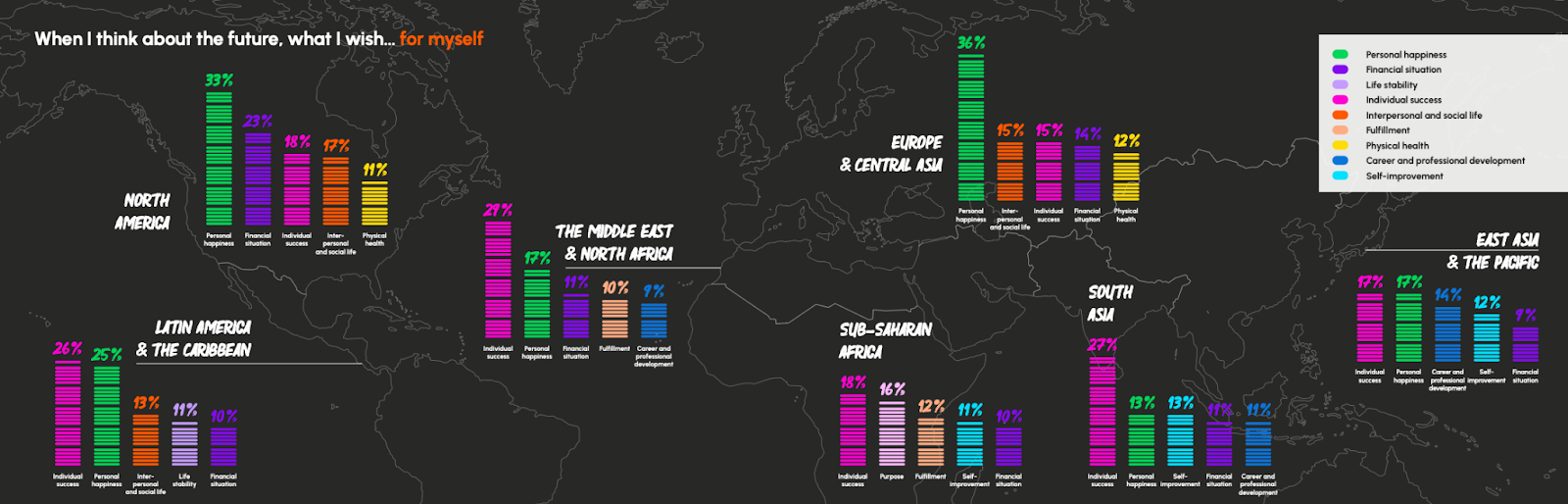
The results also showcased significant differences between youths in Sub-Saharan Africa and other parts of the world, whereby Sub-Saharan African youths were more interested in concepts such as a search for purpose, achievement, and personal development, rather than success, happiness, and financial situation.
In terms of what they prioritized for the future, personal happiness ranked seventh, behind financial and professional matters.
In addition, the report also revealed that Sub-Saharan African youths are particularly concerned with the environment (24 per cent), wars and conflicts (20 per cent), and the economy (11 per cent).
It was found that their thoughts about the future are haunted by the spectres of poverty, social inequalities, and a dearth of job opportunities. Around 10 per cent of participants in the region expressed their concerns about human behaviour in general, as they worry about an increase in human cruelty and a lack of humanity.
Speaking on the study, Marine Hadengue, Director of Youth Talks said, “The massive involvement of African youth in the consultation as participants and ambassadors demonstrates their strong desire to express themselves and actively participate in international decision-making.
“This highlights the importance of giving the younger generation from this region a platform to voice their opinions and contribute to solving the issues they face. By doing so, we can ensure that their unique perspectives are considered when shaping policies and initiatives that impact their future and the world at large.”
“Seventy-six per cent of the leaders of tomorrow – today’s youth – think that the older generations either don’t know or are deliberately ignoring their vital interest.”
“The younger generations are the future of humanity. They are the people who will initiate the greatest changes in a world turned upside down by our past actions. The priority of leaders today should be on ensuring that this generation can express themselves freely, without imposing on them the thoughts or paradigms of another era.
“Youth Talks was created precisely to address this challenge. We are evolving in our mission from giving youth a platform to raise their issues, to giving them a seat at the table. By doing so, we hope to empower the youth to not only raise their voices on the issues that matter but also to contribute to solving them,” added the Director of Youth Talks.
General
NDPC Laments Shortage of Data Protection Officers in Nigeria
By Adedapo Adesanya
The Nigeria Data Protection Commission (NDPC) has warned that the country faces a significant gap of 480,000 Data Protection Officers (DPOs), in spite of notable progress recorded in the last three years.
The National Commissioner of NDPC, Mr Vincent Olatunji, disclosed the opening of a one-week training for the second cohort of DPOs Training and Certification Programme in Abuja.
Mr Olatunji said there were still shortages even as the number of certified DPOs in Nigeria increased from fewer than 1,000 three years ago to over 10,000, while more than 27,000 professionals now operate within the broader privacy ecosystem.
However, he noted that the gap remained wide due to the increasing number of data controllers and processors in the country.
“We have identified over 500,000 data controllers and processors who require the services of data protection officers.
“At the moment, we have about 10,000 certified DPOs to work in that space.
“The gap of about 480,000 still exists, which underscores the need for sustained capacity building,” he said.
The NDPC boss said the commission was intensifying efforts to bridge the gap through continuous training programmes.
He said the initiative was aimed at positioning Nigeria as a hub for highly skilled and globally competitive data protection professionals in Africa.
“Our goal is to make Nigeria the go-to country when it comes to sourcing qualified data protection officers in Africa.
“The certification we offer meets global standards, enabling practitioners to operate not just locally but in any part of the world,” Mr Olatunji said.
He said the programme would also contribute to job creation within the digital economy, in line with the federal government’s priorities.
On her part, Mrs Tolu Fadipe, the commission’s Head of Research and Development, emphasised the critical role of data protection in the digital economy.
She said that responsible data handling was fundamental to the growth of digital systems and emerging technologies.
“As we move towards a digital economy, data becomes central and protecting that data is essential.
“This training is designed to build competence and ensure organisations comply with the Nigeria Data Protection Act,” she said.
General
Lagos Discontinues Manual Property Planning Permits System
By Modupe Gbadeyanka
The processing of planning permits for property owners in Lagos State is now fully digital, discontinuing manual and semi-digital processes.
The Special Adviser to the Governor on E-GIS and Urban Development, Mr Olajide Abiodun, said the new system is the Electronic Physical Planning Process System (EPPPS).
He described it as a transformative, web-based platform designed to completely modernise the operations of the Ministry of Physical Planning and Urban Development, which is transitioning from legacy, manual systems toward a highly efficient, transparent, and scalable digital framework.
“Lagos State has entered the dawn of a new era in digital processing of Planning Permissions, Authorisations to Commence Construction Works, Stage Certification, amongst other services,” he told newsmen recently.
Mr Abiodun noted that the full automation of the planning permit process commenced on April 1, 2026, stressing that anyone processing planning permits manually from the stated date is engaging in an illegal activity and that all applications must now go through the EPPPS platform exclusively.
The Governor Babajide Sanwo-Olu’s aide added that once one receives planning approvals via EPPPS, the journey is not over. The person should immediately apply for their Authorisation to Commence Construction Works and Stage Certifications through the EPPPS platform, amongst other services, adding that there will be a task force to monitor compliance with this activity.
While updating the citizens on other developments on Urban Development and Land Administration in the State, he said the state government has introduced CAP to further strengthen LASBCA’s capability in ensuring strict building development compliance.
According to him, CAP is a strategic Public-Private Partnership that allows accredited private professionals to work alongside LASBCA in monitoring building projects.
“This helps us ensure strict compliance with the state’s building codes. It will drastically reduce the risk of building collapses while accelerating project delivery. It is a win for safety, a win for the construction industry, and a win for Lagosians,” he said.
The Lagos State Government, in the journey of moving from the built environment to Land Administration, has actively decentralised its services to ease the burden on citizens, announcing that the e-GIS Regional Office in Ikeja has officially commenced operations.
“This is a dedicated, customer-facing hub designed specifically to handle your digitised land administration activities. Citizens will no longer need to travel all the way to Alausa for every land-related inquiry.
“The Ikeja office is fully equipped to serve residents efficiently at the grassroots level, as the Government is assuring that the remaining divisional offices across the state will also commence operations very soon,” he disclosed.
General
Oladiti Eyes NUPENG Presidency as Akporeha Bows Out
By Adedapo Adesanya
Mr Salimon Akanni Oladiti is in pole position to take over the presidency of the Nigeria Union of Petroleum and Natural Gas Workers (NUPENG).
According to reports, Mr Oladiti, who is the current National Trustee of the union, will take over from Mr Williams Akporeha, who is set to exit office at the end of April after eight years at the helm.
Mr Akporeha announced his departure at the weekend during the Quarterly National Executive Council meeting of the Petroleum Tanker Drivers (PTD) Branch in Warri, Delta State.
He noted that the union will elect a new president on April 24 in Lagos.
If Mr Oladiti, a former PTD National Chairman, emerges as the president of the union, it would be the first time a PTD member ascends to NUPENG’s top office.
The move gained momentum at the meeting, where Mr Joseph Okafor moved a motion for Mr Oladiti’s unanimous ratification, seconded by Mr Adekunle Akinlaja.
Mr Akporeha expressed gratitude to PTD members for their steadfast support throughout his tenure.
“Eight years ago, you stood by me in this same room. You didn’t only stand by me, you supported me. When things were tough, you were there through all the challenges.
“I want to appreciate all of you. If I stand to support one of your own as President, I have no apology. If I had done anything otherwise, my conscience would have troubled me. God used you to install me,” he said.
He urged members to rally behind Oladiti and the newly elected PTD National Chairman, Mathias Ote, to sustain the union’s stability and growth.
“By the grace of God, as I move along, I want to see a union stronger than I left it. I don’t want to see PTD go into disarray. The greatest favour you can do is to support this man whom you have elected today as your national chairman. Also support your own that will be the President, by the grace of God, on April 24,” he added.
On his part, the President of the Nigerian Association of Road Transport Owners (NARTO), Mr Lawal Yusuf Othman, commended NUPENG for steering a peaceful transition.
“I once again want to appreciate NUPENG. NARTO will continue to give you the necessary support,” he said.
-
Feature/OPED6 years agoDavos was Different this year
-
Travel/Tourism10 years ago
Lagos Seals Western Lodge Hotel In Ikorodu
-
Showbiz3 years agoEstranged Lover Releases Videos of Empress Njamah Bathing
-
Banking8 years agoSort Codes of GTBank Branches in Nigeria
-
Economy3 years agoSubsidy Removal: CNG at N130 Per Litre Cheaper Than Petrol—IPMAN
-
Banking3 years agoSort Codes of UBA Branches in Nigeria
-
Banking3 years agoFirst Bank Announces Planned Downtime
-
Sports3 years agoHighest Paid Nigerian Footballer – How Much Do Nigerian Footballers Earn