Connect with us

General

Nigeria’s Anti-Crude Theft Troop Destroys 50 Illegal Refining Sites

Published

on

illegal refining sites

By Adedapo Adesanya 

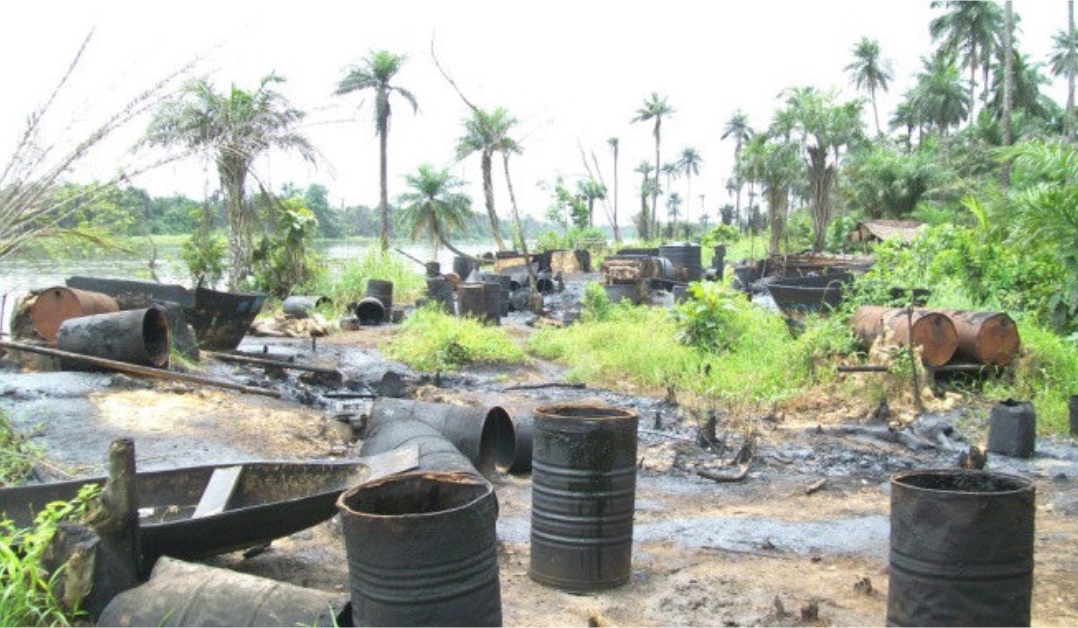
Nigeria’s anti-crude theft troop, Operation Delta Safe, has destroyed 50 illegal oil refining sites in the Niger Delta region and arrested 51 suspects in the last week.

The Director of Defence Media Operations, Maj.-Gen. Edward Buba, who made this known on Thursday in Abuja while briefing newsmen on the operations of the military, said the troops also eliminated four criminals and recovered arms and ammunition.

He added that a total of 578,900 litres of stolen crude oil, 454,330 litres of illegally refined Automotive Gas Oil and 10,000 litres of dual-purpose kerosene (DPK) were recovered during the operations.

According to him, troops also destroyed 245 dugout pits, 31 boats, 69 storage tanks, one tricycle, 23 vehicles, 162 cooking ovens, one pumping machine and three outboard engines.

He said the troops neutralised a notorious criminal and recovered one locally made pistol on November 14, in the Akpabuyo Local Government Area of Cross River State.

“On November 15, troops with hybrid forces raided suspected drugs peddlers’ hideout in Isoko North Local Government Area of Delta and arrested six suspects.

“The maritime component of Operation Delta Safe on November 17, conducted a search and rescue operation following a distress call on a missing Cameroonian-flagged motor Fishing Vessel MFV AFKI with registration number UK12 and number AFKI 8432780.

“After frantic surveillance, maritime component traced and made contact with the vessel 17 nautical miles off Pennington terminal.

“The vessel was recovered with two foreign crew members onboard,” he said.

In the South East, the troop’s spokesperson said the men of Operation UDO KA neutralised six criminals, apprehended 14 suspected IPOB/ESN elements and rescued two kidnapped hostages.

He added that the troops recovered a pump action gun, one double barrel gun, one locally made pistol, six rounds of 9mm ammo, a motorcycle and two mobile phones, among other items.

According to him, all recovered items, arrested suspects and rescued hostages were handed over to relevant authorities for further action.

The Defence Headquarters also said the troops of the Armed Forces of Nigeria in the last week eliminated 99 terrorists and apprehended 198 others in different operations across the country.

The troops also rescued a total of 139 hostages and recovered 141 assorted weapons and 1,463 assorted ammunition in the various operations across North East, North Central and North West theatres of operation.

The breakdown of recovered items, according to him, include one GPMG, one GT3 rifle, one assault rifle, 49 AK47 rifles, one Josef Magnum Pump Action gun, one double barrel gun and two single barrel guns.

Others are nine locally-made pistols, 13 Dane guns, one hand grenade, seven locally-made rifles, and two locally-made hand grenades.

In the North East, he said the troops of Operation Hadin Kai on November 17, apprehended three suspected terrorist collaborators in the Gujba Local Government Area of Yobe.

He added that the suspects claimed to have been coerced to go on the errand by terrorist elements, adding that a total of 108 terrorists and their families comprising 13 adult males, 32 adult females and 63 children surrendered to troops between Nov. 17 and Nov. 23 within the theatre of operations.

He said the troops neutralised 19 terrorists, arrested 21 and rescued eight kidnapped victims within the week across the theatre.

In the North Central, Buba said the troops of Operation Safe Haven neutralised three terrorists, apprehended 32 and rescued eight kidnapped victims as well as recovered various types of arms and ammunition, amongst other items.

He added that troops of Operation Whirl Stroke conducted raids at suspected criminal hideouts in Takum and Katsina-Ala Local Government Areas of Taraba and Benue States, respectively, neutralised two terrorists, arrested nine terrorists and rescued three kidnapped hostages.

He said the troops also recovered one AK47 rifle, one magazine and 27 rounds of 7.62mm special ammo, amongst other items.

In the North West, the Defence spokesman said the troops of Operation Hadarin Daji neutralised 20 terrorists, apprehended 20 terrorists and rescued 83 kidnapped victims in different operations across Katsina, Sokoto and Zamfara States.

He said the air component of the operation conducted air interdiction on a targeted terrorist leaders’ enclave known as Lalbi Nagogo.

According to him, the enclave is in Danmusa Local Government Area of Katsina State and the location was struck with rockets and cannons after confirmation that the terrorist and his foot soldiers were present there.

“Battle damage assessment revealed several terrorists were neutralised with various structures destroyed,” he said.

Buba said the troops of Operation Whirl Punch conducted fighting patrols in Chikun Local Government Area of Kaduna State and Kuje Area Council of FCT respectively.

He said the troops neutralised 16 terrorists, arrested 16 suspects and rescued three hostages in ambush and offensive operations on the terrorists within the period.

He added that the air component had on November 16, conducted air interdiction at a suspected terrorist leader known as Boderi in his new enclave located in Igabi Local Government Area of Kaduna State.

According to him, the location was observed to be active with terrorists and was acquired and engaged with rockets and cannons.

He said the battle damage assessment revealed that the older brother of the terrorist leader named, Nasiru, with several of his lieutenants and foot soldiers were neutralised while their structures were destroyed.


Adedapo Adesanya is a journalist, polymath, and connoisseur of everything art. When he is not writing, he has his nose buried in one of the many books or articles he has bookmarked or simply listening to good music with a bottle of beer or wine. He supports the greatest club in the world, Manchester United F.C.

Click to comment

Leave a Reply

Your email address will not be published. Required fields are marked *

General

PenCom Directs MDAs to Submit Retirees’ Data for Exit Benefit Scheme

Published

on

PENCOM pencom fraud

By Adedapo Adesanya

The National Pension Commission (PenCom) has directed treasury-funded Ministries, Departments and Agencies (MDAs) to submit details of employees who retire before December 31, 2026, as part of preparations for the implementation of the federal government’s newly approved Exit Benefit Scheme.

In a circular dated June 16, 2026, PenCom said the information must reach the Commission on or before July 6, 2026, warning that submissions must be complete, accurate and strictly comply with the prescribed template.

The circular, signed by the Acting Head of the Contribution and Bond Redemption Department, Mr Murtala M. Modibbo, was addressed to heads and chief executive officers of treasury-funded federal MDAs.

According to PenCom, the data collection exercise is critical to the smooth rollout of the Exit Benefit Scheme, which was recently approved by the federal government for employees of treasury-funded MDAs.

“The National Pension Commission is pleased to inform you that the Federal Government has approved the implementation of an Exit Benefit Scheme for employees of Treasury-funded Ministries, Departments and Agencies,” the circular stated.

PenCom directed affected MDAs to forward the required information through designated official email addresses before the July 6 deadline. The commission explained that the scheme provides for the payment of 100 per cent of the final total annual emoluments of eligible retiring employees who have served for a minimum of 10 years at the point of exit from service.

The benefit takes effect retrospectively from January 1, 2026.

To support implementation, PenCom said the Head of the Civil Service of the Federation has already issued guidelines outlining eligibility requirements, documentation, payment procedures, budgeting processes and the responsibilities of MDAs under the scheme.

The commission also disclosed that it is upgrading its Contribution and Bond Redemption Application to incorporate a dedicated Exit Benefit Scheme sub-module.

The Exit Benefit Scheme is one of the measures introduced under the provisions of the Pension Reform Act 2014 to provide enhanced financial support for retiring public servants in treasury-funded federal institutions.

Under Nigeria’s Contributory Pension Scheme (CPS), employees and employers make periodic pension contributions into Retirement Savings Accounts managed by Pension Fund Administrators. However, labour groups and retirees have often raised concerns about the adequacy of retirement benefits, particularly amid rising inflation and the increasing cost of living.

The introduction of the Exit Benefit Scheme is expected to provide an additional financial cushion for eligible federal workers at retirement while helping to strengthen social protection for public servants after active service.

Continue Reading

General

What is Automation and Why Does It Matter in Process Control?

Published

on

automation

Process control depends on accuracy, consistency, and quick response across every stage of production. In industrial environments, even small manual delays can affect quality, safety, output, and energy use. Facilities need systems that can monitor conditions, process data, and adjust equipment without constant human intervention.

Understanding automation in process control systems helps businesses see how machines, sensors, controllers, and software work together to improve operational performance. It supports faster decisions, safer workflows, and more predictable results across complex industrial processes.

Let’s look at what automation means and why it matters in process control.

What is Automation in Process Control?

Automation refers to the use of control systems, machines, sensors, and software to perform tasks with limited manual involvement. In process control, it helps monitor operating conditions and adjust equipment based on predefined logic.

For example, an automated system can track temperature, pressure, flow, or speed during production. When the process moves outside the set range, the system can send commands to valves, motors, drives, or alarms.

This makes process control more stable because actions happen quickly and consistently. Instead of depending only on manual checks, automated systems respond to live data. This helps facilities reduce errors, maintain quality, and protect equipment from unsafe operating conditions.

Why Automation Matters in Process Control

Automation matters in process control because industrial systems need accuracy, speed, safety, and repeatability. When processes depend too heavily on manual intervention, performance can vary between operators, shifts, and operating conditions.

  • Consistent Monitoring Improves Process Stability

Process control requires continuous monitoring of variables such as temperature, pressure, flow, humidity, and speed. Manual checks can miss sudden changes, especially in fast-moving environments.

Automated systems use sensors and controllers to track these variables in real time. When a process moves outside the set range, the system can trigger an immediate response. This helps maintain stable operating conditions and reduces the chance of quality variation.

  • Faster Responses Reduce Operational Delays

Manual intervention often takes time. Operators must detect the issue, understand the cause, and then adjust the system. During this delay, the process may continue moving away from the desired condition.

Automated control reduces this response time. Controllers can compare live data against programmed limits and send commands to valves, drives, motors, or alarms immediately. This helps equipment respond faster to process changes.

  • Better Accuracy Supports Quality Control

Product quality often depends on keeping process conditions within a defined range. Inconsistent settings can cause defects, waste, rework, or rejected batches.

Automated systems improve accuracy by applying the same control logic repeatedly. They can regulate speed, pressure, dosage, temperature, and timing with greater consistency than manual operation. This helps businesses maintain uniform output across shifts and production cycles.

  • Reduced Manual Dependency Improves Safety

Industrial processes can involve high temperatures, moving machinery, pressure systems, chemicals, and electrical equipment. Manual handling in such areas may expose workers to unnecessary risk.

Automation helps reduce direct human involvement in repetitive or hazardous tasks. Operators can monitor systems from control panels, human-machine interfaces, or supervisory platforms. This improves visibility while keeping teams at a safer distance from potential hazards.

  • Data Visibility Supports Smarter Decisions

Modern process control is not limited to switching equipment on or off. It also involves collecting data that helps teams understand performance over time.

Automated systems can provide insights into energy use, equipment behavior, cycle times, alarms, and process deviations. This information helps teams identify inefficiencies, schedule maintenance, and improve control strategies.

Improve Process Reliability with Smarter Automation Planning

Understanding what automation is helps businesses see why it is central to modern process control. It improves stability, reduces manual errors, and supports faster responses across critical industrial operations.

Partnering with a reputable electric brand can help businesses choose dependable control, monitoring, and automation solutions for industrial environments. This becomes important when safety, uptime, and process accuracy are key priorities.

A well-planned automated control setup helps facilities reduce errors, improve productivity, and build stronger process performance for future growth.

Continue Reading

General

FG, IFDC Sign MoU to Ease Farmers’ Access to Fertiliser

Published

on

Access to Fertiliser

Adedapo Adesanya

The federal government, through the Ministry of Agriculture and Food Security, has signed a Memorandum of Understanding (MoU) with the International Fertiliser Development Centre (IFDC) to improve farmers’ access to fertiliser.

The agreement seeks to address key challenges limiting the productivity of smallholder farmers, particularly fertiliser affordability, accessibility and timely distribution.

Under the partnership, both parties will work to strengthen fertiliser supply systems, expand soil testing and balanced nutrient management, and promote private-sector-led distribution networks across the country.

Speaking at the signing ceremony in Abuja, the permanent secretary of the ministry, Mr Marcus Olaniyi Ogunbiyi, described fertiliser as a critical input for increasing agricultural productivity and ensuring food security.

Mr Ogunbiyi noted that the MoU would support ongoing efforts to improve fertiliser accessibility, strengthen soil fertility management, promote sustainable agricultural practices and increase food production nationwide.

“Fertiliser remains indispensable for increasing crop yields and improving farm productivity across the agricultural value chain. A farmer may appreciate access to machinery, tools, or financial services; however, the availability and affordability of fertiliser often determine the success or failure of a farming season,” he said.

He said the Memorandum of Understanding will support efforts to improve fertiliser accessibility, strengthen soil fertility management, promote sustainable agricultural practices, and enhance food production nationwide.

He called on IFDC and other stakeholders to maximise the opportunities provided by the partnership to develop impactful programmes capable of boosting agricultural productivity and improving rural livelihoods.

Responding on behalf of IFDC, the organisation’s Executive Director, Mr Ben Lenkcher, pledged continued technical and logistical support to Nigerian farmers in line with the federal government’s agricultural transformation agenda.

Mr Lenkcher said IFDC remains committed to improving fertiliser accessibility, availability and affordability across Nigeria, noting that the partnership would contribute significantly to strengthening the agricultural ecosystem and enhancing food production to meet the needs of the country’s growing population.

Continue Reading

Trending