Connect with us

General

Offa Robbery: Seven Suspects in Police Net

Published

on

By Modupe Gbadeyanka

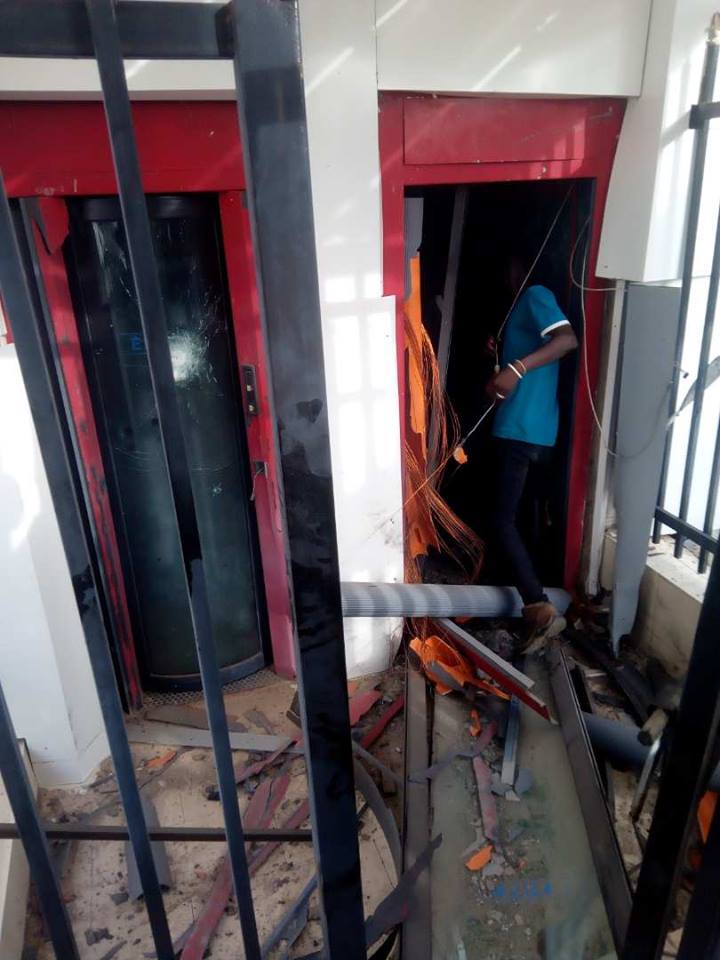
Seven persons have been apprehended by police in Kwara State in connection with invasion of some banks in the Offa area of the state on Thursday evening.

The attack left some people dead including police officers in the ancient town. The operation lasted about an hour with the armed robbers carting away with an undisclosed amount of cash.

Addressing journalists on Saturday, Commissioner of Police in Kwara State, Mr Lawan Ado, disclosed that seven suspects have been arrested.

According to him, the hoodlums abandoned some vehicles while escaping arrest and some of the abandoned vehicles have been recovered by his men.

“Seven suspects have been arrested so far. One suspect was arrested at Igosun, where the hoodlums abandoned seven vehicles and ran into the bush.

“The abandoned vehicles have been recovered and brought into the station and investigation is on,” he said.

The police chief also used the occasion to inform newsmen that 17 persons were killed during the attack, which has been described as bloody.

“Seventeen persons were killed comprising of nine policemen, eight civilians. Five banks were attacked during the operation,” Mr Ado said.

He revealed further that more police personnel have been deployed by the Inspector General of Police (IGP), Mr Ibrahim Idris, to aid the investigation and promised that all hands are on deck to ensure arrests of the suspects.


Modupe Gbadeyanka is a fast-rising journalist with Business Post Nigeria. Her passion for journalism is amazing. She is willing to learn more with a view to becoming one of the best pen-pushers in Nigeria. Her role models are the duo of CNN's Richard Quest and Christiane Amanpour.

Click to comment

Leave a Reply

Your email address will not be published. Required fields are marked *

General

SERAP Urges Tinubu to Probe Alleged Missing N26.9bn USPF Funds

Published

on

SERAP

By Adedapo Adesanya

The Socio-Economic Rights and Accountability Project (SERAP) has called on President Bola Tinubu to probe the alleged missing or diverted N26.9 billion of public funds from the Universal Service Provision Fund (USPF).

In a Sunday statement posted on its official website, the rights group asked President Tinubu to direct the Minister of Communications, Innovation and Digital Economy, Mr Bosun Tijani, and the Secretary of the USPF, Mr Yomi Arowosafe, to account for and explain the whereabouts of the missing funds.

In a letter signed by SERAP deputy director, Mr Kolawole Oluwadare, it was said that USPF is vital to expanding telecommunications access in underserved and rural communities, and any diversion of its funds directly undermines its mandate to bridge the digital divide, support infrastructure development, and promote inclusive connectivity.

SERAP demanded that President Tinubu should direct the Attorney General of the Federation and Minister of Justice Lateef Fagbemi, SAN to appropriate anti-corruption agencies to promptly and effectively investigate the allegations.

It said, “Anyone suspected to be responsible should face prosecution as appropriate, if there is sufficient admissible evidence, and any missing or diverted public funds should be fully recovered and remitted to the treasury.”

According to the statement, the allegations are documented in the latest annual report published by the Auditor-General of the Federation on 9 September 2025.

The organisation noted that, “These allegations, which include unaccounted expenditures, failure to remit public funds, irregular contract awards, and payments for services not rendered, point to serious breaches of public trust and raise concerns about systemic failures in financial accountability within the USPF.”

SERAP expressed that any failure to investigate the allegations and recover any missing or diverted public funds would not only deprive Nigerians of essential services but also frustrate national development objectives and efforts to achieve digital inclusion.

“The failure to ensure accountability for these funds also risks perpetuating inequality, particularly for marginalised and vulnerable groups who depend most on public interventions to access digital infrastructure,” it warned.

According to the letter, SERAP expressed that they would be grateful if the recommended measures were taken within seven days of the publication of this letter.

SERAP warned that if actions are not taken within seven days, it would consider appropriate legal actions to compel the government, Nigerian Communications Commission (NCC), and the USPF to comply with the request in the public interest.

Also in the letter, SERAP alleged that “According to the 2022 audited report by the Auditor-General of the Federation, which was published on 9 September 2025, the Universal Service Provision Fund (USPF) failed to disclose that it maintained a domiciliary (Dollar) account, and failed to grant the Auditor-General access to the books of the account.

“The USPF failed to remit over N13.8 billion [13,874,132.629.50] ‘being 25% annual operating surplus for four years, that is, between 2016 and 2019.’ The Auditor-General fears ‘the money may have been diverted.’ He wants the USPF to account for and remit the money.

“The USPF also ‘claimed to have spent over N11.7 million [N11,793,838.40] on international trainings in October 2020’, but ‘these claims were made without any documents.’ There were no documents, such as a letter of invitation for the programme, no receipt/invoice for registration, and no certificate of participation.”

The rights group further alleged that there was a total lockdown and restriction of movement out of Nigeria on foreign trips during the period (April to October 2020) due to the global COVID-19 pandemic. Yet, payments were made for these trips without any documents.

“The USPF also awarded contracts of over N2.8 billion [N2,853,052,005.90] but without any approval. The USPF failed to ‘provide the procurement procedures and processes adopted in awarding the contracts, including the contract files.’”

Continue Reading

General

NAFDAC, NEPZA Deepen Collaboration on Pharmaceutical Regulation in Free Zones

Published

on

NAFDAC

By Adedapo Adesanya

The Nigeria Export Processing Zones Authority (NEPZA) and the National Agency for Food and Drug Administration and Control (NAFDAC) are strengthening joint oversight within Nigeria’s free trade zones.

The collaboration focuses on pharmaceutical and consumable products manufactured by enterprises operating in the zones.

The Director-General of NAFDAC, Mrs Mojisola Adeyeye, disclosed this during a visit to the Managing Director of NEPZA, Mr Olufemi Ogunyemi, at the authority’s headquarters in Abuja.

Mr Adeyeye said the visit was aimed at deepening collaboration and partnerships that would enable NAFDAC to effectively discharge its regulatory responsibilities within the free trade zones nationwide.

According to her, the agency remains committed to monitoring the importation, exportation, production, and distribution of pharmaceuticals, food products, cosmetics, and other regulated consumables within the zones.

“We must view this meeting as a responsibility we have to the country to protect citizens from fake drugs and consumables infiltrating our markets from known and unknown destinations,” she said.

The NAFDAC boss said the agency had consistently insisted on strict testing procedures and compliance with approved standards to guarantee quality control across regulated manufacturing and export industries.

She emphasised the strategic importance of the free trade zone scheme to Nigeria’s industrialisation drive and broader economic growth objectives, particularly in manufacturing and export promotion activities.

However, Mr Adeyeye said stronger monitoring mechanisms were necessary to ensure the safety, efficacy, and quality of products entering Nigeria’s customs territory from the free trade zones.

“NEPZA and NAFDAC can fix this misalignment by jointly insisting on compliance. We can close this gap through excellent facility management and improved inspection across production lines,” she said.

On his part, Mr Ogunyemi welcomed the collaboration, describing it as critical to addressing alleged irregularities associated with medical supplies and consumable products originating from enterprises operating within the free trade zones.

According to him, the free trade zone scheme, comprising 63 zones and more than 900 enterprises, remains a major gateway for industrial growth, investment attraction, and national economic development.

The NEPZA managing director, however, acknowledged that regulating operations within the zones still presented significant challenges requiring stronger inter-agency collaboration and improved enforcement mechanisms.

“We need a joint effort to address some of the irregularities. We will allow NAFDAC to perform its regulatory functions because the public’s health depends on it,” he said.

Mr Ogunyemi added that NEPZA remained committed to ensuring that free trade zones were not used as safe havens for illicit activities or the circulation of substandard products.

“We fully endorse this partnership and collaboration, which has the potential to enhance the scheme’s global compliance across all production and export activities for the benefit of the country,” he said.

The meeting also featured the confirmation of an eight-member technical committee to examine challenges affecting seamless regulatory operations between both agencies within the nation’s free trade zones.

Continue Reading

General

Court Upholds $100m Judgment Against Chinese Oil Firm in OPL 471 Dispute

Published

on

China National Petroleum Corporation

By Adedapo Adesanya

A Federal High Court sitting in Port Harcourt has reaffirmed a $100 million judgment against China National Petroleum Corporation (CNPC) in favour of Nigerian indigenous firm, Cutra International Limited, over a disputed Oil Prospecting Licence (OPL) 471.

In a judgment delivered on April 24, 2026, the court dismissed CNPC’s application seeking to overturn an earlier judgment entered on May 23, 2025, in Suit No. FHC/PH/CS/136/2022 between Cutra International Limited and CNPC.

The Chinese oil giant filed the application on October 28, 2025, asking the court to set aside the judgment, but the court held that there was no legal basis to revisit the matter.

The dispute arose from the ownership structure and equity participation in OPL 471, which was awarded by the federal government to CNPC and its Nigerian partner, Cutra International Limited, in 2006/2007.

Under the arrangement, Cutra held a 10 per cent equity interest in the oil block. However, the company alleged that CNPC unilaterally returned the licence to the Federal Government without consulting or obtaining its consent.

Aggrieved by the action, Cutra approached the court, seeking compensation for the loss of benefits and entitlements tied to the asset.

In its earlier judgment, the court ruled in favour of Cutra after finding that evidence presented by the Nigerian firm on the estimated value of the oil block was not challenged by CNPC.

The court noted that Cutra’s claim that the minimum yield from the OPL was valued at $5 billion remained uncontroverted during proceedings.

Relying on the evidence before it, the court awarded damages of $100 million against CNPC.

Dismissing CNPC’s attempt to reopen the case, the court held that it had become functus officio after delivering judgment on the matter.

According to the court, “when a Court takes a position on a matter in controversy before it, that Court becomes functus officio with respect to that matter in controversy, and the Court stands and remains bound by the decision.”

“It is equally the position of the law that where a trial Court in the course of the proceedings in a matter before it decides on a particular issue or question, it becomes functus officio to revisit that issue or question,” the court added.

The ruling is seen as a major legal victory for Cutra International Limited and a significant development in Nigeria’s commercial dispute resolution landscape involving foreign corporate entities.

Legal and industry observers say attention may now shift to the enforcement phase of the judgment, given the international dimensions of the dispute and the substantial financial implications of the court’s decision.

Continue Reading

Trending