Connect with us

General

Olam Agri Nigeria Underlines Importance of Food, Health, Nutrition

Published

on

Olam Agri Nigeria Food

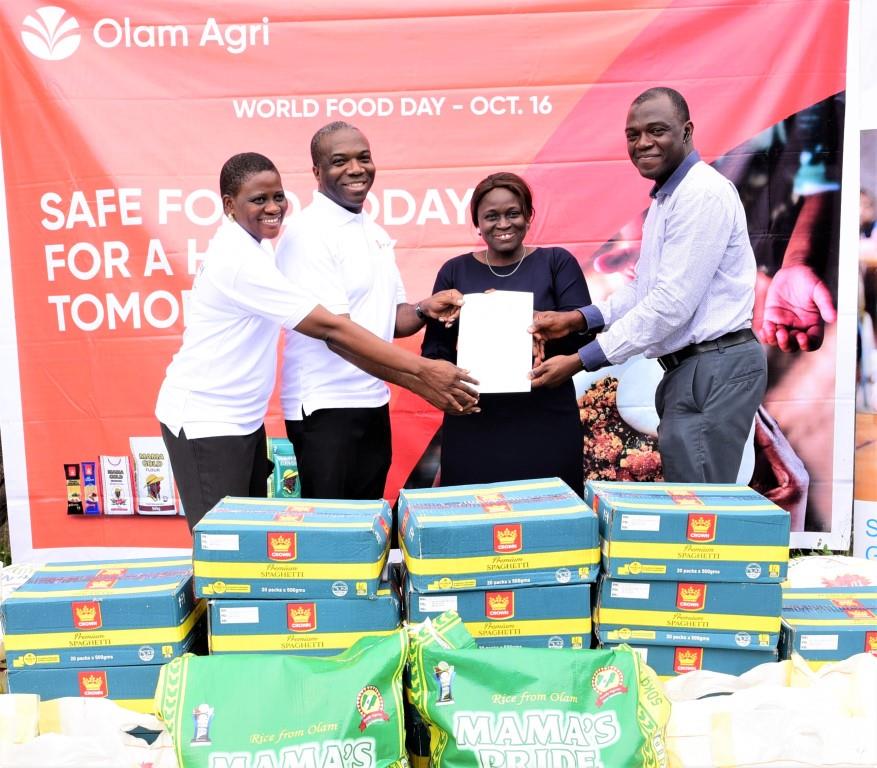
In commemoration of the 2022 World Food Day (WFD), Olam Agri Nigeria, on Tuesday, October 18, 2022, donated food items to the SOS Children’s Villages in Isolo, Lagos.

World Food Day is celebrated on October 16 globally. This year’s commemorative event is themed “Leave No One Behind”. The theme is a rallying call to governments and private organisations to scale efforts aimed at tackling food insecurity and malnutrition. Olam Agri’s visit to the SOS Children’s village is part of the business’ impressive schedule of sustainable social investments and engagements aimed at giving back to its community and enriching lives, especially the vulnerable.

In addition to the donation to the SOS Children’s Village in Lagos, a delegation of the management and staff of Olam Agri Nigeria in collaboration with the Lagos Food Bank also visited the hinterlands in the state to provide hunger relief to several indigenes that need care.

Speaking on the food donations to the SOS Children’s Village and the Lagos Food Bank, Ashish Pande, Country Head, Olam Agri Nigeria, said that the business is committed to undertaking critical social investment projects that deliver positive impact and engender a better life for the members of its host community.

“Right to food and nutrition is at the core of inclusive growth. No member of society deserves to be hungry. Therefore, we are embarking on focused social investment projects that’s targeted at accelerating the attainment of the Federal Government’s food security agenda and the United Nations’ Sustainable Development Goals (SDGs) of achieving zero hunger in the world”, Pande said.

While receiving the food item donations, Ayodeji Adelopo, Regional Programme Manager, South, SOS Children’s Village Nigeria, thanked Olam Agri for the gesture.

Adelopo said, “The food donations have come in handy too. By going to such extent to bring relief to the vulnerable segment of society, Olam Agri Nigeria has demonstrated that it values the wellbeing of the people in its host communities.”

He added, “In-country partnerships and collaborations are at the centre of our operating models, and it has been key in providing support to the children under our care. We hope to further explore such opportunities with Olam Agri Nigeria and other well-meaning corporate organisations”

Similarly, Michael Sunbola, Executive Director Lagos Food Bank initiative, explained, “Embarking on a strategic program of relief in the areas of nutrition is critical to helping the vulnerable segment of the society at this period of escalating global food security challenge. Olam Agri’s continued support for our outreaches has been invaluable. We are reaching out to provide hunger relief to an increasing number of people, thanks to such private and public support.”

Speaking further on the commemorative event, the Olam Agri Nigeria, Country Head, said that effective partnership and collaboration is vital to achieving inclusive socio-economic growth. He mentioned that providing access to safe, nutritious, healthy, and affordable food underlines the company’s corporate and investment objectives.


Click to comment

Leave a Reply

Your email address will not be published. Required fields are marked *

General

NSIA Chairman Seeks Mobilisation of Local Capital to Drive Development

Published

on

Nigeria Sovereign Investment Authority nsia

By Adedapo Adesanya

The Chairman of the Nigeria Sovereign Investment Authority (NSIA), Mr Segun Ogunsanya, has called for greater mobilisation of domestic capital from local institutions to drive Nigeria’s economic development.

Mr Ogunsanya made the remarks during his address at the Invest in Lagos 3.0 Summit, themed Lagos: The Business Gateway to Africa, urging policymakers and investors to tap funds from pension administrators, insurance firms and banks rather than relying heavily on foreign development finance institutions (DFIs) and external funding sources.

He said Nigeria must move beyond heavy reliance on DFIs and external funding, arguing that significant untapped capital exists within the country’s financial ecosystem.

“I would like to see a deeper level of local capital formation. I’ve seen a lot of emphasis on DFIs and the money coming in from outside the country. But if you look deeply, we need to find ways of harnessing local capital, capital from pension funds, capital from insurance companies, capital from banks,” he said.

According to him, domestic pension funds, insurance assets and banking liquidity represent a sustainable source of long-term financing that can be structured to support infrastructure through Public-Private Partnership (PPP) frameworks.

Mr Ogunsanya disclosed that NSIA is currently anchoring a $1 billion infrastructure fund in collaboration with the International Finance Corporation (IFC), designed to strengthen infrastructure investment and de-risk large-scale projects.

“A couple of days ago, we just got some confirmation from IFC. They’re going to be part of a $1 billion fund that we’re anchoring. This $1 billion fund is to provide some sort of guarantee for infrastructure investment,” he said.

He explained that the fund would cover key stages of infrastructure delivery, including project preparation, project development, risk guarantees and risk capital support.

“The World Bank IFC just came in again, and this funding is meant to cover four different areas of any infrastructure investment — the project preparation phase, the development phase, those who want guarantees, and also to provide the risk capital itself,” he said.

Mr Ogunsanya noted that the initiative is aimed at improving project bankability while ensuring strict financial discipline and due diligence in investment selection.

Continue Reading

General

Oyo Police Reveals Insider Role in Adelabu Family Kidnap Saga

Published

on

adelabu's sister

By Adedapo Adesanya

The Oyo State Police Command has revealed that a person attached to a member of the family of former Minister of Power, Mr Adebayo Adelabu, allegedly worked in collaboration with kidnappers to abduct his sister and her two children in Ibadan.

Police spokesperson, CSP Olayinka Ayanlade, disclosed that preliminary investigations indicate an insider role in the operation, suggesting that the abduction may have been facilitated by someone close to the family.

Mrs Olaide Busayo Adegoke John-Paul and her 12-year-old twin sons, Peter and Paul, were abducted on June 3, 2026, at the Elewura area of Challenge, Ibadan.

The victims regained their freedom on Saturday (June 6) after a coordinated intelligence-led operation by operatives of the Force Intelligence Department–Intelligence Response Team (FID-IRT) and the Oyo State Police Command.

According to the Command in its latest update, the suspect allegedly provided support to the kidnappers during the incident, which led to the abduction of the victims in Ibadan, Oyo State.

Security operatives said investigations are ongoing to track down all individuals connected to the crime and ensure the safe rescue of the victims.

The police assured residents that efforts are being intensified to dismantle the network behind the kidnapping and bring all perpetrators to justice.

On Monday, the Oyo State Government demolished a three-bedroom bungalow allegedly used as a hideout by kidnappers involved in the abduction of the younger sister of the former Minister of Power and her twin sons.

The property, located at Lakoun Estate along Olomi-Olojuoro Road in Oluyole Local Council of Oyo State, was pulled down by officials of the state Ministry of Public Works and Transportation, accompanied by operatives of the Nigeria Police Force.

Officials added that the demolition also underscores the government’s determination to confront rising security threats and send a strong message to criminal elements operating within the South West state.

Continue Reading

General

Ojude Oba 2026 Sets New Benchmark for Media Visibility, Reputation and AI Discoverability

Published

on

Ojude Oba Festival 2026

The Ojude Oba Festival is no longer merely one of Nigeria’s most celebrated cultural gatherings; it is rapidly emerging as one of Africa’s most influential cultural brands.

A newly released Media Intelligence Report by P+ Measurement Services reveals that Ojude Oba 2026 recorded its strongest media performance to date, achieving significant growth across audience reach, media visibility, social engagement, international attention and digital discoverability.

The report analysed media conversations and coverage generated between May 20 and June 5, 2026, across print, online, social media and broadcast platforms, while benchmarking performance against the 2025 edition of the festival.

The findings paint a compelling picture of a cultural institution that is not only preserving heritage but also increasingly shaping conversations across modern media ecosystems.

According to the report, total media mentions grew by 56 per cent year-on-year, increasing from 18,420 mentions in 2025 to 28,735 mentions in 2026. Audience reach expanded even more dramatically, growing by 75 per cent from 124.8 million to 218.6 million people globally.

Social media emerged as the primary engine of visibility, generating over 81,000 public conversations during the monitoring period, representing an 88 per cent increase compared to the previous year. Engagements more than doubled, rising by 115 per cent from 3.9 million interactions in 2025 to 8.4 million interactions in 2026.

Perhaps most notable was the improvement in public sentiment.

Positive sentiment increased from 60 per cent in 2025 to 79 per cent in 2026, while negative sentiment declined by half, dropping from 10 per cent to just 5 per cent. Conversations around cultural pride, heritage preservation, fashion, equestrian displays, community identity and the enduring legacy of the late Awujale of Ijebuland, Oba Sikiru Adetona, drove the overwhelmingly positive perception.

The report identified the legacy narrative of Oba Sikiru Adetona as the single most influential thematic driver of media coverage throughout the reporting period.

Unlike previous years, where conversations focused primarily on spectacle and pageantry, the 2026 edition witnessed a deeper engagement with themes of history, leadership, continuity and cultural preservation, elevating the festival beyond entertainment and positioning it as a significant cultural institution.

International visibility also recorded substantial growth.

While Nigeria remained the dominant source of conversations and media coverage, the festival generated measurable attention across the United Kingdom, United States, Canada, France, Germany, South Africa, Ghana, the United Arab Emirates, Kenya and the Netherlands. This expansion contributed to a near doubling of the festival’s global footprint and reflects the growing interest in African cultural experiences among international audiences and diaspora communities.

The report further found that social media accounted for the largest share of total conversations, followed by online news platforms, print publications and broadcast media. Coverage was amplified through extensive reporting by Channels Television, TVC News, OGTV, City People TV, Araba TV and GoldMyneTV, alongside significant digital coverage from leading Nigerian news and entertainment platforms.

Among personalities driving online conversations, Farooq Oreagba once again emerged as the most discussed cultural figure associated with the festival. Other highly visible personalities included Eniola Badmus, Lateef Adedimeji, Rotimi Salami, Jide Awobona and Samuel Banks, whose appearances and social media mentions helped sustain public interest throughout the event period.

Corporate sponsorship continued to play a critical role in the festival’s visibility ecosystem.

Globacom retained its position as the most visible sponsor, followed by Orijin, FCMB, Goldberg, Rite Foods, Maltina, Honeywell Foods, Adron Homes, Maggi, SIFAX Group and Seaman Schnapps. The report notes that brands increasingly view Ojude Oba as a strategic platform for cultural storytelling, community engagement and reputation building.

One of the most significant additions to this year’s report is the application of the AMEC GEO Framework, the newly introduced global measurement model designed to help organisations understand how reputation, content and visibility influence outcomes in AI-driven information environments.

Using the framework’s three core dimensions—Upstream Reputation Signals, Search and Content Readiness, and Downstream AI Outputs—the analysis assessed Ojude Oba’s performance not only in traditional media but also within emerging AI-powered discovery systems.

The assessment found strong performance across earned media authority, cultural relevance, content visibility and reputation consistency. The festival demonstrated growing discoverability within AI-assisted search environments and generated strong indicators for future cultural visibility across generative search platforms.

According to P+ Measurement Services, this represents a fundamental shift in how cultural events should be evaluated.

“Media success is no longer defined solely by coverage volume or impressions,” the report notes. “In an AI-driven information ecosystem, discoverability, authority, narrative consistency and reputation signals increasingly determine whether institutions remain visible, trusted and relevant. Ojude Oba’s performance demonstrates the importance of measuring cultural influence through both traditional media metrics and emerging AI visibility frameworks.”

The report concludes that Ojude Oba has evolved beyond its traditional role as a cultural celebration and now functions as a powerful platform for tourism promotion, economic storytelling, cultural diplomacy, national branding and global heritage engagement.

As governments, tourism agencies, brands and cultural institutions seek new ways to compete for attention in an increasingly fragmented media environment, Ojude Oba offers a compelling case study in how heritage can be transformed into measurable influence, sustained visibility and long-term reputation value.

With record audience reach, stronger public sentiment, expanded international visibility and growing AI discoverability, the 2026 edition marks a defining moment in the festival’s evolution from cultural event to global cultural brand.

Continue Reading

Trending