Connect with us

General

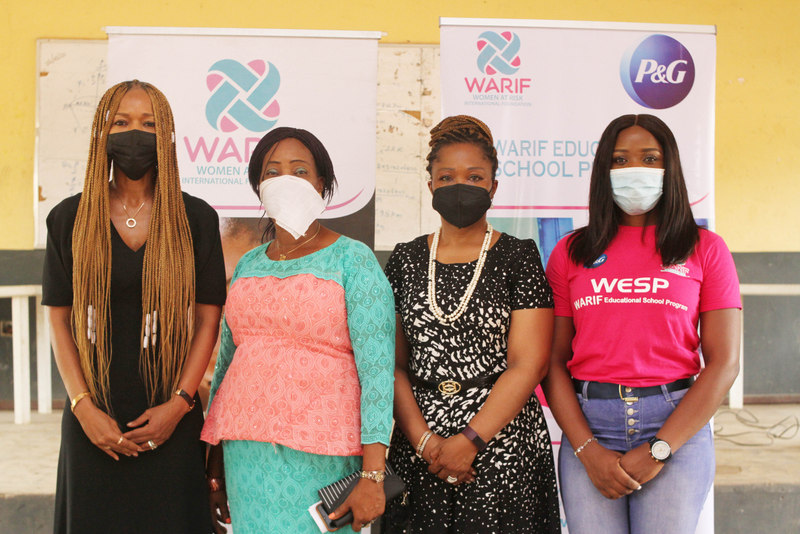
P&G, WARIF Boost Schoolgirls’ Confidence

Published

on

P&G WARIF

By Modupe Gbadeyanka

A leading consumer goods company, Procter & Gamble (P&G) Nigeria, has partnered with the Women at Risk International Foundation (WARIF) to facilitate the educational programs (WARIF Educational School Programme.

This is part of its efforts to address the issues affecting girls confidence and empowerment and with the collaboration, P&G will facilitate the educational programs around gender-based violence and support WARIF with the acquisition of personal protective equipment (PPE) for its frontline healthcare, which supports its “protect our heroes” interventions while promoting both its Education and Gender Equality Citizenship Pillars.

The partnership is driven by P&G Employees through the P&G Employee Covid-19 Support Fund where employees made voluntary contributions to sponsor identified NGO (WARIF) as part of giving back to the community.

P&G as an organisation matched 100 per cent of total Employee contributions to reiterate its corporate commitment to Education and Gender Equality Citizenship Pillars.

The mandated lockdown in 2020 and stay at home directive due to the COVID – 19 pandemic resulted in an increased number of cases of Violence Against Women and Girls (VAWG) as well as child abuse cases reported to WARIF as more women and children were in quarantine with their abusers.

The WESP Initiative, which started on March 10 at Oregun High School, was a four-week program themed “Identifying the Signs and Preventing School-Related Gender-Based Violence.” The program included P&G’s “Always Menstrual Hygiene Session.”

Commenting on the initiative, the P&G Senior Director for Africa, Global Government Relations & Public Policy, Mrs Temitope Iluyemi, reiterated P&G’s dedication to gender-based issues.

She said: “At P&G, we are always inspired by initiatives like this. Beyond this, we have a target to educate more than 50,000 adolescent girls on puberty and menstrual hygiene over the next three years in Nigeria through our Always Keeping Girls in School (AKGIS) program which will also provide a year supply of sanitary pads so that they can commit to their education and their future.”

“These trainings and sensitisation will play a pivotal role in creating the necessary education and awareness in girls on social issues that impact their confidence around puberty. That is why P&G is happy to partner with WARIF to evoke a change in the prevailing mindset of the community and a create greater awareness about the issue of violence against women and resources available to affected girls”. Temitope revealed.

Commenting on the program, Founder of WARIF, Dr Kemi DaSilva Ibru stated that “With the increasing number of cases of rape and sexual violence in our communities during the COVID-19 pandemic, it has become more critical now to engage the most vulnerable age group in our society – young girls between the ages of 12 and 18, creating awareness by educating them and providing the necessary essential services to address the issue.

“We are thankful to the P&G Team for their support and partnership with the WARIF Educational School Program; WESP an initiative specifically designed to empower and equip young adolescent schoolgirls with a tool kit in successfully tackling gender-based violence. We remain committed to ensuring that all girls can live in a society free from rape and sexual violence.”

P&G also enabled the procurement of PPEs for the WARIF frontline Healthcare staff to facilitate their sustained engagement with the increasing number of affected persons.

The WARIF Rape Crisis Centre has so far treated 2204 beneficiaries who have benefited from medical treatment, forensic testing, psychosocial therapy, and social welfare programs. Survivors from various parts of Lagos State were given care protocols (internationally accepted protocols).

Over the years through proactive leadership and collaboration, P&G has tailored efforts to grow the reach and impact of positive action for communities, equality, and the environment in Nigeria.


Modupe Gbadeyanka is a fast-rising journalist with Business Post Nigeria. Her passion for journalism is amazing. She is willing to learn more with a view to becoming one of the best pen-pushers in Nigeria. Her role models are the duo of CNN's Richard Quest and Christiane Amanpour.

Click to comment

Leave a Reply

Your email address will not be published. Required fields are marked *

General

NMDPRA Shuts Down Two Petrol Stations in Ogun for Under-Dispensing

Published

on

By Adedapo Adesanya

The Nigeria Midstream and Downstream Petroleum Regulatory Authority (NMDPRA) has sealed two fuel stations in Ogun State engaging in under-dispensing of petroleum products and non-compliance with the Petroleum Industry Act of 2021.

Leading the enforcement team around the Akute-Ajuwon axis of the state, the Head of Distribution Systems Storage and Retailing Infrastructure, Mr Olufemi Adebowale, said the move became imperative in view of repeated breaches of regulatory requirements by the affected stations and the need to protect the rights of consumers from sharp practices.

According to him, the development is part of its ongoing efforts to enforce compliance with industry regulations, protect consumers from sharp practices, and ensure that petroleum marketers dispense the correct quantity of products across the state.

He explained that records available to the authority showed that the fuel stations have consistently violated regulatory compliance by under-dispensing petroleum products, illegally breaking official seals placed on the facility, and resuming operations without authorisation.

According to him, such actions amount to a violation of the Petroleum Industry Act 2023 and undermine efforts to protect consumers from exploitation.

“The Nigerian Midstream and Downstream Petroleum Regulatory Authority is carrying out a lawful enforcement on this facility. Our records have consistently shown that this company has been violating regulatory compliance.”

“It is high time we made it clear that they cannot continue to under-dispense products, deliberately remove our seals, and believe that nothing will happen; that is why we are here to enforce the provisions of the Petroleum Industry Act 2023 he said.

“When it comes to under-dispensing, they are cheating members of the public by not selling the correct quantity of fuel. Also, once a station is sealed, it has no authorisation to operate. But this station deliberately removed our seal and continued operations, which is against the law.”

Mr Adebowale disclosed that the authority has been monitoring the station’s activities since 2025, describing the violations as persistent despite several enforcement actions.

He revealed that the affected station had been sealed no fewer than six times within the period, but continued to remove the authority’s seals and ignore invitations extended by the regulator.

“From our records, this has been happening since last year. The station has also refused to honour our invitations. It has been sealed not less than six times, yet it keeps removing our seals and resuming operations.”

On the sanctions awaiting the operators, Adebowale said the authority had served the stations with enforcement notices, while the facilities would remain shut until all stipulated conditions are met.

He added that the NMDPRA management would also consider suspending the operating licence of the affected stations, while also sending a strong warning to any fuel station intending to go against the rules of PIA.

“That is against the rules. They do not have any right to operate until we authorise them to do so. This is a clear deviation from regulatory compliance. According to the Petroleum Industry Act (PIA), when this happens, we must carry out enforcement, and that is why we are here today.

​Beyond conducting this exercise, we are also using this opportunity to address the public through the media. As long as operators are doing the right thing, they have nothing to fear. However, for those going against compliance levels—whether through under-dispensing or direct violation of our seal—all necessary enforcement, penalties, and sanctions will be strictly applied against such offenders.”

“A letter has been served, the station has been completely shut down, and they must meet all the conditions, including payment of the applicable penalties. We are also looking at suspending the operating licence, subject to management’s approval,” he said, warning that any further attempt to tamper with the seals or resume operations illegally would attract criminal prosecution.

Continue Reading

General

NPA Introduces Phased Truck Entry to Ease Apapa Port Congestion

Published

on

Apapa Port Congestion

By Adedapo Adesanya

The Nigerian Ports Authority (NPA) says it has moved to reduce port gridlock by releasing trucks into Apapa and Tin Can ports in scheduled batches based on terminal demand, while enforcing strict rules against indiscriminate parking on port access roads.

The General Manager, Lagos Port Complex, Mr Debo Lawal, said the NPA management, led by Managing Director, Mr Abubakar Dantsoho, was committed to ending indiscriminate truck parking around the ports and aligning operations with global best practices.

He said the authority was working with Truck Transit Parks Limited (TTP) to regulate truck movement into terminals through a phased release system.

According to him, trucks will now be released in scheduled batches based on terminal demand, instead of allowing all approved trucks to enter the port corridor simultaneously.

“If a terminal requires 100 trucks, they will not all be released at once. They will come in batches to reduce pressure on the port access roads,” he said in an interview with the News Agency of Nigeria (NAN) on Monday in Lagos.

Mr Lawal said a joint task force had been clearing Apapa and Tin Can port access roads since June 26, 2026, operating until about 8 pm daily to prevent indiscriminate parking.

He added that another clearance exercise would soon be conducted to sustain the gains and prevent a return to the persistent gridlock that previously characterised the port corridors.

The port manager, however, urged truck operators to support the initiative by exiting the port environment immediately after loading or offloading cargo.

He noted that some truck drivers still parked along access roads after completing port operations, despite repeated engagements by the authority.

“We engage truckers and their leadership every day, but enforcement will continue alongside sensitisation to ensure compliance,” he said.

On infrastructure, Mr Lawal said the federal government, through the NPA, had begun payment of the five per cent counterpart funding required for the 726 million dollar port rehabilitation project.

He disclosed that preliminary activities, including borehole drilling and site investigations, had been completed, while contractors were expected to mobilise to the site before the end of July.

According to him, a technical stakeholders’ meeting was held on July 7, while a broader stakeholders’ review was scheduled for July 13 to assess progress and address implementation gaps.

Mr Lawal said the rehabilitation project, alongside ongoing reforms, was aimed at reducing cargo clearance time, eliminating documentation bottlenecks and improving operational efficiency at the nation’s seaports.

He added that the National Single Window project was about 80 per cent completed, with a dedicated office already established near the port to improve inter-agency coordination.

According to him, the digital platform will integrate banks, the Nigeria Customs Service, shipping companies and other government agencies to improve efficiency, plug revenue leakages and enhance revenue collection.

Mr Lawal expressed confidence that improved digitisation, reduced human interference and more efficient truck management would strengthen Nigeria’s trade competitiveness and enhance operations at the Apapa and Tin Can ports.

Continue Reading

General

Pension Harmonisation to Restore Fairness for Retirees—PTAD

Published

on

PTAD

By Adedapo Adesanya

The Pension Transitional Arrangement Directorate (PTAD) has said the implementation of the Defined Benefit Scheme Pension Harmonisation is a reform meant to advance and enhance pension payment equity in the country.

The chief executive of PTAD, Mrs Tolulope Abiodun Odunaiya, said this initiative was a landmark reform designed to restore fairness, improve retirees’ welfare and strengthen confidence in the administration of the country’s legacy pension system.

The harmonisation exercise marks one of the most significant policy interventions in the Defined Benefit Scheme since PTAD was established in 2013 to take over the management of pensions under the old federal pension arrangement.

Unlike periodic pension increases that merely raise existing benefits by a percentage, she stressed that pension harmonisation was further than that by recomputing pensions using the latest approved salary structures that existed before the closure of the Defined Benefit Scheme.

She noted that the objective is to ensure that retirees who held similar positions and rendered comparable years of service receive equitable pension benefits regardless of their retirement dates.

The initiative comes against the backdrop of years of agitation by pensioners over historical disparities in pension computation.

She added that the PTAD’s harmonisation programme seeks to resolve that challenge by restoring parity within the system. According to her, pension harmonisation is the formal recomputation of pensions using approved salary structures applicable before the DBS cut-off date.

In practical terms, it ensures that pension outcomes are determined by rank, grade level and years of service rather than the year of retirement.

The Directorate believes the exercise will significantly improve social justice by correcting historical inequities that disadvantaged thousands of retirees.

The harmonisation applies primarily to pure Federal Government pensioners as well as eligible retirees under the Parastatals Pension Department (PaPD), Defunct and Transferred Agencies Pension Department (DTAPD), and the Education and Health Pension Department (TEHPD), particularly those who initially served under the Federal Government before their agencies were transferred to state governments.

Continue Reading