
General
Please Forgive Evans ‘Cos of Me and Our 5 Kids—Wife Begs

By Dipo Olowookere
The story of the arrested billionaire kidnapper, Mr Chikwudubem Onwuamadike, fondly called Evans last Saturday by police in Lagos is one that is refusing to fade easily.
Each day, a new twist is brought to the fore about the suspected kidnapper, who brought sorrow and tears to his victims and their families.
However, he and his family are finding it hard to withstand the heat some families went through while Evans ruled the game.
Wife of the man, Mrs Uchenna Precious Onwuamadike, has begged Nigerians to have mercy on her husband, who she described as a good man, promising that he would repent.
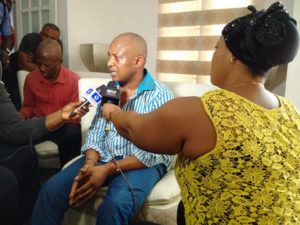
She spoke to Vanguard in a telephone chat from her base in Ghana.
My name is Uchenna Precious Onwuamadike, the wife of the Chikwudubem Onwuamadike who you call Evans. I am 31 years old. I got married to Evans at the age of 17 at Oraifite, Anambra State in 2004. He met me while I was coming back from lesson as a student of All Saints Secondary School, Oraifite and I was in class 6 going to take my West African Examination. After we met, I agreed to go with him because of my poor background. He told me his father married three wives when he was six years old and threw his mother out of his house. He said that one of the wives influenced his father to drive them out of his house also and they were forced to stay with outsiders.
Evans was taken to his grandmother who trained him. He told me his father accused the mother of being adulterous before driving her out of his house. Our marriage is blessed with five children. Our first issue is 12 years plus and her name us Udochukwu.
After we got married, he said I should stay with his mother in his village at Akanmiri, Umudim, Nnewi to teach me how to be a good housewife.
I was there for three years before he took me to Lagos. We were living at Satellite town in 2006 and after one year, he relocated us back to the village because he could not pay house rent. While in the village, he normally came to see us.
We spent three years in the village and relocated to Ghana. On our way to Ghana, we passed through Lagos and stayed at Benny Hotels in Festac where we spent two days before travelling to Ghana. He spent a month with us in Ghana before coming back to Lagos.
I was pregnant with our fourth child in 2010 when he left for Nigeria to come back in two months’ time. After I gave birth, he came back four months later and was able to clear the accumulated bills we kept for him because I borrowed money from friends to clear hospital bill. When he came back, he complained bitterly that things were rough for him in Nigeria and that customs seized his goods. I was not aware that he was into kidnapping and all the criminal acts he is being associated with now. All I know about his business is that he was into haulage, buying engine and spare parts for trucks and imports exhaust pipes. That was what he told me.
The reason he kept me in Ghana was because he said our children should get quality education. I have spent six years here and after I stopped hearing from him, I called and complained bitterly but he said I should stay for some time. I then called his friend, Okechukwu, who now lives in China. He told me that he has not been seeing him and that he spends most of his time with a girlfriend in Festac. When I called him to complain, he was angry with me and warned that I should stop listening to gossip.
He said that if I should return, I should go to his younger brother’s house in Lagos until he was ready to get accommodation for us.
The brother was formerly living in Lagos but he is in Brazil now. So, when it was impossible to pay my children’s school fees, I packed my bag and baggage and came back to Lagos with our children. We stayed at his brother’s house at Agric, close to Trade Fair until he took us to a house in Magodo where he claimed he owed rent pending the completion of his own house there.
We have spent just one year in that house in Magodo. I have no idea of the type of business he was into but he told me that his friends overseas used to buy phones and jewelleries for him.
While in Lagos, i was idle and I pressured him to find something for me to do and he promised to do that.
Several times, I asked him to take me to his office but he said they move from place to place to offload goods in haulage business and share profits. I can’t remember having any visitor in our house. It is only the agent called Sunny that helped us to pack into our house that I know.
At times, artisans come to do one repair or the other, that’s all. I don’t know any of his friends and if we were invited to parties, he would not allow us to attend. He told me that he has no friends and that he hates associating with people. I was always indoors because he warned me to beware of Lagos women that they are wayward. I was staying indoors and it was only when I was sick that he took me to a hospital in Ikeja. I always have BP and it makes weak. We went back to Ghana on the 6th of this month and he promised to join us in no distant time.
On the 9th, I called him to know when he would be coming and even the youngest of our children was crying, begging him to come as soon as possible and he promised to come.
In the afternoon, I called but he was not picking. I called again, there was noise in the background and the line was switched off. I then called the driver that took us to the motor pack when we were going to Ghana and he told me that there was a problem, that police came and arrested Oga and that they came with a fair complexioned lady.
When I heard all the allegations against him, I called his brother in Ghana, his mother, father and other relations but I could not get them. I then called their last born, a student at Oko Polytechnic but he said he had not spoken with him for long.
I was confused until I opened Niger news and Vanguard Websites. That was how I got the shocking news about my husband. I collapsed and later called my kids to inform them what I just read about their father. Since then, I have not eaten, I am still in shock. Our children could not believe what they were reading about their father. They are saying that he cannot do all the things they said he did. In fact, while we were in Nigeria, he had never slept outside our house.
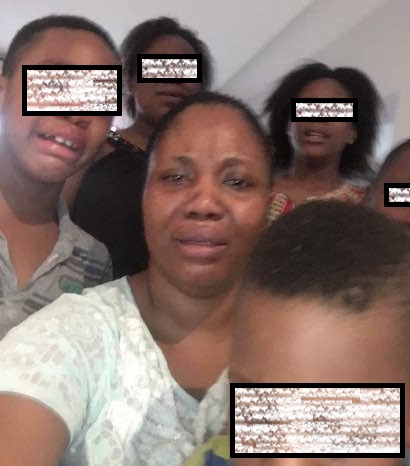
My children were crying when they saw his bloody eyes and swollen face. Our condition was worsened when I saw my picture with him and our children on Facebook. I don’t know where they got it. I have not been receiving money from him, I have never seen his money. The only thing I know is that there was a time he bought an expensive watch in Dubai and I wanted to know why he bought it when he could not open any business for me. He kept on teasing me, claiming it came from a friend. It was only when we wanted to travel to South Africa last year Christmas where we spent two years that he gave me N200,000 for the trip. I have never seen him as a rich man.
While with him, we made sure we had all we wanted to eat and that’s all. I can’t remember seeing any sign of affluence in him. He is not a proud man and he has been wearing one sandal and slippers for long now. He does not go for parties. In fact, I have never suspected him as a criminal. If I have been seeing any strange things, I would have suspected him. We have three cars, one Hilux, one grand Cherokee and an SUV.
The N20m they said he sent to me through transfer was given to one Hausa man to pay into an account in Ghana to be used in paying our rent and furnish the house in Ghana. I know he banks with GTB only. Their staff used to visit us in the house. I am not aware that he has five girlfriends and I have never suspected him because he did not keep late nights.
It was shocking to hear about his girlfriends. He did not answer calls in my presence. I used to see his phones being charged but he normally switched them off. I always asked him why uses pin code to lock his phones and that he lived a secret life but he threatened to beat me if ever I touched any of his phones. I didn’t even know the security pin. He would leave the house sometimes in the evenings with his phones and would come back between 8pm and 9pm. Most of the things I read about him are strange to me. As his wife, I should have seen the signs but I have not.
He has cancer and does not drink alcohol nor smoke anything. I have never seen gun in our house. I don’t know where they got those frightening guns. He has never told me he has another house at Igando.
Any time he went out, he always called to ask after the children and reassure me that he would be back soon. I am suspecting that whatever happened to him must have come from his father’s second wife. I don’t know what he did to him when he was young but he told the story.
He said that after their mother was driven out of the house, he was with his brothers playing outside one day when the second wife called him to pick a bucket and collect water for her. He was four years then, he picked the bucket, collected water and when he came back, she removed her dress and she was wearing only a bag made from animal skin on her waist. She brought seven small stones from the bag, gave to Evans and ordered him to pour the stones into the bucket to know if the gravel would rise (sail) on top of the water or not.
Evans said he did as she directed but the only thing the woman did was to take the bucket back and ordered him to go back and play with his brothers.
He said he told his father later but he said he was telling lies. I feel very bad because I did not know if he was doing all these or not.
Even if he was into all these, why did he not stop because of me and his children? All the time when we pray, he used to promise God that he would tell Him his story later in life. Here reads psalm 23 a lot.
Even his phone, he sets alarm for 12 noon to read psalm 23. He took part in our daily prayers in the morning, evening and night. He used to lead us in prayers. We attend Anglican Church. He has never given them money to show off. We used to give N5000 or N10,000 and the highest we have given so far was N50,000 when we baptised one of our children. I am appealing to the powers that be to spare his life (crying), as I speak now, I am kneeling down with my children, crying and begging for forgiveness. Have mercy on us. He did not know what he was doing. He did not know what came over him. I am ready to come back to Nigeria and plead on his behalf. What I am reading in the news is shocking.
Though, I have not heard that he killed anybody but all those he injured or took their money should please forgive him because me and my children. They should kindly forgive him, he will repent. God knows I will not be alive and see my husband doing bad thing and keep quiet. All his wealth should be sold off and given to his victims. Evans is a good man. He takes care of all his relations including the children of the second wife we are suspecting did this to him. He has just two houses in Ghana but I have never seen them. I saw the house on his phone.
Since I have been living with him, he has never injured anybody or beat me. He has milk of human kindness in his heart. He has not been harsh or wicked to anybody. He always advised us to be prayerful I (starts crying again) and complain bitterly any time I failed to pray. His neighbours also know him as a kind and generous man. Members of my family are worse hit by this ugly development. They said some people brought newspaper publications to show them about their in-law and they have been wondering if he actually did all that because he has been good to all of them.
I am from a very good, God-fearing family and if any of us had suspected this in him, they would have forced me out of his house for long. I am ready to come back and testify on his behalf. I will also like to see the Governor of Lagos state and explain the whole thing to him. They said he is rich but I have only N13,000 in my Diamond bank account. He does not give me money. He told me he will be paying N40, 000 into my account every month but after two months, he stopped, claiming that he was penniless.
Source: Vanguard




By Aduragbemi Omiyale
The sum of N3.3 trillion has been approved by President Bola Tinubu to finally clear the outstanding debts in the power sector.
A statement issued on Sunday by the Special Adviser to the President on Information and Strategy, Mr Bayo Onanuga, said the “long-standing debts accumulated between February 2015 and March 2025.”
It was stated that the payment plan for the debts under the Presidential Power Sector Financial Reforms Programme should restore reliable electricity to the country.
“Following verification, N3.3 trillion has been agreed as a full and final settlement, ensuring a fair and transparent resolution,” a part of the statement noted.
“Implementation has begun, with 15 power plants signing settlement agreements totalling N2.3 trillion. The federal government has already raised N501 billion to fund these payments. Out of the amount, N223 billion has been disbursed, with further payments underway,” it added.
The statement said, “With payments reaching the power value chain, generation will be more stable. With power plants supported, electricity reliability will improve.”
“This programme is not just about settling legacy debts. It is about restoring confidence across the power sector — ensuring gas suppliers are paid, power plants can keep running, and the system begins to work more reliably,” the Special Adviser to the President on Energy, Ms Olu Arowolo-Verheijen, was quoted as saying in the statement.
“It is part of a broader set of reforms already underway — including better metering and service-based tariffs that link what you pay to the quality of electricity you receive.
“The government is also prioritising power supply to businesses, industries, and small enterprises — because reliable electricity is critical to creating jobs, supporting livelihoods, and growing the economy.
“The goal is simple: more reliable power for homes, stronger support for businesses, and a system that works better for all Nigerians,” she added.
President Tinubu has commended all stakeholders who supported efforts to resolve the legacy issues in the power sector. He has also confirmed that the next phase (Series II) will begin this quarter.

By Adedapo Adesanya
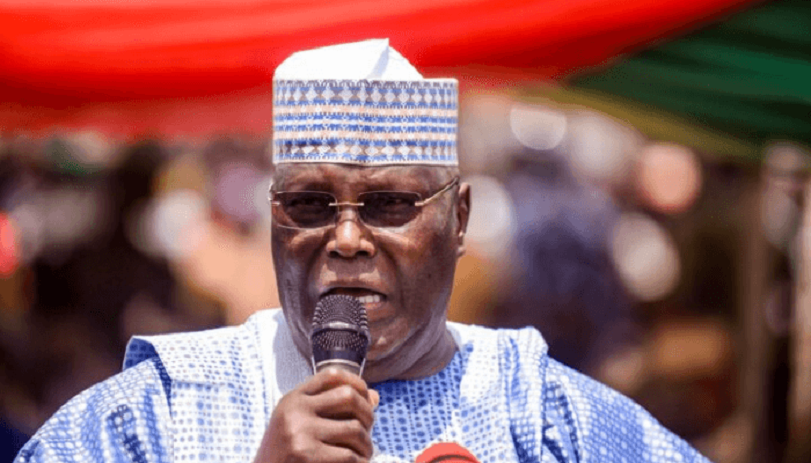
Former Vice-President Atiku Abubakar has hired Von Batten-Montague-York, L.C., a Washington-based lobbying firm, to protect and strengthen his “reputational standing” in the United States for $1.2 million.
According to The Cable, the contract agreement was signed by Mr Karl Von Batten, the managing partner at the firm, and Mr Fabiyi Oladimeji, a Nigerian politician, on March 9 and 10, 2026, respectively.
Based on a document filed with the US Department of Justice, one of the contract’s objectives entails that the firm will “counterbalance” the Nigerian government’s “lobbying narratives” in the US. It comes after the federal government reportedly spent $9 million to strengthen lobbying with the US government earlier this year.
Mr Abubakar, who is eyeing the Nigerian presidency, is currently with the African Democratic Congress (ADC). He will use the firm to “advance understanding” within US policymaking institutions of his “leadership posture and policy vision”.
Based on the contract details, the firm will facilitate and arrange meetings for the former vice-president to engage with US government officials and members of Congress.
Von Batten-Montague-York will also provide the politician with “guidance on policy positioning, reputational considerations, and engagement strategy”.
“These activities include lobbying and government affairs engagement with Members of Congress, congressional staff, and executive branch officials concerning issues related to democratic governance, regional stability, economic development, and U.S. engagement with Nigeria and the broader West African region,” part of the contract details reads.
“The Registrant (lobbying firm) may advocate for policies and perspectives aligned with the foreign principal’s stated positions, including matters relating to governance, economic policy, and bilateral relations with the United States.
“The Registrant also engages in promotion, perception management, and public relations activities designed to enhance understanding among U.S. policymakers and relevant stakeholders of the foreign principal’s policy positions, leadership posture, and strategic priorities.
“This includes the development of messaging strategies, narrative positioning, and reputational advisory services.
“In furtherance of these activities, the Registrant prepares, distributes, and may assist in the dissemination of informational materials, including briefing memoranda, policy papers, talking points, and related communications, intended to inform U.S. government officials and stakeholders.”
The former vice-president is expected to pay the $1.2 million for the 12-month contract in six instalments.
By Dipo Olowookere
The need for Africa to protect itself from many external shocks not of its making has again been emphasised by the African Development Bank (AfDB), the African Union Commission (AUC), the United Nations Development Programme (UNDP), and the UN Economic Commission for Africa (UNECA).
On the margins of the 58th session of the Economic Commission for Africa in Tangier, Morocco, the continent was tasked to strengthen regional integration, accelerate African-led financial solutions, and invest decisively in energy, food, and trade resilience so as to move from vulnerability to preparedness.
The meeting focused on the spikes in energy, food and fertiliser prices caused by the ongoing conflict in the Middle East.
The United States and Israel launched airstrikes on Iran in February 2026, and since then, global oil prices have surged by more than 50 per cent as of late March. Twenty-nine currencies in Africa have weakened, raising the cost of servicing external debt and importing food, fuel, and fertiliser.
Disruptions linked to Gulf energy supplies limit access to ammonia and urea during the critical March–May planting season. This will affect agricultural production, compounding risks of crisis and emergency levels of food insecurity, especially for low‑income households and import‑dependent economies.
To address these issues, the quartet has asked African leaders to, in the short-term, stabilise fuel, food, and fertiliser supply, and execute medium‑term reforms to strengthen energy security, targeted social protection, and regional trade under the African Continental Free Trade Area (AfCFTA).
They also tasked leaders to come up with long‑term structural reforms towards stronger domestic resource mobilisation and African financial safety nets, including accelerated implementation of the African Financing Stability Mechanism.
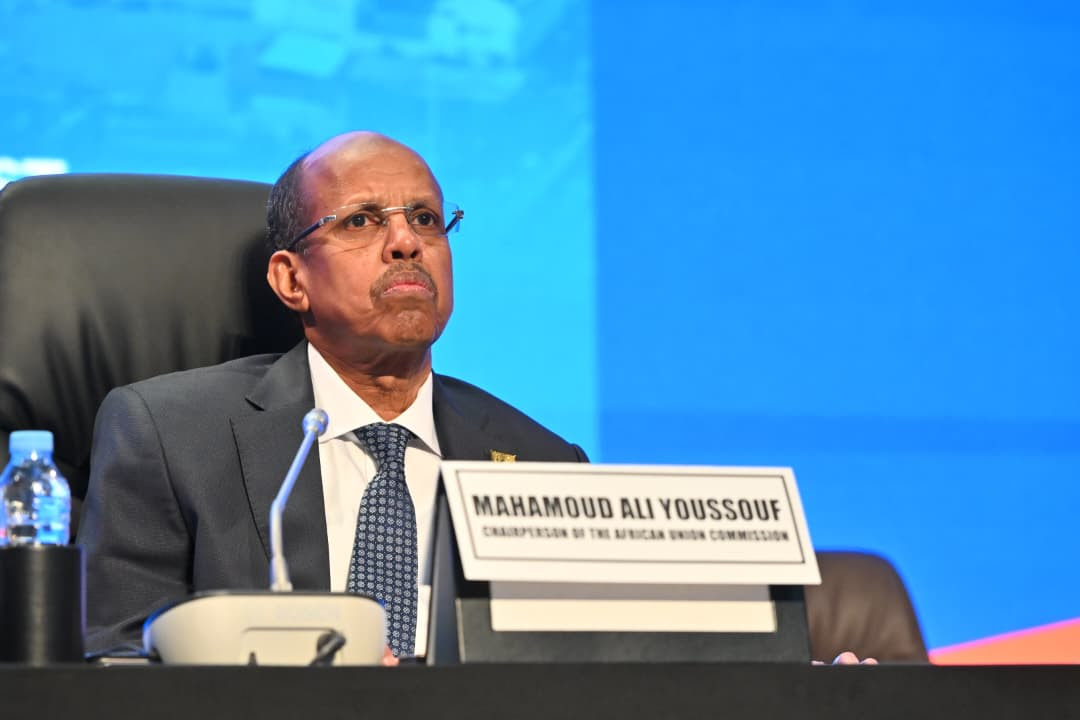
“Continued escalation of the conflict worsens global instability, with serious implications for energy markets, food security, and economic resilience, particularly in Africa, where economic pressures remain acute,” the chairperson of AUC, Mr Mahmoud Ali Youssouf, said.
Also commenting, the UN Under-Secretary-General and Executive Secretary of UNECA, Mr Claver Gatete, said, “Africa has been hit by too many external shocks not of its making. Crises like this reinforce why Africa must finance more of its own future and strengthen regional solutions that build resilience before the next shock hits.”
On her part, the UN Assistant Secretary‑General and Director of UNDP’s Regional Bureau for Africa, Ms Ahunna Eziakonwa, submitted that, “With the right mix of policy choices, financing tools, and political resolve, Africa can weather this shock and emerge more resilient, more self-reliant, and better positioned to shape its own economic future.”
“As global crises multiply, Africa’s response must evolve from managing shocks to fostering resilience. African institutions and development partners need to act swiftly and in concert, leveraging their comparative advantages to cushion short-term shocks while laying the foundations for long-term resilience,” the president of AfDB, Mr Sidi Ould Tah, stated.
-
 Feature/OPED6 years ago
Davos was Different this year
-
Travel/Tourism10 years ago
Lagos Seals Western Lodge Hotel In Ikorodu
-

 Showbiz3 years ago
Estranged Lover Releases Videos of Empress Njamah Bathing
-
 Banking8 years ago
Sort Codes of GTBank Branches in Nigeria
-

 Economy3 years ago
Subsidy Removal: CNG at N130 Per Litre Cheaper Than Petrol—IPMAN
-

 Banking3 years ago
Sort Codes of UBA Branches in Nigeria
-

 Banking3 years ago
First Bank Announces Planned Downtime
-

 Sports3 years ago
Highest Paid Nigerian Footballer – How Much Do Nigerian Footballers Earn