General
Private Sector Crucial to Successful AfCFTA Implementation—Delegates
By Dipo Olowookere
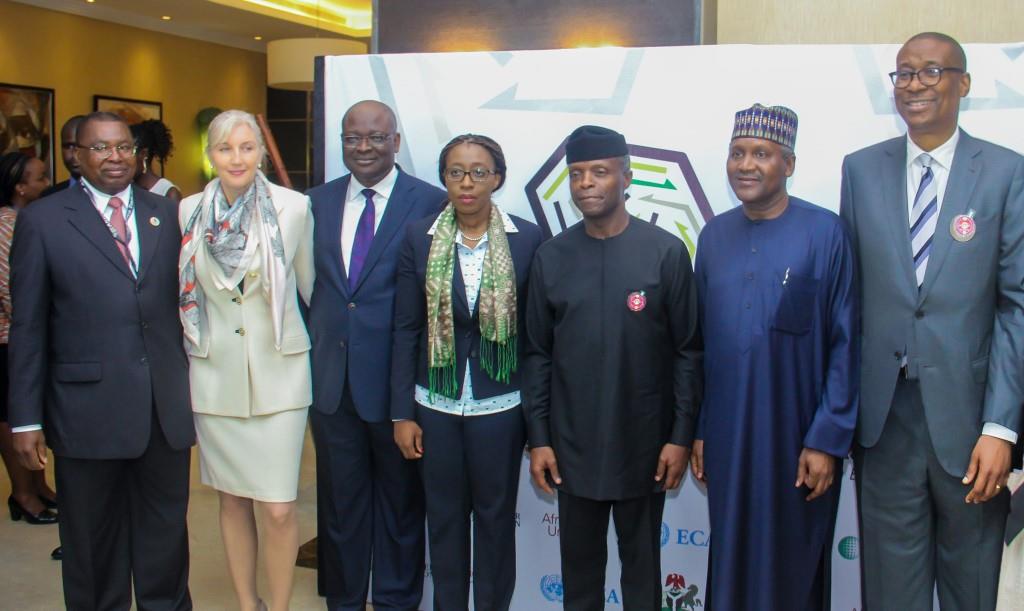
Delegates at the recently-concluded 2018 Africa Trade Forum held in Lagos have agreed that while governments need to set a conducive environment through collective and coordinated actions for the successful implementation of the African Continental Free Trade Area (AfCFTA), the private sector should be the main driver of the policy.
During the event, they also agreed that complementary interventions to boost competitiveness and reduce the high costs of doing business on the African continent would be crucial to ensure win-win gains from the AfCFTA, saying these will require proactive policies and programmes in the areas of infrastructure, financing, skills development, trade facilitation and quality infrastructure.
According to the Economic Commission for Africa’s Regional Integration and Trade Division Director, Stephen Karingi, while summing up the major takeaways from the forum, “In implementing the AfCFTA we must also make sure not to forget MSMEs, women traders, smallholder farmers and informal cross border traders, who represent the majority of Africa’s trading community, and are crucial to driving poverty reduction efforts.”
Delegates agreed the establishment of new business models, including renewable energy mini grids, was key to ensure efficient and sustainable access to electricity and help fill the existing gap.
“The recommendation is that we should promote new and reinforce existent sub-regional power pools within the continent,” Mr Karingi said.
Data, delegates agreed, was critical for the implementation of the AfCFTA. Countries, regional economic communities and the African Union Commission need to understand trade patterns to determine the correct strategies. Data is also central to the monitoring of the AfCFTA.
“Africa needs to design a data economy strategy to ensure that it is not vulnerable through data exposure caused by data storage in other regions. The combination of data and technology can address the challenges around formalisation of trade,” added Mr. Karingi in his closing remarks.
On agriculture, delegates said the AfCFTA by integrating African economies, offers opportunities for the continent to reduce its food imports from the rest of the World by increasing intra-African trade of processed agro-food products. For this to happen, effective implementation of the Agreement is key, in addition to removing non-tariff barriers to trade. Critical to this is to create an environment that will support small farmers and small producers (SMEs) to have timely access to markets, both output and input markets.
Speaking at the forum, Rockefeller Foundation’s Vice President, Global Policy and Advocacy, Christine Heenan, emphasized the importance of partnerships in ensuring the AfCFTA was a real game changer in Africa.
She said an online poll commissioned by Rockefeller was very compelling with more than 83 percent of respondents from across the continent saying the AfCFTA was important for Africa’s development. The poll is open until December 31.
“Engaging stakeholders remains very important,” she said, adding the poll meant a lot in terms of inclusivity of common African voices in the implementation of the African Continental Free Trade Agreement.
The Rockefeller Foundation, Ms. Heenan said, believed and relied on its partners for collective action that leads to progress on the continent.
In his closing remarks AUC’s Trade and Industry Commissioner, Albert Muchanga said six African countries have not yet signed the AFCFTA but two were expected to do so by December.
“African countries have resolved and are committed to making the AfCFTA a reality and there is no going back. We have to continually beat the challenges and use opportunities to come up with solutions,” he said.
Ambassador Chiedu Osakwe, Nigeria’s Chief Trade Negotiator, said to build a free trade area, Africa has to be at ease with the process of sincere debates on its trade policies.
“The European Union dealt with a lot of continuous debate for a long period of time. African countries need to work on consensus building, being at ease with challenges on ideas, methodologies and processes in order to be at ease with the negotiations process, “Ambassador Osakwe said.
On the next steps, Mr Karingi said the ECA with financial support of the EU was offering technical assistance to support Member States in developing comprehensive AfCFTA National Implementation Strategies. These strategies will: Identify new opportunities for diversification, industrialization and value chain development; identify current constraints to intra-African trade which must be addressed; recommend steps required for each country to take full advantage of national, regional and global markets in the AfCFTA context; align to existing policy frameworks at the national, regional and continental levels; and adopt a nationally-driven multi-stakeholder participatory approach.
The Forum highlighted the crucial importance of advocacy, consultations and consensus-building on the continent around its major programmes.
Mr Karingi thanked Nigeria and the Government of Lagos State for hosting the forum and for their dedicated support and collaboration in the lead up to this Forum.
“Although Nigeria has not yet signed the AfCFTA, it is in many ways many steps ahead in ensuring that the Agreement is a real game changer for economic transformation and development,” he said.
The Africa Trade Forum, which was held under the theme; AfCFTA Ratification and implementation: A game changer for African economies, was co-organized by the ECA, the Rockefeller Foundation, and the Nigerian government in collaboration with the AUC.
General
DSS Re-Arraigns Malami, Son on Terrorism, Firearms Charges
By Adedapo Adesanya
The Department of State Services (DSS) on Wednesday re-arraigned former Attorney General of the Federation (AGF), Abubakar Malami (SAN) and his son, Abdulaziz, before a Federal High Court in Abuja on an amended charge bordering on alleged terrorism and unlawful possession of firearms and ammunition.
The counsel to the DSS, Mr Akinlolu Kehinde (SAN), told the court that an amended charge has been filed to replace an earlier one on which they had been arraigned.
Mr Kehinde applied to withdraw the earlier charge and requested that the amended one be read to the defendant for the pleas to be taken afresh.
The counsel to the defendants, Mr Shaibu Aruwa (SAN), confirmed that his clients were served with the amended charge and agreed that the fresh charge be read to the defendants.
Mr Malami and his son are alleged to have, in December 2025, prepared to commit acts of terrorism by having in their possession and without a license, a Sturm Magnum 17 – 0101 firearm, 16 Redstar AAA 5’20 live rounds of cartridges and 27 expended Redstar.
However, Mr Malami and his son both pleaded not guilty, following which the prosecution sought a date for the commencement of the trial.
Mr Aruwa did not object to a date for trial, but prayed the court to allow the defendants to remain on the bail earlier granted them by the court, on the conditions they had met.
With Mr Kehinde not opposing Mr Aruwa’s oral application, Justice Joyce Abdulmalik held that the defendants should continue on the bail earlier granted them on February 27, which conditions they had met.
Justice Abdulmalik adjourned till May 26 and June 15 for trial.
Counts in the amended charge read:
“That you Abubakar Malami, Adult, Male, and Abdulaziz Abubakar Malami, Adult, Male, sometime in December, 2025, at Geeze Phase II Area, Birnin Kebbi LGA, Kebbi State, within the jurisdiction of this Honourable Court, did engage in preparation to commit acts of terrorism by having in your possession and without license, a Sturm Magnum 17 – 0101 firearm, Sixteen (16) Redstar AAA 5’20 live rounds of Cartridges and Twenty-Seven (27) expended Redstar and thereby committed an offence contrary to and punishable under Section 29 of the Terrorism (Prevention and Prohibition) Act, 2022.
“That you, Abubakar Malami, Adult, Male, and Abdulaziz Abubakar Malami, Adult, Male, sometime in December, 2025, at Geeze Phase II Area, Birnin Kebbi LGA, Kebbi State, within the jurisdiction of this Honourable Court did conspire amongst yourselves in preparation to commit acts of terrorism by having in your possession and without a license a Sturm Magnum 17 – 0101 firearm, Sixteen (16) Redstar AAA 5’20 live rounds of Cartridges and Twenty-Seven (27) expended Redstar, contrary to Section 26 (1) of the Terrorism (Prevention and Prohibition Act) 2022 and punishable under Section 26 (3) (a) and (b) of the Terrorism (Prevention and Prohibition Act) 2022.
“That you, Abubakar Malami, Adult, Male, and Abdulaziz Abubakar Malami, Adult, Male, sometime in December, 2025, at Geeze Phase II Area, Birnin Kebbi LGA, Kebbi State within the jurisdiction of this Honourable Court, without a license, did have in your possession a Sturm Magnum 17 – 0101 firearm and thereby committed an offence contrary to Section 3 of the Firearms Act, CAP F28, Laws of the Federation of Nigeria, 2004 and punishable under Section 27 (1) (a) (i) of the Firearms Act, CAP F28, Laws of the Federation of Nigeria, 2004.
“That you, Abubakar Malami, Adult, Male, and Abdulaziz Abubakar Malami, Adult, Male, sometime in December, 2025, at Geeze Phase II Area, Birnin Kebbi LGA, Kebbi State within the jurisdiction of this Honourable Court, without a license, did have in your possession Sixteen (16) Redstar AAA 5’20 live rounds of Cartridges and thereby committed an offence contrary to Section 8 (1) (b) (ii) of the Firearms Act, CAP F28, Laws of the Federation of Nigeria, 2004 and punishable under Section 27 (1) (a) (i) of the Firearms Act, CAP F28, Laws of the Federation of Nigeria, 2004.
“That you, Abubakar Malami, Adult, Male, and Abdulaziz Abubakar Malami, Adult, Male, sometime in December, 2025, at Geeze Phase II Area, Birnin Kebbi LGA, Kebbi State within the jurisdiction of this Honourable Court, without a license, did have in your possession Twenty-Seven (27) expended Redstar AAA 5’20 live rounds of Cartridges and thereby committed an offence contrary to Section 8 (1) (b) (ii) of the Firearms Act, CAP F28, Laws of the Federation of Nigeria, 2004 and punishable under Section 27 (1) (a) (i) of the Firearms Act, CAP F28, Laws of the Federation of Nigeria, 2004.”
General
DHQ Denies Deploying Repentant Boko Haram Fighters to Tackle Terrorism
By Adedapo Adesanya
The Defence Headquarters (DHQ) has dismissed claims circulating on social media that repentant and active Boko Haram members are being armed to fight alongside Nigerian troops under Operation Safe Corridor.
The allegation, made in a viral video by a Danish vlogger identified as Jones Raw, was described by the military as “false, misleading, and entirely unfounded.”
The Coordinator of Operation Safe Corridor, Brigadier General Yusuf Ali, clarified that the facility shown in the video is not one of the programme’s De-radicalisation, Rehabilitation, and Reintegration (DRR) camps.
He explained that the official OPSC facility handling former Boko Haram members is located in Mallam Sidi, Gombe State, and operates as a secure and controlled military environment.
According to him, the location depicted in the video does not match the structural design, layout, or operational setting of the recognised facility.
He further noted that neither the vlogger nor the individuals featured in the footage have ever been granted access to the camp.
The officer stressed that Operation Safe Corridor is a strictly non-kinetic, multi-agency initiative focused on the deradicalisation, rehabilitation, and reintegration of carefully screened individuals.
“At no point are participants armed, mobilised, or deployed for combat operations,” he said, adding that beneficiaries are handed over to state authorities after completing the programme and remain under monitoring frameworks.
He added that the initiative operates with the support of international partners, including the European Union, ensuring adherence to global best practices and transparency.
The DHQ maintained that the programme remains a key component of Nigeria’s counterterrorism strategy, aimed at reducing the number of active fighters and encouraging voluntary disengagement from insurgent groups.
He also invited credible observers to visit the OPSC facility in Mallam Sidi to independently verify its operations, urging the public to disregard the misleading claims, which seek to destabilise the country.
General
10 Reasons to Join the MTN MIP 2026 Webinar April 16
If you work in media and have been watching the industry shift around you, faster news cycles, shrinking revenues, AI in the newsroom, the MTN Media Innovation Programme may be exactly the kind of intervention your career needs right now.
Now in its fifth edition and bigger than it has ever been, MIP 2026 is calling for applications. The webinar on April 16 is your best first step.
What Is the MTN Media Innovation Programme?
The MTN Media Innovation Programme (MIP) is a certificate course run by the School of Media and Communication, Pan-Atlantic University, with a focus on the convergence between ICT and the media. It is a fellowship for journalists and media practitioners across the entire spectrum, including social media, designed to help them build capacity at both professional and business levels, delivered over a six-month period.
The programme gives participants skills to create better content, run media businesses, and earn money in a tough industry. It mixes classroom time, international trips, and real-world visits.
This year, the programme crosses a significant milestone. The cohort has been expanded to 25 fellows, up from 20 in previous editions, as a deliberate reflection of MTN Nigeria’s 25-year anniversary.
Tobe Okigbo, Chief Corporate Services and Sustainability Officer at MTN Nigeria, explained the thinking behind it: “The expansion to 25 fellows this year is a deliberate reflection of our 25-year milestone, and a reminder that as the media industry continues to evolve, there is a continued need to invest in the people and ideas that will shape its future.”
MTN is hosting a webinar on April 16 to walk prospective applicants through everything they need to know. Here is why you should be on that call.
- You will understand exactly what MIP is built to do. MIP is designed to increase participants’ knowledge and skill base and help them understand the changing media landscape and how to effectively use technology to create impactful media content. The webinar is your clearest path to grasping that mission before you apply.
- You will learn how to apply correctly, before it is too late. With less than a week between the webinar and the closing date, attendance gives you just enough time to fix mistakes and strengthen your submission before the April 22 deadline.
- You will know for certain whether you qualify. MIP is open to media practitioners and digital content creators across the entire spectrum, including social media. But eligibility has specific requirements. The webinar helps you confirm your fit before you invest time in the application.
- You will understand what the selectors are actually looking for. Shortlisted candidates are reviewed independently based on professional merit, potential impact, and their commitment to the evolution of African media. Knowing this helps you position your application more effectively.
- You will grasp the full scope of the curriculum. Fellows build skills in three main areas: the telecom industry, media innovation, and writing and reporting. Modules cover media entrepreneurship, ethics, fintech, 5G, financial reporting, and more. The webinar will walk you through what that looks like in practice.
- You will learn about the international component. Accepted participants get a seven-day, all-expenses-paid trip to South Africa for special training in Johannesburg, including a day at MTN Nigeria Headquarters and another at MTN Group Headquarters, plus industry visits and tours at an Innovation Hub.
- You will hear what past fellows actually experienced. The alumni speak for themselves. Oloye Ayodele Samuel, CEO of Rock FM Jalingo and a past MIP fellow, described it this way: “This fellowship is a transformative experience that has completely shifted my perspective. From Nigeria to South Africa, the training and conversations have ignited a burning desire to push beyond the status quo. It’s a new future reimagined, and it’s coming soon.”
- You will see the career value of the alumni network. The programme has built a strong alumni network, with participants occupying key roles across media organisations and contributing to public discourse through impactful storytelling. The webinar will show you what that network looks like and what it can open up for growth.
- You will get your questions answered live. A few things sharpen an application like a direct answer to the question you were afraid to ask. A live session removes the guesswork that costs candidates competitive ground.
- You will leave with the momentum to apply actually. Content Strategist and MIP 2 fellow Anu Odubanjo put it plainly: “If you are in the media industry, here is a life-changing opportunity you shouldn’t miss. Being selected as one of the 20 fellows for the second cohort of the fully funded media fellowship out of over 2,500 applications was definitely the highlight of 2023 for me. Truly an unforgettable experience and one I will forever cherish.”
Applications for MIP 2026 are now open.
Application Deadline: April 22, 2026.
Apply here: mtnmip.smc.edu.ng
Have questions? Join the webinar on April 16.
-
Feature/OPED6 years agoDavos was Different this year
-
Travel/Tourism10 years ago
Lagos Seals Western Lodge Hotel In Ikorodu
-
Showbiz3 years agoEstranged Lover Releases Videos of Empress Njamah Bathing
-
Banking8 years agoSort Codes of GTBank Branches in Nigeria
-
Economy3 years agoSubsidy Removal: CNG at N130 Per Litre Cheaper Than Petrol—IPMAN
-
Banking3 years agoSort Codes of UBA Branches in Nigeria
-
Banking3 years agoFirst Bank Announces Planned Downtime
-
Sports3 years agoHighest Paid Nigerian Footballer – How Much Do Nigerian Footballers Earn