Connect with us

General

The Poster That Breathes: Designing Visuals That Feel Alive Even When Still

Published

on

Ai image generator

Have you ever noticed a poster that seemed to move, not actually, but emotionally? Perhaps its colors seemed to pulse or the composition changed with your eyes. That’s the magic of visual rhythm, when static design seems cinematic, living, and breathing.

With Dreamina, making that illusion happen is a breeze. You can create your posters to appear as if they’re breathing in color and breathing out mood, fueled by creativity and the magic of an AI photo generator that transforms rich descriptions into expressive designs.An actually great poster moves the eye, even statically. It directs attention as choreography, each color and shape is part of a silent dance.
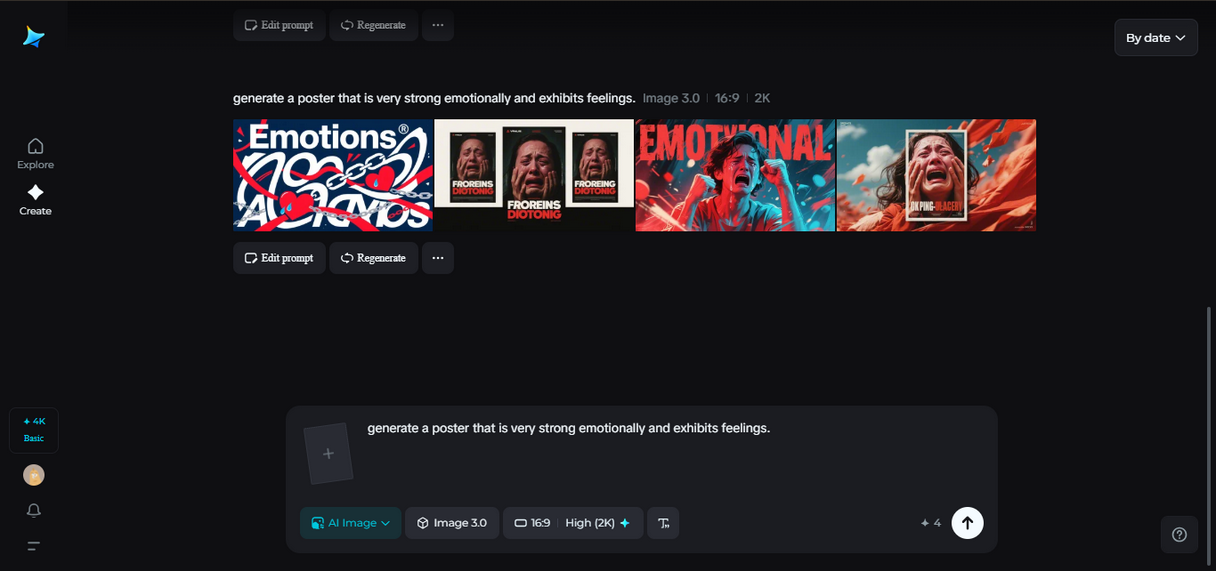
Here’s how designers create static images that seem alive:
  • Directional flow: Diagonal or curved lines imply movement.
  • Circular composition: Reeks of energy captured during spin.
  • Gradient play: Gradual color transitions mimic emotional movement.

Emotional pacing: imparting stillness with a heartbeat

Emotion in a piece of design isn’t about faces or movement; it exists in pacing, the way contrast, tone, and texture work together. Much like film, where tension builds and then abates, posters can convey rhythm in visual contrast and silence.
Designers build this heartbeat by:
  • Blending light and dark areas to replicate pulses of energy and serenity.
  • Employing color temperature changes — to cool, warm — to convey mood shift.
  • Creating layered depth, so that observers feel air and space even on a two-dimensional surface.

Creating a poster that feels cinematic

To create something cinematic, start thinking like a storyteller. What moment are you stopping in time? What feeling should resonate beyond the edge of the frame?
Cinematic posters tend to feature:
  1. Thoughtful framing — all that leads the viewer in one emotional direction.
  2. Atmospheric lighting — the shadows are as full of feeling as highlights.
  3. Anticipation — the feeling that the next frame is about to be cut in.

When silence speaks louder

Action doesn’t always arise out of noise. Sometimes, sparse design shouts louder than a dense one.
For example:
  • One feather drifting across black space can feel like time standing still.
  • A whispery ripple over calm water evokes emotional tension.
  • A texture dissolving into nothing feels like wind blowing through light.

Bringing identity to logos

Even little things like logos can have rhythm. A new logo isn’t necessarily stiff; it can be fluid, as if it’s part of an organism. Designers can create marks that “breathe” by tweaking form, gradient, or weight.
This is where an AI logo generator proves useful. It allows one to try out infinite combinations of shape and mood until the symbol begins to feel at home, not stiff but alive. Such a logo not only represents a brand but moves in tandem with its narrative.

Giving your poster life with Dreamina

Now that you’ve learned about how emotion and rhythm inform design, it’s time to create your own living visual with Dreamina. Its workflow is creative, quick, and unexpectedly intuitive.

Step 1: Write a text prompt

Navigate to Dreamina and start off by articulating your vision, and be as colorful and passionate as you can. Think of your words like paint strokes. The more descriptive you can be with your words, the more life your image will possess.
Example prompt:
A surreal poster of a glowing dancer made of particles of sunlight caught mid-twirl in nebulous mist, with cinematic lighting and soft contrast, dreamy and atmospheric.
The detail is Dreamina’s way of knowing the rhythm and feeling you are looking for, this is how stillness begins to move.
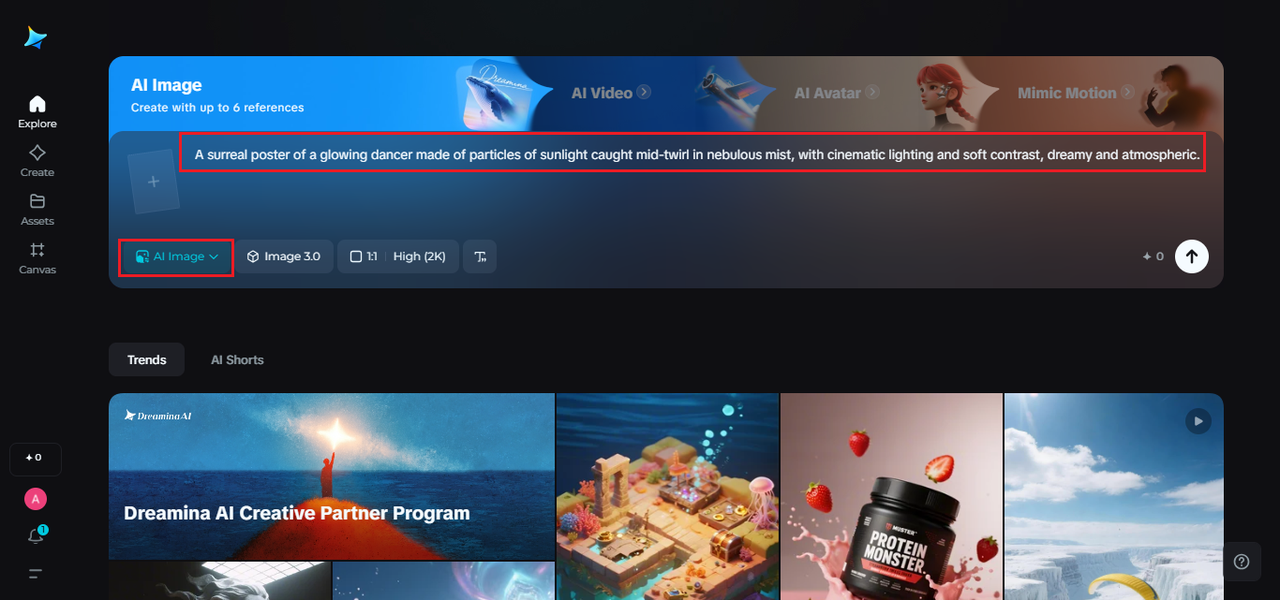
Step 2: Adjust parameters and generate

The next stage is setting the details of your prompt. After interpreting, select the aspect ratio of the model based on your final posters layout, either vertical or landscape. Next, select a resolution and size, choose 1K for early drafts and 2K for fully requested post-production.
When ready, simply select Dreamina’s icon and the purely automated generation process will begin. In a moment’s time, you will experience concept materialize as a visual pulse full of depth and atmospheric feeling.
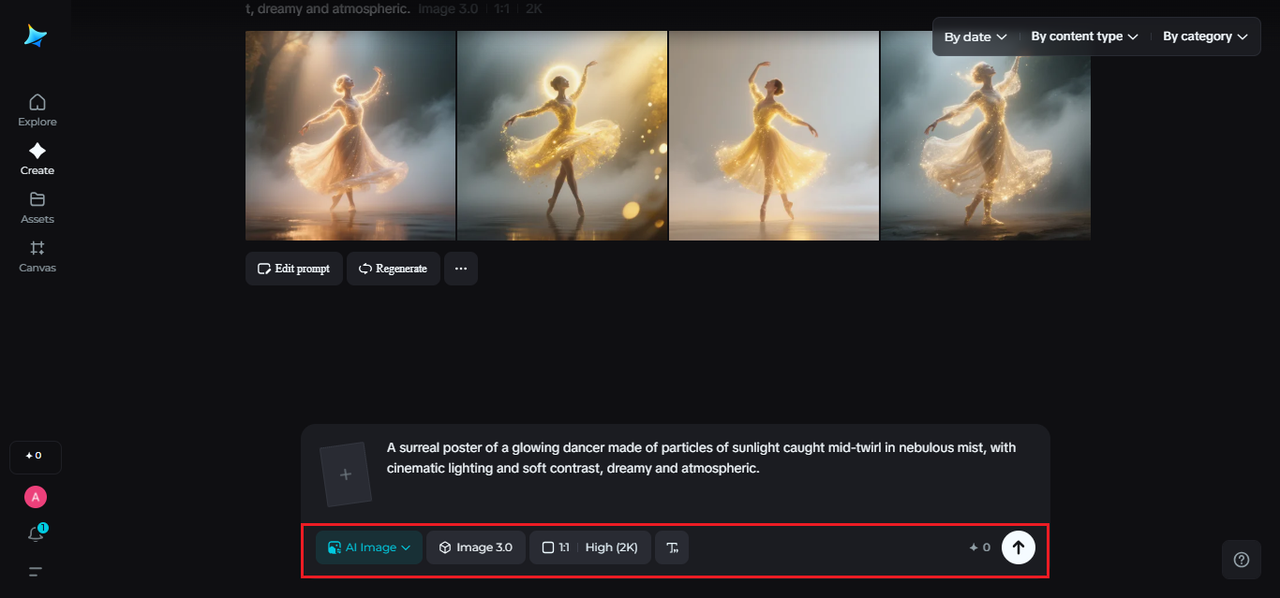
Step 3: Customize and download

People often talk about polishing up images with tools like those in Dreamina. You can try inpaint feature to sort out small details. Or expand the whole thing to make the composition broader. Remove those annoying distractions too. Retouch helps refine the overall tone.
When the image starts to feel balanced. It breathes softly with its light and colors. That is the time to hit download. You end up with a static design. Yet it carries emotional movement.
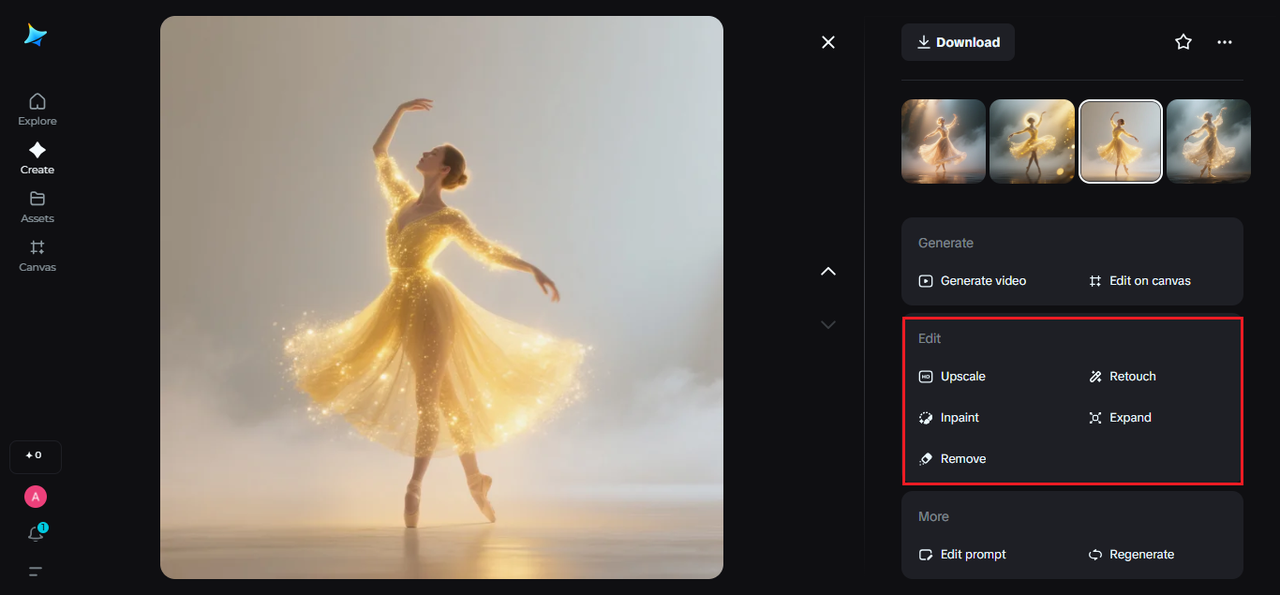
Editing: the art of breathing room

After the initial generation, editing makes the poster come alive. Subtle tweaks matter a lot. Think of a soft edge here. A shadowed spot in the corner there. Even shifting the color temperature. All that sets the pacing right. The AI image editor shines in this phase. It lets you adjust finely without losing any emotion.
Editing feels like handling breath itself. You add elements. Hold them in place. Then release until the rhythm flows properly.

The final exhale

Creating a poster that breathes means adding feeling to the quiet parts. It stays away from adding actual movement. Instead, it reveals a rhythm. The kind hidden between colors and calm. Dreamina makes it possible. You turn words into images that live and breathe. Start however you want. From a simple prompt. A flowing logo. Or a careful edit. The result is an image pulsing with life. Open Dreamina now. Take a deep breath. Let your next design release a story. It remains still. But clearly full of life.


Dipo Olowookere is a journalist based in Nigeria that has passion for reporting business news stories. At his leisure time, he watches football and supports 3SC of Ibadan. Mr Olowookere can be reached via [email protected]

Advertisement
Click to comment

Leave a Reply

Your email address will not be published. Required fields are marked *

General

Military Must Apologise for Disrupting Nigeria’s Democratic Path—Banwo

Published

on

ope banwo

By Modupe Gbadeyanka

For disrupting Nigeria’s democratic path and weakening its institutions, the military must tender an apology to the nation, foremost public commentator, Mr Ope Banwo, has submitted.

The legal practitioner, who called for a national reckoning, insisted that an apology would acknowledge the harm caused by repeated military interventions and reaffirm the supremacy of the constitution.

Speaking on the recently commemorated Armed Forces Remembrance Day, Mr Banwo argued that decades of political intervention by the military disrupted the country’s democratic growth.

According to him, repeated military takeovers did not rescue the country from early post-independence challenges but instead deepened instability and entrenched authoritarian governance.

‎‎While acknowledging that Nigeria’s early civilian leaders contributed to political chaos through electoral malpractice and ethnic tensions, he maintained that military coups worsened the situation, noting that the first coup in 1966 triggered a cycle of interventions that culminated in civil war, institutional breakdown, and long-term political trauma.

‎He emphasised that successive military regimes promised to fight corruption, restore discipline, and sanitise governance, but failed to deliver lasting reforms.

‎‎“Rather than ending corruption, they professionalised it,” he posited, adding that military rule created a powerful elite class that continues to wield influence in politics and business long after the return to civilian rule.

Mr ‎Banwo further argued that the military never fully relinquished power, but merely exchanged uniforms for civilian attire, leaving behind a culture where constitutional authority is often treated as optional, stressing that in democratic societies, the armed forces must remain subordinate to civilian leadership, warning against any renewed appetite for military intervention in governance.

‎‎“The military is not Nigeria’s emergency solution to political failure,” he disclosed, urging the armed forces to focus on their constitutional responsibility of securing the country amid rising insecurity.

Continue Reading

General

Housing Deficit: FG to Prioritize Use of Local Materials

Published

on

affordable housing

By Adedapo Adesanya

The federal government has said it would prioritize the use of local materials to drive its new reform agenda that will close the housing deficit in the country.

This was disclosed by the Minister of Housing and Urban Development, Mr Ahmed Musa Dangiwa, at the 14th National Council on Lands, Housing and Urban Development meeting on Monday in Ilorin, the Kwara State capital.

He said Nigeria’s housing deficit, estimated in tens of millions, remains one of the most pressing social and economic challenges, driven by rapid urbanisation, population growth and rising construction costs, noting that the new policy framework is expected to shape housing delivery, land administration and urban development planning across the federation in the coming years.

Speaking at the event, the Minister, represented by the Director of Planning, Research and Statistics of the ministry, Mr Mukhtar Ilyasu, said the government has placed effective land management at the centre of its housing delivery strategy, describing land administration as the foundation for expanding access to affordable housing nationwide.

According to him, urban renewal and regeneration have now been adopted as national policy tools for modernising Nigerian cities, addressing uncontrolled urban growth and responding to population pressure and climate challenges.

He said the government is also prioritising the large-scale adoption of locally sourced building materials and technologies as a cost reduction strategy aimed at making housing more affordable while strengthening domestic construction industries.

“Effective land management remains the foundation of housing delivery in Nigeria. Without fixing land administration, it will be difficult to close the country’s housing deficit.

“Urban renewal and regeneration have been adopted as national policy tools for rebuilding Nigerian cities, addressing uncontrolled urban growth and improving the quality of life of our citizens.

“The promotion of locally sourced building materials and technologies is now a policy priority to reduce construction costs, deepen local industry and improve housing affordability.”

“Federal and state governments are being aligned under a unified housing and urban development agenda to ensure coordinated implementation and results driven execution”, he said.

Mr Dangiwa added that public private partnerships will serve as the main engine for mass housing and urban infrastructure delivery across the federation.

The government, he noted, will provide policy support, land governance reforms and investment frameworks to attract private capital into the sector.

To support the new direction, he said the FG is strengthening national land governance frameworks to promote inclusive urban growth and remove long standing bottlenecks in land administration that have slowed housing development.

The minister said the new policy thrust further includes innovative housing finance and investment strategies designed to unlock long term funding for real estate development and bridge Nigeria’s widening housing gap.

He stressed that federal and state governments are being aligned under a unified housing and urban development agenda to ensure coordinated implementation and results driven execution.

Continue Reading

General

DSS Arrests ex-AGF Malami After Release from Kuje Prison in EFCC Case

Published

on

remand abubakar malami

By Adedapo Adesanya

The Department of State Service (DSS) has arrested former Attorney-General of the Federation (AGF) and Minister of Justice, Mr Abubakar Malami, shortly after his release from Kuje prison in Abuja on Monday.

He was reportedly arrested to face a fresh probe over arms allegedly discovered in his house in Birnin-Kebbi, the Kebbi State capital, last December.

Recall that two weeks ago, Justice Emeka Nwite of the Federal High Court in Abuja granted the former AGF and two others bail in the sum of N500 million.

The Economic and Financial Crimes Commission (EFCC) had filed a 16-count alleged money laundering charge against Mr Malami, his son, Abdulaziz Malami, and his wife, Mrs Asabe Bashir.

The DSS operatives reportedly arrested him as he was exiting the Kuje Correctional Centre in Abuja, where he had been held since December 30, 2025, over the pending N8.7 billion money laundering charges filed by the anti-graft agency.

Monday’s arrest followed weeks of reports of surveillance by the secret police in front of the prison facility since the time Mr Malami, his wife and son were remanded there over the money laundering charges.

As per reports, Mr Malami had gathered that he would be picked up upon regaining his temporary freedom decided to wait. However, after his eventual emergence, the DSS operatives took the ex-AGF into detention again.

In a press statement by Mr Malami’s aide, Mr Mohammed Doka, shared on the former AGF’s Facebook page on January 7, the planned arrest of the legal practitioner was confirmed.

The post, the latest on the Facebook page as of Tuesday morning, said the former minister’s camp had been “reliably informed of plans by government security agencies to rearrest him immediately upon his release, despite being granted bail by a court of competent jurisdiction.”

“This development is deeply troubling and raises grave concerns about due process, the rule of law, and personal safety,” the statement added, describing the allegations informing the planned arrest as “trumped-up charges”.

Mr Malami’s arrest on Monday began the third phase of his ongoing detention by various agencies since December 8, 2025.

The EFCC detained him from 8 December 2025 to 30 December 2025, when the Federal High Court in Abuja where he and his family members face money laundering charges transferred him to the Correctional Centre in Kuje, Abuja, following his arraignment.

The trial court granted him bail on 7 January but only for him to be rearrested by the SSS upon his release after meeting the bail conditions on Monday.

Continue Reading

Trending