General
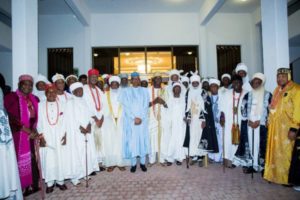
Traditional Rulers Trained On Land Negotiations Skills

By Dipo Olowookere
A two-day seminar to sensitize African traditional leaders on the risks and opportunities of large-scale land based investments (LSLBIs) kicked off Wednesday in Accra, Ghana, with more than 50 traditional authorities and community leaders from across Africa.
Organized by the Land Policy Initiative (LPI), the event will equip traditional leaders with key principles for negotiating land investment deals that are sustainable and beneficial to African people and communities.
Mr Hubert Ouedraogo, lead land expert from the Land Policy Initiative Section of the Economic Commission for Africa (ECA), explained that the focus on traditional leaders is a strategic move.
“It is important to engage traditional leaders in such activities because land rights in most African communities are customary law based, and are governed by traditional institutions,” said Mr Ouedraogo.
Africa harbours an estimated 60 percent of the world’s arable lands but the continent is still a net importer of food and agricultural produce. Meanwhile, the continent’s youths are fleeing massively to Europe as economic migrants. These are clear indications that Africa’s rich land resources are not properly harnessed to meet the needs of its growing population and rapid urbanization.
Also, the need for developed countries to access natural resources critical to their economic competiveness and sustainability has fuelled increasing demand for African farmlands. This has resulted in a phenomenon of large-scale land acquisitions across Africa. Consequently, African governments are blamed for giving away the continent’s land resources at the expense of poor local communities.
Speaking at the opening of the seminar, Ghana’s minister of Lands and Natural Resources, Nii Osah Mills, said his country has established several customary lands secretariats – institutional structures to facilitate efficient and effective administration of customary lands.
“When the Ghana Land Policy was launched in 1999, a prime place was provided for capacity development of traditional authorities,” Said Mr. Mills. “ Under the Ghana Land Administration Project, Customary Land Secretariats are encouraged and supported by my ministry to enable customary landowners to have proper administrative structures to manage their lands.”
AUC’s representative, Laila Lokosang, also emphasized the importance of recognizing and protecting the customary based land rights of African people.
“If Africa is to feed its rapidly growing population, then land rights of African farmers, the majority of whom are smallholder farmers, need to be secured,” said Mr. Lokosang. “Protecting the customary based land rights of African people, including those of women, is a key determining factor for Africa’s development.”
Speaking on behalf of the Ghanaian National House of Chiefs, Nene Akuaku III described the seminar as a first-of-kind opportunity for traditional leaders.
“I understand it is first of its kind for traditional authorities to meet and deliberate on land issue. I will therefore entreat all of us to use this opportunity to share experiences learn and document lessons for future considerations.”
The seminar is part of several activities carried out by the LIP under the auspices of the AUC, AfDB and ECA, to provide guidance to African governments, traditional leaders and other stakeholders on how to make land related investments benefit local people and economies.
General
Effurun Shooting: Police Orders Dismissal, Prosecution of ASP Nuhu Usman, Others
By Modupe Gbadeyanka
All the police personnel involved in the fatal shooting of Mr Mene Ogidi in the Effurun area of Delta State have been dismissed by the leadership of the Nigeria Police Force (NPF).
A statement issued on Wednesday by the police spokesman, Mr Anthony Okon Placid, a Deputy Commissioner of Police (DCP), said findings established unequivocally that the principal officer, ASP Nuhu Usman, acted in gross violation of Force Order 237 and other extant regulations governing the use of firearms.
The police described his actions as unlawful, unprofessional, and a clear betrayal of the oath to protect life and uphold the law.
It was gathered that the assassination of Mr Ogidi, captured in a video online, happened on Sunday when the deceased was with a package believed to contain a pistol.
After a public outrage, the Inspector-General of Police (IGP), Mr Tunji Disu, directed all officers connected to the incident to be immediately withdrawn from the Delta State Command and transferred to Force Headquarters, Abuja, where they were subjected to expedited disciplinary proceedings.
The Force Disciplinary Committee (FDC), alongside other internal disciplinary processes, after the conclusion of its review, recommended the immediate dismissal of ASP Nuhu Usman and other officers found culpable.
This has been approved by the police chief and forwarded to the Police Service Commission (PSC) for ratification in line with due process.
It was disclosed that upon completion of the administrative procedures, the affected officers will be handed over to the appropriate judicial authorities for prosecution for their roles in the extrajudicial shooting.
Mr Disu reiterated, in the strongest terms, that the Nigeria Police Force maintains a zero-tolerance stance on extra-judicial actions and abuse of power. No uniform confers the right to take life outside the provisions of the law. Any officer who violates this fundamental principle will face the full weight of disciplinary and legal consequences.
He extended his deepest and most solemn condolences to the family of the deceased, acknowledging the pain and loss suffered and assured the family that this tragic incident would not be treated lightly. The Force is fully committed to ensuring that justice is not only served but seen to be served, in a manner that reinforces public confidence and institutional accountability.
Members of the public were urged to remain calm and law-abiding, as the Nigeria Police Force remains steadfast in its commitment to discipline, professionalism, and the protection of the rights and dignity of all citizens while ensuring accountability at all levels.

General
FG Declares Friday Public Holiday for 2026 Workers’ Day
By Modupe Gbadeyanka
Friday, May 1, 2026, has been declared a public holiday by the federal government to celebrate this year’s International Workers’ Day.
The public holiday was declared by the Minister of Interior, Mr Olubunmi Tunji-Ojo, in a statement signed by the ministry’s Permanent Secretary, Mrs Magdalene Ajani, on Thursday.
The Minister congratulated Nigerian workers on this year’s celebration, lauding them for their hard work and dedication to national development.
He noted that their efforts are essential for the nation’s growth and prosperity, urging them to embrace patriotism, productivity, and dedication to their duties. According to him, these qualities are crucial for sustainable development, assuring that the federal government is committed to supporting the welfare and security of all workers and creating a favourable environment for economic growth.
While wishing workers a happy celebration, the Minister urged all Nigerians to remain peaceful and law-abiding, encouraging everyone to use this occasion to reflect on the importance of unity and hard work in building the nation.
General
IFC, Standard Chartered Unveil Facility to Boost Supply Chains in Nigeria, Seven Others
By Adedapo Adesanya
The World Bank Group’s private-sector arm, the International Finance Corporation (IFC), and Standard Chartered on Wednesday announced a new risk-sharing facility aimed at strengthening supply chains and supporting business growth across Africa.
The programme will roll out across eight markets—Côte d’Ivoire, Egypt, Ghana, Kenya, Nigeria, South Africa, Tanzania and Zambia—targeting sectors including agriculture, healthcare and manufacturing, with a focus on improving access to working capital for suppliers.
This marks the IFC’s first project under its Global Supply Chain Finance Program and the Africa Trade and Supply Chain Recovery Initiative, supported by the International Development Association’s Private Sector Window Blended Finance Facility.
Global demand for supply chain finance continues to rise, reaching an estimated $2.7 trillion in 2025, an increase of 8 per cent year-on-year. However, access in emerging markets remains limited, as financial institutions tend to prioritise developed economies.
The facility will cover up to $300 million in supply chain and trade finance assets originated by Standard Chartered. It includes financing instruments such as payables finance, receivables discounting and pre-shipment finance programmes, which enable businesses to access funds earlier in the payment cycle.
The facility aims to address this imbalance by mitigating risk in short-term trade and supply chain finance portfolios, helping to unlock capital in underserved markets.
By accelerating payments to suppliers, the initiative aims to strengthen supply chain relationships, improve delivery reliability and support job creation across value chains.
IFC will provide guarantees of up to $150 million, with $100 million committed as an initial tranche. The facility will support transactions in both U.S. dollars and selected local currencies.
Over three years, the partnership is expected to enable approximately $1.9 billion in supply chain finance transactions, supporting more than 500 suppliers, including small and medium enterprises. The programme also has the potential to indirectly benefit over 1 million farmers.
Speaking on this development, Mr Mohamed Gouled, Vice President, Products & Clients at IFC, said, “Supply chain finance is among the fastest ways to narrow the growing finance gap that businesses, particularly small and medium enterprises, are facing in emerging economies. By partnering with Standard Chartered to support companies at the centre of strategic value chains, we can unlock much-needed working capital at scale for businesses across Africa, including smaller firms and farmers, making supply chains more competitive and boosting job creation.”
On his part, Mr Dalu Ajene, Chief Executive and Head of Coverage, Standard Chartered Africa, said, “This $300 million facility with IFC underscores our shared commitment to strengthening Africa’s supply chains and enabling sustainable business growth. As a super-connector bank with deep expertise across key trade corridors linking Africa to Europe, Asia, the Middle East and the Americas, we are uniquely positioned to channel capital and innovation into the real economy.”
“By expanding access to supply chain finance, we are helping African companies unlock liquidity, manage risk, and invest with confidence. Our collaboration unites Standard Chartered’s cross-border expertise with IFC’s development mandate to empower businesses – from major corporations to smaller local suppliers – to engage more actively in regional and global trade, fostering job creation and promoting inclusive growth,” he added.
-
Feature/OPED6 years agoDavos was Different this year
-
Travel/Tourism10 years ago
Lagos Seals Western Lodge Hotel In Ikorodu
-
Showbiz3 years agoEstranged Lover Releases Videos of Empress Njamah Bathing
-
Banking8 years agoSort Codes of GTBank Branches in Nigeria
-
Economy3 years agoSubsidy Removal: CNG at N130 Per Litre Cheaper Than Petrol—IPMAN
-
Banking3 years agoSort Codes of UBA Branches in Nigeria
-
Banking3 years agoFirst Bank Announces Planned Downtime
-
Sports3 years agoHighest Paid Nigerian Footballer – How Much Do Nigerian Footballers Earn