

General
Transcript of President Buhari’s 2018 Democracy Day Speech

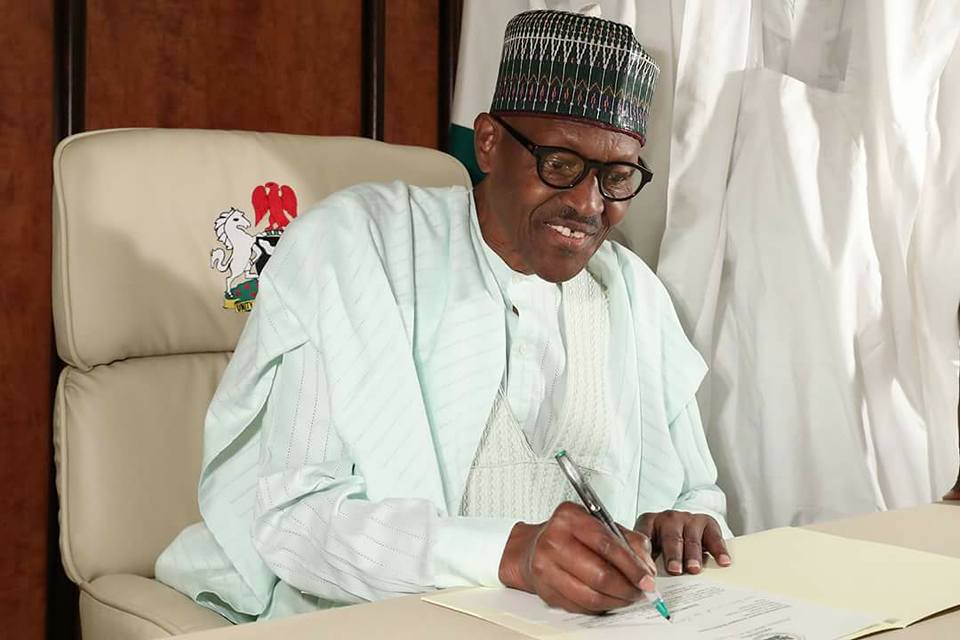
ADDRESS BY MUHAMMADU BUHARI, PRESIDENT OF THE FEDERAL REPUBLIC OF NIGERIA IN COMMEMORATION OF THE 2018 DEMOCRACY DAY CELEBRATION , TUESDAY, 29 TH MAY, 2018
My Dear Nigerians!
Today marks the 19th year of our nascent democracy and the 3rd Anniversary of this administration. I am thankful to Almighty God for bringing us thus far. This administration came at a time that Nigerians needed Change, the Change we promised and the Change we continue to deliver. We have faced a lot of challenges on this journey and Nigerians have stood by us in achieving the three cardinal points of this administration namely; Security, Corruption and the Economy.
- The commemoration of this year’s Democracy Day is a celebration of freedom, a salute to the resilience and determination of Nigerians and a recommitment by Government to keep its promise to lead Nigeria into a new era of justice and prosperity.
- Public safety and security remains the primary duty of this Government. Before this Administration came into being 3 years ago, Boko Haram held large areas of land spanning several Local Governments in the North East.
- Today, the capacity of the insurgents has been degraded leading to the re-establishment of authority of government and the release of captives including, happily, 106 Chibok and 104 Dapchi girls, and over 16,000 other persons held by the Boko Haram.
- In order to minimize the impact of the insurgency on Internally Displaced Persons, Government has established secure IDP Camps and has improved the mechanism for the distribution of basic aid, foods and essential commodities using various strategies in collaboration with local and international Organizations.
- Efforts are in process for resettlement of IDPs in their home communities by providing schools, hospitals, clinics, water and sanitation to facilitate a quick return to economic activities. Government is similarly implementing de-radicalization and rehabilitation programmes to facilitate sustainable peace and development.
- The unfortunate incidences of kidnappings, herdsmen and farmers clashes in several communities which have led to high number of fatalities and loss of properties across the country is being addressed and the identified culprits and their sponsors shall be made to face the full wrath of the law. All the three tiers of Government are presently engaged with communities and religious organizations to restore peaceful co -existence among Nigerians.
- I want to commend members of the Multinational Joint Task Force drawn from Niger, Benin, Chad, Cameroon and our own country in collaboration with the International Community who are assisting in the fight against insurgency in the North East. I also commend the gallantry of members of our Armed Forces and other security agencies that have continued to provide security for lives and properties across the country. State and Local traditional authorities are helping with much needed intelligence in this fight against insurgency.
- This administration is pained over the grievous loss of lives and properties occasioned by the carnage of insurgency and other forms of criminality in the country. I wish to assure Nigerians that we will not rest until all criminal elements and their sponsors are brought to justice. Government is boosting the capacity of our security agencies through recruitment of more personnel, training and procurement of modern equipment, enhancement of intelligence gathering as well as boosting their morale in the face of daunting challenges.
- The Niger Delta Region has enjoyed relative peace through social inclusiveness and cooperation of the Elders and the good people of the region. Government is committed to implementing the comprehensive peace, security and development plan for the region. The environmental clean-up of the region which commenced with the launch in Bodo, Ogoni in June, 2016 is progressing satisfactorily. Furthermore, farming assets are being revived and investors in cocoa and palm oil plantations are showing serious interest.
- The second primary object of this Administration is to fight corruption headlong. Like I have always said, if we don’t kill corruption, corruption will destroy the country. Three years into this Administration, Nigerians and the international community have begun to applaud our policies and determination to fight corruption. We are more than ever before determined to win this war, however hard the road is. I therefore appeal to all well-meaning Nigerians to continue to support us in this fight.
- Various policy measures already put in place to stem the tide of corrupt practices are yielding remarkable results. Some of these key reform policies include:
a. The Treasury Single Account (TSA) has realized billions of Naira being saved from maintenance fee payable to banks. N200 billion has also been saved from elimination of ghost workers in public service.
b. The Whistle-Blowing Policy has helped to recover over N500 billion;
c. The Presidential Initiative on Continuous Audit set up with a mandate to validate controls, assess risks, prune personnel costs, ensure compliance with Public Financial Management reforms has helped to identify and remove over 52,000 ghost workers from the Federal Government MDAs Payroll;
d. The Voluntary Asset and Income Declaration Scheme (VAIDS) aimed at expanding tax education and awareness has offered the opportunity for tax defaulters to regularise their status in order to enjoy the amnesty of forgiveness on overdue interest, penalties and the assurance of non-prosecution or subject to tax investigations.
e. The Sovereign Wealth Fund project portfolio has been expanded with an injection of $650 million so as to strengthen its investment in local infrastructure, power, health, re -construction of Abuja- Kano road, Lagos-Ibadan Expressway, East West Road (Section V) and the Mambilla Hydro -electric Power project as well as the construction of the 2nd Niger Bridge.
13. The fight against corruption through the Economic and Financial Crimes Commission and the Independent Corrupt Practices and Other Related Offences Commission has resulted in recoveries of billions of Naira, as well as forfeiture of various forms of assets. This alongside other efforts has improved Nigeria’s international image and regional cooperation.
14. We have retained the services of one of the world’s leading assets tracing firms to investigate and trace assets globally. This is in addition to the exploitation of provisions of existing Treaties, Conventions as well as Bilateral Agreements with Multilateral bodies and Nations. Nigeria has also signed Mutual Legal Assistance Agreements to ensure that there is no hiding place for fugitives.
15. This Administration has therefore focused on revamping the ailing economy it inherited in 2015. In 2016, Government executed an expansionary budget and developed the Strategic Implementation Plan. For the first time, 30% of the budget was earmarked for capital expenditure which represents an upward review when compared with the 2015 budget. The SIP was followed by the development of a comprehensive medium term plan–the Economic Recovery and Growth Plan 2017–2020.
16. The broad strategic objectives of the ERGP were to; Restore and sustain economic growth; Build a globally competitive economy; and Invest in our people. The implementation of the ERGP has started yielding results. The National Bureau of Statistics reports that the economy grew by 1.95% in 1st quarter 2018, which is a good performance when viewed against -0.91% in 1st quarter 2017 and -0.67% in 1st quarter 2016 respectively.
17. Our foreign reserve has improved significantly to $47.5 billion as of May 2018 as against $29.6 billion in 2015. The inflationary rate has consistently declined every month since January 2017.
18. Recently, Government conducted Focus Labs in three key sectors of the Economy namely, Agriculture & Transport, Manufacturing and Processing as well as Power and Gas. These have yielded significant prospects for investments and Job creation to the tune of $22.5 billion with a potential for creating more than 500,000 jobs by 2020. These investment generation initiatives are expected to increase capital inflows in the form of foreign direct investment. There is a high prospect that the cumulative investments from this first phase of the Labs will hit $39.2 billion by 2025.
19. Under agriculture, Nigeria continues to pursue a strategic food security programme built around self-sufficiency and minimization of import dependency. As a result, rice importation from other countries has been cut down by 90% which has a direct impact on foreign reserves.
20. The Social Investment Programmes (SIP) has been created as a means to graduating our citizens from poverty through capacity building, investment and direct support. The major strategic objective is to restore livelihood, economic opportunities and sustenance for the poor across the country. The SIP programmes and projects include:
a. Home Grown School Feeding Programme – About 8.2 million pupils are currently being fed from 24 States of the Federation with over 75,000 Catering Staff engaged under the programme.
b. The Conditional Cash Transfer has so far recorded over 297,000 caregivers and being trained by 2,495 Community Facilitators in 21 states. Less privileged Nigerians are now being paid N5,000 monthly stipend in 9 pilot States of Bauchi, Borno, Cross River, Ekiti, Kwara, Kogi, Niger, Osun and Oyo. Eventually, the scheme will cover all the 36 states of the federation including the FCT.
c. Under the Government Enterprise Empowerment Programme – About 264,269 loans had been disbursed to 4,822 societies in the 36 States and FCT, while another 370,635 are awaiting release of funds.
d. N-Power Job creation Scheme – is targeted at providing jobs for unemployed young graduates and has so far recruited 200,000 youths while the next batch of 300,000 have been selected, verified and would soon be deployed across the 36 States and the FCT. Furthermore, 20,000 non-graduate volunteers have also been selected to kick off the N-Build programme in collaboration with the National Automotive Design and Development Council and the Council of Registered Builders of Nigeria.
21. In the area of power generation, Nigerians from all parts of the country continue to report better power supply and less use of generators. This underscores the effectiveness of the methodical plan to deliver incremental and uninterrupted power supply to our homes, markets, offices and factories.
22. The country achieved 5,222.3 MW representing the highest peak of power generated onto the national grid and delivered to customers in December 2017. With new facilities, repairs and rehabilitations by Government and private investors, generation capability now exceeds 7,500 MW.
23. This Administration is committed to lawful interventions to ensure the operators of the distribution business live up to expectations especially in the areas of distribution capacity, service delivery, collection efficiency, and metering to eliminate contentious estimated billing.
24. The Transportation Sector continues to undergo a series of reforms in order to sustain the international best practices and ensure safety and security. The nation’s major airports have witnessed reconstruction of runways, installation of navigational equipment and new international terminals due for commissioning in Abuja, Lagos, Kano and Enugu. Bilateral Air Services Agreements between Nigeria and the Governments of other countries will significantly open up new flight routes.
25. As a result of strict regulatory and compliance policies, Nigeria retained her Federal Aviation Administration (FAA) Category 1 status, after a routine international audit. Recently, a new Maintenance Repair and Overhaul facility with capacity for aircraft C-checks and other comprehensive levels of maintenance was established in Lagos. This would save the country an estimated $90 million annually.
26. Giant strides have been recorded over the past three years to improve road transport infrastructure in all geopolitical zones of the country.
27. The Railway Sector has also received tremendous attention as this Administration is committed to the goal of linking all State capitals in the Federation by rail network to ease the movement of goods and passengers.
28. The Education Sector especially at tertiary level has continued to witness expansion in order to improve access to higher education by millions of youths in Nigeria. Over the last three years, Government has approved the establishment of 1 new Federal Polytechnic, granted licenses for the establishment of 4 State and 14 private-owned Universities as well as 12 private Polytechnics.
29. Government has also continued to support the implementation of various initiatives aimed at improving the quality of Basic Education delivery. Thus, it has ensured proper funding at the Basic Education level with the disbursement of N42.2 billion UBE Matching Grant to 26 States and the FCT, N851.5 million Special Education Grant disbursed to 23 States and private providers of Special Education and N2.2 billion Teachers Professional Development Fund to 33 States and the FCT.
30. The Federal Government has continued to support fiscal sustainability at the sub-national governments through the implementation of the Budget Support Facility which was accompanied by the 22-point Fiscal Sustainability Plan. Thus, bailouts funds were made available to States to ease their fiscal challenges and other obligations including payment of salaries.
31. In addition, a total of 73 Ecological Fund projects for the control of gully erosion in different communities across all geopolitical zones have been completed in the last three years and are undergoing commissioning while 53 other projects are ongoing. The execution of these projects has generated 357 skilled jobs and 1,350 unskilled jobs during this period.
32. It is pertinent to also make mention of the immeasurable contributions of the Nigerian woman to national development and advancement of democracy, over the last three years. The government and people appreciate you all as mothers of our great country.
33. My dear country men and women, as we all celebrate our democratic experience, let us resolve to avoid hatred and intolerance; we can only achieve our objectives in an atmosphere of harmony and peaceful co-existence.
34. Finally, the up-coming months will usher us into another season of general elections. Let me use this opportunity to urge us all to conduct ourselves, our wards and our constituencies with the utmost sense of fairness, justice and peaceful co-existence such that we will have not only hitch free elections but also a credible and violence free process.
35. In few days to come, I will be joined by many promising young Nigerians to sign into law the “Not Too Young to Run” Bill.
36. I thank you for your attention.
37. God bless the Federal Republic of Nigeria.



By Adedapo Adesanya
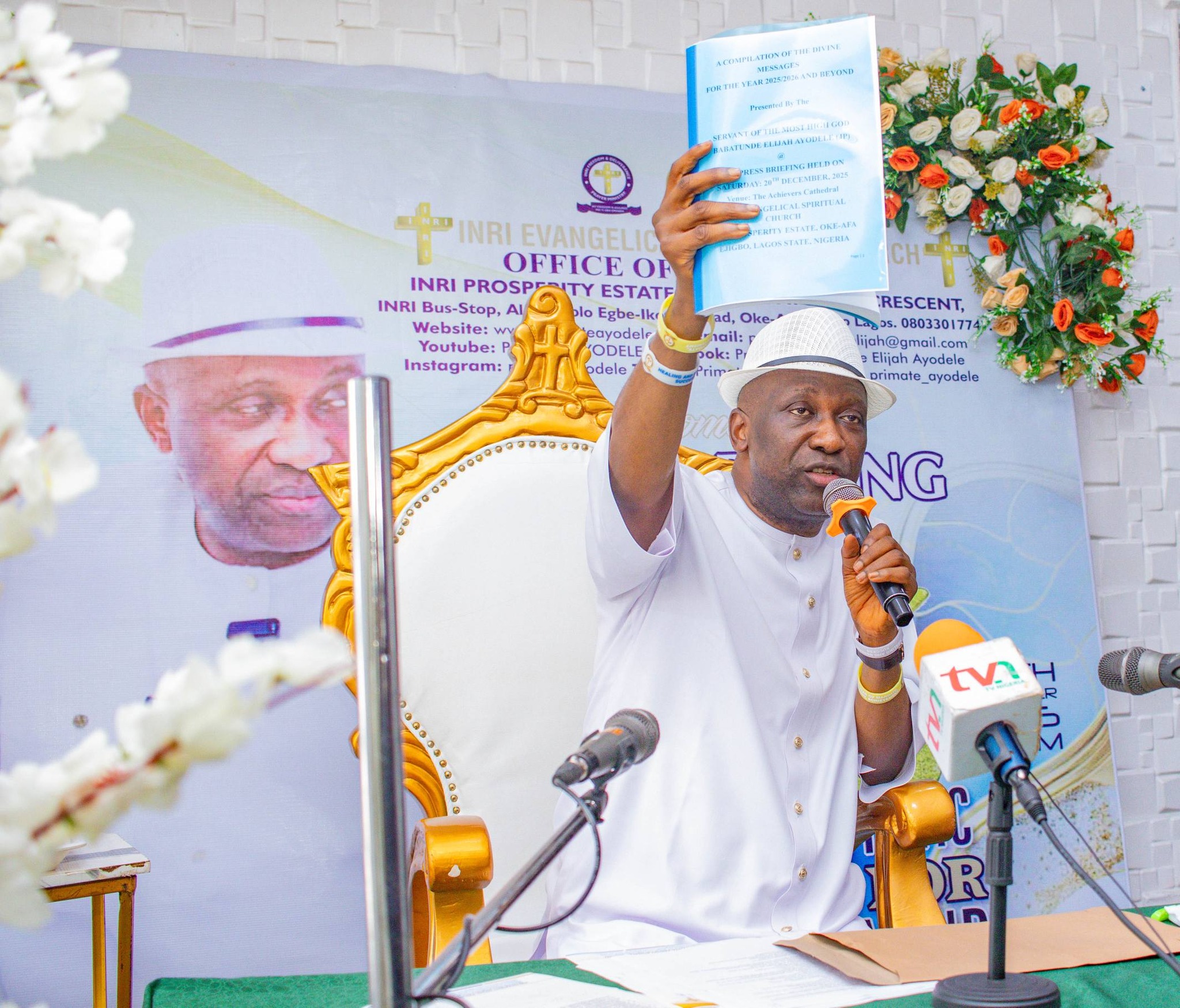
Popular Nigerian prophet and founder of INRI Evangelical Spiritual Church Lagos, Primate Elijah Ayodele, has called on the Nigerian government to be careful and watchful of economic hardship in the new year.
He made this warning and others at his End of the Year 2025 Press Conference, where he gave prophecies for Nigeria and the world.
According to the man of God, the government will do its utmost best to stabilize things but the balancing will be very difficult.
“The country will face so many political upheaval that will frustrate the efforts of the government in all fronts. I foresee the government in the process will take a lot of wrong steps. There will be wrong pieces of advice,” he said.
“The Lord revealed to me that the efforts of the President will be frustrated with wrong pieces of advice. These are the words of the Lord,” he added.
Primate Ayodele noted that “The spirit of God says in the year 2026, the President must be watchful for what is tagged political nemesis in the country. He needs fervent prayers in this regard.”
He warned President Bola Tinubu to be wary of several advices from different quarters, noting that Nigeria’s opposition groups will frustrate all his efforts unless he is able to take decisive steps to scuttle and scatter the plans, particularly that of the African Democratic Congress (ADC).
“I foresee the ADC members are ready to fight in order to wrestle for the political control of the country from the ruling APC. The main obstacle will be if the ADC is fielding a weak candidate. The ADC will want to use all the apparatus at its command to achieve what they want to do in order to achieve victory at the polls.”
On the 2027 polls, he said the ruling All Progressives Congress (APC) would do everything possible to make sure they use the Independent National Electoral Commission (INEC) and other things within their powers to secure victory.
“The ADC as a political party must watch carefully the unfolding drama. I foresee that all areas where the ADC can have an upper hand during polls will be blocked.”
The prophet as part of his prophecies also foresaw the crude oil from the Nigeria not being of quality grades expected in the international oil and gas market in the next 20 years from now.
On the tax reforms due to start in the new year, Primate Ayodele said this would cause misconceptions and the government needs to explain.
“I foresee our budget will not be properly implemented. They will use budget to fight inflation and hunger yet Tinubu will still borrow surplus money. People will be frustrated,” he said in the prophecies.
General
QNET’s Global Reach in 100+ Countries: What International Access Means for Local Distributors

Global scale means market access and international supply chains. For individual distributors in direct selling, it can shape everything from product availability to income stability and long-term opportunity.
QNET, the multinational wellness and lifestyle direct selling company, positions its business model around that idea: connecting locally based independent distributors to an international operating platform. With activity spanning more than 100 countries, the company sits within a direct selling industry that, according to the World Federation of Direct Selling Associations (WFDSA), has stabilized after several relatively volatile post-pandemic years.
Global Reach Within a Stabilizing Industry
The WFDSA’s latest global report estimates worldwide direct selling retail sales at roughly $163.9 billion in 2024, essentially flat year over year. That flat performance, however, masks gradual improvement beneath the surface. Nearly half of reporting markets showed growth in 2024, and average market growth rates rebounded to positive territory.
The report estimates more than 104 million independent sales representatives globally in 2024, a figure that has remained largely stable year over year.
This stabilization sets a backdrop for companies like QNET. A global footprint is no longer about rapid expansion alone; it is increasingly tied to resilience: operating across regions with different economic cycles, consumer behaviors, and growth trajectories.
For distributors, this matters because opportunities extend beyond individual effort. They are often shaped by the health of the company’s broader channel and product reach.
A Platform Designed for Distributed Entrepreneurship
QNET’s model centers on local execution supported by centralized infrastructure. Products—ranging from nutritional supplements and wellness devices to home and lifestyle solutions—are sold through the company’s proprietary e-commerce platform. Independent distributors do not manage warehouses, shipment logistics, or customer service systems.
As Ramya Chandrasekaran, who heads communications at QNET, explained in a recent interview, the company views direct selling as a form of accessible “micro-entrepreneurship.” The idea is to reduce the operational burden typically associated with starting a business, allowing distributors to focus on product education, customer relationships, and market development.
Why Global Scale Changes the Distributor Equation
One practical benefit of international reach is product continuity. WFDSA data shows that wellness products account for roughly 29% of global direct selling sales, making it the largest category worldwide. In the Asia-Pacific region, the largest direct selling region by sales, wellness represents more than 40% of total category share.
QNET’s emphasis on wellness and lifestyle products places distributors in line with the strongest demand segments globally. Instead of relying on narrow local trends, distributors operate within product categories that have shown consistent global interest.
International scale also supports consistency in training, compensation structures, and digital tools. Distributors in different countries access identical back-end systems, tracking referrals, commissions, and orders through the same platform. This standardization reduces friction and uncertainty, particularly for individuals operating in markets where informal commerce is common.
Workforce Shifts
The WFDSA’s report highlights notable shifts in the global direct selling workforce. Women continue to make up more than 70% of participants worldwide, and representation among individuals aged 35 to 54 remains the largest cohort.
Independent Distributors increasingly value flexibility, long-term viability, and support systems that allow them to operate sustainably rather than aggressively scale. QNET’s emphasis on digital access, centralized operations, and gradual business building reflects those priorities.
For many participants, especially those balancing work with caregiving or other responsibilities, direct selling infrastructure offers a way to stay engaged at their own pace.
Training, Exposure, and Cross-Market Learning
QNET’s international conventions and training programs connect distributors across regions, creating informal networks for peer learning. Events that draw participants from dozens of countries expose distributors to varied approaches to sales, customer engagement, and market adaptation.
This mirrors one of WFDSA’s broader conclusions: direct selling increasingly functions as a global learning ecosystem, with companies providing tools and education that help individuals navigate uncertain economic conditions.
For distributors, exposure to cross-border experiences can recalibrate expectations, reinforcing that success often comes from steady engagement rather than rapid recruitment or short-term activity.
International Access, Interpreted Locally
Despite its global scale, QNET’s business ultimately plays out in local communities. Distributors adapt messaging around wellness, home quality, and lifestyle enhancement to cultural norms and household priorities. The international platform provides reach and structure, but relevance is built locally.
That balance, global systems supporting local relationships, defines much of modern direct selling. The WFDSA describes the industry not as a single growth story, but as a framework that can scale proportionally with economic conditions across regions.
For QNET distributors, international presence does not guarantee income or uniform outcomes. What it offers is access: to resilient product categories, standardized systems, training resources, and a global marketplace that extends beyond any single region. For local distributors navigating today’s uncertain global economic environment, that is an important foundation to maintain.
By Adedapo Adesanya
The Federal Competition and Consumer Protection Commission (FCCPC) has unsealed the headquarters of Ikeja Electric Plc in the Lagos State capital after a week under lock and key.
According to a statement on Friday, the electricity distribution company committed to a binding undertaking to comply with the remedial process following consumer rights violations.
The statement signed by Mr Ondaje Ijagwu, Director of Corporate Affairs at the commission, Ikeja Electric undertook to resolve all consumer complaints referred to it by the FCCPC within agreed timelines
The headquarters was earlier sealed on December 11, 2025, because Ikeja Electric allegedly failed to comply with a directive by the Nigerian Electricity Regulatory Commission (NERC) to unbundle a Maximum Demand account into 20 individual accounts for a customer who had been without power for over two and half years.
The FCCPC noted that following the resolution, any breach of the undertaking would expose it to renewed and escalated enforcement action under the Federal Competition and Consumer Protection Act.
Reacting, the Executive Vice Chairman and Chief Executive Officer of the FCCPC, Mr Tunji Bello, said the Commission’s intervention was necessary to enforce the provisions of the FCCPA (2018).
“Our responsibility is to ensure that consumers are treated fairly and that service providers comply with lawful decisions and directives. Enforcement is not an end in itself. Where compliance is achieved and credible commitments are made, the Commission will respond appropriately,” he said.
Clarifying further, Mr Bello said the outcome reflects the commission’s balanced approach to regulation.
“We intervene decisively where consumer harm persists, and we de-escalate where enforceable compliance is secured. What remains constant is our duty to protect consumers and uphold regulatory accountability,” he said.








-
 Feature/OPED6 years ago
Davos was Different this year
-
Travel/Tourism9 years ago
Lagos Seals Western Lodge Hotel In Ikorodu
-

 Showbiz3 years ago
Estranged Lover Releases Videos of Empress Njamah Bathing
-
 Banking7 years ago
Sort Codes of GTBank Branches in Nigeria
-

 Economy3 years ago
Subsidy Removal: CNG at N130 Per Litre Cheaper Than Petrol—IPMAN
-

 Banking3 years ago
First Bank Announces Planned Downtime
-

 Banking3 years ago
Sort Codes of UBA Branches in Nigeria
-

 Sports3 years ago
Highest Paid Nigerian Footballer – How Much Do Nigerian Footballers Earn