Connect with us

Jobs/Appointments

Nigerians Trust Their Employers More—Report

Published

on

2019 Edelman Trust Barometer

A new report has shown that of the four mainstream institutions of government, business, media and non-governmental organisations, Nigerians trust more in business and believe that their employers should take the lead on change rather than waiting for the government to initiate it.

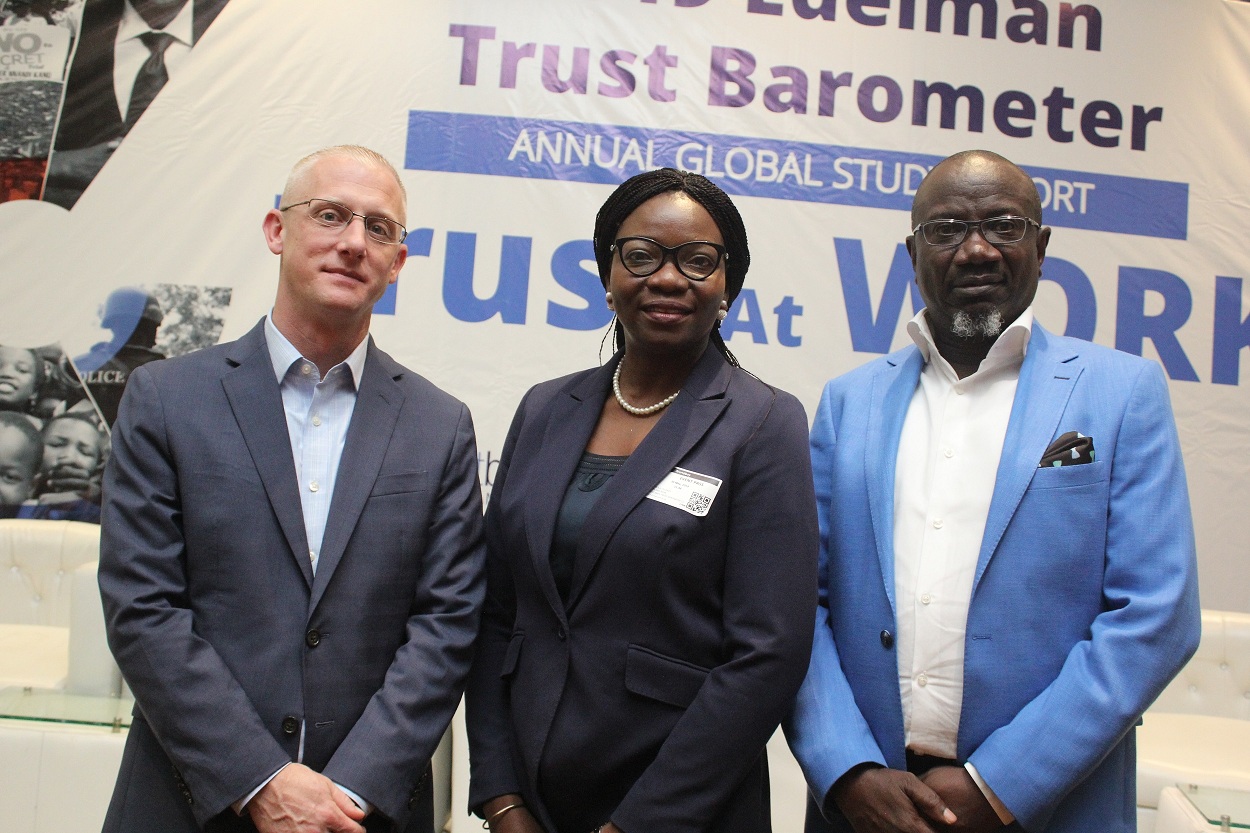
This revelation amongst others was contained in the 19th Edelman Trust Barometer Survey Report unveiled by Edelman and its Exclusive Nigerian Affiliate and the Preferred West African Partner, Chain Reactions Nigeria, in Lagos on Thursday, May 30, 2019.

Edelman Trust Barometer launched in 2001 is the annual global trust and credibility online survey conducted by Edelman Intelligence, the independent research arm of the Edelman global network, testing how well people trust the institutions of government, business, media and nongovernmental organisations to do what is right.

Presenting the data from the Nigeria Trust Breakout, Managing Director, Edelman Africa, Jordan Rittenberry, said, “Ninety-five per cent of respondents agreed that employers can create positive change in skills training, while 93 percent said that CEOs can influence economic prosperity in Nigeria. 88 percent agreed that their employers can create positive change in job creation while another 83 percent believed in the ability of their employers to initiate positive change in discrimination.”

The survey conducted by Edelman Intelligence between October 19 to November 16, 2018, further revealed that 72 percent of the Nigerian respondents see their employers as a trustworthy source on the global economy while 58 percent perceive business as a reliable source on technology.

Rittenberry added that, “Fifty-eight percent of respondents look to their employer to be a trustworthy source of information about social issues and other important topics on which there is not general agreement. A further 77 percent believe that a company can take specific actions that both increase profits and improve the economic and social conditions in the communities where it operates.”

He revealed further that trust across the four mainstream institutions in the country decreased by 24 percent from 2018 with a drop from 66 percent to 42 percent and that in Africa in general, trust fell four points from 2018 to 2019.

Rittenberry disclosed that in Nigeria and nine other African countries included in the survey, “government is the least trusted institution while trust in media amongst the 10 African countries exceeds the global average of trust in media at 47 percent. Business is the most trusted institution amongst the 10 African countries, while NGOs are trusted in six of the 10 African Markets.”

The 2019 Edelman Trust Barometer with the theme, ‘Trust at Work’, is the second exclusive deck on Nigeria, the first being that of year 2018 survey while this year also made it the third time the report was presented in Nigeria. 2017 was the first time the report was ever presented in Nigeria although Nigeria was not included in the study then. The other African countries surveyed are South Africa, Egypt, Ghana, Kenya, Morocco, Cote’d Ivoire, Ethiopia, Tanzania and Angola.

Speaking further, Rittenberry disclosed that for the media in Nigeria, search engines were the most trusted at 84 per cent followed by earned media (69%), social media (64%) and traditional media at 60%. Online media was the least trusted with 56 per cent.

“Trust in government is really low while trust in media is fairly balanced; business is the most trusted institution in Africa while trust in NGOs varies across the continent”, he said.

Earlier in his welcome address, Managing Director/Chief Strategist, Chain Reactions Nigeria, Mr Israel Jaiye Opayemi, affirmed that the importance of trust could not be over-stated, noting that trust played a key role in the last general elections and called on government to invest in its trust quotient.

“Trust is built by what we say as well as by what we do and so for a government like ours, perhaps this is an auspicious time for those who are responsible for managing the institutions of government in Nigeria to begin to think about investing in that asset of trust.

“My admonition to President Muhammadu Buhari and his Vice, Prof Yemi Osinbajo is to make a deliberate effort to earn the trust of Nigerians in their second tenure of four years.

“For them to earn our trust as Nigerian citizens, one of the things my experience has taught me on this job is, perhaps, we need to rethink the entire communication architecture of government once more. I ask that fundamental question, ‘in what way has the present architecture helped the government to earn the trust of the people?’ And President Muhammadu Buhari, our appeal (this morning) is that as you select the next set of ministers, you must reign them in. What we saw in the last four years was that there were too many people speaking for your government.”

To curb the increasing menace fake news in the media, Mr Opayemi suggested self-censorship for professionals. “Can we begin to do what our colleagues are doing in other countries? That weekly, we do a compilation of all the false stories and the fake news that newspapers have published or that TV and radio stations have broadcast and name and shame them. This is going on with a lot of impunity. Let us generate ideas on how to tame this monster that’s in our society,” he advised.

He also urged businesses and NGOs to invest in trust, noting that, “how well can businesses further invest in this asset of trust the same way they invest in machinery and other things?”

The highpoint of the presentation ceremony was a panel discussion featuring eminent professionals drawn from business, government, media and NGOs, who shared their perspectives on the report.

They included publisher of BrandCrunch, O’Lekan Babatunde; Assistant Director, Programmes, Radio Nigeria, Lagos Operations, Funke Treasure-Durodola; Coordinator, Campaign Against Impunity, Shina Loremikan and Executive Chairman, Centre for Anti-Corruption and Open Leadership, Debo Adeniran.

The others were former sole administrator, Eti-Osa East Local Council Development Area of Lagos State, Prince Babatunde Ayo Ayeni; Head, Brand Communications, SUNU Assurance Plc, Oluwayemisi Mafe and Bukola Oluyadi, Enterprise Transformation/Corporate Planning and Strategy, Polaris Bank Limited. The TV personality, Oscar Oyinsan, moderated the session.

Founder and chairman, Proshare Nigeria Limited, Mr Olufemi Awoyemi, in his brief keynote speech, said trust was paramount in all aspects of life and that trust issue is not only a Nigerian problem, but generally a common problem across human society.

Chairman, Nigerian Institute of Public Relations, Lagos State chapter, Mr Olusegun McMedal and President, Public Relations Consultants Association of Nigeria, (PRCAN), Mr John Ehiguese, also gave goodwill speeches at the event.

Mr McMedal expressed happiness that Nigeria was considered in the global report for the second time and noted that the report is perfect for Africa.


Dipo Olowookere is a journalist based in Nigeria that has passion for reporting business news stories. At his leisure time, he watches football and supports 3SC of Ibadan. Mr Olowookere can be reached via [email protected]

Click to comment

Leave a Reply

Your email address will not be published. Required fields are marked *

Jobs/Appointments

Norfund Appoints Erik Sandersen New CEO

Published

on

Erik Sandersen Norfund CEO

By Modupe Gbadeyanka

A Norwegian investment fund for developing countries, Norfund, has appointed Mr Erik Sandersen as its new chief executive, succeeding Mr Tellef Thorleifsson, who in January announced that he would step down after over seven years in the position.

The appointee, who assumes office on July 1, 2026, will be responsible for Norfund’s three mandates: the original development mandate from 1997, aimed at reducing poverty through job creation in developing countries; the Climate Investment Fund, which Norfund has managed since 2022; and the Ukraine Fund, established in December 2024.

A statement disclosed that Mr Sandersen is armed with 25 years of experience from the financial sector and has, for the past decade, headed Norfund’s Financial Inclusion department.

He joined Norfund in 2014 as Investment Director in the Financial Inclusion department, which invests in banks, microfinance and fintech, with a particular aim of contributing to job creation in small and medium-sized enterprises.

Since 2016, he has headed the department, and from 2024, he has also led the work on the Ukraine Fund. Over a number of years, he has represented Norfund on the boards of, among others, Arise, an investment company for banks in Africa, and Abler Nordic, which invests in microfinance in Africa and Asia.

The chairman of the Norfund board, Ms Olaug Svarva, said Mr Sandersen “has strong investment expertise, in-depth knowledge of Norfund’s work and a strong commitment to the fund’s mission.”

Reacting to his appointment, Mr Sandersen described Norfund’s profitable investments as “an effective tool for development – whether it is about creating jobs in low-income countries, avoiding emissions in emerging economies or contributing to reconstruction in Ukraine.”

“The strong results Norfund delivers are based on the efforts of a highly skilled and diverse staff of 152 employees from 33 nationalities, and I look forward to working closely with them to further develop Norfund as a leading purpose-driven investment company,” he added.

Mr Sandersen said he looks “forward to leading the organisation going forward at a time when access to the capital and expertise we can offer is becoming increasingly important.”

Continue Reading

Jobs/Appointments

Oyo Guber: Adelabu to Resign as Power Minister, Gets Tinubu’s Blessings

Published

on

adebayo adelabu resigns

By Adedapo Adesanya

The Minister of Power, Mr Adebayo Adelabu, is set to resign from his position in the coming days after a high-level meeting with President Bola Tinubu at the Presidential Villa, Abuja.

The development was confirmed in a statement issued by the Minister’s Special Adviser on Strategic Communications and Media Relations, Mr Tunji Bolaji, after the closed-door meeting on Tuesday.

“President Tinubu commended the minister for his dedication and the progress recorded, particularly in laying a strong policy foundation for the transformation of the power sector,” the statement read, adding that the President granted Mr Adelabu his “consent and blessing” to pursue his governorship ambition in Oyo State for 2027.

“In view of this development, Adebayo Adelabu is expected to resign his position as Minister of Power in the coming days,” the statement added.

At the meeting on Tuesday, Mr Adelabu presented a comprehensive report on his stewardship of the power sector over the past two and a half years.

He outlined key milestones recorded during his tenure, including efforts to stabilise electricity generation, strengthen transmission infrastructure, and implement reforms aimed at improving efficiency across the power sector value chain.

A major highlight of the engagement was the presentation of the National Integrated Electricity Policy (NIEP), alongside its Strategic Implementation Plan (SIP), as well as the Medium- to Long-Term Integrated Resource Plan for the power sector.

The minister, who’s an Oyo native, explained that the NIEP provides a long-term roadmap for achieving energy security, expanding electricity access, integrating renewable energy, and building a more resilient electricity system.

The SIP, on the other hand, serves as the operational framework detailing specific actions, timelines, and institutional responsibilities required to translate policy objectives into measurable outcomes.

The minister noted that the timing of his anticipated resignation reflects his commitment to addressing critical challenges in the sector and ensuring continuity in ongoing reforms before exiting office.

These include efforts to stabilise electricity supply amid recent declines in generation caused by gas supply constraints, pipeline repairs, and outstanding obligations to gas suppliers.

Mr Adelabu also expressed appreciation to the president for his support, reaffirming his commitment to the advancement of Nigeria’s power sector and national development.

His planned exit follows weeks of speculation surrounding his political future and compliance with a presidential directive requiring cabinet members with political ambitions for the 2027 elections to resign.

Rumours of his resignation spread around late March 2026, when a purported resignation letter circulated widely on social media. However, his camp denied the rumours.

Following the March 31 deadline reportedly set for political appointees, speculation intensified that Mr Adelabu had halted his governorship ambition, but he debunked the claim.

With the latest development, Mr Adelabu is expected to join the Oyo State governorship race under the All Progressives Congress (APC), where he will face strong competition from other aspirants within the party.

He had attempted governorship bids in 2019 and 2023.

He ran in 2019 as the candidate for the APC. Despite strong backing, he lost to Seyi Makinde. In 2023, after losing the APC primary to Teslim Folarin, he defected to the Accord Party to run as their flag bearer. He finished third in the general election.

Continue Reading

Jobs/Appointments

John Ternus to Become Next Apple CEO as Tim Cook Steps Down

Published

on

John Ternus

By Adedapo Adesanya

Apple, makers of the iPhone and iPad, said on Monday that Mr Tim Cook will step down as the company’s chief executive, after 15 years at the helm. Senior Vice President of Hardware Engineering, Mr John Ternus, will take the top executive position on September 1.

Mr Cook, who succeeded the late Steve Jobs in 2011, will not leave Apple but will remain at the company as executive chairman, and Mr Ternus will join Apple’s board of directors.

Mr Arthur Levinson, who has served as Apple’s non-executive chairman for the past 15 years, will become lead independent director, also effective September 1.

Mr Cook expanded his predecessor’s vision after he died of pancreatic cancer just six weeks after formally handing off the job. He grew Apple into a $4 trillion business with annual revenue that has more than quadrupled on his watch.

A statement said Mr Cook turned Apple Services into a business exceeding $100 billion annually and credits him with creating the flourishing wearables category at Apple.

“It has been the greatest privilege of my life to be the CEO of Apple,” Mr Cook said in the statement on Monday. “I love Apple with all of my being, and I am so grateful to have had the opportunity to work with a team of such ingenious, innovative, creative, and deeply caring people who have been unwavering in their dedication to enriching the lives of our customers.”

Mr Ternus, who joined Apple in 2001, has played a central role in reviving products such as the Mac, which has gained market share against personal computers. Though he has kept a low public profile, he has been deeply involved in shaping Apple’s biggest products, such as iPads and AirPods.

The incoming CEO, Mr Ternus, said: “Having spent almost my entire career at Apple, I have been lucky to have worked under Steve Jobs and to have had Tim Cook as my mentor,” he said. “I am humbled to step into this role, and I promise to lead with the values and vision that have come to define this special place for half a century.”

On his part, Mr Cook said of his successor, “John Ternus has the mind of an engineer, the soul of an innovator, and the heart to lead with integrity and with honour,” he said. “He is without question the right person to lead Apple into the future.”

Continue Reading

Trending