
Media OutReach
Allianz Risk Barometer 2026: Cyber remains top business risk but AI fastest riser at #2 in Asia Pacific

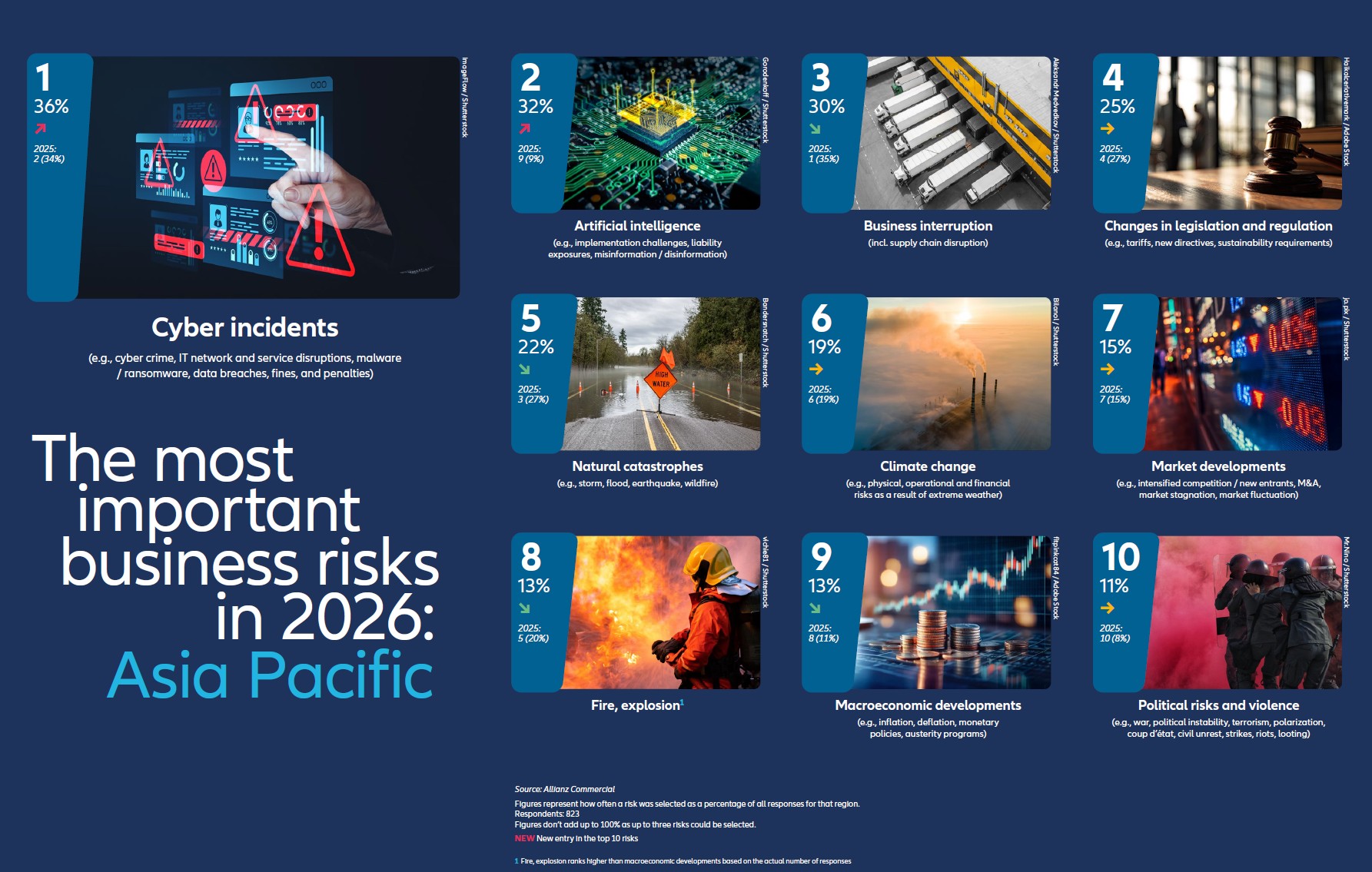
- Cyber, especially ransomware attacks, ranks as the #1 risk for companies of all sizes (36% of responses)
- Artificial Intelligence is the biggest riser and jumps from #9 to #2 (32%), highlighting the emerging risks for companies in almost all industry sectors
- Business interruption, strongly connected to geopolitical risks and natural catastrophes, remains a significant concern at #3
Allianz Commercial CEO Thomas Lillelund comments: “Following the volatility and uncertainty of 2025, businesses continue to face interconnected and highly complex risks in 2026’s fast-changing environment. Given the continuing rise of AI across society and industry, it is unsurprising that it is the big mover in the Allianz Risk Barometer. As well as bringing huge opportunities, its transformative potential and rapid evolution and adoption are also reshaping the risk landscape, making it a standout concern for firms of all sizes worldwide, alongside other more established threats.”
Christian Sandric, Allianz Commercial President, Commercial, Asia Pacific, says, “The evolving risk landscape, particularly in the areas of cyber threats and the adoption of AI, pose new challenges to businesses in the region. With Asian economies playing a pivotal role in global and regional trade, the potential for business interruption also remains a significant concern. This volatile environment stresses the importance of resilience in a business’ supply chain, response measures, and risk management strategies to withstand and recover from disruptions.”
Cyber risks the biggest concern for companies
Cyber incidents is the top risk in Asia Pacific, and a top three risk in Australia, Hong Kong, India, Japan, Singapore, South Korea, and Thailand. The Asia Pacific region experienced the most cyberattacks in 2024, increasing 13% year-on-year and accounting for 34% of attacks globally. While businesses in Asia, in particular large companies, have shown an increase in cyber resilience and appetite for cyber risk transfer solutions, their overall cyber coverage is generally lower compared to American or European peers and a significant portion of large organizations still remain self-insured.
Globally, cyber incidents is the top risk for the fifth year in a row, with its highest-ever score (42% of responses), and by a higher margin than ever before (+10%). It ranks as the main corporate concern in every region (Americas, Asia Pacific, Europe, and Africa and Middle East). The continued presence of cyber at the top of the Allianz Risk Barometer reflects a deepening reliance on digital technology at a time when the cyber threat landscape, and geopolitical and regulatory environments, are fast evolving.
AI creates emerging risks as well as new business opportunities
Ranking #2 in Asia Pacific, AI is a top three risk and biggest riser in Australia, China, Hong Kong, India, Malaysia, and Singapore, economies which are in the top 50% in terms of AI readiness. More than 90% of companies in the region are planning to scale up Generative AI over two years, with a focus on managing costs and lifting revenues.
Globally, AI has surged into the top tier of business concerns, rising to #2 (32%) in 2026 from #10 in 2025 – the biggest jump in this year’s ranking. It is a big mover in all regions – ranked #2 also in the Americas, Africa and the Middle East, and #3 in Europe – and is a growing risk for companies of all sizes too, moving into the top three for large, mid-sized and smaller firms. As AI adoption accelerates and becomes more deeply embedded in core business operations, respondents expect AI-related risks to intensify, especially when it comes to liability concerns. The rapid spread of generative and agentic AI systems, paired with their growing real-world use, has raised awareness of just how exposed organizations have become.
Business interruption strongly connected to geopolitical risks and natural catastrophes
Business interruption (BI) is the third most significant risk in Asia Pacific and a top three risk in China, India, Japan, Malaysia, Philippines, Singapore, and South Korea. The closely linked risk of changes in legislation and regulation – which includes trade tariffs – ranks #4 (25%), unchanged year-on-year driven by concerns over growing protectionism. Commerce is increasingly taking place between geopolitically aligned economies, resulting in new paths in global trade and the emergence of next generation trade hubs, including Vietnam, Malaysia, and Thailand in the region.
2025 marked a shift towards protectionist trade policies and tariff wars that brought uncertainty to the world economy. Geopolitical risks are putting supply chains under increasing pressure, but as risks rise, just 3% of Allianz Risk Barometer respondents view their supply chains as “very resilient”. In the past year alone, trade restrictions have tripled to affect an estimated US$2.7trn of merchandise – nearly 20% of global imports according to Allianz Trade – fueling companies exploring trends such as friendshoring and regionalization. These developments lead to a high-risk perception – 29% of respondents rank BI as a top peril, placing it at #3 globally, although it drops a position year-on-year.
Natural catastrophes ranks #5 (22%) in Asia Pacific, and is a top three risk in Japan, Malaysia, Philippines, and Thailand. The region experienced several natural catastrophes in 2025, including the Myanmar Earthquake, Typhoons Matmo, Ragasa, and Bualoi, Cyclone Alfred, wildfires in South Korea, as well as floods in Malaysia and Thailand. A delayed onset of the tropical cyclone season resulted in flooding and landslides, exerting a high human and economic toll in Asia where the insurance gap remains high at over 80%. According to research, there has been a significant increase in the intensity of tropical cyclones in recent decades, and these trends are linked to rising ocean temperatures and climate change, which retains its #6 ranking (19%) in the survey.
Resources:
Hashtag: #Allianz #AllianzCommercial #AllianzRiskBarometer #ARB2026
 https://commercial.allianz.com/
The issuer is solely responsible for the content of this announcement.
About Allianz Commercial
Allianz Commercial is the center of expertise and global line of Allianz Group for insuring mid-sized businesses, large enterprises and specialist risks. Among our customers are the world’s largest consumer brands, financial institutions and industry players, the global aviation and shipping industry as well as family-owned and medium enterprises which are the backbone of the economy. We also cover unique risks such as offshore wind parks, infrastructure projects or film productions. Powered by the employees, financial strength, and network of the world’s #1 insurance brand, we work together to help our customers prepare for what’s ahead: They trust us in providing a wide range of traditional and alternative risk transfer solutions, outstanding risk consulting and Multinational services as well as seamless claims handling. Allianz Commercial brings together the large corporate insurance business of Allianz Global Corporate & Specialty (AGCS) and the commercial insurance business of national Allianz Property & Casualty entities serving mid-sized companies. We are present in over 200 countries and territories either through our own teams or the Allianz Group network and partners. In 2024, the integrated business of Allianz Commercial generated around €18 billion in gross premium globally. https://commercial.allianz.com/



Media OutReach
CPA Australia: Malaysian Small Businesses Urged To Adopt Productivity-enhancing Technologies For Sustained Growth

- Young business owners drive small businesses in Malaysia
- Technology adoption remains concentrated in front-end activities
- Improved access to finance needed for deeper digital transformation
KUALA LUMPUR, MALAYSIA – Media OutReach Newswire – 7 April 2026 – Innovation, technology and young entrepreneurs continue to power growth among Malaysian small business, but this has yet to translate into sustained improvements in business performance, according to CPA Australia’s Asia-Pacific Small Business Survey findings.
While half of Malaysian small businesses report improved profitability from their technology investments over the past two years, the proportion generating more than 10 per cent of revenue from online sales declined from 74 per cent in 2024 to 62 per cent in 2025.
Digital payment usage has also declined in 2025 with 74 per cent of small businesses receiving more than 10 per cent of their sales through digital payment platforms such as GrabPay, Touch ‘n Go and Boost, compared to 78 per cent in 2024.
Priya Terumalay, CPA Australia’s Regional Head for Southeast Asia, said while government initiatives have helped support technology adoption, these efforts have yet to drive significant uptake of deeper productivity-enhancing technologies, such as artificial intelligence, process automation, data analytics and systems integration.
“Technology investment remains concentrated in computer hardware and customer-facing functions like mobile apps and payments, while structural constraints continue to limit more transformative approaches,” Priya said.
“With cost pressures remaining a persistent challenge compressing margins, policy priorities should focus on addressing structural constraints such as re-orienting digital support towards automation, systems integration, and data use along with support for productivity-enhancing responses rather than short-term relief.”
Businesses making technology investments must include adequate protection measures to minimise cyber risk exposure as 35 per cent of small businesses lost time or money due to a cyber-attack in 2025.
Only 39 per cent reviewed their cybersecurity protections over a six-month period, the second lowest result among the 11 markets surveyed.
Despite the challenges, business sentiment on the Malaysian economy remains positive with 75 percent of small businesses expecting the economy to grow in 2026.
A strong 77 per cent also anticipate business growth this year, although improved access to effective finance, especially for investment will be important to enable deeper digital transformation and build resilience.
“This is particularly crucial for outward-oriented small businesses navigating global supply chain pressures and trade policy uncertainty that could weigh on growth, especially firms integrated into regional supply chains.” Priya said.
About the survey
CPA Australia’s 17th annual Asia-Pacific Small Business Survey was conducted among small business owners/senior managers during November and December 2025 to identify the characteristics of successful small businesses across the region. The findings for the survey come from 4,166 small businesses in 11 markets. From the commencement of the survey in 2009, we have surveyed over 50,000 small businesses across the region. These include Australia, Mainland China, Hong Kong, India, Indonesia, Malaysia, New Zealand, Philippines, Singapore, Taiwan and Vietnam.
Hashtag: #SmallBusiness #CPAAustralia #MalaysiaBusinesses
https://www.cpaaustralia.com.au
cpaaustralia.com.au

Media OutReach
Launch of the Asian Hackathon for Green Future 2026 with a Total Prize Pool of USD 24,000

This marks the first time an Asia-wide environmental hackathon exclusively for undergraduate and master’s students is held in Vietnam. The competition aims to identify and develop technology-driven solutions to pressing environmental challenges, while fostering innovation and interdisciplinary collaboration among the younger generation.
Participants will advance through three main stages: Registration & Preliminary (April 6 – May 17, 2026); Online Training Phase (June 2 – June 28, 2026); and Final Round & Hackathon at VinUniversity (July 2 – July 5, 2026, tentative).
During the Registration & Preliminary Round, participants register online in teams of up to four members. Eligible applicants must be current undergraduate or master’s students at universities across Asia.
Application materials include an idea proposal and an introductory video. Based on evaluation by the Technical Board, the Top 30 teams will be selected to advance to the next stage.
The competition encourages interdisciplinary ideas that integrate multiple fields—including technology, environmental sciences, economics, and social sciences—with the aim of creating solutions that are innovative, feasible, and socially impactful.
Proposed ideas should address one of three key challenge areas: Renewable Energy and Low-Carbon Mobility; Urban Air Quality and Climate Resilience; Water Resources and Climate-Resilient Agriculture.
During the Online Training Round, the Top 30 teams will participate in a series of intensive training sessions and expert consultations with multidisciplinary specialists. These sessions are designed to equip teams with deeper domain knowledge and up-to-date insights on sustainability trends and relevant technologies, enabling them to further refine and expand their proposed solutions.
During the Final Round and Award Ceremony, all travel and accommodation expenses for the Top 30 teams will be fully covered. The teams will take part in a 24-hour hackathon at VinUniversity (Hanoi), where they will further develop and refine their technology-driven solutions before presenting them to the Judging Panel. Based on this evaluation, the Top 9 teams will be selected to advance to the final assessment round, from which the winning team will be determined.
The Chair of the Judging Panel is Prof. Duong Nguyen Vu, Vice Provost of Graduate Education at VinUniversity and Chief Scientific Officer at the Center for AI Research. He had been a Professor of Aerospace Engineering at Nanyang Technological University (NTU), Singapore until July 2025, where he served as Scientific Director at the Air Traffic Management Research Institute (ATMRI). Under his leadership—as Executive Director until 2025—the institute has emerged as a global leader in air traffic management research, thanks in large part to the scientific foundation he helped establish. Before joining NTU, Prof. Vu was the founding Director of the John von Neumann Institute at Vietnam National University Ho Chi Minh City, spearheading university-industry collaborations and championing innovation and entrepreneurship in education.
Prior to returning to Vietnam in 2010, he was Head of Innovative Research and Senior Scientific Advisor at the European Organisation for the Safety of Air Navigation (EUROCONTROL). He also advised Vietnam’s Minister of Planning and Investment on innovation strategy, contributing to the establishment of the National Innovation Center.
The competition offers a total prize pool of USD 24,000, comprising one First Prize of USD 8,000, one Second Prize of USD 5,000, two Third Prizes of USD 3,000 each, and five Consolation Prizes of USD 1,000 each. Beyond the awards, participating teams will gain valuable opportunities to engage with leading experts from across the region, expand their professional networks, and strengthen their access to the broader innovation ecosystem.
Dr. Le Thai Ha, Managing Director of the “For Green Future” Foundation and Head of the Organizing Committee, shared: “We believe that ideas with the power to shape the future do not always emerge from large laboratories or well-established institutions; they often arise from the insight, initiative, and determination of young people to make a difference. Through the Asian Hackathon for Green Future, we seek to create a platform where students across the region can transform their environmental awareness into tangible, innovative solutions that deliver meaningful impact for communities and the future.”
The Asian Hackathon for Green Future is expected to foster innovation aligned with sustainable development, while contributing to the development of a new generation of young talents capable of cross-border collaboration to create solutions with lasting, positive impact across the region.
Interested candidates may register for the competition via: https://forms.gle/o3L5BVLExUYKQtGJA
For any inquiries, please contact the Organizing Committee at [email protected] for further assistance.
Hashtag: #ForGreenFutureFund
The issuer is solely responsible for the content of this announcement.

Media OutReach
MyRepublic Launches MyRepublic Email Guard to Protect Singapore’s SMEs From Rising Email-Borne Cyber Threats

Singapore’s SMEs account for 99% of all enterprises and employ nearly 70% of the local workforce, yet many remain chronically underserved in enterprise-grade cybersecurity. Email continues to be one of the most exploited attack vectors, with threat actors increasingly targeting resource-constrained businesses that lack the dedicated IT security teams of larger organisations. MyRepublic Email Guard is designed to close this protection gap, delivering a simple, effective, and locally supported solution that levels the playing field for SMEs without adding operational complexity.
Powered by Check Point, advanced email threat protection technology, MyRepublic Email Guard helps businesses detect and block malicious emails before they reach users’ inboxes. The solution is designed to support businesses using popular email platforms such as Microsoft 365 and Google Workspace, giving customers an additional layer of protection against modern threats.
“Singapore’s SMEs are the heartbeat of our economy, and protecting them from cyber threats is not just a business imperative. It is a national one,” said Lawrence Chan, Managing Director & Chief AI Officer, MyRepublic. “Far too many local businesses remain exposed simply because they cannot access or afford the cybersecurity tools available to larger enterprises. With MyRepublic Email Guard, we are changing that. We bring enterprise-grade protection to businesses that have long been underserved, backed by the local expertise and support they deserve.”
MyRepublic Email Guard combines advanced security technology with managed service support, allowing businesses to benefit from a more streamlined approach to email protection. The service is positioned as an all-in-one offering that includes deployment, ongoing management, and local support, helping customers reduce the burden on internal teams while improving cyber resilience.
“Enterprise-grade cybersecurity has been out of reach for the SMEs that need it most. That has to change,” said Imran Nazi, Head of ICT, MyRepublic. “MyRepublic Email Guard is built specifically for Singapore’s SMEs, where it is designed to be affordable, easy to adopt, and supported by a team that understands the local business environment. We want every SME in Singapore to have access to the same level of protection that large enterprises take for granted, because a safer SME ecosystem means a stronger Singapore.”
The launch of MyRepublic Email Guard marks a significant step in MyRepublic’s commitment to building a more cyber-resilient Singapore. Aligned with national efforts to strengthen digital security across all business segments, MyRepublic is focused on ensuring that SMEs, often the most targeted yet least protected segment, are equipped to defend themselves. By combining world-class technology from Check Point with localised managed service delivery, MyRepublic is bridging the cybersecurity gap for businesses that have historically been underserved.
MyRepublic Email Guard is now available for businesses in Singapore.
Hashtag: #MyRepublic #EmailSecurity #CyberSecurity #SMEs #DigitalSecurity #ManagedServices #EmailGuard
 https://myrepublic.net/sg/
 https://www.linkedin.com/company/2426006/admin/dashboard/
 https://x.com/myrepublic
 https://www.facebook.com/MyRepublicSG/
 https://www.instagram.com/myrepublicsg/
The issuer is solely responsible for the content of this announcement.
MyRepublic Broadband Pte Ltd
MyRepublic is a telecommunications and ICT services provider committed to delivering innovative digital solutions for consumers and businesses. In addition to connectivity services, MyRepublic supports businesses with a growing portfolio of ICT solutions, including cloud, cybersecurity, managed services, and digital enablement offerings.

-
 Feature/OPED6 years ago
Davos was Different this year
-
Travel/Tourism10 years ago
Lagos Seals Western Lodge Hotel In Ikorodu
-

 Showbiz3 years ago
Estranged Lover Releases Videos of Empress Njamah Bathing
-
 Banking8 years ago
Sort Codes of GTBank Branches in Nigeria
-

 Economy3 years ago
Subsidy Removal: CNG at N130 Per Litre Cheaper Than Petrol—IPMAN
-

 Banking3 years ago
Sort Codes of UBA Branches in Nigeria
-

 Banking3 years ago
First Bank Announces Planned Downtime
-

 Sports3 years ago
Highest Paid Nigerian Footballer – How Much Do Nigerian Footballers Earn