
Media OutReach
Everlasting City: Kaifeng’s Cultural Renaissance Thrilled SCO Partners


The summit, themed “Upholding the ‘Shanghai Spirit’ to Build a More Beautiful Home”, designated Kaifeng as a key destination for foreign guests from its inception.
Located in China’s heartland along the Yellow River, Kaifeng boasts a history of over 4,100 years as a settled urban center and served as the capital of eight dynasties. Most notably, during the Northern Song Dynasty (960–1127), it thrived for 168 years as both a political hub and one of the world’s most bustling metropolises.
The renowned British historian Arnold Joseph Toynbee once said, “Given the choice, I would choose to live in China’s Song Dynasty.” In his eyes, the Song Dynasty, with its economic prosperity, cultural brilliance, and social openness, was “the finest age for human life”.
A glimpse of Kaifeng past lingers in Along the River During Qingming Festival, the timeless masterpiece by Northern Song painter Zhang Zeduan: along the Bian River, shops pressed close in a lively cluster, boats and carriages thronged the waters and roads, and crowds bustled with life. Thanks to an open society and abundant resources, ordinary life in the Northern Song Dynasty began to bloom with extraordinary richness and vitality. History was no longer solely the grand tale of emperors and nobles; in the bustle of markets and the warmth of daily toil, it etched its most touching stories.
Though dynasties fade, the pulse of daily life endures. Modern Kaifeng integrates Song Dynasty aesthetics into ordinary existence, embedding ancient elegance within morning bells, evening drums, and the rhythm of daily necessities.
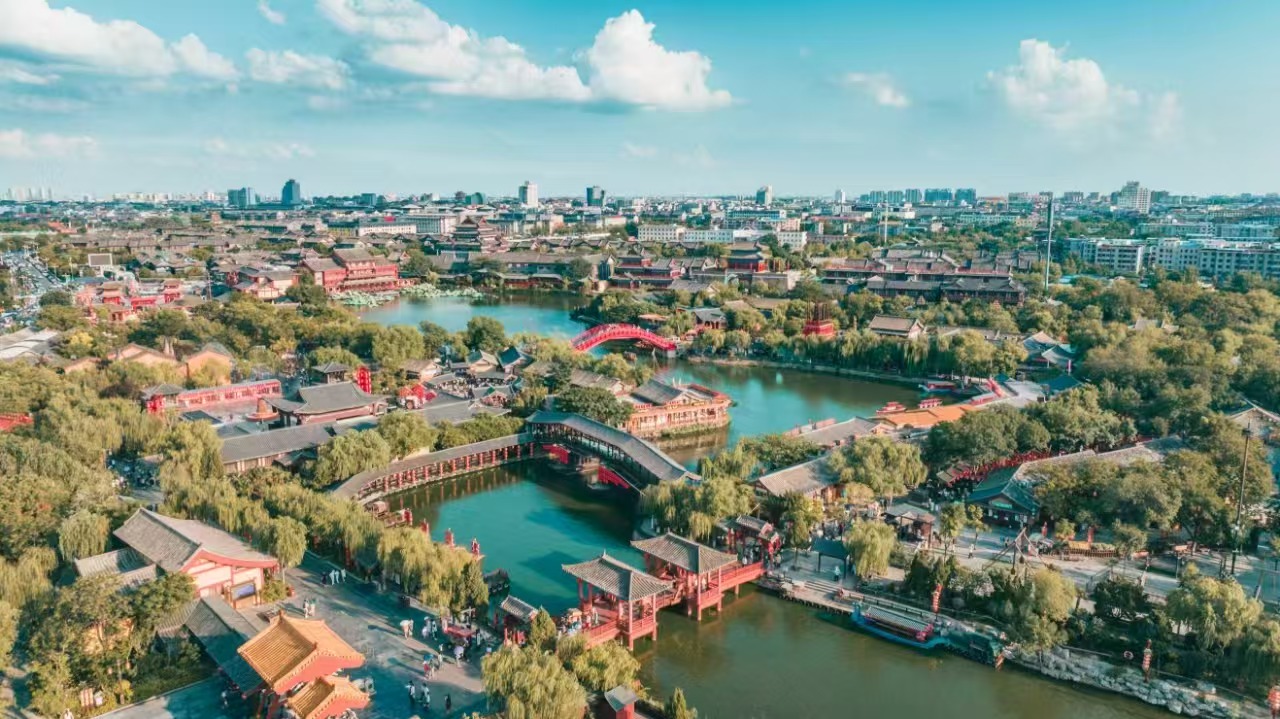
Strolling through Kaifeng’s streets resembles stepping into a classical Chinese scroll. Waterways crisscross the city, linking ancient buildings with gray tiles and red walls. On imposing city gates, vivid yet time-honored woodblock New Year paintings burst with life. The fragrance of tea drifts through the lanes, and the melodies of Yuju opera curl endlessly along the Bian River. In classrooms, children recite Song poems with ease. Around every corner, unexpected treasures await: Kaifeng Prefecture, Daxiangguo Temple, Longting, Daliang Gate, and the Ruins of Zhouqiao Bridge. Every inch of the city whispers: History has never left but lives in Kaifeng people’s daily routines and flows through the city’s very essence.
The Millennium City Park (Qingming Riverside Landscape Garden) was a highlight of the guests’ visit. This Song culture-themed park recreates scenes from Along the River During Qingming Festival. Over 200 Song-style structures, including government offices, taverns, and tea houses, stand in orderly rows. More than 800 performers in Song-era costumes wander through, staging over 100 distinctive shows. Here, over 20 intangible cultural heritages are on display, featuring Bian embroidery, the “Four Arts of Song Dynasty”, woodblock New Year paintings, and Northern Song official porcelain. This 600-mu (98.8-acre) “living museum” does more than replicate the painting’s scenes. Through its innovative integration of scene restoration, cultural performances, and tech-driven interaction, visitors gain a firsthand sense of the “bustle of crowds and buzz of markets” that characterized life in the Northern Song Dynasty.
“This is my first visit to Kaifeng. Its beauty transports me through time to the Northern Song Dynasty’s glorious heyday,” remarked Nikita Kornev, Executive Director of the Center for China and Asia-Pacific Studies, Ural Federal University, Russia.
If an unbroken cultural legacy and the enduring pulse of daily life define the soul of a cherished home, then humanity’s indomitable spirit forms the very core that builds it.
For millennia, the Yellow River’s roaring floods, thick with silt, have repeatedly devastated Kaifeng. Yet, with unwavering resilience, the people here have rebuilt their homes time and again.
Today, this timeless resilience finds perfect expression in the paulownia trees that tower toward the sky.
On the same day, other guests visited Lankao County. They were deeply moved by the story of Jiao Yulu, who, over 60 years ago, led Lankao’s people in fighting sandstorms and planting paulownias to restore the ecosystem. Ahmed Hassan Ahmed Mohamed Moustafa, Owner and Director of the Asia Center for Studies and Translation, noted that he was profoundly impressed by China’s achievements in poverty alleviation. He further observed that Lankao’s remarkable development, driven by afforestation and other efforts, offers valuable insights that could be adopted in his own nation.
Today, the paulownias planted to tame desertification have grown into towering giants. Locals discovered that paulownia wood makes an exceptional material for traditional musical instruments, as it resists warping and offers excellent breathability and acoustic properties. Today, the traditional instrument industry has become one of Lankao’s pillar economic sectors. Guzheng zithers, pipa lutes, and other instruments crafted from local paulownia not only sell well across China but also reach markets in numerous countries and regions.
In Kaifeng, a city where ancient charm weaves with modern vitality and economy thrives alongside culture, this confidence finds expression in melodies unbroken through generations, diverse elements advancing in harmony, exchanges that deepen mutual understanding, and differences cherished amid shared brilliance.
Hashtag: #Kaifeng
The issuer is solely responsible for the content of this announcement.



Media OutReach
Zuellig Pharma Acquires Cialis® (Tadalafil) from Lilly in three additional markets in Asia

Following the acquisition, Zuellig Pharma will now own the trademarks, marketing authorizations and license manufacturing know-how for Cialis®, a treatment for erectile dysfunction (ED) and benign prostatic hyperplasia (BPH), in 11 markets in Asia, with the expansion of its ownership into three additional markets beyond the original eight. Zuellig Pharma will also continue to promote and distribute the brand in these markets.
The expanded ownership of Cialis® will widen accessibility of the drug to a significant population of men in Asia who are affected by ED and BPH. The acquisition also aligns with Zuellig Pharma’s strategic priority of building a strong portfolio of owned prescription healthcare products as an integrated healthcare solutions company.
“Our acquisition of Cialis® in three additional markets builds on the strong foundation we established two years ago and highlights our proven success in scaling trusted brands effectively through our commercial capabilities and deep expertise. As we broaden our footprint, we remain focused on delivering sustainable growth and advancing our purpose of making in-demand healthcare solutions more accessible to communities in Asia,” said John Graham, CEO of Zuellig Pharma.
Hashtag: #ZuelligPharma #EliLillyandCompany #Cialis #MensHealth #Healthcare #Pharmaceuticals
https://www.zuelligpharma.com/ https://www.linkedin.com/company/zuellig-pharma
The issuer is solely responsible for the content of this announcement.
About Zuellig Pharma
Zuellig Pharma is a leading healthcare solutions company in Asia, and our purpose is to make healthcare more accessible to the communities we serve. We provide world-class distribution, commercialization, and clinical trial support services, underpinned by a strong culture of innovation to support the growing healthcare needs in this region. The company was founded a hundred years ago and has grown to become a multibillion-dollar business covering 18 markets with over 12,000 employees. Our people serve more than 200,000 medical facilities and work with over 450 clients, including the top 20 pharmaceutical companies in the world.

Media OutReach
Ingdan Powers Embodied AI with Humanoid-Style Brain-Cerebellum Chipset to Boost Robotics Ecosystem
2026 is widely regarded as a milestone year for humanoid robotics, in which humanoid robots transition from laboratory prototypes and demonstration performances to large‑scale mass production. At CES in January, NVIDIA announced the commercial launch of its physical‑AI core platform Jetson Thor. Tesla is scheduled to officially release the mass‑production engineering version of its Optimus (V3) humanoid robot by the end of March, with plans to initiate million‑unit‑level production lines by the end of 2026—an inflection point widely regarded as the “Model 3 moment” of the humanoid robotics industry. At the same time, Chinese robotics companies such as AGIBOT, Unitree, and Fourier Intelligence have already deployed products at scale in warehousing and logistics scenarios.
Against this backdrop, the upstream hardware focus of the humanoid robotics industry is increasingly converging on “Brain-Cerebellum” collaboration and low‑latency, multi‑joint real‑time control, which are essential to achieving coordinated, smooth, and human‑like robotic motion. During the CMG Spring Festival Gala, robots from multiple companies demonstrated complex coordinated movements and dexterous hand operations, further highlighting the value of this technical direction.
D‑Robotics, originating from the AIoT and robotics division of Horizon Robotics, focuses on edge‑side embodied intelligence solutions characterized by high computing power, integrated computation and control, and low latency. Leveraging its parent company’s long‑term experience in intelligent driving, D‑Robotics has established a precise position in humanoid robot “Brain-Cerebellum” coordination and real‑time joint control.
In November 2025, D‑Robotics unveiled its flagship robotics computing platform S600, with an official release planned for the end of the first quarter of 2026. The S600 platform features a highly integrated humanoid‑style “Brain-Cerebellum” chipset architecture. Its “Brain” configuration combines an 18‑core A78AE CPU with a proprietary Nash‑architecture BPU, delivering 560 TOPS (INT8) edge computing power and supporting efficient deployment of VLA, VLM, LLM, and locomotion models. Its “Cerebellum” configuration integrates a 6‑core R52+ MCU, providing high‑reliability, real‑time motion control.
By integrating CPU, BPU, and real‑time MCU capabilities into a single SoC, S600 enables a closed‑loop architecture encompassing perception, decision‑making, and real‑time action control. This design addresses a key industry challenge in which many edge AI processors lack embedded real‑time MCUs and rely on external controllers, resulting in excessive latency. The integrated MCU supports high‑frequency, high‑precision PWM signal generation based on FOC algorithms, enabling precise motor control and contributing to stable rhythm and natural gait.
The S600 platform has been adopted by multiple robotics companies such as Fourier Intelligence, Booster Robotics, X Square Robot, and ROBOTERA, supporting applications that require stable multi‑joint coordination and smooth motion performance.
Ingdan, Inc. (00400.HK) is a core supplier in the AI computing power supply chain and an application technology solutions provider covering both AI infrastructure and AI intelligent terminals. The Company represents a broad portfolio of international semiconductor manufacturers, including NVIDIA, Xilinx, Intel, AMD, and SanDisk, as well as numerous domestic chip vendors. It serves hundreds of robotics manufacturers and Tier‑1 customers and has formed a comprehensive embodied intelligence ecosystem.
D‑Robotics is a core product line Ingdan distributes . Building on D‑Robotics’ products and combined with its own technical services—such as multi‑sensor fusion development, real‑time closed‑loop tuning, Quantization‑Aware Training (QAT) support, simulation testing, and modular SOM customization—the Group has supported sophisticated customers including Galbot and ROBOTERA, continuously enriching the robotics industry ecosystem.
Looking ahead, Ingdan will continue to focus on the humanoid robotics sector. Leveraging an IC product matrix centered on NVIDIA Jetson and D‑Robotics platforms, the Company aims to further strengthen its AI intelligent terminal capabilities and continue supporting the iterative development of embodied intelligence products.
For investor and media enquiries
Please email to **@****an.com
Hashtag: #Ingdan #Chips #humanoid #D‑Robotics #NVIDIA #Tech
The issuer is solely responsible for the content of this announcement.
Ingdan, Inc.
Ingdan, Inc. (00400.HK) is a core supplier in the AI computing power supply chain and an application technology solutions provider covering both AI infrastructure and AI intelligent terminals. The Company represents a broad portfolio of international semiconductor manufacturers, including NVIDIA, Xilinx, Intel, AMD, and SanDisk, as well as numerous domestic chip vendors. It serves hundreds of robotics manufacturers and Tier‑1 customers and has formed a comprehensive embodied intelligence ecosystem.
Media OutReach
Snow, Ice, and Performance: 2026 Changan Global Testing Season Arrives in Europe with Back-to-Back Winter Events
- European dealers and journalists experienced the CHANGAN DEEPAL S05 AWD at 2026 Changan Global Testing Season this February.
- With intelligent AWD and advanced ADAS, the CHANGAN DEEPAL S05 AWD offered uncompromising safety and control on winter roads.
Saalfelden, Austria – Media OutReach Newswire – 12 March 2026 – Following extreme cold tests in Yakeshi, China, the 2026 Changan Global Testing Season made its European debut this February with the Changan Winter Experience in Courmayeur and the Winter Test Drives in Saalfelden. The all-electric CHANGAN DEEPAL S05 AWD was tested on snow and ice—familiar conditions for European drivers—offering dealers and journalists an immersive introduction to Changan’s electric mobility vision through dynamic drives.
Three-time Olympic gold medalist and Milano Cortina 2026 Ambassador Deborah Compagnoni joined the event in Courmayeur, testing the CHANGAN DEEPAL S05 AWD. Her career—defined by determination, control, and reliability—reflects Changan’s core values. “I felt that the principles of trajectory and speed in skiing apply to driving. With this model, you gain confidence on challenging terrain,” she said.
Snow-Validated Performance: The CHANGAN DEEPAL S05 AWD
Tested in Europe, the CHANGAN DEEPAL S05 AWD demonstrated controllable dynamics, reliable traction, and enhanced safety—highlighting its cutting-edge AWD and ADAS. The system adapts seamlessly: ECO/COMFORT modes prioritize RWD efficiency, while AWD will engage automatically when sensors detect slip, high torque demand, or extreme cold below -25°C. SPORT mode delivers permanent 50:50 torque for sharper response. SNOW mode maintains balanced torque with optimized slip control for confident driving on low-grip surfaces.
The intelligent AWD system delivers up to 320 kW power, 502 Nm torque, and 0–100 km/h acceleration in 5.5 seconds. It also improves hill climbing with a 40% gradient capability, ensures stability by actively balancing power to prevent skidding, and enables safer cornering at higher speeds through optimized grip and vehicle dynamics.
Changan Standard: Proven in the Alps, Bound for the World
Changan Standard is defined by a principle: forged in extremes, built for every day. From Yakeshi to the Alps, the test environments are selected to verify specific performance attributes—safety technologies, chassis response, all-wheel-drive calibration, and ADAS in low-grip scenarios. The objective of 2026 Global Testing Season is not to demonstrate extremes, but to confirm consistency: that the same level of safety, control, and stability demonstrated will be replicated in Mexico, Thailand, and Saudi Arabia.
Hashtag: #Changan
The issuer is solely responsible for the content of this announcement.








-
 Feature/OPED6 years ago
Davos was Different this year
-
Travel/Tourism10 years ago
Lagos Seals Western Lodge Hotel In Ikorodu
-

 Showbiz3 years ago
Estranged Lover Releases Videos of Empress Njamah Bathing
-
 Banking8 years ago
Sort Codes of GTBank Branches in Nigeria
-

 Economy3 years ago
Subsidy Removal: CNG at N130 Per Litre Cheaper Than Petrol—IPMAN
-

 Banking3 years ago
Sort Codes of UBA Branches in Nigeria
-

 Banking3 years ago
First Bank Announces Planned Downtime
-

 Sports3 years ago
Highest Paid Nigerian Footballer – How Much Do Nigerian Footballers Earn