Connect with us

Showbiz

South Africa Supports Black Filmmakers with $7.7m

Published

on

By Dipo Olowookere

South Africa’s Department of Trade and Industry (the dti) has disclosed that it would have spent R100 million (about $7.7 million) to support emerging black filmmakers through its Emerging Black Filmmakers Incentive by the end of March 2018.

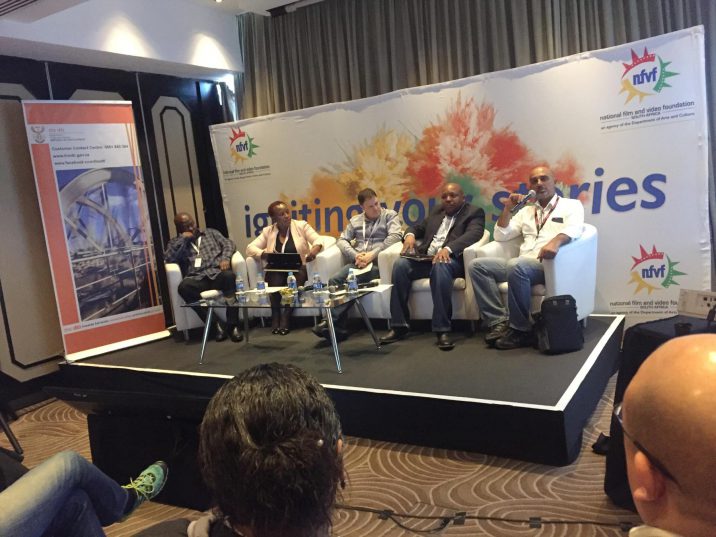
This was announced by the Director of Film Production at the dti, Ms Nelly Molokoane, at the Emerging Black Filmmakers Workshop at the Durban International Film Festival (DIFF). The workshop was targeted at emerging film producers who want to access the incentives scheme.

According to Ms Molokoane, since its launch, the Incentive scheme has managed to support 40 projects of emerging filmmakers as part of the R100 million budget, but in terms of finalising those projects and productions, producers still find it difficult accessing additional funds to close their projects due to financial constraints.

She said the dti has now partnered with the Industrial Development Cooperation, National Film and Video Foundation, South African Broadcasting Corporation and provincial film commissions to assist filmmakers.

“The scale of projects has been increasing since the inception of the scheme in 2014. The department approved 15 applications thereafter it increased to 40 over a period of three years.

“Partnership with these institutions will yield positive results in the near future and we will see more productions being supported. We are planning to host intense workshops in various provinces to assist filmmakers access this support,” said Ms Molokoane.

She adds that the workshop at the Durban International Film Festival (DIFF) was in essence hosted to assist those that needed training on the incentive scheme and, guidelines. It also aimed at educating producers on crucial information needed by the dti if one wants to access the funding.

The Director of the Marikana documentary Miners Shot Down, Mr Rehad Desai who is also a beneficiary of the incentive said the scheme was the most singly important development for the South African film industry in that it allows producers to go out into the country, continent and the wider world as equal partners with other producers.

“We are seeing far more films being produced since the launch of the scheme and this means funding of projects happens in a lot short space of time and one can go into production quicker. This also means our production companies are becoming sustainable but the incentive can be made more accessible as some of the costs are regarded as non-qualifying and this affects the production qualification,” said Desai

DIFF is an annual film festival that takes place in Durban, KwaZulu-Natal. It is one of the oldest and largest film festivals in Southern Africa and presents over 200 screenings celebrating the best in South Africa, African and international cinema.


Dipo Olowookere is a journalist based in Nigeria that has passion for reporting business news stories. At his leisure time, he watches football and supports 3SC of Ibadan. Mr Olowookere can be reached via [email protected]

Click to comment

Leave a Reply

Your email address will not be published. Required fields are marked *

Showbiz

How Far Would You Go For the People You Love? Stripped Answers This

Published

on

Africa Magic Stripped

Five episodes in, and Africa Magic’s limited series, Stripped, has quietly got people talking. Not because of the stripping, though yes, that is very much part of it, but because of what sits underneath all of it. The guilt. The shame. The quiet, suffocating pressure of being a man in Lagos who is supposed to have it all together but simply does not.

The premise sounds simple. Five friends, all broke, all stuck, all too proud to say it out loud, stumble into a stripping gig at an upscale club called Trabaye after its sharp and seductive owner, Yvonne (Constance Owoyemi) spots them at a birthday party and sees something worth paying for. What follows is anything but simple.

Kelechi “Kel” Okere (Daniel Etim Effiong) is the one carrying the most weight. A former marketing executive now driving Uber to keep his wife and children afloat, Kel is the kind of man who will smile through a crisis so nobody worries. His wife, Ada (Future Lolo Lamai), thinks he is still closing big deals. His children need school fees. The rent is overdue. And every night he comes home, the lie gets a little heavier.

Bolaji (Mofe Duncan), who is loud, charming and energetic, watches his cafe dream bleed out quietly. Suppliers want cash; customers want credit, and charm, it turns out, cannot patch a leaking roof.

Damina (Efa Iwara) is the cool bachelor whose carefully constructed life collapses the moment his pregnant ex walks back through the door. Mensah (Ian Wordi) is a Ghanaian-Nigerian architect and youth pastor caught in a relationship that is slowly erasing him. And Voke (Kunle Remi) is running out of time to free his imprisoned father, one clever scheme at a time.

Their first night at Trabaye is overwhelming. The music, lights, money, and the strange, intoxicating feeling of being wanted. They laugh in the car afterwards and call themselves “Strip Gawds.” For one night, the bills don’t exist. But nothing in Lagos stays clean for long.

Bolaji’s wandering eye pulls the group into dangerous territory. Voke’s schemes start bleeding into the club’s shadier edges. Kel finds himself dangerously close to a line he cannot cross, pulled back only by the sound of his wife’s voice on the phone. And Mensah quietly wonders how many layers of himself he can strip away before there is nothing left worth keeping.

The show’s most devastating moment comes in Episode 4, when Kel has a panic attack. There is no dramatic score, just a man cracking under the weight of everything he has been holding alone. Viewers have not stopped talking about it since. It is the kind of scene that does not just tell you about a character; it shows you something true about the world.

Etim Effiong, who also serves as executive producer, said it plainly. “Men need to catch a break. It’s a really tough world for men, and we deserve some credit.” Episode 5 offers a brief exhale before the walls begin closing in again. The money is good. But the shadows are getting closer.

Stripped is no longer just a show about five men taking their clothes off for money. It is about what men carry in silence, what friendship costs when survival is on the line, and whether the things you do to save your life can also be the things that cost you your soul.

If you have not started watching, you should start now. Catch up on all five episodes now on DStv Stream, and tune in for the final episode this Sunday at 8 PM on Africa Magic Showcase, DStv Channel 151, and GOtv Channel 8.

Continue Reading

Showbiz

Nigerian Singer Niniola Loses Husband to Death

Published

on

Niniola Michael Ndika

By Modupe Gbadeyanka

Popular Nigerian singer, Niniola Apata, professionally known as Niniola, has lost her husband to the cold hands of death.

Niniola confirmed the demise of her heartthrob, Mr Michael Ndika, in a series of posts, including God took my husband, and My husband died, among others.

However, the circumstances behind the death of Mr Ndika were not revealed by the Nigerian afro-house songster.

In the Instagram story on Wednesday morning, the 39-year-old Grammy-nominated entertainer indicated that she had been in a relationship with her late husband for over a decade.

The posts attracted reactions as she was consoled by her teeming fans, who expressed condolences to her for the loss.

Before his death, Mr Ndika was the chief executive of a multimedia platform focused on afro-house and contemporary African music known as NaijaReview.

Niniola is the older sibling of another famous entertainer, Teni.

Continue Reading

Showbiz

MasterChef Nigeria: Food Meets Fashion

Published

on

Food Meets Fashion

This week, the MasterChef Nigeria kitchen turned up the heat as the home cooks faced one of the competition’s most demanding tests yet, the very first team challenge. The team challenge was built around the two ingredients essential to every successful kitchen: leadership and teamwork.

For many, it was unfamiliar territory. Cooking under pressure is one thing, but trusting others, communicating effectively and working together against the ticking clock proved to be an entirely different challenge.

Adding an extra layer of excitement to the challenge, the home cooks were tasked with drawing inspiration from the vibrant and expressive world of Nigerian fashion. To help steer and judge this unique culinary showcase, the MasterChef Nigeria kitchen welcomed renowned fashion expert and founder of Zinkata, Ezinne Chinkata, as guest judge.

Bringing the energy and glamour of the runway into the kitchen, Ezinne introduced eight models fresh from Lagos Fashion Week, setting the stage for a challenge where fashion and food collided in spectacular style.

In a challenge where presentation was just as important as flavour, each team was tasked with creating four dishes inspired by the looks worn by the models. From bold prints and striking colours to intricate textures and silhouettes, every plate had to serve as an edible interpretation of Nigerian fashion, transforming runway style into culinary artistry.

Having secured victory in last week’s challenge, Fads entered the MasterChef Nigeria kitchen with a valuable advantage: the opportunity to select her first teammate. Without hesitation, she chose Demilade, setting the tone for what would become a closely coordinated Red Team.

Made up of Fads, Demilade, Loye and Favy, the Red Team approached the challenge with structure and intention. Under the leadership of Demilade, the team carefully mapped out their menu, ensuring that every dish aligned with the brief and that each home cook had a clearly defined role in bringing their culinary vision to life.

On the other side of the kitchen, the Blue Team — led by David embraced a more free-flowing and instinctive approach to marrying the worlds of fashion and food. However, with differing creative perspectives in the heat of competition, tensions soon surfaced, leading to an unexpected and spirited clash between Isabella and David as the pressure of the challenge mounted.

Despite their challenges, the Blue Team’s organic approach ultimately paid off. Their bold interpretation of the brief impressed the judges, earning them victory and proving that in the MasterChef kitchen, there is more than one recipe for success.

Next week, the members of the Red Team, Demilade, Fads, Loye and Favy enter the MasterChef Nigeria kitchen for the competition’s very first Pressure Test. Who will rise to the occasion and survive the heat — and whose MasterChef journey will come to an end?

Produced by Primedia Group, MasterChef Nigeria is supported by a strong coalition of leading Nigerian brands, including headline sponsor Power Oil, alongside Indomie, Dano Milk, Malta Guinness, Sonia Tomato, Kiara Rice, Golden Penny Flour, Golden Penny Sugar, Golden Penny Garri, Golden Penny Semolina, Golden Penny Chocolate Spread, and Golden Penny Wheat.

The show airs weekly on Sundays at 7 pm on Africa Magic Showcase and Africa Magic Family with rebroadcasts on Wednesdays at 6 pm on Africa Magic Showcase and Thursdays at 12 pm on Africa Magic Family.

Continue Reading

Trending